That one-star review feels like a personal attack, doesn't it? But the real hit isn't to your pride—it's to your bank account. It quietly siphons off high-value jobs, creating a revenue leak that most contractors never even see.
The most effective way to plug that hole and win back those lost sales is with a professional reputation management service.
How Bad Reviews Quietly Drain Your Contractor Business
Let's walk through a scenario that happens every single day. A homeowner has a leaky pipe and pulls out their phone. They search "plumbers near me," and your company shows up. Great! But before they call, they do a quick sanity check on Yelp. The first thing they see is a scathing one-star review.
Just like that, they're gone. They've already clicked over to your competitor who has a page full of glowing five-star ratings.
This isn't just a plumber problem. It happens to roofers, HVAC techs, remodelers—any contractor who relies on local trust. Inviting a stranger into your home is a big deal, and these days, that trust is built online first. A bad review is basically a digital "Keep Out" sign, turning customers away before you even get a chance to make your pitch.

The Hidden Cost of a Bad Reputation
The financial fallout from a poor online reputation is staggering. In the dog-eat-dog world of home services, a business with bad reviews can lose out on 30 potential customers for every negative comment they get. When your average job is over $500, that adds up fast.
On the flip side, the numbers show that boosting your average rating by just one star can increase revenue by an incredible 5-9%. Those are the leads that are now calling you instead of the other guy. You can dig deeper into these reputation management statistics and see how they impact local businesses firsthand.
Simply hoping for the best isn't a strategy anymore. If you ignore what's being said about you online, you're letting angry customers define your brand and control your sales pipeline.
Think of it this way: Your online reputation is your business's digital curb appeal. A bad review is like a broken window or graffiti on your storefront. It doesn't matter how great your work is if customers are too scared to even walk through the door.
This is exactly where a reputation management service comes in. It’s not about just playing defense; it’s about going on offense and taking control of your story. By systematically building a strong, positive online presence, you make sure that when a homeowner looks you up, they find a trustworthy pro ready to solve their problem. This isn't just another business expense—it’s an investment in your future growth.
What a Reputation Management Service Actually Does for Contractors
Let’s get one thing straight: a real reputation management service does a lot more than just beg for five-star reviews. For a contractor, your online presence is your new storefront. A single nasty review on Google or Yelp? That’s like having ugly graffiti spray-painted right across your front door, scaring off good customers before they even think to call you.
A professional service doesn’t just paint over the graffiti. They’re the crew that comes in to relandscape your entire property, install great new lighting, and build an impressive stone walkway right up to the entrance. The goal is to make your business’s online curb appeal so overwhelmingly positive that the old graffiti becomes a tiny, insignificant detail no one even notices.
Beyond Just Getting More Reviews
A comprehensive service isn’t about review generation; it’s a full-scale campaign to control what potential customers see when they search for your business. It all boils down to three core pillars.
Digital Footprint Audit: First, a specialist does a deep dive into every corner of the internet where your business is mentioned. They map out everything—from Google and Angi to obscure local directories and social media—to find both the damage and the hidden opportunities.
Positive Asset Creation: Next, the team gets to work building a portfolio of high-quality, positive content that you own and control. This isn’t just fluff. We’re talking about professionally written articles that showcase your expertise, new profiles on authoritative sites, compelling video testimonials, and fully optimized social media accounts.
Strategic Promotion and Suppression: Finally, all those new, positive assets are promoted using smart SEO tactics. The entire point is to push them to the top of Google’s search results. This buries the negative reviews and outdated complaints on page two or three, where over 90% of searchers never venture.
This all ties back to proactively Managing Online Reviews. A modern strategy uses both positive promotion and savvy review handling to make sure you—not one angry customer—are the one telling your company's story.
Here’s a quick breakdown of how this proactive approach stacks up against the old, reactive way of dealing with your reputation.
Reactive vs Proactive Reputation Management
| Approach | Reactive Method (The Old Way) | Proactive Service (The New Way) |
|---|---|---|
| Timing | Wait for a bad review to appear, then panic. | Continuously build positive assets before a crisis hits. |
| Focus | Damage control; trying to delete or dispute negative posts. | Dominate search results with positive, controlled content. |
| Tools | Pleading with customers; arguing on review sites. | SEO, content marketing, profile creation, and review funnels. |
| Outcome | Stress, lost revenue, and a reputation held hostage by others. | A durable, positive online presence that attracts new business. |
As you can see, waiting for a problem is a recipe for disaster. The new way is about building a defense before you ever need one.
The Financial Impact of Taking Control
Ignoring your digital reputation isn't just a mistake; it's a costly gamble. When a reputation crisis hits, 41% of companies report an immediate drop in both brand value and revenue. That’s a sobering statistic for any contractor who's ever felt the sting of a one-sided Yelp review.
On the flip side, even a one-star increase in your average rating can boost revenue by 5-9%. For a local plumber, HVAC tech, or remodeler, that’s the difference between a fully booked schedule and a phone that won’t ring.
It's estimated that 25% of a company’s market value is directly linked to its reputation. With over 95% of people saying they trust companies more when they have a strong, positive online presence, it’s clear reputation isn't a vanity metric—it's one of your most critical business assets.
This proactive strategy is all about building a digital fortress. Instead of fighting a losing battle to get one negative review taken down, you’re constructing a wall of positive, authoritative content around it. This is how a modern reputation management service turns your online presence from a constant liability into your most powerful sales tool.
Using a Content Flood to Bury Negative Results
When a nasty review or a negative article pops up about your business, the first impulse is always the same: get it deleted. But as anyone who’s tried knows, that’s a frustrating and often dead-end road. Review sites like Google or Yelp rarely take things down unless they break specific rules, like using hate speech or posting private info.
A real reputation management service doesn't waste time fighting that losing battle. Instead, we use a much smarter, more powerful strategy. We don't try to remove the negative result; we bury it. This is done with a strategy called a content flood, also known as search engine suppression.
Think of Google's first page as the main street in your town. There are only about ten storefronts, and right now, a negative result is sitting in a prime spot, scaring away customers. A content flood doesn't tear down that ugly storefront. It builds ten bigger, better, and more professional-looking ones and lines them up right in front of it, pushing the negative one out of sight.
This simple concept map breaks down how a reputation service pulls this off.
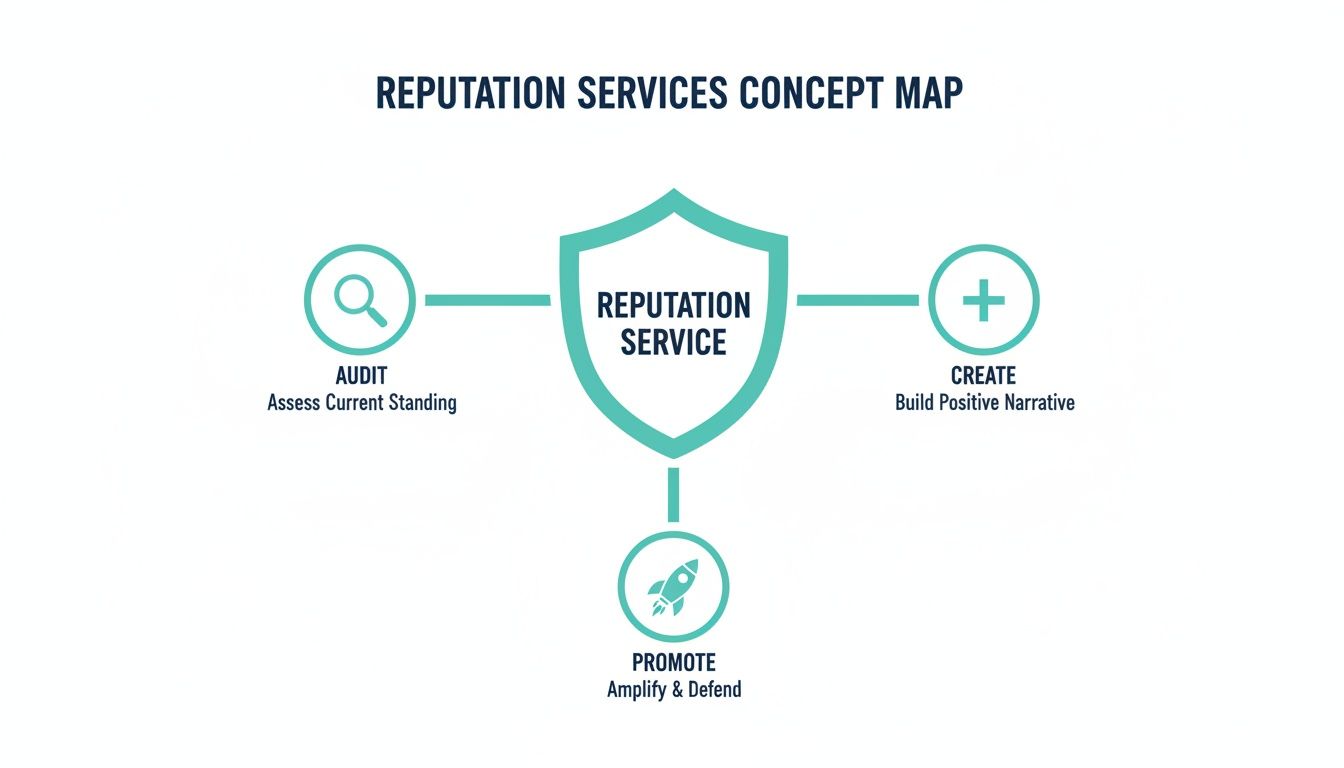
The entire campaign hinges on this cycle: auditing your current situation, creating positive assets, and promoting them so they rank high on Google.
Building Your Digital Fortress
This "flood" isn't just about throwing random content online. It's a strategic process of building a portfolio of high-quality digital properties that you own and control. Each one is designed to rank for your company’s name.
The goal is to systematically push that one negative item down in the search rankings until it’s on page two, three, or beyond—where over 90% of people will never even find it.
It's a more reliable strategy for one simple reason: it’s always easier to create a new, positive web page than it is to get an old, negative one taken down. To do this right, a core part of the content flood is to build domain authority for these new assets. Sites that Google sees as more authoritative naturally rank higher, making them the perfect tools for your positive content.
The types of assets created in a content flood often include:
- New Business Profiles: Setting up and optimizing profiles on authoritative directories like Crunchbase, Foursquare, and other sites specific to the trades.
- Expert Articles: Writing and publishing articles on platforms like Medium or through guest posts that establish you as an expert in roofing, plumbing, or HVAC.
- Optimized Social Media: Creating and actively managing professional accounts on LinkedIn, Facebook, and even YouTube, where you can share project photos and company news.
- Company Microsites: Building small, focused websites around a specific service you offer (e.g., "Dallas Emergency Plumbing") or your company's story.
- Video Content: Producing and sharing videos like customer testimonials or how-to guides that can rank on their own in Google and YouTube search results.
Each of these is a brand new piece of digital real estate you own, competing for a spot on Google's first page and pushing the bad stuff down.
Why Suppression Outperforms Removal
Trying to get a review removed puts all the power in the hands of a platform that doesn't have your best interests at heart. Suppression, on the other hand, puts you back in the driver's seat of your own online story.
The concept is pretty simple: You can't always get a library to remove a bad book from its shelves. But you can write ten great books and make sure they get placed right in front of it. The bad book is still there, but nobody ever sees it.
This approach gives you a durable, long-term fix. The positive websites, profiles, and articles you create are permanent assets. They don’t just vanish after the campaign ends; they keep working for your brand for years to come. Our detailed guide explains more about how to push down negative search results and create a positive presence that lasts.
This is the core strategy behind professional reputation management. It’s not some kind of black magic or secret back-door trick. It's a methodical, content-based approach to SEO that ensures when a potential customer looks you up, they find a first page full of results that make them want to pick up the phone and call you.
Realistic Timelines and What to Expect
Let's get right to it. One of the first questions every contractor asks is, "How long will this actually take to work?" It's a fair question. You're investing your hard-earned money and you want to see results.
It’s important to know that professional reputation management is a campaign, not a magic trick. We can’t just snap our fingers and make a bad review disappear. Instead, the goal is to systematically bury it under a mountain of positive content, effectively pushing it off the first page of Google where it can do real damage.
Think of it less like a quick patch and more like building a new, solid foundation for your online presence. It happens in phases.

The First 30 Days: Laying the Groundwork
The first month is all about getting our boots on the ground. This is where we launch the "content flood"—a strategic push to create and publish a whole suite of new, positive digital assets all tied to your company's name.
Here's what you can realistically see in the first 30 days:
- New Positive Content Goes Live: You’ll start to see brand-new articles, blog posts, and professional profiles pop up in Google search results for your business.
- Initial Rankings Appear: Don't expect these to hit the top spot overnight. They'll typically start showing up on the second or third page of Google as the search engine indexes them and begins to figure out what they're about.
- A Foundation is Built: This initial wave of content is crucial. It sets the stage for the next phase, where we really start to climb the rankings.
Think of this first month as deploying your army. The troops are on the battlefield and moving into position, even if the main fight hasn't started yet.
Months Two and Three: The Push for Page One
This is where the campaign really picks up steam. By the second and third months, the positive content we created in month one has had time to "age" a bit. Google has had a chance to see it, crawl it, and assign it some authority. Now, we can start aggressively promoting it to move up the search results.
By month three, we expect to see that stubborn negative result—the one that was sitting at the top of Google—pushed down and completely off the first page. This is the primary win we're fighting for.
The momentum from all that new content starts to pay off in a big way. That one negative link is now competing against a dozen or more positive, authoritative pages that are all fighting for the same top spots.
Considering that over 90% of customers never click past the first page of search results, pushing a negative item to page two is a huge victory. For all practical purposes, it becomes invisible. This is the real-world value you get from a professional reputation management service.
Understanding Service Pricing and What You Pay For
When you're looking at reputation management, the first question on any contractor's mind is simple: "What's this going to cost me?" For a roofer, plumber, or remodeler who watches every dollar, you need to know exactly where your money is going. Understanding the price isn't just about the monthly bill; it's about seeing it as an investment in future jobs.
Let's break down the common pricing structures and what you're actually paying for when you hire a professional service.
Common Reputation Management Pricing Models
Most services bill in one of a few ways. Some will lock you into a long-term contract, while others offer more flexibility. Understanding the difference is key to finding a partner who is motivated to get you results.
| Pricing Model | How It Works | Best For Contractors Who… |
|---|---|---|
| Monthly Retainer | You pay a flat fee each month for ongoing monitoring, content creation, and promotion. | …need continuous, long-term work to suppress negative results and build a strong positive presence. This is the most common and effective model. |
| Project-Based Fee | A one-time, upfront cost for a specific, defined goal, like removing one false review or pushing down a single negative article. | …have a very isolated, one-off problem and don't require ongoing management. It's less common for widespread issues. |
| No-Contract Monthly | Similar to a retainer, but you pay month-to-month without a long-term commitment. Impruview uses this model. | …want the flexibility to leave if they aren't seeing results. This puts the pressure on the provider to constantly prove their value. |
The no-contract model is becoming the standard for a reason—it holds the reputation company accountable. If they don't deliver, you can walk away. They have to earn your business every single month.
What's Included in the Price?
So, what’s actually happening behind the scenes? When you invest in a service, you’re not just paying for a single task. You're funding a full-scale campaign to take back control of your company's story online.
Here’s what your investment typically covers:
Initial Digital Inspection: Think of this as a full diagnostic of your online presence. Experts map out every single mention of your business, from review sites and forums to local news and social media. This identifies where the damage is and, just as importantly, where your best opportunities are.
Professional Content Creation: This is the heart of the "content flood" strategy. You're paying for a team of skilled writers and strategists to build a portfolio of positive digital assets. This includes everything from expert articles and professional bios to brand-new websites and social media profiles designed to showcase your expertise.
Publishing and SEO Tools: Creating content is only half the battle. Your investment also covers the cost of publishing on high-authority websites and using powerful SEO (Search Engine Optimization) tools. This is what gives your new, positive content the muscle it needs to outrank the negative stuff on Google.
Ongoing Monitoring & Reporting: Your reputation isn't something you can fix and forget. A portion of your fee goes toward constantly monitoring search results for your name. You should also receive detailed monthly reports that show you exactly how the campaign is working and where your positive assets are ranking.
The Real Cost of Doing Nothing
It's easy to look at the monthly fee for a reputation service and see it as just another business expense. But what's the cost of not fixing the problem?
That one nasty review from an unreasonable client isn't just an annoyance. It’s a silent lead killer. If that single search result costs you just 2-3 decent-sized jobs a year, you could easily be losing $20,000, $30,000, or even more in revenue.
When you look at it this way, reputation management stops being a "cost" and starts becoming a high-return investment. It's an activity that pays for itself by winning back the jobs you would have otherwise lost.
This completely changes the conversation. You’re not just paying to make a problem go away; you're investing in a system that protects your sales pipeline and actively helps you secure more work.
For contractors who want to dig into the numbers, you can learn more about how to calculate online reputation management costs and the potential return on your investment. The goal is to build a digital presence that doesn't just play defense but actively attracts and converts your ideal customers.
Your Checklist for Choosing the Right Reputation Partner
Picking someone to manage your company's online image is a huge decision. With so many agencies out there making big promises, it’s tough to know who to trust. You don't need a generic marketing firm; you need a partner who gets the unique grind contractors face day in and day out.
To separate the real pros from the slick salespeople, you have to ask the right questions. This checklist is your guide to vetting any reputation management service so you can find a team that can actually protect your business and help you reclaim those lost leads.
Strategy and Case Studies
First things first, you need to dig into their actual game plan. Vague answers are a massive red flag. You're looking for a team with a clear, proven process built specifically for contractors like you.
Question 1: "Walk me through your exact strategy for a negative Yelp or Google review."
A good answer will be all about suppression, not removal. Any honest expert knows that getting a legitimate review deleted is a long shot at best. They should instead detail their "content flood" strategy—explaining how they’ll create and promote a wave of positive content to bury that negative review deep in the search results where no one will see it.
Question 2: "Can you show me real-world case studies for other contractors?"
If they’re good at what they do, they’ll be eager to show you. Ask for before-and-after proof for businesses just like yours—other roofers, plumbers, or remodelers. If all they have are examples from dentists and restaurants, they probably don't understand your world.
A strong partner can show you a clear history of helping home service companies take control of their search results. They should have concrete examples of pushing bad reviews on Yelp, Angi, or Google right off the first page.
Content and Reporting
Next, you need to know precisely what they'll be creating in your name and how they'll prove it's actually working. This is where you find out who can walk the walk.
Question 3: "What kind of content will you create for my business?"
Demand specifics. A solid plan will involve things like building new professional profiles on sites like Crunchbase, publishing expert articles on platforms like Medium, and setting up optimized social media pages. High-quality, diverse content is what makes a campaign successful.Question 4: "How do you measure success and what will your reports show me?"
The only acceptable answer is one based on clear data. A professional reputation management service will give you monthly reports that track the search engine rankings of your new, positive assets and show the negative ones dropping. You need total transparency to see where your money is going and the impact it's having.
Contract Terms and Guarantees
Finally, the contract itself says a lot about how much confidence a company has in its own service.
Question 5: "What are the exact terms of your contract?"
Be very cautious of any agency trying to lock you into a long-term contract of 6 or 12 months. A company that’s confident it can deliver results doesn't need to trap you in a long-term deal.
A month-to-month agreement means they have to earn your business every single month. It shows they believe their work is so effective that you'll choose to stay, no strings attached. For more details on what to look for, it's worth learning about the different types of reputation management consulting and how to structure a partnership that puts you in control.
By asking these five direct questions, you can get past the sales pitch and find a true partner who will build a positive, lasting online presence for your contracting business.
Your Reputation Management Questions, Answered
Even after laying out the strategy, most contractors have a few more practical questions about how this all works on the ground. It's only natural. Let's get straight to the point and tackle the most common ones we hear.
Can You Just Delete the Bad Review on Yelp or Google?
This is always the first question, and I get it. You see something unfair tarnishing your name, and you want it gone. The short answer, though, is almost always no.
Platforms like Google and Yelp have very rigid rules. Unless a review contains something extreme like hate speech or someone’s private information, they simply won’t remove it just because you disagree with a customer's opinion. Trying to fight that fight is a waste of time and money.
A smart reputation service doesn't bother with that losing battle. Instead, we focus on a far more powerful strategy: suppression. We create a tidal wave of positive, professional content about your business. This new content systematically pushes the negative review off the first page of Google, where over 90% of searchers will never see it. We make it irrelevant.
How Is This Different from Just Asking for More Reviews?
Asking your happy customers for reviews is a fantastic habit, but it’s just one tool in the toolbox. It might bump up your star rating on a single website, but it does absolutely nothing to control the other nine results that show up on the first page of a Google search.
True reputation management is about controlling your entire digital first impression. The goal isn't just a better star rating; it's to ensure that when a homeowner searches your company name, the entire page is filled with positive, high-quality assets you own and control. This includes professional articles, social media profiles, and your own websites—not just a single review profile.
Will I Be Locked into a Long-Term Contract?
Some old-school agencies still try to lock clients into 6 or 12-month commitments. We believe that’s a red flag. Modern, confident providers like Impruview operate on a flexible, month-to-month basis.
Why? Because it puts all the pressure on us to get you visible results, fast.
A month-to-month agreement means the reputation firm must continually earn your business. If you aren't seeing clear progress and a positive return on your investment, you should be free to walk away without penalty.
This approach keeps us accountable and ensures our goals are perfectly aligned with yours: clean up your search results as efficiently as possible.
What Happens If I Stop the Service?
All the positive digital assets we build for you—the articles, profiles, and websites—are permanent. They don't vanish if you decide to pause or stop the service. The work we do to rank that content has a lasting impact on your search results.
However, your online reputation isn't a "set it and forget it" kind of thing. It's constantly changing. New reviews pop up, articles get published, and things can shift without warning. Think of ongoing service as defense. It's about maintaining that clean, professional footprint and protecting your hard-won search results for the long haul.
Ready to stop losing jobs to unfair reviews? The team at Impruview is built to help contractors like you take back control of your online story. With our proven content flood strategy and no long-term contracts, we can push negative results down and put your best foot forward. See how it works at https://www.impruview.com.