Let's get straight to the point. The real value of managing your reputation isn't about fuzzy feelings or vanity metrics. It’s about stopping the silent bleed of revenue that a few bad reviews can cause and turning your online name into a machine that brings in high-quality jobs.
For contractors, this means you stop losing money to that one angry customer on Yelp and start actively pulling in bigger, better projects.
How Your Reputation Is Quietly Draining Your Bank Account
Think of your online reputation as a salesperson who works for you 24/7. Is that salesperson closing deals for you, or are they standing at the door telling potential customers to go somewhere else? For most roofers, plumbers, and remodelers, a handful of negative reviews becomes a hidden cost, quietly siphoning off thousands in potential work every single month.
It's like having a slow leak in a pipe. One bad comment might seem like a tiny drip, but over time, those drips add up to a full-blown flood of lost income. Every time a homeowner searches for your services and sees a low star rating or a scathing review, another high-ticket job drips right into the hands of your competitor down the street.
The Real-World Cost of a Single Star
This isn't just a theory; you can actually put a dollar amount on it. Research consistently shows that jumping your average star rating by just one full star can boost your revenue by 5-9%. Think about that. If your average job is $2,500, that’s a significant amount of new business hitting your books.
With nearly 68% of consumers refusing to even consider a business with less than a 4-star rating, having a 3.8-star average on Google is like putting a "closed" sign on your digital front door. You can see more data on this in a detailed report on reputation management statistics.
To see how this plays out, let's look at the real financial risk. A drop in your star rating doesn't just feel bad; it directly reduces the number of calls you get.
The Financial Impact of a Single Negative Review
| Average Job Ticket | Potential Monthly Leads Lost | Estimated Monthly Revenue at Risk |
|---|---|---|
| $750 (HVAC Repair) | 5 | $3,750 |
| $4,500 (Remodel) | 3 | $13,500 |
| $12,000 (Roof) | 2 | $24,000 |
As you can see, even losing just a couple of leads a month because of a poor reputation can cost you tens of thousands of dollars over the course of a year. It's a silent killer for growth.
A few years ago, your brand and your truck wrap were enough. Today, your online reputation is more valuable. Homeowners are making expensive, high-stakes decisions based on what strangers say about you online, and a couple of negative comments can completely overshadow a decade of quality craftsmanship. This is why reputation management isn't a marketing expense—it's a direct investment in your sales pipeline.
The bottom line is that your reputation determines who calls you and who keeps scrolling. A strong, positive online presence builds instant trust before they even talk to you. This makes it much easier to:
- Attract More Qualified Leads: Homeowners are already sold on your quality and professionalism before they even dial your number.
- Increase Your Closing Rate: Fewer prospects will ghost you or shop your quote around because your reviews have already established your credibility.
- Command Higher Prices: A 4.8-star reputation gives you the power to price your services based on the value and quality you provide, not just to beat the lowball competition.
You can't afford to ignore the quiet drip of a poor reputation any longer. It's time to fix the leak and turn what might be a liability into your most powerful sales tool.
Connecting a Strong Reputation to Business Growth
Let's get straight to it: a strong online reputation isn't just about feeling proud of your business. It's a direct line to real, measurable growth. We're talking about more leads, better conversion rates, and the ability to charge what you're worth. This is about turning your hard-earned good name into more revenue.
When a homeowner needs a plumber, roofer, or remodeler, what’s the first thing they do? They search online. And with nearly 95% of consumers reading reviews before they even think about making a call, your star rating is your first impression. A 4.5-star business on Google will simply get more clicks, more calls, and more quote requests than a 3.5-star competitor. It’s that simple.
That initial spark of trust doesn't just get you the phone call; it stays with them through the entire process.
From Star Ratings to Signed Contracts
Picture this: a local remodeling contractor manages to bump their average rating from 3.5 stars to 4.5. That single-point jump does more than just look good on a search page—it completely changes the sales conversation.
Suddenly, you see a real uptick in your quote-to-job conversion rate. Why? Because a prospect who has already scrolled through dozens of glowing reviews for your company is practically pre-sold. They aren't just looking for the cheapest price; they're looking for peace of mind. This means your team spends less time trying to convince them of your quality and more time scheduling profitable work.
Your reputation becomes your most powerful closing tool.
Think of it this way: your reputation is the ultimate tiebreaker. When two contractors offer similar services at similar prices, the one with the overwhelmingly positive online footprint almost always wins the job. Your star rating becomes a signal of trust that justifies your price and validates a homeowner's decision to hire you.
The infographic below puts some hard numbers on just how much a small improvement in your online rating can impact your bottom line.
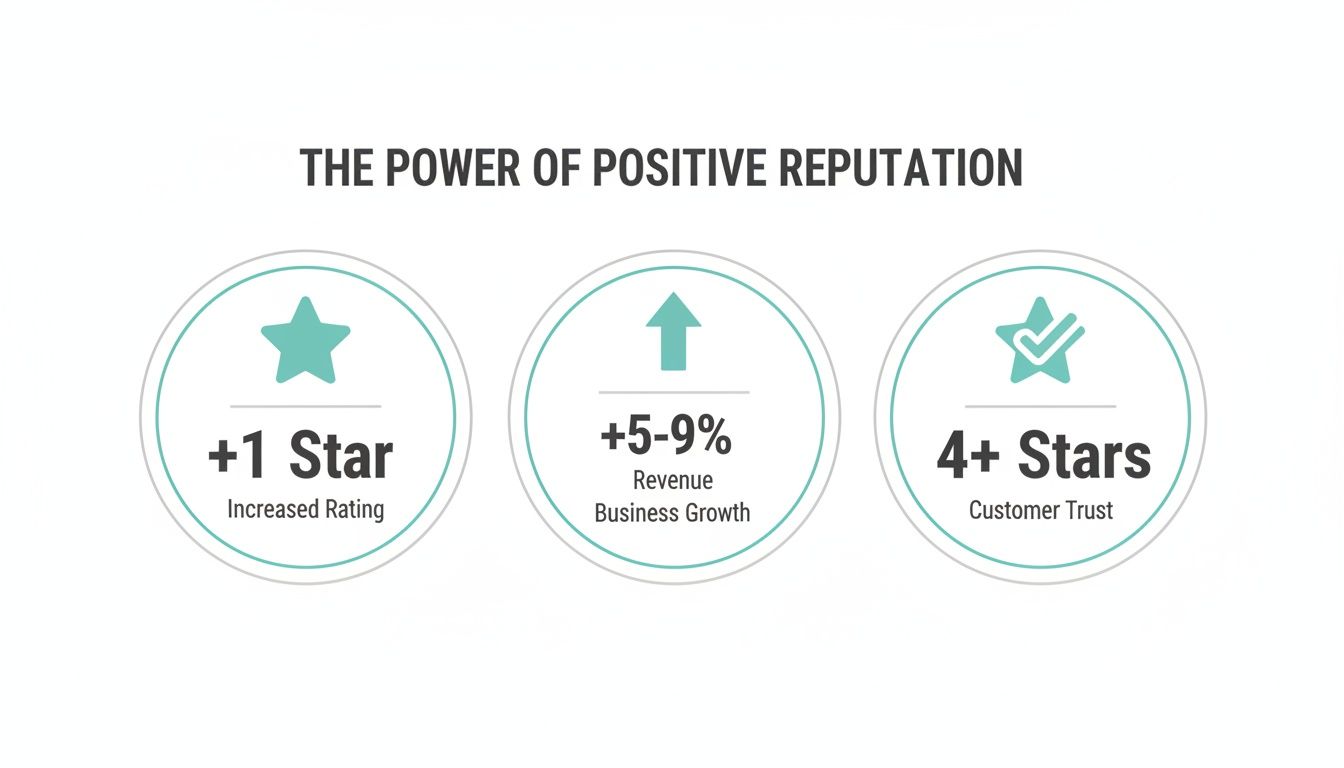
That’s not a typo. A one-star jump in your rating can boost revenue by 5-9%. What that data really tells us is that having a rating above four stars is the new baseline for earning a customer's trust.
Managing your reputation is one of the most effective levers you can pull to grow your sales. It allows you to win more jobs and, just as importantly, command a higher average ticket. Homeowners will gladly pay a premium for the confidence that comes from hiring a trusted, well-regarded contractor. Your reputation stops being an abstract idea and starts becoming your best-performing asset.
Winning with a Content Flood Not a Review War
If you're a contractor, you know the feeling. A single negative review pops up on Yelp or Google, and suddenly you’re in a frustrating, uphill battle. You spend countless hours trying to get a comment you know is unfair taken down, only for the platform to tell you it doesn’t violate their terms.
This is the "review war," and it's a fight you're almost guaranteed to lose. But there's a much smarter way to play the game. Instead of fighting an endless war of attrition, you can win the peace by launching a content flood.

Drowning Out the Negativity
Think of your company's online search results as your digital front yard. That one-star review is a stubborn, ugly weed sprouting right by the sidewalk where every potential customer can see it. You can try to yank it out, but it's a frustrating chore, and another one might just grow back.
A content flood is the expert-gardener approach. Instead of obsessing over the weeds, you focus on seeding, watering, and cultivating a thick, vibrant, and healthy lawn. You publish so much positive content—glowing testimonials, detailed project galleries, helpful blog posts—that the weeds get choked out and become practically invisible.
Instead of fighting to remove the negative, you create and promote so much positive content that the bad stuff becomes irrelevant. This proactive strategy is one of the core benefits of reputation management because it puts you back in control of your own narrative.
This works because you’re giving search engines like Google what they want. Their algorithm is designed to rank the most relevant and authoritative content for any given search, like "[Your Company Name] reviews." If a negative Yelp page is the most substantial thing out there about your business, that's what Google is going to show people.
A content flood completely changes that equation.
Owning Your Search Results
The goal here is simple: create a library of high-quality, positive content about your business that you own and control. By optimizing this content to rank for your company name, you give Google a whole new set of better, more accurate results to display on the first page.
This isn't about fluff. We're talking about real assets that showcase your expertise:
- Detailed Project Showcases: Go beyond a simple photo gallery. Create in-depth articles on your website for a recent roof replacement, HVAC install, or kitchen remodel, complete with high-resolution "before and after" photos.
- Customer Success Stories: Take a fantastic five-star review and turn it into a full-blown testimonial page. Tell a real story about the homeowner's problem and how your team delivered the perfect solution.
- Positive Press and Mentions: Did a local blog feature your work? Win a community award? Get involved in a charity event? Create dedicated pages on your site to highlight these achievements.
- User-Generated Content (UGC): Actively encourage your happiest customers to post photos of their finished projects on social media. Knowing how to make UGC that actually converts turns authentic customer posts into powerful, trust-building marketing.
As you build and promote these positive assets, you're essentially showing Google, "Hey, this detailed project breakdown and these customer stories are far more authoritative than that old, negative link." Over time, your own content starts to dominate the first page of search results, pushing the negativity down to page two where it’s almost never seen. To get into the nuts and bolts of this process, you can learn more about how to push down negative search results in our detailed guide.
Why Fake Reviews Are a Growing Threat to Your Business
Your online reputation isn't just a collection of star ratings. For a local contractor, it’s one of your most valuable assets, and it’s constantly under attack. We're not just talking about the occasional unhappy customer; there's a more deliberate threat on the rise: fake and malicious reviews.
These aren't honest feedback. They’re weapons, plain and simple, designed to do one thing—damage your business.
Think about a disgruntled ex-employee who knows exactly what to say to make you look bad. Or an unethical competitor trying to siphon off your leads. In just a few minutes, they can post a scathing, completely fabricated one-star review that makes homeowners think twice. Even worse, automated bots can spam your Google or Yelp profile with negative reviews, tanking your rating before you’ve even had your morning coffee.
The Scale of the Problem
This isn't some far-off possibility; it's happening right now. Fake reviews are flooding the very platforms that homeowners trust to find reliable roofers, plumbers, and remodelers. Projections show that by 2026, up to 40% of all online reviews could be fraudulent. That's a staggering number, especially when you consider that 93% of customers use reviews to decide who to hire. You can see more data on this trend in these reputation management statistics.
The real danger is that most people can't spot a fake. A convincing but fraudulent review claiming you left a mess, overcharged, or did shoddy work is enough to scare away a stream of qualified leads, costing you thousands in lost jobs. If you're currently facing this, our guide on how to remove fake Google reviews is a good place to start.
Here’s the scary part: these attacks work. One study found that a single fraudulent "extra star" on a competitor’s profile can boost their business by 38%. Now, flip that around. Imagine what a fake one-star review does to you—it actively pushes your best customers straight to the competition.
Building Your Reputational Buffer
You can't afford to be reactive. Trying to get a fake review taken down after the damage is done is an exhausting, uphill battle that you often lose. The only effective defense is a proactive one.
This is where a real reputation management strategy shows its value. By consistently building a deep and authentic online presence, you create a powerful buffer. When you have a solid foundation of dozens of genuine, positive reviews and content that showcases your quality work, one or two fake reviews simply lose their sting. They become obvious outliers that potential customers will rightfully ignore, instead of being the first—and only—thing they see.
How to Measure Your Reputation Management ROI
Investing in your reputation just feels like the right thing to do. But how do you actually prove it's paying off? For any contractor, connecting those efforts to real-world business results is the only way to turn a monthly spend into a measurable return on investment (ROI).
Measuring ROI isn’t as complicated as it might sound. It's about looking past the star ratings and tracking how your online presence directly influences your bottom line. You don't need fancy, expensive software to get started, either. Simple, consistent tracking with tools you probably already use is all it takes.

Key Metrics to Track
First things first: you need a baseline. Before you start any new campaign, you have to know exactly where you stand today. This gives you a starting line to measure all future progress against.
Focus on these three core areas:
- Search Engine Rankings: Do a quick Google search for your business name plus the word "reviews" (e.g., "[Your Company Name] reviews"). Take a screenshot or just jot down where any negative results from Yelp or other complaint sites show up. The whole point is to bury those links, and tracking their position week-over-week is a direct way to see if your strategy is working.
- Inbound Lead Sources: This one is simple but powerful. Start asking every single person who calls, "How did you hear about us?" Train your team to do it. When you start hearing "I saw your great reviews online" or "I found you on Google," you have concrete proof that your reputation is bringing people in the door.
- Conversion Rate: Keep a close eye on your quote-to-job closing ratio. As your online reputation gets stronger, this number should start ticking up. Why? Because homeowners who have already seen dozens of positive reviews are pre-sold on your quality and trustworthiness. They're not just kicking tires; they're ready to hire you.
A Simple Framework for Calculating ROI
Once you have a handle on those metrics, you can start connecting the dots to your bank account. This is where you get a crystal-clear picture of the financial impact.
The real power of reputation management lies in its ability to turn trust into revenue. When you can show that a higher star rating led to five more jobs last month, your reputation becomes a predictable growth engine, not an expense.
Let’s break down how to calculate your return in simple terms. Say you can attribute three additional jobs per month to your improved reputation, and your average project is worth $2,500.
- Calculate New Revenue:
- 3 new jobs/month x $2,500/job = $7,500 in new monthly revenue.
- Determine Your Net Gain:
- From that $7,500, subtract what you're spending on reputation management each month. If you're wondering what a typical investment looks like, our guide to online reputation management costs breaks it down.
- Calculate Your ROI:
- (Net Gain / Investment Cost) x 100 = ROI %.
This simple math proves the value in a language every business owner understands: dollars and cents. It demonstrates that the benefits of reputation management aren’t just about feeling good or looking good online—they're about directly fueling your company's growth.
Your Next Steps to Reclaim Your Online Reputation
Alright, you've seen the numbers and understand how a few bad reviews can silently drain your bank account. It’s clear that a strong online reputation isn't just a "nice-to-have"—it's an asset that brings in real jobs and real money. Now, it's time to stop reacting to bad press and start building a reputation that works for you.
So, where do you begin? The first move is a simple but critical one: an honest audit of your online footprint. This isn't just a quick Google search. It's about systematically mapping out what a potential customer sees and finding exactly where you’re bleeding leads.
Your Initial Action Plan
Think of this as taking inventory before a big project. You need to know what you have before you can start building.
- Document Your Current Standing: Go to Google and search for "[Your Company] reviews." Take a screenshot of that first page. This is your "before" picture—the baseline you'll measure all your progress against.
- Identify Negative Assets: Make a simple list of every bad review, complaint board, or negative article you find on the first two pages of Google. These are the fires you need to put out first.
- Find Your Positive Assets: Now, find the good stuff. Note any glowing testimonials, great project photos you’ve posted, or local news mentions. These are the powerful tools you'll use to flood out the negativity.
Your online reputation is the story your business tells when you’re not in the room. Taking control means you get to write that story, instead of leaving it to a handful of unhappy clients or anonymous trolls. It's about being the author, not just a character.
As you map out your strategy, you also need to think about how modern search tools work. Understanding how to influence AI answer engines is becoming a crucial piece of the puzzle, ensuring your brand's true story is what gets told in automated results.
Don't let another valuable lead search your name and walk away. By taking these first steps, you’re officially moving from defense to offense. You're not just patching holes; you're building a fortress that will protect your business and actively help it grow.
Frequently Asked Questions About Reputation Management
Before you put your hard-earned money into any new strategy, you need straight answers. We get it. Let's tackle the questions we hear most often from contractors just like you.
Review Management Versus Reputation Management
This is a big one, and it’s easy to get them mixed up. A lot of services only focus on review management, which is just one small part of the equation. It's all about trying to get more stars on sites like Google.
Reputation management is the whole ballgame. Think of it this way: review management is like fixing a single leaky faucet in a house. Reputation management is like renovating the entire kitchen—we're looking at what potential customers see everywhere online. This includes search results for your name, your social media, and any articles or directory listings out there. We don't just chase reviews; we build and protect your brand's entire story.
How Long Does It Take to See Results
Naturally, you want to know when you'll see a return on your investment. While every company's starting point is different, this isn't a years-long process. Our clients usually see a real, positive change in what shows up when people Google their company name within 30 to 60 days.
How? Our content-flood strategy works fast to create a wave of positive, professional content about your business. Google finds and ranks these new assets, and as they gain authority, they start pushing the negative stuff down and off the first page, where it's basically invisible to customers.
Can you guarantee the removal of a negative review from Google or Yelp? No. And frankly, any company that promises they can isn't being honest. Instead of fighting an uphill battle you can't win, our approach is much smarter. We make those negative reviews irrelevant by burying them under so much positive, high-ranking content that they simply fade away.
Ready to stop losing valuable leads to bad reviews? The team at Impruview can help you take back control of your online search results and turn your reputation into your most powerful sales tool. Learn more about our content-flood strategy and get started today.