Before you can even think about building a 5-star reputation, you have to know where you stand. You need a clear picture of what customers are really saying and how you measure up against the local competition. This initial audit is the bedrock of any successful review strategy—it gives you the raw data to build a plan that actually works.
Your Foundation: A Comprehensive Google Review Audit
Jumping straight into asking for more reviews without a plan is like building a house without a foundation. Sure, you might get a quick burst of activity, but it won't be stable or sustainable. A deep-dive audit is the only way to truly take control of your online reputation. It’s about getting past your overall star rating and uncovering the real story your reviews are telling.
This isn't just a quick scan of your score. It's about digging into the feedback itself to find out what you’re doing right and, more importantly, where the cracks are showing.
Analyze Your Review Sentiment and Themes
First things first, sit down and read through your last 20-30 reviews—good, bad, and ugly. You're looking for recurring patterns. Are multiple customers calling out a specific technician by name for being professional and on time? That’s gold. It’s a marketing message you can and should be using everywhere.
On the flip side, do you see repeated complaints about scheduling mix-ups, surprise charges, or techs who don't communicate well? These aren't just one-off bad days. They're red flags pointing to a deeper operational problem that needs to be fixed.
Key Insight: Your reviews are a free source of business intelligence. They tell you exactly what customers love and what frustrates them, giving you a clear roadmap for operational tweaks that will naturally earn you better reviews.
Think about it this way: a roofing contractor might see three different reviews mentioning that the crew left nails in the yard. That's not just a reputation issue; it’s a safety hazard and a failure in your process. By addressing it at the company level—maybe by making a post-job magnetic sweep mandatory—you solve the root cause and stop those negative reviews from ever happening again.
Assess Your Response Rate and Tone
How you handle feedback is a public performance. A huge part of your audit is an honest look at how you—or your team—are responding to reviews. Are you replying to all of them, or just the glowing 5-star ones? A business that only thanks happy customers while ignoring criticism looks defensive and, frankly, like they don't care.
Next, check the tone of your replies.
- Positive Reviews: Are you using a canned "Thank you" for every single one? Or are you personalizing it by mentioning a specific detail from their feedback? A personalized response shows you’re actually listening and makes that positive review even more powerful.
- Negative Reviews: Do you get defensive and start making excuses? Or are your responses calm, professional, and focused on a solution? Taking ownership can completely defuse a bad review and shows potential customers that you’re accountable when things go wrong.
A critical part of your Google review foundation involves thoroughly optimizing your presence on platforms like Google Business Profile. This is a strategy well-articulated in guides such as this one on Google My Business for restaurants. Even though it's for a different industry, the core principles of having a complete, engaging profile are universal for any local business.
Benchmark Against Your Local Competitors
Finally, remember that your reputation doesn't exist in a bubble. You’re being judged against every other contractor in your area. Pick your top three to five local competitors—the ones you always see in the map pack—and put their Google Business Profiles under the same microscope.
Analyze their reviews with the same rigor you used on your own. What are they getting praised for? What are their common complaints? This intel can reveal gaps in the market or highlight areas where you can easily outperform them. It's also worth exploring how to improve your visibility by learning more about local listings management.
You can’t just ask for reviews whenever you remember to. A random email blast might get you a few here and there, but that’s not a strategy—it's a gamble. If you want to build a truly dominant, 5-star reputation on Google, you need a system.
Think of it as an "always-on" machine that predictably brings in authentic feedback. It doesn't have to be complicated. In fact, the simpler, the better. It's all about building a repeatable workflow that asks for a review at the exact right moment: when your customer is happiest and most likely to say yes.
This isn't a one-and-done deal. It's a continuous loop of auditing your reviews, responding to them, and seeing how you stack up.
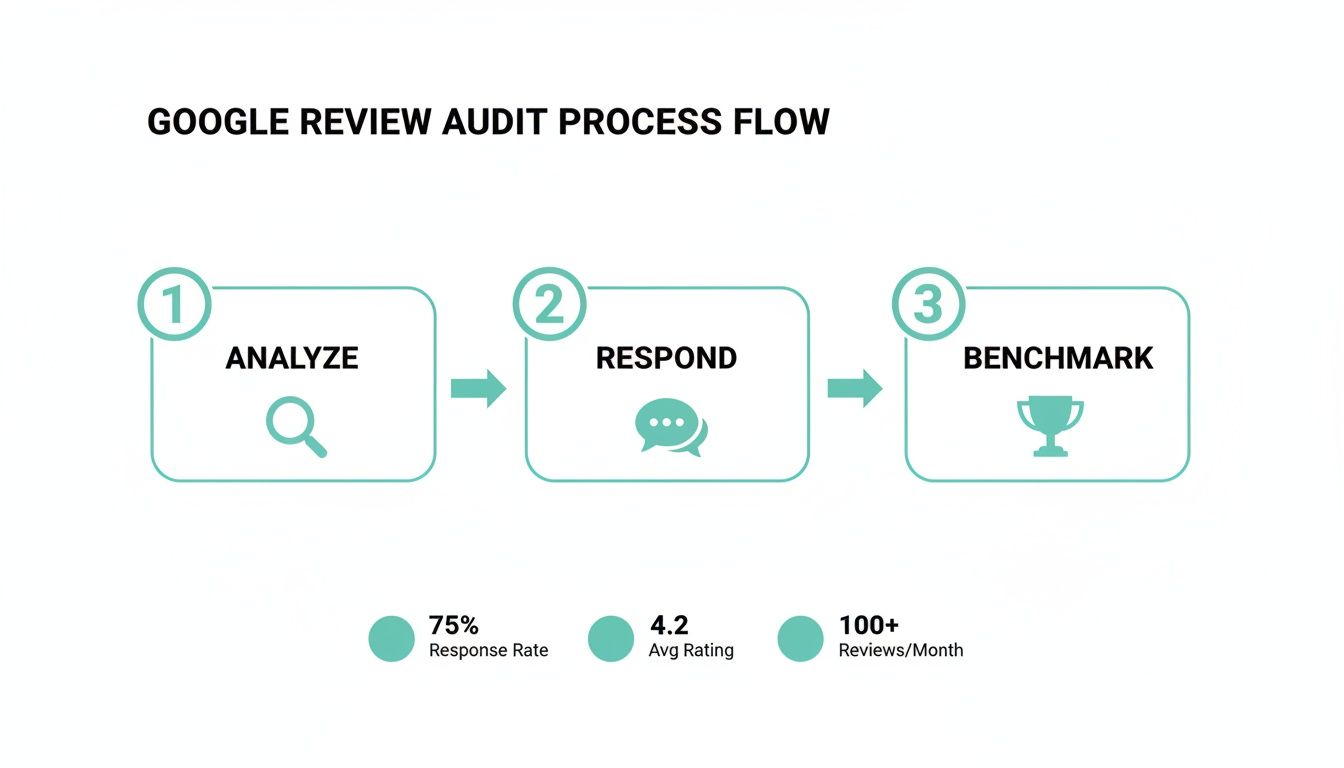
As you can see, getting reviews is just one part of a bigger cycle. You analyze what you've got, you respond to everyone, and you constantly benchmark your progress.
The Art of Perfect Timing
If I could only give you one piece of advice, it would be this: timing is everything. Ask too soon, and it feels pushy. Wait a week, and the customer has already forgotten that feeling of relief you gave them. For home service contractors, that perfect window is tiny, but it's incredibly powerful.
The absolute best time to ask is right after the job is done and the customer is clearly satisfied. It's that "magic moment" when the problem is solved and they're feeling grateful.
- For HVAC or Plumbing: The moment the AC kicks back on or the drain is finally clear. Your tech has cleaned up, the problem is gone, and the homeowner is relieved. That's your window.
- For Remodeling or Roofing: This happens during the final walkthrough. The client sees their gorgeous new kitchen or feels secure under their brand-new roof. The "wow" factor is at its absolute peak.
Get Your Techs to Make the Ask
Your field technicians are your secret weapon for getting reviews. They’re the ones on the front lines, building real rapport with customers. If you can train them to make the ask a natural part of finishing the job, you’ll see your review count soar.
This isn't about turning them into aggressive salespeople. It’s about adding one simple step to their wrap-up process. Something as simple as this works wonders:
"I'm really glad we got that sorted out for you. Honestly, the best way you can thank me is by taking 30 seconds to leave a review on Google. It helps me and our whole team out a ton. I can text you the link right now to make it super easy."
This is so effective because it’s personal. It’s not a faceless company asking; it’s a request from the person who just solved their problem. If you're looking for more ways to structure this, there's a proven system for getting Google reviews that breaks it down even further.
Automate Your Follow-Up (The Smart Way)
The in-person ask is your best shot, but you absolutely need a safety net. Not every customer will do it on the spot. That’s where a quick, automated follow-up via email or SMS comes in. The key is to send it within 1-2 hours of the job completion, while the experience is still fresh.
Below is a comparison of different review request methods and when they are most effective for contractors.
Review Request Timing and Method
| Method | Timing | Effectiveness | Pro Tip |
|---|---|---|---|
| In-Person Ask | Immediately after job completion | Very High | Empower technicians with a simple script and make it part of their job checklist. The personal connection is key. |
| SMS Follow-Up | Within 1-2 hours of job completion | High | Keep it short, personal, and include a direct link. Mentioning the tech's name adds a nice touch. |
| Email Follow-Up | Within 24 hours of job completion | Moderate | Good as a secondary backup. Use a clear subject line and keep the message focused on a single call-to-action. |
| QR Code on Invoice | At the time of payment | Low to Moderate | Passive but can capture a few extra reviews. Best used in combination with an active ask. |
This two-pronged approach—a personal ask backed up by a convenient digital link—is what separates the pros from the amateurs.
An SMS template like this is perfect:
"Hi [Client Name], this is [Tech Name] from [Company Name]. It was a pleasure getting your AC running again today! If you have a moment, a review on Google would mean a lot. Here's a direct link: [Your Google Review Link]"
For a more comprehensive look at these different methods, you can dig deeper into our guide on https://impruview.com/how-to-get-google-reviews-from-customers/.
One last thing to remember: consistency beats volume. A sudden flood of 50 reviews looks suspicious to Google. What you want is review velocity—a steady, natural trickle of new reviews each month. A business getting 2-3 reviews every week looks far more authentic than one that gets a huge burst and then goes silent. That's how you build a reputation that lasts.
Mastering the Art of Responding to Every Review

Think of your review responses as a public conversation. Every potential customer is listening in, and what you say (or don't say) tells them a lot about your business. A thoughtful response can turn a simple review into a powerful marketing message, while ignoring feedback just tells prospects you don't care.
Responding to every single review—the good, the bad, and the ugly—is non-negotiable. It’s one of the easiest, highest-impact things you can do for your reputation. The data backs this up, too.
In fact, some studies show that simply responding to reviews can lead to an 18% revenue increase. With 73% of consumers saying they only pay attention to reviews from the last 30 days, it’s clear that this needs to be an ongoing part of your process. You can dig into the numbers on the revenue impact of review responses yourself, but the takeaway is simple: it’s great for your bottom line.
Responding to Positive Reviews
Getting a 5-star review feels great. But a generic "Thanks!" is a huge missed opportunity. You can turn that praise into an evergreen marketing asset that works for you 24/7.
Your goal here is to amplify the good stuff for everyone else to see. Instead of a bland reply, get specific. Mention a detail from their review to prove a real person is reading it.
- Mention the Project: "We're so glad you love your new kitchen remodel!"
- Shout Out Your Crew: "It's great to hear that Mike provided such excellent service during your HVAC repair."
- Reinforce What You Stand For: "We pride ourselves on being punctual and professional, so your feedback means the world to us."
This simple tactic does two things: it makes the original customer feel heard and appreciated, and it subtly advertises your best qualities to anyone scrolling through your reviews. For more ideas, check out these positive review response examples that show you how to do it right.
Turning Negative Reviews Around
A 1-star review can feel like a punch to the gut. But how you react is what really matters. Getting defensive or starting an online argument is the absolute worst thing you can do. The goal isn’t to "win" against the customer; it's to show everyone else you handle problems with integrity.
I’ve always found the best approach is what I call the Acknowledge, Apologize, Act (AAA) method. It's a straightforward way to de-escalate the situation and shift the focus to a solution.
The AAA Framework for Negative Reviews
1. Acknowledge: Start by validating their feelings. Use their name and reference the specific issue. It shows you’re actually listening.
Example: "Hi Sarah, thank you for sharing your experience. I'm very sorry to hear about the scheduling mix-up you described."2. Apologize: Give a real, unconditional apology for their bad experience. No excuses like "we were busy." A simple, "We apologize that we didn't meet your expectations on this job," goes a long way.
3. Act: Get the conversation offline, fast. Provide a direct name, phone number, or email to fix the problem privately. This shows you're serious about making it right.
Example: "This isn't the standard we hold ourselves to. Please call me, the owner, directly at [Phone Number] so I can personally address this."
This approach kills two birds with one stone. It gives the unhappy customer a clear path to getting their issue resolved, and you might even win them back. More importantly, it sends a powerful message to every prospect who reads that review: when things go wrong, this company steps up and fixes it. That’s how you build real trust.
Navigating Google's Review Removal Process
Nothing stings like a fake or defamatory review. When you see one pop up on your Google Business Profile, your first instinct is to get it gone—immediately. But before you dive into a fight with Google, it's crucial to take a breath and understand how their removal process actually works.
Let me be blunt: trying to get every negative review taken down is a losing game. Google almost always sides with the customer's right to share their experience, even if you know they've got the facts twisted. Your time and energy are far better spent on a system that buries those bad reviews under a mountain of fresh, positive ones.
What Actually Qualifies for Removal?
The only way a review gets removed is if it clearly breaks one of Google's specific content policies. Disagreeing with the customer’s version of events or feeling the review is unfair isn't enough. You have to pinpoint an actual rule violation.
For contractors, most removable reviews fall into one of these buckets:
- Spam and Fake Content: This is your most common angle. It covers reviews from fake accounts, content blasted out multiple times, or reviews clearly posted by a competitor or disgruntled ex-employee trying to sabotage your rating.
- Off-Topic Rants: The review is supposed to be about their experience with your company. If someone complains about the cost of copper in general, the traffic on the way to their house, or their mother-in-law, it's off-topic and can be flagged.
- Prohibited Content: This is the serious stuff. It includes threats, harassment, discriminatory language, or profanity. If a review threatens one of your techs or uses slurs, Google takes that very seriously.
- Conflict of Interest: This one's straightforward. An employee can't review their own company. A competitor can't pose as a customer to tank your rating.
Key Takeaway: You're the prosecutor here, and the burden of proof is on you. Simply telling Google a review is "fake" won't work. You have to build a clear, logical case connecting the review to a specific policy violation.
The Right Way to Flag and Dispute a Review
Once you’ve found a review that genuinely breaks a rule, it's time to report it. This kicks off Google's review process, which is mostly automated at first.
Instead of a formal step-by-step, think of it as a simple workflow. First, find the review on your Google Business Profile. Next to the reviewer's name, you’ll see the three-dot menu icon—click that and select "Report review."
This is the most important part: a new window will pop up asking you to choose why you're reporting it. Don't just click the first option. Match your evidence to the violation. If it's an ex-employee, report it as a Conflict of Interest. If the person is ranting about something unrelated to your service, choose Off-Topic. Misclassifying it is the fastest way to get your request denied.
After you submit the report, you'll get an email confirmation. Then, you wait. It can take a few days or even a couple of weeks for Google's systems (and sometimes, a human) to make a decision. Don't expect an instant result.
It's also worth noting that the entire review landscape has gotten more volatile. Recent industry analysis shows Google is removing reviews at a much higher rate than ever before, but it's not always the ones you'd expect. In fact, some home service businesses have seen removal rates as high as 15%, with many of those being legitimate five-star reviews mistakenly flagged by overzealous algorithms. You can get the full story by reading this deep dive into Google's updated review removal policies.
This trend only reinforces the main point: don't bank on the dispute process. Your best defense is a great offense—a steady, authentic stream of new reviews.
Using a Content Flood to Control Your Search Results

Let's be honest. Sometimes a few ugly search results can haunt your business. It might be a misleading news story from years ago, a nasty blog post, or a couple of terrible Yelp reviews that just won't go away. These things can hijack the conversation, dominating the first page of Google when a customer searches for your company name.
When you're up against this, getting more five-star Google reviews is important, but it often isn't enough to solve the root problem. Those negative links can still cost you good leads before they even think about calling you. This is where a more advanced strategy called a content flood comes into play.
Instead of trying to remove content you don’t own (which is often impossible), you go on the offensive. The idea is to create and promote a wave of positive, high-quality content that you do control, effectively pushing the bad stuff off of page one. The goal is simple: own the search results for your brand name.
What Kind of Content Actually Works?
A content flood isn't about spamming the internet. It's a strategic move. You're building a portfolio of digital assets that showcase your expertise, are genuinely helpful, and are built to rank for your brand name. Every piece you publish is another piece of digital real estate you own.
For a contractor, here are the types of content I’ve seen work time and time again:
- Detailed Project Case Studies: This is your best weapon. Document a complex HVAC installation or a stunning kitchen remodel. Take great before-and-after photos. Write up the story: what was the homeowner's problem, how did your team solve it, and what was the result? Be sure to use your company name and location throughout.
- "Best Of" and Award Pages: Did you make a local "Top Roofers" list or win a service award? Don't just mention it once—create a dedicated page on your website for it. These pages build instant credibility and tend to rank very well for your brand name.
- Community Involvement Stories: If your company sponsored the local little league team or your crew volunteered for a park cleanup, write about it. A quick blog post with photos shows you're a part of the community, not just a faceless business. This builds an incredible amount of goodwill.
These assets are powerful because they’re authentic. When a potential customer searches for "[Your Company Name] reviews," you want them to find your amazing project gallery and your community sponsorship page, not some angry rant on a third-party site.
Optimizing Your Content to Win the Page
Creating great content is only half the job. You have to make sure Google sees your positive assets as more important than the negative ones you're trying to bury. This means optimizing each piece to rank for searches about your brand.
The process is pretty straightforward. For every new asset you create, you need to ensure your full company name—and variations like "[Your Company Name] reviews"—appears in the right places.
Key Takeaway: You want to make your positive content the most obvious and relevant answer when someone searches for your brand. By building a diverse lineup of quality content and optimizing it correctly, you’re telling Google that your properties are the authoritative source of information about your business.
Here’s a simple action plan for how this looks in practice:
| Content Asset | Key Optimization Tactic | Why It Works |
|---|---|---|
| Project Case Study | Use your company name in the page title, URL, and image alt text. Weave it naturally into the project description. | This signals to Google that the page is a core resource about your company's work, making it a prime candidate to rank for your name. |
| Blog Post (Community Event) | Put your company name and the event in the headline. Add a few links from the post back to your main service pages. | This connects your brand with positive local events and creates another relevant, brand-owned page for Google to find and rank. |
| Social Media Profiles | Make sure your business profiles on platforms like Facebook, LinkedIn, and even Instagram are complete, active, and professional. | Social profiles almost always rank on the first page for brand searches. Owning and controlling these is an easy and essential win. |
This strategy takes consistency, but it’s the most reliable way to seize control of your online reputation. You stop playing defense and start building a digital fortress that protects your brand from every angle.
Your Top Google Review Questions, Answered
Once you start digging into your Google reviews, the same tricky questions always surface. The process isn't always black and white, and what works for a retail store often falls flat for an HVAC or roofing business. Let's tackle some of the most common curveballs we see contractors deal with.
My goal here is to give you straight answers from the trenches so you can handle these situations confidently. We’ll cover everything from those frustrating anonymous reviews to whether you should shell out cash for fancy software.
What Should I Do About Anonymous or Fake-Name Reviews?
It’s infuriating. A one-star review pops up from "A A" or "Google User" with a blank profile, and you can't find them anywhere in your customer database. The immediate reaction is to assume it's fake or from a competitor.
You can—and probably should—flag it for Google to review, citing it as a conflict of interest or spam. But I'll be honest with you: the odds of Google removing it are slim unless you have undeniable proof. They tend to lean heavily toward protecting user privacy.
The best move you have is to respond publicly and professionally.
Here's a solid response template:
"Hi, thank you for taking the time to leave this feedback. We take service issues very seriously, but we haven't been able to locate a work order in our system that matches your name or the details provided. Could you please call our owner, [Owner's Name], directly at [Phone Number]? We'd appreciate the chance to understand what happened and make it right."
This approach does two things. First, it shows every potential customer reading your reviews that you are responsive and accountable. Second, it subtly plants a seed of doubt about the review's legitimacy without you having to scream, "This is fake!"
Is It Okay to Offer Incentives for Reviews?
Let me be crystal clear on this one: no. Offering gift cards, discounts, or any kind of kickback for a review is a major violation of Google's policies. It's often called "review gating" or incentivization, and it's a game you don't want to play.
If you get caught, Google can wipe out all the reviews you gained that way. In the worst-case scenario, they can even slap a penalty on your Google Business Profile. The risk just isn't worth the reward.
Forget incentives. Instead, focus on making it dead simple for genuinely happy customers to share their experience. A personal request from your technician right after they've solved a homeowner's problem is infinitely more powerful (and compliant) than a $10 Amazon gift card.
Can I Delete a Bad Google Review Myself?
Unfortunately, no. As a business owner, you have zero power to directly delete a review left on your profile. The only reviews you can remove are the ones you’ve written about other businesses.
Your only recourse is to report a review that you believe violates Google's specific content policies. From there, it's completely in the hands of Google's moderation team. This is why we tell contractors not to pour all their energy into fighting one bad review. Your time is almost always better spent on a system that buries it with new, positive ones.
Should I Use a Reputation Management Software?
This is a "it depends" situation. Reputation management software can be a game-changer, but it's not a silver bullet that fixes a bad reputation. These tools are fantastic for automating review requests via text and email, which can save you a mountain of time. They also pull all your reviews into one dashboard for easy monitoring and responses.
But a tool is only as effective as the strategy you build around it.
- When it’s a great idea: If you're a larger operation running dozens of jobs a week, automation is practically a necessity. It’s the only way to keep a steady stream of review requests going out consistently.
- When you can probably skip it: If you're a smaller, owner-operator business, a simple manual process can work just as well. Having your tech make the ask on-site and then sending a personal follow-up text is incredibly effective and costs you nothing.
Don't fall into the trap of thinking software will solve a service problem. If your customer experience is broken, a tool will just help you get more one-star reviews, faster. Nail down your service and your manual "ask" process first. Once that's working, then you can look at software to scale your success. A solid strategy for how to improve Google reviews should always come before the technology.
Are you a contractor tired of seeing unfair Yelp or Google reviews at the top of your search results? Impruview uses a proprietary content flood strategy to push those negative results off of page one, giving you back control of your online reputation. Stop losing leads to bad reviews and see how we can build your digital fortress.