So, you want to delete your Yelp business page. Let’s get one thing straight right away: you almost certainly cannot permanently delete it. I know that's not what you wanted to hear, but it's the hard truth.
Yelp sees itself as a keeper of public records for consumers. That means they very rarely remove business listings, even if the business is long gone or has new owners.
The Hard Truth About Deleting Your Yelp Business Page
If you're a contractor staring down a Yelp page full of negative reviews, the urge to just nuke the whole thing is completely understandable. You’ve probably already typed "how to delete yelp business page" into Google, hoping for a magic button that just doesn't exist. Trust me, you're not alone in that frustration.
So, why is it so difficult? It all comes down to how Yelp views its own platform. They don’t see that page as your property; they see it as a permanent public record, for better or worse. Think of it like a library that keeps old newspapers on file. Yelp does the same for businesses to provide a historical timeline for the community.
Key Takeaway: Yelp’s entire operation is built on the idea that its business listings are a matter of public interest, a stance protected by Section 230 of the Communications Decency Act. Your page isn't something you own and can delete; it’s a community resource they allow you to manage.
Grasping this fundamental concept is the first real step forward. Wasting your time and energy fighting for complete deletion is a losing battle that only leads to more headaches. The real path to success is to shift your mindset from "deletion" to "management" and control.
Yelp Page Removal Reality Check
To really understand the situation, it helps to see how your goals stack up against Yelp's rigid policies. This isn't a new problem; countless business owners have run into the same roadblocks. It’s a similar dynamic to how you generally can't delete Google reviews; the platform ultimately controls the content on its site.
This table contrasts what most business owners want with what actually happens.
| Your Goal | Yelp's Official Policy | Most Likely Outcome |
|---|---|---|
| Erase my business entirely from Yelp. | Business listings are public information and are generally not removed. | Your page stays online, but you can mark it as "closed." |
| Remove unfair negative reviews. | Reviews are only removed for specific violations (like hate speech, fake content, or a clear conflict of interest). | The review will almost certainly stay up unless it breaks a specific rule. |
| Stop my old, closed business from showing up. | Old listings get a "closed" banner to inform consumers but aren't deleted. | The page becomes less visible over time but will still exist and can be found in searches. |
Once you accept these realities, you can start taking back control. You can’t force Yelp’s hand on deletion, but you absolutely can take smart, strategic actions that neutralize a page’s negative impact.
This guide will walk you through exactly how to do that. It's time to stop fighting with the "delete" button and start using strategies that actually work.
Why Negative Yelp Reviews Are Costing Your Business Thousands
Before we jump into the nuts and bolts of handling a troublesome Yelp page, let's talk about what’s really at stake. For contractors in high-ticket trades—roofing, plumbing, HVAC, and the like—a few bad reviews aren't just an annoyance. They're a direct leak in your sales funnel, draining thousands of dollars in lost jobs right out of your business.
It’s easy to underestimate the damage. Many contractors I've worked with initially write off Yelp as a minor headache, not a major business liability. But the truth is, your potential customers are vetting you online long before they ever think about picking up the phone. A low star rating on your profile is the digital equivalent of a "Keep Out" sign, sending great leads straight to your competitors.
The Real Cost of a Poor Reputation
The urgent need to figure out how to delete a Yelp business page almost always comes from this painful realization. You can feel that you're losing jobs, but the actual scale of the loss is often shocking when you add it up. When your entire business model depends on local customers and word-of-mouth, a bad online reputation becomes a direct threat to your bottom line.
The numbers don't lie. Research shows that a staggering 92% of consumers actively avoid businesses with negative reviews. Making matters worse, nearly half of all consumers check Yelp before deciding to engage with a company. For home services where the average job can easily top $500, losing even one solid lead a week to bad reviews means you're watching thousands of dollars in revenue vanish every month. For a deeper dive into these numbers, check out this in-depth statistical report on Yelp's influence.
A 2.5-star rating isn't just a number; it’s a powerful deterrent. It signals risk, unreliability, and poor service to a homeowner in a moment of need, pushing them toward any competitor with a 4-star rating or better.
A Real-World Scenario
Let's put this into perspective. Imagine an HVAC company, "Reliable Home Comfort," in a competitive suburb. Their Yelp page is sitting at 2.5 stars, mostly due to two angry reviews from last summer about scheduling mix-ups. The owner is fed up and decides to ignore the page, hoping the problem just goes away on its own.
Now, picture a homeowner whose AC unit dies during a brutal heatwave. It’s an emergency. They pull out their phone and search for "emergency AC repair near me." Three options pop up:
- Company A: 4.7 stars on Yelp
- Company B: 4.5 stars on Yelp
- Reliable Home Comfort: 2.5 stars on Yelp
Who gets the call? It’s a no-brainer. The homeowner instantly dismisses Reliable Home Comfort. They don't have time to dig into whether the old reviews are fair or not; they just need someone trustworthy, and they need them now. That single decision just cost the company a potential $1,500 emergency repair job.
This isn't a one-time thing. It’s a scenario that repeats itself over and over, week after week. The lost revenue isn't from one missed call, but from a constant pattern of being disqualified before you even get a chance. This is why managing your Yelp presence isn't about ego—it's about revenue protection. Your online profile is your new storefront, and a negative Yelp page is like having a busted, boarded-up window right at the front door.
Official Methods to Neutralize a Problematic Yelp Page
Let's get one thing straight: you can't just hit a "delete" button on a Yelp page. It's a frustrating reality for many business owners, but once a page exists, it’s usually there for good.
So, we have to change our strategy. Instead of trying to remove the page, our goal is to neutralize it. Think of it less like demolishing a building and more like cutting its power. We're going to use Yelp's own rules and tools to take control, effectively defanging the listing so it no longer hurts your business.
We’ll walk through the official channels you can use, from taking ownership of the page to getting unfair reviews taken down.
Start by Claiming Your Business Page
The first and most critical move is to claim your business page. An unclaimed page is a major liability—it's like leaving your shop's front door wide open. You have zero control over the information displayed, from your phone number to the photos people see.
Claiming your page is completely free. Once you do, you unlock the business owner’s dashboard, which becomes your command center for managing everything.
After claiming your page, you can finally:
- Update Business Information: Fix incorrect hours, phone numbers, or addresses so customers can actually find and contact you.
- Respond to Reviews: Address feedback publicly or privately. This alone gives you a powerful voice.
- Add Photos: Upload high-quality images of your best work, your team, and your equipment to build trust and show professionalism.
- Enable Messaging: Let potential customers message you directly from the Yelp page, giving you a chance to win their business before they get bogged down in old reviews.
Key Insight: Claiming your page is the single most important action you can take. It immediately signals to Yelp and potential customers that you're an active, engaged owner, which instantly adds credibility to your business.
Leaving a page unclaimed makes you a sitting duck. Any random user can suggest edits to your information, and you have no official way to fight back against false claims. Taking this simple step is the foundation of managing your reputation online. It's a core principle we apply to all online properties in our local listings management services.
Mark the Business as Permanently Closed
This is your nuclear option, but it's incredibly effective if your business has genuinely shut down, moved, or completely rebranded. Marking your business as "Permanently Closed" doesn't delete the page, but it does render it harmless.
When a page is marked as closed, Yelp places a large, unmissable red banner across the top, telling visitors you're out of business. This action immediately stops new reviews from coming in and causes the page's visibility in search results to plummet over time. It's the closest you'll get to making the page disappear.
Be careful, though. This isn't a trick for active businesses trying to escape a few bad reviews. Falsely marking your business as closed violates Yelp’s terms of service, and their moderators or even other users will likely reverse it. Only use this when it reflects the honest status of your company.
Report Policy-Violating Content
Here's where you can go on the offensive against blatantly fake or unfair reviews. Yelp maintains a strict set of content guidelines, and any review that breaks these rules is fair game for removal. The key is understanding that Yelp won't remove a review just because it's negative or you disagree with it. The review must violate a specific policy.
Keep an eye out for these common violations:
- Conflicts of Interest: Reviews posted by competitors, disgruntled ex-employees, or anyone else with a clear axe to grind.
- Not Based on Personal Experience: A review detailing a story they heard from a friend or neighbor.
- Inappropriate Content: Any threats, harassment, hate speech, or lewd comments.
- Irrelevant Information: Rants about your political views or other topics that have nothing to do with a consumer experience.
Yelp has been cracking down harder than ever. In 2025 alone, their moderation teams shut down over 1 million accounts for policy violations—a 138% increase from the year before. They also removed over 1,340 business pages tied to deceptive tactics and rejected nearly 50,700 new page submissions for suspicious activity, with a heavy focus on contractors in plumbing and HVAC. You can see the full breakdown in Yelp's 2025 Trust & Safety report.
This data proves that while the process is tough, Yelp is actively moderating its platform. Your success hinges on submitting a clear, factual report that points directly to the rule being broken. Skip the emotional appeals and just state the facts. The more direct and evidence-based your report is, the better your chance of getting that review removed.
What to Do When Yelp Refuses Your Request
So you got the email. It's the one almost every contractor gets when they try to remove a problematic Yelp page: "After reviewing your request, we’ve determined that the page will not be removed." That brick wall of a response is frustrating, and it can feel like a dead end.
But this isn't the end of the road. Think of it as a critical fork in it. Your next move comes down to a choice: Do you double-down and try one more time with a smarter approach, or do you pivot to a strategy that puts you back in control? Knowing when to keep fighting that battle versus when to change the battlefield is everything.
Refining Your Removal Request
Before you give up on removal entirely, take a hard look at your first request. Was it as strong as it could have been? An emotional message about how unfair a review is will get you nowhere. Yelp’s support teams are processing thousands of these a day, and they’re looking for clear, policy-based reasons to take action, not a sob story.
If you have a truly legitimate case—like proving the business was a fraudulent listing or never actually existed at that address—it might be worth one more shot.
To build a much stronger case, you need to think like a paralegal, not a frustrated business owner.
- Gather Hard Evidence: Don't just say the business is closed; provide official business closure documents. Don't just say the address is wrong; show them a utility bill or lease for your correct, current address.
- Quote Their Own Rules: Never just say a review is "fake." Instead, state something like, "This content directly violates your policy against conflicts of interest, as public records show it was posted by a direct competitor."
- Stay Professional and to the Point: Strip all emotion out of your writing. Present the facts clearly and concisely. Make it incredibly easy for the support agent to see your point and justify a decision in your favor.
Basically, you’re preparing a case file. The more organized and evidence-based your submission is, the better your chances. But even with a perfect request, you need to be realistic—the odds are still heavily stacked against you.
Shifting from Defense to Offense
This is the turning point where most successful contractors change their entire mindset. If Yelp won't let you tear down the house, you have to build a bigger, better one right next door. You stop begging a platform that doesn't care and start taking control of what people see when they search for you online.
You can’t control Yelp, but you can control what a potential customer sees when they search for your business name. The goal is to make that negative Yelp page irrelevant by burying it under a mountain of positive content you own.
This is a fundamental shift from playing defense to going on offense. Instead of trying to delete one negative result, you're going to create ten positive ones. You’re moving from a position of weakness—hoping a third party will do you a favor—to a position of power where you dictate your own online narrative.
This is where the real work begins, and frankly, where you’ll see real results. Fighting with Yelp is reactive and draining. Building your own digital presence is proactive and profitable. You're not just solving a Yelp problem; you're building a powerful marketing asset that will bring in customers for years to come. This approach puts you back in the driver's seat, turning a major headache into an opportunity to build a more resilient brand. The next section shows you exactly how to do it.
What To Do When Yelp Says No: The Content Flood Strategy
So, you've tried everything, and Yelp still won't remove your business page. It’s frustrating, but fighting them directly is almost always a losing battle. At this point, you have one incredibly powerful option left: make the Yelp page irrelevant.
This is where we shift from defense to offense with a content flood strategy, sometimes called search suppression. Instead of trying to erase a negative result, you're going to bury it under a mountain of positive, professional content that you control.
Think of it this way: when a potential customer googles your company, you want them to see a first page dominated by your official website, glowing articles, and active social media profiles. The goal is to push that troublesome Yelp page so far down in the search results—to page two or three—that it becomes practically invisible.
Start by Auditing Your Digital Footprint
Before you build anything new, you need to map out the territory. The first move is a simple brand audit. Just open a private or incognito browser window and search for your exact business name.
Carefully look at the first page of results. What do you see? Make a list of every link and sort it into one of three buckets: positive, negative, or neutral.
This quick audit is your new battle plan. It shows you exactly which negative results you need to demote and which positive or neutral ones you can boost to take their place. For a contractor, the gold standard is to own at least seven of the top ten search results for your brand name.
Here’s what you might find:
- Negative Assets: The Yelp page in question, maybe an old news article, or a complaint filed with the Better Business Bureau.
- Neutral Assets: Bare-bones directory listings on sites like Yellow Pages that don't have many reviews.
- Positive Assets: Your company website, a nice feature in a local blog, or your LinkedIn company page.
You're moving from a place of reacting to Yelp's refusal to proactively burying the result. This strategic pivot is the key.
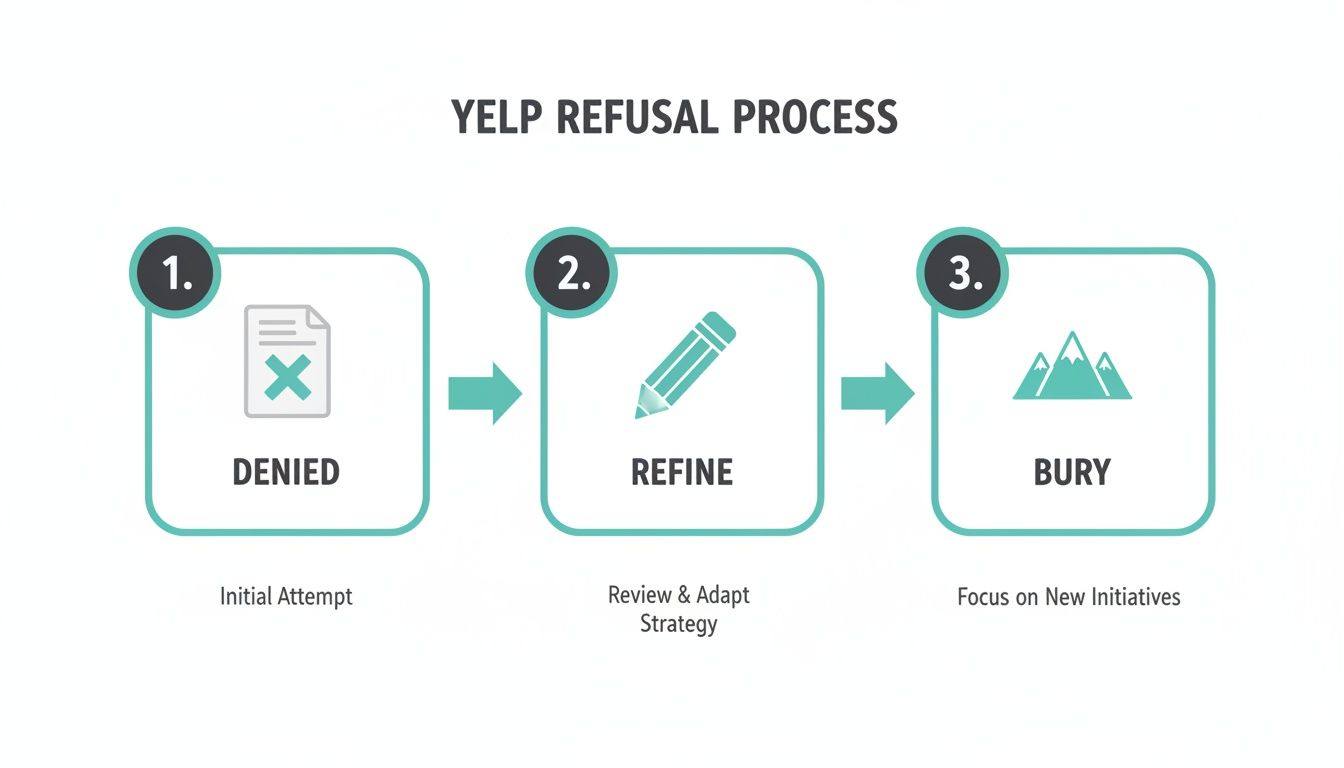
As the diagram shows, once you hit that "Denied" wall with Yelp, the next move isn't to try again—it's to refine your approach and start burying the page. This is the heart of modern reputation management.
Build Your Arsenal of Positive Assets
Now that you know what you're up against, it’s time to create your positive content. The trick isn't just to make a lot of stuff; it's to create the right kind of content on websites that Google already trusts and ranks well for brand-name searches.
These new assets will act as a buffer, crowding out and pushing the Yelp page down. Your focus should be on a diverse mix of digital properties that showcase your expertise and professionalism.
Some of the most effective assets to build include:
- A Professional Website: This is non-negotiable. It’s your digital home base and should always be the #1 result for your brand.
- Social Media Profiles: Get active on LinkedIn, Facebook, and Instagram. If you have video, YouTube is a powerhouse.
- Other Business Directories: Claim and flesh out your profiles on Google Business Profile, Angi, and Thumbtack. Give customers positive places to find you.
- Guest Articles: Offer to write helpful posts for local industry blogs or publications.
- Press Releases: Announce a new service, a key hire, or a company milestone. It's an old-school tactic that still works.
The key is diversity. When you have different types of content on various high-authority websites, you build a resilient online presence. A single negative result has a much harder time making a dent. For a deep dive into this process, check out our guide on how to https://impruview.com/bury-yelp-reviews/ and reclaim your narrative.
Promote Your Positive Content to the Top
Creating these digital assets is only half the job. Now you have to promote them so they gain enough authority to outrank your Yelp page. This is where search engine optimization (SEO) becomes your engine for growth.
To really get this done efficiently, you can use tools like an AI short video generator to turn a single project walkthrough video into dozens of clips for social media. This drives traffic and signals to Google that your other profiles are active and important.
Ultimately, this strategy turns a frustrating problem into a massive marketing opportunity. You’re not just dealing with a Yelp issue; you're building a dominant online presence that attracts better customers and cements your reputation as a trusted professional. Your focus shifts from "how to delete a Yelp business page" to building a brand so strong that one negative page can't touch it.
Frequently Asked Questions About Managing Your Yelp Presence
Even with a solid game plan, you're bound to have some lingering questions. That's completely normal—dealing with Yelp can often feel like you're playing by a set of rules you can't see. Let's dig into some of the most common questions we hear from contractors trying to get a handle on a problematic Yelp page.
If I Change My Business Name, Will That Get Rid of the Old Yelp Page?
It's a common thought, but unfortunately, it doesn't work that way. A name change won't make your old Yelp page vanish. What actually happens is that Yelp's moderators will likely update your original page, marking it as "Renamed" or "Permanently Closed."
Then, they'll create a brand-new, separate page for your new business. The old page, along with all its baggage, sticks around. It can even pop up in search results when people look for your new company, causing confusion and defeating the purpose of your fresh start. A much better strategy is to flood the search results with positive content about your new brand, burying the old, closed page and making it irrelevant.
Can I Sue Yelp to Have My Business Page Taken Down?
Let's be blunt: suing Yelp to remove a page is a long shot that almost never pays off. The primary reason is Section 230 of the Communications Decency Act (CDA), which gives online platforms broad immunity from being held responsible for content posted by their users—in this case, customer reviews.
Legal action is really only a possibility in a few very specific cases, like a clear-cut trademark violation that Yelp ignores, or if you've already won a defamation lawsuit against the person who wrote the review. For most business owners, it's an incredibly expensive and time-consuming battle you're not likely to win. You're far better off investing that time and money into a proactive reputation management campaign.
How Long Does It Take to See Results From a Reputation Campaign?
Every situation is unique, but you can realistically expect to see noticeable improvements in your search results within 30 to 60 days. The first positive assets you build—like a new professional website or optimized social media profiles—can start ranking surprisingly fast.
The key is consistency. A sustained, strategic approach builds momentum over time, systematically pushing negative results like a problematic Yelp page further down. It's not a one-time fix but an ongoing process of building and promoting your brand's positive narrative.
Is It Worth Paying for Yelp Ads to Combat Negative Reviews?
Putting money into Yelp Ads will get you more visibility on their platform, but it’s crucial to understand its limitations. Running ads does not remove negative reviews, nor does it have any direct impact on your overall star rating.
Your ads might show up at the top of a search, but customers are still just one click away from your main profile with every single review—the good, the bad, and the ugly. While ads can have a place in a broader marketing plan, they won't fix a fundamentally negative reputation. It's often smarter to invest that budget into building positive digital properties that you own and control. For tradespeople in particular, learning about effective SEO for contractors is a game-changer for building a strong local presence that doesn't depend on Yelp.
If you're tired of watching a negative Yelp page cost you thousands in lost revenue, Impruview can help. We specialize in pushing those negative results off page one, putting you back in control of your online reputation. Get your free brand audit today.