It’s one of the most maddening things that can happen to a contractor. You finish a big job, your client is thrilled, and they take the time to leave you a fantastic 5-star review. You see it pop up, and it's a huge win. Then, a day or two later, it's just… gone.
When a google review is removed, it leaves you scrambling, wondering if you did something wrong or if that crucial piece of social proof has vanished for good. In my experience, the reason almost always boils down to one of two things: Google’s own automated systems getting it wrong, or a simple issue on the customer’s end.
Figuring out which one it is is your first move.
Why Did a Legitimate Google Review Disappear

Before you jump into the appeals process, a quick diagnosis can save you a ton of time and effort. Most missing reviews are not gone forever, but you need to know what you're up against.
To help you quickly identify the likely culprit, I've put together this quick-reference table. Think of it as a cheat sheet for diagnosing the problem based on what you know.
Quick Diagnosis for a Missing Google Review
| Suspected Cause | What This Means for You |
|---|---|
| Google's Algorithm | The review was "soft deleted" by a filter. It's invisible to the public but the customer can likely still see it. This is recoverable. |
| Customer Deletion | The customer removed it, either on purpose or by mistake. This is not recoverable through Google. You'll need to contact the customer. |
| Customer Account Issue | The customer's entire Google account was suspended or deleted. This is not recoverable. All their contributions are gone. |
| Policy Violation | The review contained a link, email, or flagged keyword. This is the most common reason the algorithm removes a review. This is often recoverable. |
Understanding these scenarios helps you set realistic expectations. If it's a filter issue, you have a good shot at getting it back. If the customer's account is gone, it's time to focus on getting new reviews instead.
The Overzealous Algorithm
More often than not, the culprit is Google's own algorithm being a little too aggressive. Its main job is to filter out spam and fake reviews, and while it's good, it's far from perfect. Legitimate, heartfelt testimonials get caught in the net all the time.
A review might get flagged for reasons that seem totally harmless:
- A Link in the Review: If a customer adds a link—even one to your own website to show off the project you did—the system can read it as promotional spam and block it.
- The Reviewer’s Profile: Google gets suspicious of brand-new accounts or accounts that have never left a review before. A sudden 5-star review can look out of place to the algorithm.
- Posting from Your Location: This is a huge one for contractors. If a client is at your office or uses your job site Wi-Fi to leave a review, the system sees it as a conflict of interest and will likely remove it.
Here's the classic sign of a filter removal: The customer can still see their review perfectly fine when they're logged in, but it's invisible to you and everyone else. They have no idea it’s gone, which means you have to be the one to investigate.
Customer Actions and Simple Mistakes
Of course, sometimes the explanation is much simpler. The customer might have just deleted it. It happens—maybe they meant to edit a typo and accidentally hit the delete button instead.
There's also the chance their entire Google account was suspended or deleted. If Google terminates an account for any policy violation on their end, all of that user's contributions, including that awesome review they left for your business, get wiped out.
In these situations, there’s nothing Google Support can do. The review is tied to an account that no longer exists or a deliberate user action. The only way forward is to figure out what happened, and that starts with a quick, polite conversation with your customer.
Why Google Zaps Reviews: A Contractor's Guide to the Rules
To fight back when a google review is removed, you first have to understand the rules of the game. Google's content policies can feel a bit hazy, but once you see them through the lens of a contracting business, they start to make perfect sense. This isn't just about recovering lost reviews; it's about knowing how to coach your clients to write testimonials that are powerful, genuine, and built to last.
Think of Google’s algorithm as an overzealous bouncer at a club. It's programmed to spot anything that looks even slightly out of place. It would rather turn away a few legitimate customers by mistake than let one spammer or fake review slip through the ropes.
Here's what you need to burn into your memory: Google's AI doesn't read reviews for emotion. It scans for patterns. It couldn’t care less if a review is a glowing 5-star or a scathing 1-star; it only cares if the review—or the person who left it—trips one of its policy wires.
This means a genuinely thrilled customer can accidentally get their review flagged and deleted. Your job is to know where those tripwires are so you can help your clients step right over them.
The Conflict of Interest Trap
One of the most common reasons a google review is removed is a "conflict of interest." For contractors, this is a minefield of innocent-looking mistakes that can get a great review nuked.
Reviews from Your Crew: This is the most obvious one. A current or former employee simply cannot review your business. Google sees this as you trying to pad your own score, and it’s a fast-track to deletion.
Subcontractor & Vendor Reviews: What about that plumber you use on every remodel? Even if they genuinely love working with you, their review is at high risk. Google’s system can easily identify the business relationship as a conflict.
Family Reviews: A rave review from your brother-in-law, even after you completed a paid project for him, often gets flagged. The algorithm is smart enough to connect accounts that share a last name, a home Wi-Fi network, or other behind-the-scenes data points.
"I'll Review You if You Review Me": Never, ever trade reviews with another business, especially another local contractor. This kind of review swapping is a classic spam signal that the algorithm is specifically designed to catch and punish.
While you're here trying to protect your good reviews, you might also be dealing with bad ones. If you're fighting unfair or fake negative reviews, our guide on how to remove unwanted Google reviews can give you the strategies for that battle.
Prohibited Content That Trips the Filters
It's not just about who writes the review; it's also about what they write. When you're asking a happy client for feedback, you need to gently steer them away from including a few specific things that act as red flags for Google's automated filters.
The review should tell the story of their experience with your work, not read like an ad.
Common Red Flags That Get Reviews Removed:
| Content Type | Why It Gets Flagged | The Contractor Example |
|---|---|---|
| Pricing Details | Google flags specific dollar amounts as promotional content, not part of an authentic experience. | "They replaced our entire roof for $12,500! What a steal." |
| Website Links or URLs | Any link to an outside website—even a link to your own portfolio—is seen as potential spam. | "Check out the photos of my new kitchen at www.theirportfolio.com/project123" |
| Phone Numbers or Emails | This is a major privacy violation in Google's eyes and will be removed almost instantly. | "Just call them at 555-123-4567 and ask for Dave. He's the best!" |
Ultimately, you want your customers to focus on the narrative. Encourage them to talk about your communication, the quality of the craftsmanship, how professional your team was, and the feeling of seeing the finished project.
Those details are what sell your next customer, and they're exactly what Google wants to see in a legitimate, high-quality review. By getting a handle on these rules, you not only boost your chances of getting a removed review reinstated but also build a much stronger, more trustworthy online reputation from the ground up.
Your Action Plan for Appealing a Removed Review
It’s a gut-punch. A genuinely happy customer leaves you a fantastic review, and then, a few days later, it vanishes. It’s easy to throw your hands up and assume Google's decision is final, but I’m here to tell you it's not.
With the right game plan and solid proof, you can build a strong case and get that review put back where it belongs. This isn’t about sending an angry, all-caps email into the void. It’s about methodically showing a human support agent that their algorithm made a mistake.
This is a peek into how Google's system works behind the scenes.
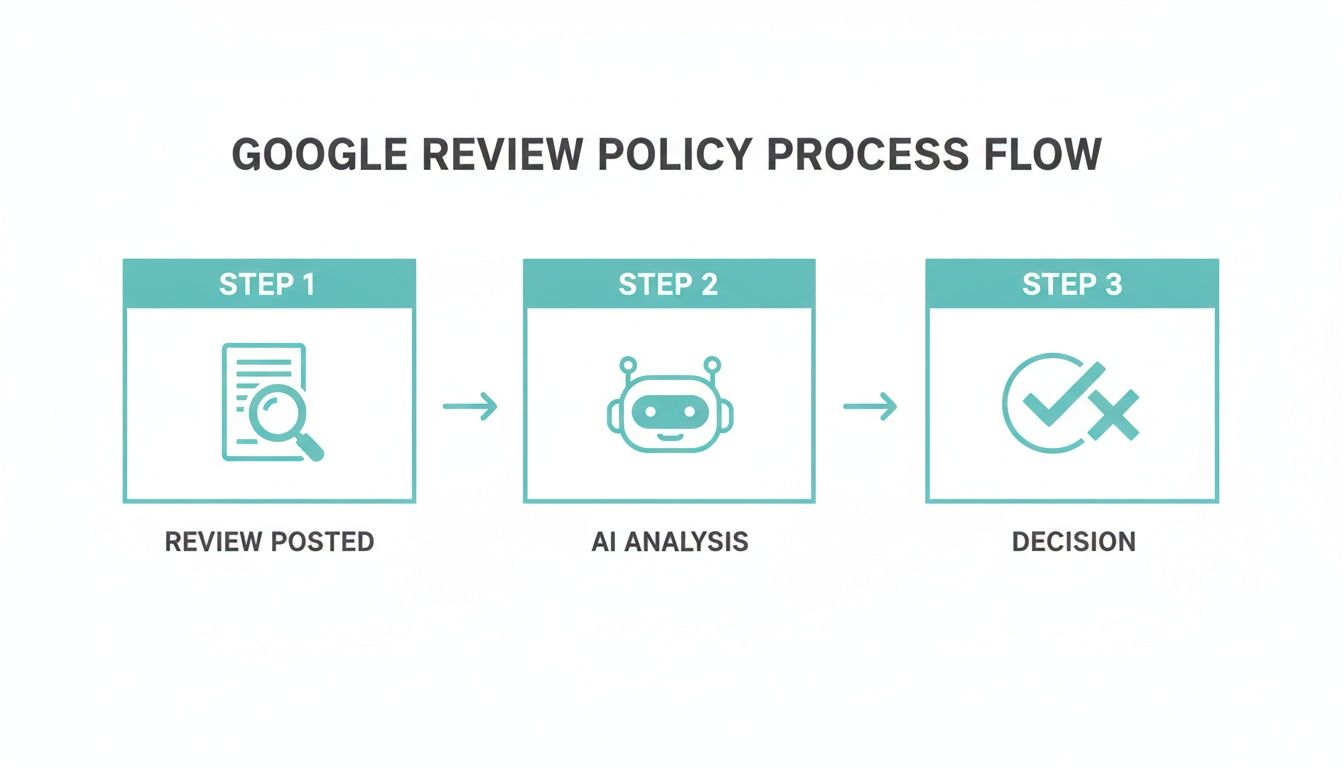
As you can see, the first line of defense is an AI. It’s fast, but it’s not perfect, which is exactly why legitimate reviews get zapped. Your appeal is your chance to get human eyes on the situation, so let's make it count.
Get Your Evidence Together First
Before you even think about opening a support ticket, you need to gather your proof. Sending an appeal without evidence is a guaranteed way to get a polite "no." Your job is to make it incredibly easy for the support rep to say "yes."
Here’s the documentation you need to pull together to prove the review came from a real client.
- Proof of Service: This is non-negotiable. You need something that ties the reviewer to a paid job. Think dated invoices, signed work orders, or project contracts. The golden ticket is having the customer's name on the paperwork match their Google profile name.
- Customer Communication: Dig up those text messages or emails. Anything where you’re discussing the project or, even better, where they’re telling you how happy they are with the work. This adds a layer of authenticity to their positive review.
- A Screenshot from the Customer: This one is huge. Ask your client to log into their Google account, go to their "Contributions" section in Google Maps, and grab a screenshot of the review they wrote. If it's still visible on their end but not on your profile, that's the classic sign of an AI filter removal.
My Go-To Tip: When asking a customer for a screenshot, be brief and appreciative. I usually say something like, "Hey [Customer Name], thanks again for the great review! It looks like Google's automated system accidentally hid it. To help me get it restored, would you mind sending me a quick screenshot of it from your Google profile? It would be a massive help."
How to Actually Contact Google Support
Once your evidence folder is ready, it's time to reach out. Don’t just Google a support email—that’s a dead end. You have to go through the official Google Business Profile (GBP) support portal to get a case number and ensure your ticket lands in the right department.
Head to the Google Business Profile Help center and click "Contact Us." When it asks for your issue, type something like "appeal a removed review". You’ll answer a few quick questions that will lead you to the correct contact form. This is where you’ll state your case and—most importantly—upload all that evidence you just gathered.
Writing the Perfect Appeal Message
The person reading your appeal is looking at dozens, if not hundreds, of these a day. Make their job easy. Be professional, quick, and stick to the facts.
Start by clearly stating that a legitimate review from a paying customer has been removed. Give them your business name, the customer's name as it appears on Google, and the rough date the review vanished.
Then, walk them through your evidence. Don't just attach it; explain it. For example: "I’ve attached the signed work order for the project, our text message conversation confirming the job was completed, and a screenshot from the customer showing the review on their end."
Finally, wrap it up with a polite request like, "This is a review from a real customer, and it's important to our business. We’d appreciate it if you could please investigate and reinstate it."
Keep emotion and accusations out of it. A calm, evidence-based appeal is always more effective. It's also worth noting that this process is for recovering legitimate reviews. If you're dealing with fake negative reviews, that requires a different strategy. We've got a whole guide on how to remove fake Google reviews from your profile if you're in that boat.
After you submit your appeal, you'll get a case ID. Hang onto that number. The review can take a few days or even a couple of weeks, so be patient while the team does their work.
What to Do When Your Appeal Is Denied
Getting that final "no" from Google after you’ve jumped through all their hoops is incredibly frustrating. You sent the invoice, the screenshots, and proved the review was from a legitimate, happy customer, but they denied your appeal anyway. It feels completely unfair.
But here's the hard truth: this isn't the end of the road. It's just a sign that you need to change your strategy. Pouring more time and energy into fighting a decision that’s already been made is a waste. It’s time to make that one missing review totally irrelevant.
The new game plan is to take back control of your brand's story online so effectively that a single missing review becomes a footnote. You're going to build a 'content fortress' that completely dominates your search results, leaving no doubt about the quality of your work.
Pivot to Proactive Reputation Management
When a google review is removed and the appeal goes nowhere, dwelling on it is the worst thing you can do. The most powerful move you can make is to bury that empty space with an avalanche of positive, authentic content. The goal here is simple: control what potential customers see when they search your company name.
Instead of noticing one missing review, you want them to find a mountain of assets that prove your professionalism and dedication to quality. This is how you build a reputation so bulletproof that it can easily withstand a few bumps and bruises along the way.
Think of this as owning your digital real estate. By creating and promoting positive content that you control, you push any negativity—or in this case, the void left by a removed review—so far down the search results that it might as well not exist.
You're no longer playing defense against a faceless algorithm. You're playing offense by telling your own story, on your own terms.
Building Your Content Fortress
So, how do you actually build this fortress? It's all about creating and promoting different types of content that highlight your expertise and happy customers. Every new piece becomes another positive search result for your business.
Here's what you should focus on:
- Detailed Project Galleries: Don't just throw a few photos on a page. Create dedicated pages on your website for your best projects. Show high-quality before-and-after shots. Tell the story behind the job—the challenges you solved, the specific materials you used, and the homeowner's goal.
- In-Depth Case Studies: Go a step further than a gallery and turn your signature projects into detailed case studies. Interview the homeowner if they're willing, document your entire process, and spell out the fantastic results. A solid case study is a powerful sales tool that also happens to rank very well in search engines.
- Video Testimonials: Nothing beats a video of a smiling customer talking about their great experience. It’s authentic, builds immediate trust, and is way more engaging than text. A simple, well-lit video shot on a smartphone is often more than enough to make a huge impact.
- Local Press and Blog Features: Get in touch with local bloggers or community news outlets. You're an expert in your trade, so offer to share some knowledge. A plumber could write about "How to Winterize Your Pipes," or a roofer could offer tips on "Choosing the Right Shingle for Our Climate." These features establish you as an authority and create powerful links back to your site.
Amplify Your Existing Positive Reviews
Your existing positive reviews are gold. Don't just let them sit there on your Google Business Profile collecting dust.
You need to put them to work. Turn your best 5-star quotes into simple, branded graphics for your Facebook or Instagram page. Add a dedicated section to your website's homepage that proudly displays a live feed of your best reviews.
By actively promoting the good feedback you already have, you multiply its impact and make sure it gets seen. This proactive approach completely buries the tiny dent left by a single google review removed from your profile. It puts the focus back where it belongs: on the overwhelming proof of your great work.
Building a Review Generation System That Lasts

Look, the best way to handle the frustration of a google review removed from your profile is to make sure you have plenty more coming in. It's a numbers game. When you have a steady, predictable flow of positive feedback, the loss of one review—while still annoying—barely makes a dent. This doesn't happen by accident; it's the result of a simple, repeatable system.
For us contractors, it all comes down to timing. You want to ask for that review right at the peak of your client's happiness. Think about that "wow" moment when they see their finished kitchen, feel the first blast of cold air from a new AC install, or step back to admire a perfectly repaired roof. That's your golden window. They're thrilled with your work and most likely to share that excitement.
Making the Ask Effortless
Your customers have lives to get back to. If asking for a review feels like a chore, it's not going to happen. The goal is to make it so unbelievably easy that it takes them less than a minute. Sending them to Google's homepage to search for your business name is a recipe for failure.
You have to eliminate every single step that stands between them and the review form.
- Direct QR Codes: I've seen this work wonders. Print a QR code that goes straight to your Google review page. Stick it on the final invoice, a fridge magnet you leave behind, or a business card you hand them during the final walkthrough. They just point their phone, scan, and start typing. It's that simple.
- Simple Email & Text Follow-ups: The day after you’ve wrapped up, send a quick, personal message. Nothing fancy. Just, "Hey [Client Name], we loved working on your project. If you have 30 seconds, would you mind sharing your thoughts on Google? It makes a huge difference for our team." And, of course, include the direct link.
Making it this convenient is the key to getting them to act on that initial impulse to help you out. To really get ahead of review loss and build a rock-solid reputation, learn the best practices for how to get Google reviews for your business that create local trust.
Coaching Your Customers for Success
Getting them to click the link is only step one. The next part is gently guiding them on what to write so their review actually sticks around and helps you. This isn't about feeding them lines, but about prompting them to share the details that matter—and avoid the things that might get their google review removed.
Basically, you want to nudge them away from anything that could accidentally trigger Google's spam filters.
Your goal is to encourage storytelling. A review that says "Great work, good price" is forgettable and can even look suspicious. A review that says, "Their team was so professional, the communication was excellent, and they left the job site cleaner than they found it" is powerful, trustworthy, and policy-compliant.
Take a look at what Google itself recommends. The focus is all on authenticity and relevance.
Google's own guidance confirms what we already know from experience: they want reviews to be about the actual experience a customer had with your service. This reinforces why you need to help your clients focus on descriptive, narrative-style feedback.
When you ask, encourage them to touch on:
- The Process: How was the communication? Was the team on time and professional?
- The Craftsmanship: What specific details do they love about the final result?
- The Problem You Solved: How did your work fix their issue or improve their home?
This little bit of coaching accomplishes two critical things. First, you get far more compelling testimonials that will actually persuade future clients. Second, it naturally steers them clear of policy-violating content—like mentioning specific prices or adding links—that gets good reviews flagged and taken down. For more on this, our guide on how to get more Google reviews from your customers has more templates and tactics you can put to use right away.
When a review vanishes, it's natural to have a million questions and feel a ton of frustration. You just want straight answers so you can figure out what to do next. Let's tackle the most common questions I hear from contractors who are in the exact same boat.
How Long Does Google Take to Respond to an Appeal?
This is the part that requires some patience, and it’s always frustrating. Shortly after you submit your appeal, you'll get an automated email with a case number. That’s just the system telling you, "Got it."
Getting a final decision from an actual person, though, is a different story. It can take anywhere from a few days to several weeks. The timeline really depends on how swamped Google's support team is and how clear-cut your case is. If your evidence is a slam dunk, things tend to move faster.
My best advice is to submit all your evidence at once to prevent the back-and-forth delays that can drag this out. If you haven't heard anything meaningful on your case within three weeks, it’s perfectly reasonable to send a polite follow-up to your original support ticket email.
Can I Sue Over a Removed Review or a Fake One?
Look, you can technically sue anyone for anything. But the real question is whether it's a fight you can actually win or afford as a contractor. The short answer? Almost always no.
Going the legal route is an incredibly expensive, time-consuming, and uphill battle.
- Proving defamation for a bad review has a very high legal bar.
- Suing a massive company like Google over a content moderation decision is a monumental task with a slim-to-none chance of succeeding.
Your time and money are far better spent on the proactive reputation strategies we’ve been talking about. Building a "content fortress" and generating a steady stream of new, positive reviews will always give you a better return on your investment.
Why Can My Customer Still See Their Review but I Can’t?
This is the classic, tell-tale sign that a google review removed by an automated filter is what you're dealing with. It’s a confusing but incredibly common scenario.
Here’s what’s happening: to stop spammers from just reposting flagged content over and over, Google often makes the review visible only to the user who wrote it. From their end, everything looks fine. But for everyone else—including you and potential new customers—it's gone.
How to Confirm This:
The quickest way to be sure is to open a private or "incognito" browser window and look up your Google Business Profile. This lets you see your profile as a stranger would, without being logged into any Google account. If the review isn't there, you can be 100% certain it was filtered by the algorithm.
This is your signal to start gathering your evidence and begin the appeal process. Whatever you do, don't just ask the customer to repost it—that's a surefire way to get it flagged again. You need to appeal the original removal.
When a review gets removed and Google denies your appeal, it really shows how risky it is to depend on one platform. At Impruview, we help contractors take back control. Our content flood strategy is designed to push negative items and missing reviews far down in search results, making sure the great stories about your work are what customers see first. Visit https://www.impruview.com to see how we can help protect your hard-earned reputation.