You've probably checked Google reviews for a local business yourself. It’s a simple click on the star rating in Search or Maps. For a contractor, that same simple action from a potential customer has become the most powerful force shaping your success. Your Google Business Profile isn't just a listing anymore—it's your most important sales tool.
Why Google Reviews Are Your New Sales Team
Let's be real—for any contractor, your Google Business Profile is the new frontline. It’s where potential clients make a snap judgment about you, often long before they even think about visiting your website. That star rating isn't just some number; it's a direct, public measure of your quality and trustworthiness.
Think about it in practical terms. A single, unanswered one-star review can be enough to scare away a homeowner who’s looking to start a high-value project. That single negative impression could cost you a five-figure roofing job or a major kitchen remodel, and you'd never even know you were in the running.
The Financial Impact of Your Star Rating
Picture two competing HVAC companies in the same town. The first one is on top of every review. They thank customers for positive feedback and quickly, professionally address any complaints that come in. The other company just lets the reviews pile up, ignoring the negative ones.
It’s no surprise when the first company's phone keeps ringing with lucrative installation jobs, while the second one wonders why their lead flow is drying up. This isn't a fluke. It's the modern sales funnel in action, and it all starts with your reviews.
The data backs this up decisively. In 2026, 91% of consumers read online reviews before making a purchase, a huge jump from just a few years ago. Even more telling, a study from National Today found that 68% of people who read positive reviews will contact that business within 24 hours. For a contractor, where a single job can be worth thousands, a prominent negative review isn't a small problem—it's a sales killer.
A solid collection of positive reviews doesn't just attract customers; it pre-sells them on your value and professionalism. It builds trust at the most critical stage of their decision-making process.
From Chore to Unstoppable Sales Tool
This direct line between your reviews, how you show up in local search, and your bank account means you have to think differently. Managing your reviews isn't just another task to check off the list; it's one of the most powerful sales activities you can do. Your online reputation is now a primary driver of:
- Lead Generation: A higher star rating makes you the obvious choice in a crowded local market, plain and simple. More clicks, more calls.
- Customer Trust: Homeowners are looking for reasons to trust you. A history of great feedback and professional responses is the social proof they need to feel confident.
- Search Engine Visibility: Google’s algorithm rewards businesses with fresh, frequent, and positive reviews by ranking them higher in local search and on Maps.
Understanding the direct benefits of reputation management is the first step. This guide will walk you through how to go from being a passive target of reviews to actively using them to build a more profitable and resilient contracting business.
How to Find Every Review, Wherever You Are
As a contractor, you're constantly on the move. Customer feedback doesn't wait until you're back at a desk, so you need a fast way to find reviews whether you're planning the week in the office or wrapping up a job on-site. Let's walk through how to find every single review without getting bogged down.
The link between a great customer experience, the reviews they leave, and your company's revenue is a straight line. It’s a powerful cycle you need to manage actively.
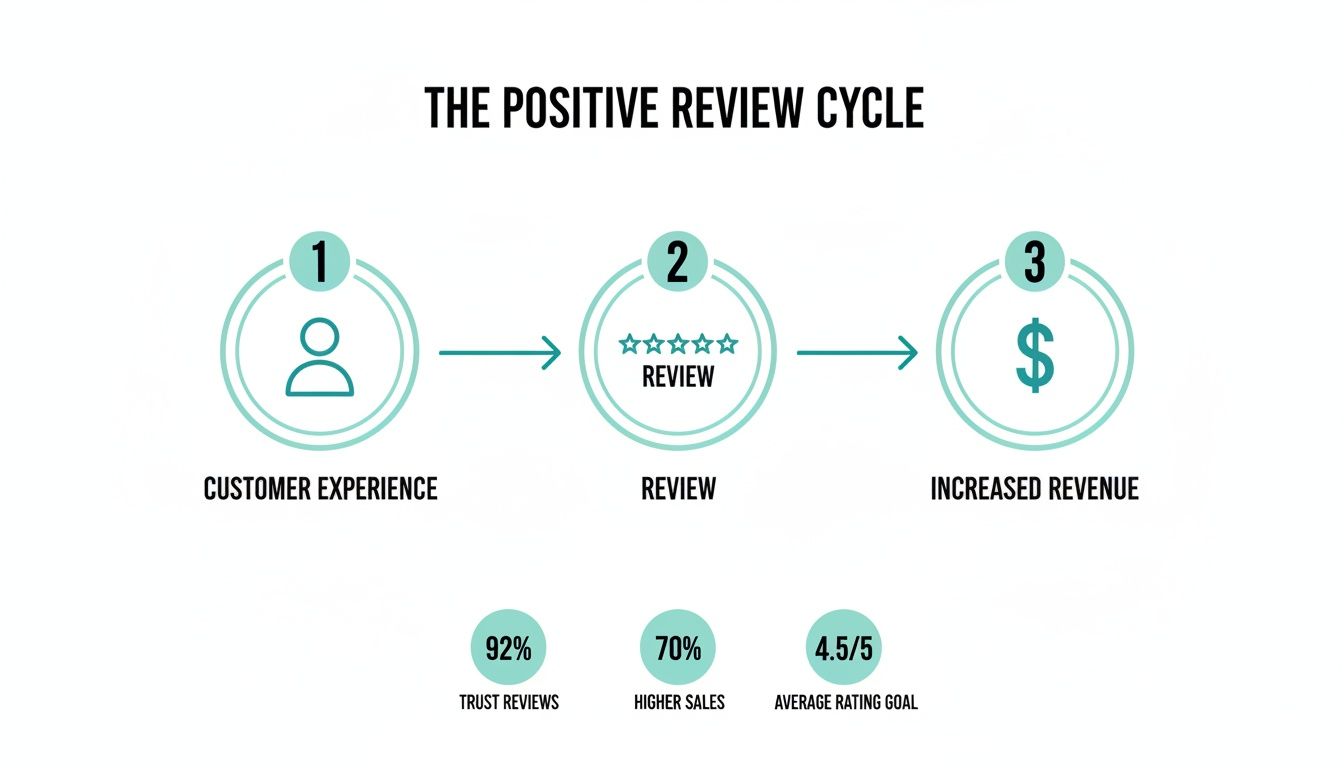
This isn't just a business school theory; it's how things work on the ground. A happy client leads to a 5-star review, which in turn convinces the next homeowner to call you instead of the competition.
Finding Reviews on Your Desktop
When you’re in the office, the quickest way to see what people are saying is right through a simple Google Search. Forget navigating through a complicated dashboard.
Just open Google and type in your exact business name and city—for example, "Main Street Plumbing Denver." Your Google Business Profile will pop up on the right-hand side. Look for the link showing your star rating and click it. It’ll look something like this: 4.8 ★★★★★ (132 reviews).
That one click takes you directly to a full list of all your customer reviews. It's a two-click process that should be as routine as checking your email first thing in the morning.
Pro Tip: Once you're on your reviews page, bookmark it! This saves you the search step and gives you one-click access to all your customer feedback. It's a simple timesaver that really adds up.
Finding Reviews on Your Mobile Device
More often than not, you'll need to check reviews while you're out in the field. This is where your smartphone and the Google Maps app become your best friends for staying on top of new feedback.
Picture this: you've just finished a big installation and you're waiting for the client to do a final walkthrough. That two-minute window is the perfect time to check for new reviews.
Here's the quick-and-dirty method:
- Open the Google Maps app on your phone.
- Search for your business name.
- Tap on your business profile when it appears.
- Swipe up on the profile card and tap the "Reviews" tab.
This gives you an immediate, real-time look at what customers are saying. Being able to read reviews on Google from your phone means you can catch a critical comment and respond before it sits there for days, which makes a huge difference.
This mobile workflow is absolutely essential for managing your reputation on the go. Staying consistent with monitoring your reviews is just one piece of the puzzle; you also need to make sure your business information is accurate everywhere it appears online. For a deeper dive on that, our guide to local listings management can help you get everything buttoned up.
Turning Reviews into Real Business Intelligence
Reading your reviews is just the starting point. The real work begins when you start to connect the dots and understand the story your customers are telling you about your business. When you consistently read reviews on Google, you’re gathering raw data. The goal is to turn that feedback into actionable intelligence that can genuinely improve your operations.
This goes way beyond just filtering by star rating. It means digging in and manually categorizing what people are saying. By doing this, you can transform a simple stream of opinions into a powerful dataset that pinpoints your biggest strengths and most costly weaknesses.

Find the Recurring Themes in Your Feedback
As you comb through your reviews, look for the patterns. You'll quickly notice certain words, phrases, and complaints popping up over and over again. For contractors, these themes usually fall into predictable buckets related to how you run your jobs.
I once worked with a roofing company that kept getting comments like, "they never called me back" or "I had to chase them for an update." We started tagging every review mentioning communication issues. Soon, the pattern was impossible to ignore—it wasn’t just one or two unhappy clients, but a real, systemic problem in their process that was costing them referrals.
Keep an eye out for these common themes in your own reviews:
- Quote Accuracy: Are customers happy that the final invoice matched the quote, or are they constantly surprised by extra charges?
- Crew Professionalism: Do reviews praise your team for being polite, clean, and respectful of the homeowner's property?
- Project Timeliness: Do people mention that you finished on schedule? Or are delays a common source of frustration?
- Sales Process: Was your initial consultation helpful and professional, or did clients feel pressured or rushed?
By tracking these themes, you move from simply reacting to individual complaints to proactively fixing the root causes. These are the operational gaps that, if ignored, will keep generating bad reviews and costing you future jobs.
From Raw Feedback to a Competitive Edge
Turning all this qualitative feedback into something you can measure is easier than it sounds. A simple spreadsheet is all you need to get started.
Create columns for the star rating, the date, and the main themes you've identified. Every time a new review comes in, just log it and tag it with the categories it touches on.
Do this for a few months, and you'll have a clear, data-driven picture of what you're doing right and where you're dropping the ball. This process, known as sentiment analysis, helps you understand the emotion behind the words. For a deeper dive, there are even dedicated sentiment analysis tools that can automate some of this work and reveal subtle trends in customer feelings.
This systematic approach is how you build a real strategic advantage from customer opinions. It helps you fix problems before they become reputation-killing patterns. Ultimately, understanding why customers feel a certain way is the key to growth. To explore this topic further, our detailed guide on how to measure customer satisfaction is a great next step.
Mastering the Art of the Review Response
Think of your Google reviews less as a report card and more as free marketing material. Every single reply you post is a public testament to your company's values and customer service. It’s a conversation that every potential customer is watching.
And believe me, they are watching on Google. With the platform hosting a staggering 57-58% of all online reviews and owning 73% of the review market share, your Google Business Profile isn't just another online listing—it's the main stage. For a contractor, what happens here directly impacts your bottom line. You can see just how dominant Google is with these in-depth review statistics.

Let's walk through how to handle both glowing praise and sharp criticism to protect—and even build—your hard-earned reputation.
Responding to Positive Reviews
Getting a 5-star review feels fantastic. But a quick "Thanks!" is a huge missed opportunity. Your real goal is to amplify that positive energy and use it to subtly market your business to the next person who reads it.
A truly effective response accomplishes a few things. It thanks the customer for their time, repeats the specific praise they gave you, and weaves in important keywords about your services and location.
Instead of this:
Before: "Thanks for the review!"
Try this:
After: "Thank you so much for the kind words, Sarah! We're thrilled you're happy with your new roof installation in the Denver area. Our team always aims for professionalism and efficiency, so it's fantastic to hear we hit the mark. We appreciate you choosing us!"
See the difference? The "After" version confirms you do great work ("professionalism," "efficiency") and boosts your local SEO with the phrase "new roof installation in Denver." It turns a simple thank you into a powerful marketing asset. For more ideas, check out these 7 Positive Review Response Examples.
Responding to Negative Reviews
A negative review can feel like a punch to the gut. It's easy to get defensive, but that’s the worst thing you can do. The key is to de-escalate the situation publicly and immediately take the conversation offline.
Never admit fault or liability in your public response. Your goal is to demonstrate that you are reasonable and committed to a resolution, not to argue the details of the complaint online.
Here’s a proven game plan I’ve seen work time and time again.
First, thank them for their feedback and acknowledge their frustration. You don't have to agree with their claims, but you should show empathy. A simple, "We are sorry to hear your experience did not meet expectations," goes a long way.
Next, and this is crucial, provide a direct, private channel to solve the problem. Give them a specific person to contact, along with a phone number and email address. This shows you're taking it seriously. Finally, close by reiterating your commitment to making things right.
A bad response will only pour fuel on the fire:
Before (A Poor Response): "You're wrong, that never happened. Our crew would never do that and you were difficult from the start."
A professional response protects your reputation:
After (A Professional Response): "Hi Mike, thank you for bringing this to our attention. We're very sorry to hear that your experience with our recent plumbing repair was not what you expected. We are committed to customer satisfaction and would appreciate the opportunity to discuss this further. Please contact our owner, David, directly at (555) 123-4567 or david@ourcompany.com so we can work to resolve this."
This strategic reply shows every future customer that you handle issues with professionalism and integrity, turning a potential disaster into a display of excellent customer service.
Navigating Google’s Disappearing Reviews Problem
It’s one of the most maddening things that can happen to a contractor. You finish a great job, the client leaves you a glowing 5-star review, and then—poof. It’s gone. If you've seen legitimate reviews vanish from your Google Business Profile, you're not going crazy. This is a real, and frankly, growing problem.
Google is trying to fight spam and fake feedback, which is a noble goal. The problem is, their automated filters have gotten so aggressive they often take out the good with the bad. Perfectly honest reviews from real customers get caught in the crossfire, and it feels completely out of your control.
This isn't just a random fluke. Things got especially bad between late 2025 and mid-2026 when Google launched a massive enforcement wave that zapped reviews from over 60,000 business profiles. This sweep seemed to hit five-star ratings particularly hard; one business owner I know lost more than 20 reviews in just a matter of weeks. You can dig into more of the details on what contractors need to know about Google's review removals on almcorp.com.
Your Star Count is More Fragile Than You Think
This changes the game. For years, the simple playbook was to stack up as many 5-star reviews as possible. While that's still a piece of the puzzle, treating your star rating as the only goal is a fragile strategy. Your hard-earned reputation can get torpedoed overnight by an algorithm update you have no say in.
Imagine your Google rating as a single support beam holding up your entire online reputation. If a rogue algorithm suddenly cracks that beam, the whole thing can come crashing down. It's time to build a more solid foundation.
The smartest contractors I see are no longer just chasing stars. They're building a diverse portfolio of online proof that acts like an insurance policy, making sure their reputation stands strong no matter what Google does next.
Building a More Resilient Online Reputation
The key is to think beyond the real estate you're "renting" on your Google Business Profile. You need to build what I call a "reputation moat"—a collection of powerful, positive assets that you own and control, all surrounding your brand.
This is more than just playing defense; it’s just plain smart marketing. When a potential customer looks you up, you want them to find a whole chorus of positive signals, not just a single star rating that could change at any moment.
Start by building out these assets on your own turf:
- A project gallery on your website: Don't just post photos. Show off your best work with high-quality images and captions that tell the story of the project.
- Video testimonials from happy clients: Nothing sells like a real customer on camera. A short, authentic video of a homeowner praising your crew is incredibly powerful. You can host it on your own site and share it everywhere.
- In-depth case studies: Turn a successful project into a detailed story. Write a blog post that walks through the job from start to finish, highlighting the challenges you solved and the fantastic results you delivered.
This kind of content is undeniable proof of your skill and professionalism. It reinforces the story your best reviews are trying to tell and gives you a safety net if some of those reviews get zapped. Having a broader content strategy like this is no longer a bonus—it's essential for staying in business long-term.
Common Questions About Google Reviews (and Straightforward Answers)
As a contractor, you're juggling a thousand things at once. Dealing with online reviews can feel like a whole separate job you never signed up for. We get it. You've probably got some real, pressing questions about how to handle this stuff. Let's tackle the most common ones we hear from contractors just like you, with no fluff.
Can I Remove a Bad Review From Google?
This is always the first question, and I'll be blunt: almost never. You can't just delete a review because you disagree with it or the customer was difficult.
For Google to even consider removing a review, it has to clearly violate their specific content policies—think hate speech, spam, or a blatant conflict of interest (like a review from a fired employee). A customer's negative opinion, even if you feel it's unfair, doesn't qualify.
Instead of fighting a losing battle, pivot your strategy. Here’s what actually works:
- Respond Professionally: Post a calm, public reply. This shows potential customers that you're reasonable and take feedback seriously, even when it's tough.
- Focus on Volume: The single best way to neutralize a bad review is to bury it with a flood of new, positive ones. When prospects see dozens of 5-star reviews and one 1-star complaint, they'll correctly assume the negative one is an outlier.
How Often Should I Check for New Reviews?
Make it a daily habit. Seriously. Set aside five minutes every morning to read reviews on Google. Getting back to people quickly—especially on negative feedback—is crucial. A good rule of thumb is to respond within 24-48 hours.
A fast reply can stop a small complaint from turning into a major reputation fire. On the flip side, a quick "thank you" for a positive review makes that customer feel great and shows everyone else you’re an engaged, active business.
What if a Review Is Fake or From a Competitor?
If you're certain a review is bogus, you need to act. Go into your Google Business Profile dashboard and flag it immediately. When you flag it, you'll have a chance to briefly explain why you believe it's fraudulent.
But don't stop there. While you wait for Google to (maybe) take action, you absolutely need to post a public reply.
Keep it calm and factual. Something like this works wonders: "We appreciate you reaching out, but we can't find any record of a customer with this name or a project matching this description in our system. Please give our office a call directly so we can sort this out." This tells other readers everything they need to know—that the review is likely fake—without you getting into an online fight.
Do I Really Need to Respond to Positive Reviews?
Yes. 100%. Don't skip this. Replying to your happy customers is one of the easiest, highest-impact marketing tasks you can do.
It accomplishes two things: First, it reinforces that customer's good feelings, making them more likely to recommend you to friends and family. More importantly, it shows every single person who reads your reviews in the future that you're a business owner who cares and appreciates their customers. It's a powerful signal.
If you're tired of seeing unfair reviews cost your business thousands in lost jobs, Impruview can help. We specialize in building a powerful online presence for contractors that pushes negative results down and highlights the quality work you do. Stop losing leads and start controlling your reputation by visiting us at https://www.impruview.com.