Online reputation management is all about controlling the conversation. Think of it as your digital first impression—a planned effort to make sure that when potential customers look you up, they see the best, most accurate version of your contracting business. It's not about hiding the truth; it's about making sure one angry customer doesn't drown out a hundred happy ones.
Why Online Reputation Is Your Most Valuable Tool
Let's paint a picture. A homeowner's AC dies in the middle of a heatwave. They pull out their phone, search for local HVAC pros, and your company pops up. But right below your name is a one-star Yelp review from a disgruntled client. That single comment is a digital stop sign, sending that desperate customer straight to your competitor without a second thought.
This is the reality for contractors today. Your online presence isn't just a fancy business card anymore; it's the main arena where you win or lose jobs. In trades like roofing, plumbing, and remodeling, trust is the currency. A tarnished digital footprint can stop your phone from ringing.
The Financial Stakes of Your Digital First Impression
We're not just talking about feelings here; we're talking about money. By 2026, a company's reputation is expected to make up a massive 30-40% of its total value. That's a huge number, but let's bring it down to earth for a contractor.
For an electrician or remodeler whose average job is over $500, a single prominent bad review will cause 70% of potential customers to immediately look elsewhere. If you're curious, you can dig deeper into online reputation management statistics and see just how much this affects local businesses.
What used to be "goodwill" is now a hard asset—or a costly liability—that directly impacts your bottom line.
A single negative review doesn't just cost you one job. It costs you a stream of potential jobs from every customer who sees it and decides not to call. It's a silent leak in your revenue pipeline that grows worse over time.
Before we move on, let's look at a quick breakdown of what this really costs.
The Real Financial Cost of a Negative Review
This table breaks down the tangible financial impact of negative online reviews on a typical home service business.
| Problem Area | Immediate Impact | Long-Term Financial Loss (Example) |
|---|---|---|
| Lost Leads | A homeowner searches for "roof repair near me" and sees a 1-star review. They immediately click on a competitor's listing instead. | 10 lost leads per month @ 20% close rate = 2 lost jobs. If the average job is $5,000, that's $10,000 in lost revenue that month. |
| Lower Close Rate | A potential client gets a quote but decides to research your company before signing. They find negative feedback and get cold feet. | Your sales team has to work twice as hard to overcome objections, dropping the close rate from 30% to 20% and costing deals you should have won. |
| Reduced Pricing Power | You're forced to lower your prices to compete, as your reputation can't justify a premium rate against a 5-star competitor. | A 5% price reduction on $300,000 of annual revenue is $15,000 straight off your profit margin. |
| Recruiting Difficulty | Top-tier technicians and project managers look up your company before applying. A poor reputation suggests a chaotic work environment. | You struggle to attract skilled labor, leading to project delays, higher hiring costs, and potentially lower-quality work, which creates more bad reviews. |
As you can see, the financial damage snowballs, affecting everything from sales to hiring.
Regaining Control of Your Narrative
This is where professional reputation management services come into play. The goal isn't to wave a magic wand and make bad reviews disappear—that's rarely possible and often not the point. The real strategy is to build a firewall of positive, authentic proof of your good work.
Here’s how it works in practice:
- Promote genuine customer testimonials: We actively find your happy customers and make their voices the loudest ones online.
- Publish expert content: We create articles, project showcases, and press releases that position you as a knowledgeable authority in your trade.
- Polish your digital profiles: We make sure your business listings on sites like Google, Yelp, and Angi are accurate, professional, and full of positive information.
By consistently executing this plan, we push your best assets to the top of the search results. The negative stuff gets buried deep on page two or three, where almost no one ever looks. You get back in the driver's seat, ensuring that the first thing a new client discovers is your commitment to quality and professionalism.
How Professionals Bury Negative Search Results
When a nasty review or a critical article about your contracting business pops up on the first page of Google, it can feel like a permanent black mark. Many contractors assume the only fix is to get it taken down, but that's rarely possible. Instead, professional reputation management services use a much more effective and reliable strategy: we essentially bury it.
Think of it this way. You can't always just yank a stubborn weed out of your front yard. But you can plant a garden of beautiful, vibrant flowers so dense and tall that the weed becomes completely invisible to anyone passing by. In this case, the negative content is the weed; the new, positive online assets we build are the flowers.
This isn't about erasing history. It's about taking decisive control of your company's story right now and shaping what potential customers see first.
The infographic below shows just how damaging that "digital weed" can be, stopping a potential job in its tracks before you even get a chance to submit a bid.
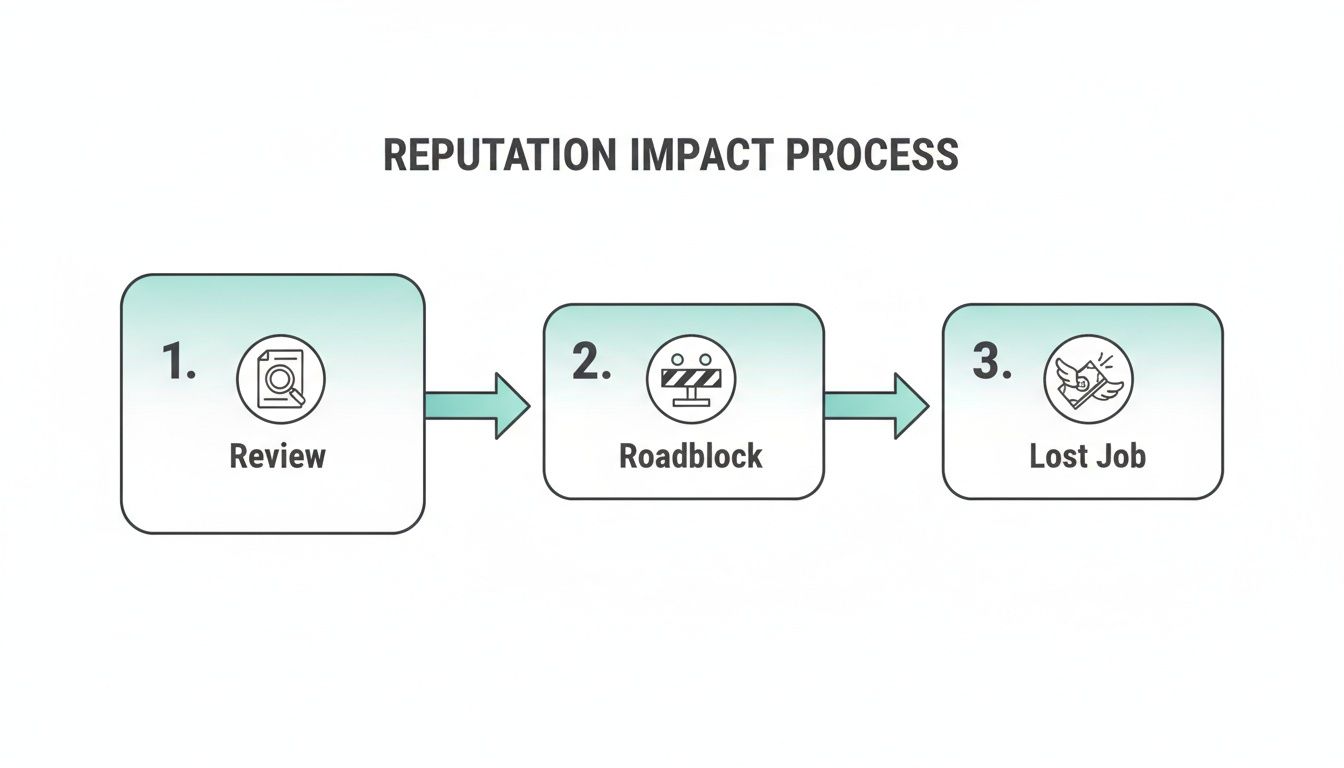
As you can see, a bad search result acts as a digital roadblock, directly leading to lost work and lost revenue.
The Three-Step Playbook for Owning Your Search Results
Successfully burying negative content isn't about just throwing up a few random blog posts. It's a methodical, three-step campaign designed to systematically push the bad stuff down and pull the good stuff up.
1. The Deep-Dive Digital Audit
First things first, we map out your entire digital footprint. This initial audit is like a full diagnostic on your brand's online health. We don't just skim the surface; we dig deep to find every single mention of your company—good, bad, and neutral—across the web.
- Review Platforms: We're talking Google, Yelp, Angi, Houzz, and any other site specific to your trade.
- Social Media: We look at Facebook pages, local community groups, Nextdoor, and anywhere customers might be talking.
- News Articles & Blogs: This includes any local news coverage or blog posts that have mentioned your business.
- Public Records: We even check online directories and public listings that could influence a customer's perception.
This audit gives us a complete battlefield map. We identify the negative "weeds" we need to smother and find the positive "seeds" we can help grow.
2. Strategic Creation of Positive Assets
With our map in hand, we start planting the garden. We create a whole range of high-quality, professional content that is specifically designed to rank high in search results for your company’s name. This isn't just filler; each piece is a valuable digital asset that you control.
The whole point is to build a portfolio of brand-owned web properties. When a potential customer searches for you, they should find a digital landscape that reflects your professionalism and expertise, not a single disgruntled voice.
Some examples of these assets include:
- Press Releases: Announcing new services, a key hire, or your involvement in a community project.
- Professional Profiles: Building out or optimizing profiles on sites like LinkedIn, Houzz, or trade-specific directories.
- Company Blog Posts: Showcasing successfully completed projects, offering helpful tips for homeowners, and highlighting your team's expertise.
3. The Targeted SEO Suppression Campaign
Creating the content is only half the job. The final, most critical step is making sure these new, positive assets actually outrank the negative ones. To do this, we launch a targeted search engine optimization (SEO) campaign focused entirely on your branded search terms (like "Your Company Name" or "Your Company Name reviews").
This involves building authority for your new content so Google sees it as more relevant and important than the negative link. Over time, the positive assets climb to the top of the search results, pushing the negative content down onto the second page where it becomes practically invisible. Different platforms require different tactics; you can learn more about how to specifically bury negative Yelp reviews in our detailed guide.
What’s a Realistic Timeline for Results?
This process gets results faster than most contractors think. While completely suppressing a very stubborn negative result on a high-authority site can take several months, you'll see positive momentum much sooner.
Typically, you can expect to see new, positive content appearing on the first page of Google within 30-60 days. Seeing these new assets pop up is the first sign that the strategy is working. For contractors who live and die by their local reputation, taking control of your online image isn't just a good idea—it's essential for survival and growth.
Real-World Contractor Success Stories
Theory is great, but what really matters is seeing this stuff work in the wild for contractors just like you. These aren't just feel-good stories; they're the actual blueprints for how you can fight back against bogus online attacks and take back control of your good name.
Let's break down a couple of real-world scenarios where a focused reputation strategy didn't just fix a problem—it created a major business advantage. This is where the rubber meets the road, translating directly into more calls, more quote requests, and more signed contracts.
The HVAC Company Haunted by a Former Employee
Our first case involves a fantastic HVAC company that got stuck in a tough situation. After they had to let a technician go for poor performance, a string of nasty, one-star reviews started popping up everywhere. They were clearly fake—full of specific, but false, details meant to do maximum damage. And of course, they were the first thing people saw when they Googled the company.
The owner was feeling the heat. His sales team was spending more time defending the company's honor on calls than they were talking about BTUs and ductwork. Leads were drying up, and you could feel the morale taking a hit.
The Solution and Strategy
Fighting to get the reviews taken down was a dead end. So, we went on the offensive with a "content flood" campaign. The idea was simple: make the current, awesome team the real story.
- Team Spotlights: We created professional profiles and blog posts showcasing the experience, certifications, and loyalty of their best technicians.
- Positive Press: We wrote and sent out a press release about their recent charity work in the community, which got picked up by a few local news blogs.
- Review Promotion: We put a simple system in place to encourage their many happy customers to leave feedback, which started to lift their overall star rating.
The Outcome and ROI
Within 60 days, the new, positive content started showing up on the first page of Google, pushing those bogus reviews further down. By the end of the first quarter, the negative links were off to page two, where almost no one ever looks.
The turnaround was undeniable. The company saw a 40% jump in qualified leads through their website within 90 days of starting. They were no longer losing business to a ghost from the past.
This is a perfect example of how you can neutralize a targeted attack. You don't always have to erase the negative; you just have to drown it out with a stronger, more positive reality.
The Roofer Buried by a Single Bad Review
Here’s another classic problem we see all the time. A top-notch roofer's entire online reputation was being tanked by one bad review. A single two-star Yelp profile, from a misunderstanding about project scope two years ago, was the number one result when you searched their company name.
They had done hundreds of flawless jobs since, but that one blemish was costing them big time. They were losing bids to competitors with worse track records simply because their Google results looked cleaner. That one bad review was like a digital "road closed" sign, turning customers away before they even had a chance to ask for a quote.
The Solution and Strategy
Our goal was straightforward but tough: get that damaging Yelp profile off the first page of Google. To do it, we focused on building out a portfolio of new, high-authority web properties that we could control.
- Project Showcases: We built detailed case studies for their most impressive jobs, complete with killer photos and glowing testimonials from the homeowners.
- Profile Optimization: We beefed up their profiles on other contractor-friendly sites like Houzz and the Better Business Bureau, making sure they were complete and looked professional.
- Branded Search Polishing: Every single piece of new content was optimized to rank for the company's name, putting them in direct competition with that negative Yelp link.
The Outcome and ROI
It worked. Pushing out a steady stream of positive, authoritative content did the trick. First, the negative link got bumped down the page. Then, after about four months of consistent effort, it was kicked to page two.
Once that digital roadblock was gone, the effect on their lead flow was almost instant. The roofer saw a 25% month-over-month increase in online quote requests. Better yet, they started closing bigger, higher-margin jobs because their online reputation finally reflected the quality of their work.
How to Choose the Right Reputation Partner
Picking an agency to manage your online reputation is a massive decision. This world is crowded with firms making big promises, but very few can deliver real, lasting results. Getting it wrong means you're out thousands of dollars with nothing but months of frustration to show for it.
Think of it like hiring a critical sub for a major project. You wouldn't hire an electrician who says he can rewire an entire house in an hour for a hundred bucks. You’d look for a licensed pro with a solid track record. The same thinking applies here—you need a strategic partner, not someone selling magic beans.
The stakes have never been higher. Bad reviews are silent killers for contractors. With 70% of consumers willing to walk away after just one negative experience, it's no surprise the online reputation management industry is projected to hit $22.18 billion by 2032. For a home service business, a poor rating doesn't just sting; it directly cuts off your flow of new leads. You can learn more about the exploding market for online reputation services and why it's become so critical.
The Hallmarks of a Trustworthy Agency
A legitimate reputation firm is an open book. They focus on strategies that build permanent digital assets for your company. They know there are no shortcuts—just methodical, proven work that gets the job done right.
When you're talking to potential agencies, keep an eye out for these green flags:
- They Talk Suppression, Not Deletion: A pro will tell you upfront that removing legitimate reviews is next to impossible. Their entire strategy should revolve around creating and promoting positive content to push the negative stuff down and out of sight.
- They Offer a Custom Strategy: They won't pitch a cookie-cutter solution. The first step should always be a deep dive into your specific online footprint to build a plan just for you.
- They Give You Realistic Timelines: You'll get an honest schedule. They'll explain that you can see initial movement in 30-60 days, but completely burying stubborn negative links will take more time.
- They Provide Clear Reporting: A good partner commits to regular, easy-to-read reports. You should always know exactly what work is being done and see how your search results are improving.
A great reputation partner isn't just there to clean up a mess. They're there to build a resilient online presence that shields your business from future attacks. Think of it as building a "digital fortress" of positive content that you own and control.
Major Red Flags to Watch Out For
Just as there are good signs, there are blaring red flags that signal an ineffective or shady operator. If you hear any of these, it’s time to hang up the phone and run.
- "Guaranteed" Review Removal: This is the number one red flag. No one can ethically guarantee the removal of a legitimate customer review from a major platform like Google or Yelp.
- Vague or "Secret" Methods: If they can’t explain how they get results in plain English, they're probably using outdated or "black-hat" tactics that can get your business penalized by search engines.
- High-Pressure Sales Tactics: A real professional will educate you and give you space to make an informed decision. They won't try to lock you into an expensive, long-term contract on the very first call.
We've put together a simple checklist to help you spot the difference between a real partner and a real problem. At Impruview, we believe in transparent, effective strategies that are built specifically for contractors and deliver results you can actually see.
Agency Vetting Checklist: The Right Way vs. The Wrong Way
The right partner sets you up for long-term success, while the wrong one can make your problems even worse. Use this table to compare your options and make the right call.
| Feature | The Right Approach | Red Flag to Avoid |
|---|---|---|
| Primary Strategy | Focuses on content creation and SEO suppression to bury negative links. | Promises to get negative reviews deleted or removed. |
| Transparency | Clearly explains the process, provides case studies, and offers clear reporting. | Uses vague language like "proprietary methods" without explaining them. |
| Pricing Model | Offers clear, flexible pricing, often with no long-term contracts. | Pushes for expensive, long-term contracts with high setup fees. |
| Communication | Sets realistic expectations for timelines and results. | Makes unrealistic promises of instant, overnight fixes. |
Ultimately, choosing a partner comes down to trust and transparency. A firm that educates you, sets clear expectations, and shows you their work is one you can build a future with.
What to Expect: Timelines, Budgets, and Your Return on Investment
Deciding to bring in a professional to manage your reputation is a big move. It’s a real investment of time and money, so you need to know exactly what you’re getting into. Let’s pull back the curtain on how long this actually takes, what it costs, and most importantly, what kind of return you can expect.
First things first: this isn't a magic wand. It's a strategic process, much like building a high-quality custom home. The first month is all about pouring the foundation—we audit everything people can find about you online and roll out the first wave of positive material. The months that follow are about framing the house, running the electrical, and getting it ready for move-in—or in this case, pushing all that great new content to the top of the search results.
A Realistic Timeline for Results
The number one question we hear from contractors is, "How long until I see a change?" It's a fair question. While every single case is different, a good agency will give you a straightforward, no-fluff timeline. You'll actually see things start to shift faster than you probably think.
Here's how a typical campaign unfolds:
- Months 1-2 (The Foundation): Within the first 30-60 days, the initial results start popping up. New, positive assets we’ve built for you—like professional profiles, articles about your work, or project showcases—will begin appearing on the first page of Google for your company's name. This is the first and most critical step in taking back control of the conversation.
- Months 3-6 (Building Momentum): Now, we really hit the gas. By consistently creating and promoting high-quality content, we start building serious authority for your brand online. This is where you'll see the negative, unwanted search results get pushed down, buried where far fewer potential customers will ever see them.
- Ongoing Efforts (The Fortress): Reputation management isn’t a one-and-done job; it's an ongoing defense. Once we’ve cleaned up the first page, the strategy shifts to maintenance and protection. We're essentially building a fortress around your online reputation to make sure those positive results stick and to shield you from any negative comments that might pop up down the road.
Calculating the Real ROI
It's easy to look at reputation management as just another line item in your budget. That’s the wrong way to think about it. This is a direct investment in protecting your revenue. When you do the math, it becomes one of the clearest financial decisions you can make.
Let's walk through a simple, conservative scenario for a remodeling contractor:
If your average project brings in $2,500 and just one bad review at the top of Google costs you one job per month, you're looking at $30,000 in lost revenue over a year. That money doesn't just vanish—it goes straight into your competitor's pocket.
When you see it like that, the cost of professional reputation management is just a small fraction of the money you're already losing. It's not an expense; it's an investment that patches a huge leak in your sales pipeline. It delivers a measurable return by winning back the jobs you were losing before you even got a chance to bid on them.
How Agencies Price Their Services
In the world of online reputation management, you'll run into a few different pricing models. Frankly, most of them aren't built for contractors. A lot of agencies will try to rope you into rigid, long-term contracts that just don't fit the flow of a contracting business.
You need a partner who is flexible and transparent. Here at Impruview, we don’t do long-term contracts. We believe we should have to earn your business every single month. This keeps us focused on getting you results and puts you in complete control.
When you're shopping around, look for a provider who is confident enough in their work that they don't need to lock you into a year-long commitment. That's how you know their priority is what it should be: protecting your good name so your phone keeps ringing.
Your Action Plan for a Stronger Online Reputation
Alright, we've covered a lot of ground on what reputation management is and how it works. But theory is one thing—putting it into practice is what actually protects your business and brings in more jobs.
This is your launchpad. Think of it as a simple, no-nonsense checklist you can start on today to get a handle on what people are saying about you online.

Let’s walk through the first few steps to building a rock-solid digital presence.
Your Immediate Contractor Checklist
1. Run a Quick Brand Audit.
First things first. Open a "private" or "incognito" window in your browser. This gives you an unbiased view, just like a potential customer would see. Search for your company name, and then search for things like "[Your Company] reviews." What pops up? That's your reality, for better or worse. Take notes.
2. Claim and Polish Your Key Profiles.
Your Google Business Profile is the big one—it's non-negotiable. Make sure you've claimed it, it's fully verified, and every section is filled out with recent photos, accurate hours, and a clear list of your services. Then, do the same for any other platform that matters in your trade, like Yelp, Houzz, or Angi. A half-finished profile just looks sloppy.
3. Set Up a Simple Review Funnel.
Don't just cross your fingers and hope for good reviews. You have to ask. The moment you finish a job and have a happy customer, send them a quick text or email. The key is to include a direct link to your Google review page. The easier you make it, the more likely they are to leave that 5-star feedback.
4. Know When to Call in the Pros.
If that brand audit you did in step one turned up some nasty results on the first page of Google—especially from news sites or aggressive review platforms—that’s your red flag. DIY work is great for building up the good stuff, but pushing down serious negative content often requires a professional touch.
Think of this checklist as your first line of defense. It helps you manage the day-to-day, but it also shows you exactly when you're up against a problem that needs a team with specialized reputation management services to fix it right.
Running through these steps will give you a ton of clarity on where you stand.
If you’re dealing with some particularly tough issues, our guide on how to remove negative online reviews offers a much deeper dive. Getting these basics handled makes your business far more resilient and attractive to new customers.
Frequently Asked Questions
When you're trying to manage what people see about your business online, a lot of questions come up. We get it. Here are some straightforward answers to the questions we hear most often from contractors like you.
Can You Just Delete a Bad Review on Yelp or Google?
I wish it were that simple, but the short answer is no. Platforms like Google and Yelp are built to protect customer feedback, even when it's negative. Trying to get a legitimate review zapped is almost always a waste of time and energy.
A much smarter approach is to bury it. Professional reputation management services work by creating a flood of positive, high-quality content about your business. We get this new content—articles, professional profiles, positive press—to rank high in search results, effectively pushing the bad stuff down onto the second page, where over 90% of people will never see it. It's less about erasing the past and more about controlling the present narrative.
How Long Does It Take to See Real Results?
Every contractor's situation is different, but you can generally expect to see the first signs of progress within 30 to 60 days. That’s when you'll start seeing new, positive websites and articles showing up on the first page when someone Googles your company's name.
Pushing a really stubborn negative link off that first page entirely? That can take a few months of consistent work. The main thing to remember is that this is a sustained campaign, not an overnight fix.
Is This Service Worth the Cost for a Small Business?
It's not just worth it; it's essential. Think about the numbers for a second. Let's say your average job brings in $2,000. If one nasty review at the top of Google costs you just one of those jobs a month, that's $24,000 a year walking out the door.
A professional reputation management campaign costs a tiny fraction of that lost revenue. See it as an investment to protect your pipeline of leads, not just another business expense. You're securing future jobs that might otherwise go straight to your competitors.
What Is the Difference Between Review and Reputation Management?
This is a great question, and it's easy to mix them up. Here’s a simple way to think about it:
- Review Management is a specific task. It’s all about getting more positive reviews on sites like Google, Yelp, and Angi, and responding to the ones you already have. It's one piece of a much larger puzzle.
- Reputation Management is the whole strategy. It covers review management, but it goes way beyond that. We’re talking about creating articles, managing what appears on the entire first page of Google for your name, monitoring social media, and building a powerful and positive presence across the whole internet.
So, review management is about your profiles. Reputation management is about everything a potential customer can find about you online.
Ready to stop losing jobs to unfair reviews? The team at Impruview specializes in helping contractors take back control of their online narrative. Get your free, no-obligation reputation analysis today.
Powered by Outrank app