That gut-punch feeling when a bad review pops up on Google or Yelp is all too real. It can feel like a direct hit on your business, scaring off potential customers before they even think to call you for a quote.
Let's get one thing straight: you probably can't just delete that review. The real secret isn't finding a magic removal button. It's about shifting your mindset from panic to a smart, strategic campaign that puts you back in control of your company’s story.
From Panic to a Practical Action Plan

When that negative search result first appears, your instinct is to make it go away. Now. The hard truth, though, is that platforms like Google and Yelp are designed to protect user expression. This makes most attempts to remove negative search results a long, frustrating, uphill battle.
Flying off the handle or firing back an angry public response is the absolute worst thing you can do. It just adds fuel to the fire.
Instead, your first move is to take a breath and reframe the problem. You need a practical action plan that doesn't hinge on the unlikely outcome of getting the post deleted. This starts with understanding the crucial difference between two core strategies: removal and suppression.
Removal vs Suppression Where Contractors Should Focus
This table compares the two main strategies for handling negative search results, helping you decide where to invest your energy for the best outcome.
| Factor | Removal (Direct Deletion) | Suppression (Content Flood) |
|---|---|---|
| Goal | Permanently delete the negative content from the source website. | Push negative content down in search results so it's not visible. |
| Probability | Very low. Only works for clear violations of platform policy. | Very high. You have full control over the process and outcome. |
| Control | Low. You're at the mercy of the platform's moderators. | High. You control the content you create and promote. |
| Timeframe | Unpredictable. Can take weeks or months with no guarantee. | Predictable. Results can be seen within weeks or a few months. |
| Best For | Spam, hate speech, posts from competitors, clear factual errors. | Legitimate (but negative) customer opinions, old negative news. |
Ultimately, suppression is the more reliable and powerful strategy for a busy contractor.
The first approach, removal, is exactly what it sounds like: getting the content permanently taken down from the website it’s on. This is the dream scenario, but honestly, it’s rare. It generally only succeeds if a review clearly violates a platform’s terms of service—think hate speech, a fake review posted by a competitor, or something completely unrelated to your business.
The second, and far more effective strategy, is suppression. This is where you go on the offensive. You create and promote a wave of new, positive, and relevant content about your business. This new content floods the search results, pushing the negative item down and, most importantly, off the first page of Google.
Since a staggering 75% of people never click past the first page of search results, burying a bad review is often just as good as deleting it.
As a contractor, your time and energy are your most valuable assets. Wasting them on a low-probability fight to remove one review is a strategic mistake. The smarter, more reliable path is to invest that energy into a suppression campaign that you fully control.
This guide is built on that reality. We’ll absolutely cover the specific, limited cases where you can successfully dispute and remove content. But the real meat of this playbook is the suppression strategy—your step-by-step guide to dominating search results and making a single negative comment totally irrelevant.
This approach flips the script, moving you from a defensive crouch to an offensive push, letting you build a digital fortress that protects your business for the long haul.
How to Get Illegitimate Reviews Taken Down

While burying negative results with positive content is your best long-term play, sometimes a review isn't just negative—it’s out of bounds. It’s not an unhappy customer venting; it’s a flat-out violation of the platform’s rules. In those specific instances, you have every right to go after it and get it removed.
Successfully disputing a review isn't about getting into a "he said, she said" argument over someone's opinion. It’s about methodically proving that the review breaks a specific rule. Think of yourself as a detective building a case for a platform moderator at Google or Yelp.
You need to gather your proof, point to the exact policy that was violated, and present your case calmly and clearly. Do this right, and your odds of getting that bogus review deleted go way up.
Knowing When You Have a Case for Removal
Before you start flagging every one-star review that stings, you need to understand the battlefield. Platforms like Google and Yelp are built to protect genuine customer feedback, good or bad. What they don't protect is content that crosses the line into specific, prohibited territory.
Your first job is to learn how to spot these violations. Put on your investigator hat and look for these red flags in the review itself or on the reviewer's profile:
- Spam or Promotion: Is the review trying to sell something or linking out to another business? That’s a clear violation.
- Hate Speech or Harassment: The review uses slurs, threatens anyone, or launches personal attacks based on identity. This is an instant red flag.
- Conflict of Interest: You know for a fact the reviewer is a competitor, a bitter ex-employee, or a family member of a competitor.
- Off-Topic Rants: The review has nothing to do with a customer experience. Instead, it’s a tirade about your political signs, where your crew parks, or something else completely unrelated to your service.
- Impersonation: The reviewer is clearly pretending to be someone else—maybe even a real customer of yours.
I’ve seen this a thousand times with contractors. The most common removable reviews come from disgruntled former subcontractors fuming about payment or a neighbor who’s upset about noise. Those are not legitimate customer reviews, and you have a strong case for removal.
How to Frame Your Dispute to Get Results
Once you've identified a clear violation, it's time to flag the review and state your case. How you write this dispute is everything. A long, emotional rant will get your request ignored by a busy moderator who has seen it all.
Be brief, be professional, and be factual. Your mission is to make the moderator's job easy. Tell them exactly which rule was broken and hand them the proof on a silver platter.
For example, let's say you're sure a competitor left a fake review.
Here's what NOT to do:
"This is a total lie from a competitor! He runs a plumbing company down the street and is just trying to sink my business. This is fake and you need to delete it now!"
Here’s how to do it right:
"This review violates the conflict of interest policy. The reviewer’s name and profile photo are an exact match for the owner of 'ABC Plumbing,' a direct competitor located at 123 Main Street. The review makes false claims about our pricing and does not describe an actual service we performed. This appears to be an intentional effort to mislead customers."
See the difference? The second example is calm, cites a specific policy, and gives the moderator verifiable facts. Always take screenshots of the review, the reviewer's profile, and any other evidence you have, like a link to the competitor’s website. For an even deeper dive into platform-specific tactics, check out our complete guide on how to remove Google reviews.
Keep a folder with all your documentation for each dispute. Sometimes you have to appeal a decision, and having all your evidence and communication in one place is a huge advantage. While removal is never a 100% guarantee, a well-argued, evidence-based case gives you the absolute best shot at cleaning up your online profile.
Building a Digital Fortress with Content Suppression

Let's be blunt: when you can't get a negative review or an unfair article taken down, you have one move left—you bury it. This is the reality of modern online reputation management. Instead of wasting time trying to delete something that won't budge, the smart play is to build such a strong positive presence that the bad stuff becomes practically invisible.
I call this the Content Flood. It’s basically an aggressive SEO campaign focused squarely on your brand name. The goal is to push negative results so far down in Google that no one ever stumbles upon them. This isn't about deception; it's about ensuring one person's bad day doesn't define your entire business online.
Google ranks content on authority and relevance. A single negative review on a big platform like Yelp often has more authority than a contractor's own website, which is why it can stick to the top of your search results. The Content Flood strategy flips this on its head. You'll create a portfolio of positive, high-authority web properties that Google trusts more than that one angry post.
Your Content Roadmap: The Foundation
You can't remove negative search results from the first page by just throwing random blog posts out there. You need a game plan. For a contractor, that means creating content that establishes you as the go-to expert in your service area.
Your roadmap should be a mix of different content types, all optimized for your company name and your main services.
- Optimized Company Blog Posts: Get serious about your blog. Write detailed posts about recent projects, answer common customer questions, or discuss local trends. A post like "Choosing the Right Siding for North Texas Weather" not only ranks for your brand name but also positions you as a local authority.
- Authoritative Company Profiles: A bare-bones Yelp page isn't enough. You need to claim and completely fill out profiles on sites like Angi, Houzz, the Better Business Bureau, and your local Chamber of Commerce. Google already sees these as trustworthy domains.
- Press Releases Announcing Company News: Did you just earn a new GAF certification, hire a master electrician, or win a local "Best of" award? A professionally distributed press release can get picked up by local news outlets, generating powerful, positive search results for your name.
- Powerful Video Testimonials: Nothing beats a video of a thrilled homeowner showing off their new kitchen. Post these to YouTube, embed them on your website, and share them on social media. They are fantastic for building trust and can rank on their own in search results.
Every piece of content you create is another positive result fighting to own a spot on the first page of Google. The more you have, the less room there is for the negative.
Why This Is More Than Just a "Nice-to-Have" Strategy
This isn't just theory; it’s a necessity. The hard truth is that most negative content is nearly impossible to remove directly. Unless it clearly violates a platform’s terms of service, it's probably there to stay. This is why successful contractors focus on suppression, which can start showing real results in as little as 3-6 months.
Looking ahead, AI-driven search will only intensify this need. AI is all about judging a business's overall reputation and trustworthiness. A weak or negative online presence could get you buried, while a strong one, built by pushing down toxic links, will boost your visibility. In fact, broader data shows that suppressing negative results with a content flood can lift conversions by 20-30%—all from just controlling what people see on page one. You can find more insights on how AI is changing online reputation and see the full research on negative result suppression.
This means the old "wait and see" approach is a recipe for failure. You have to be proactive and build the reputation you deserve.
Suppression isn't a one-time fix; it's an ongoing discipline. Think of it like maintaining your work truck. You don't just fix it when it breaks down; you perform regular maintenance to keep it running smoothly and prevent problems before they start.
The Power of Owning Your Digital Real Estate
The core principle here is simple: create and control the web properties that show up when someone searches for your business. You want that entire first page of Google to be filled with links you own or directly influence.
These are your non-negotiable digital assets:
- Your Official Website: This is your digital headquarters and should always rank #1.
- Your Google Business Profile: This is your front door on Google, where customers see reviews, hours, and photos first.
- Major Social Media Profiles: Active and professional pages on Facebook, LinkedIn, and even Instagram.
- Key Industry Directories: Well-maintained profiles on sites like Angi, HomeAdvisor, and Houzz.
- Your YouTube Channel: A home for all your video testimonials, project showcases, and how-to guides.
When you actively manage and optimize these properties, you build that digital fortress. Now, when a new negative review pops up on some random site, it has to fight its way through your wall of positive, authoritative content. And with a strong suppression strategy in place, it almost never will. This is how you take back control of your name.
Getting Your Positive Content to Rank on Google
Creating a bunch of positive content is a great start, but it won't do you any good if no one ever sees it. To truly push negative results off the first page, you need to convince Google that your positive assets are more credible and relevant. This is where we get into the technical side of SEO—the work that turns your content from a hopeful trickle into a powerful flood that dominates search results.
Think of it this way: every blog post, social media profile, or directory listing you create is a potential asset. But for that asset to actually rank, it needs to be properly optimized. It's not enough for Google to just find it; it has to understand what it is and trust it.
This means you need to be strategic. Every single piece of content you control should be optimized for your brand name and your main services. Don't just be "J&J Roofing." Be "J&J Roofing, Austin's most trusted roof repair" or "J&J Roofing, commercial roofing specialists in Springfield." This constant, strategic repetition is what signals to Google who you are, what you do, and where you operate.
Master Your NAP: The Foundation of Local Trust
Before you do anything else, you have to lock down your NAP profile: your business Name, Address, and Phone number. This sounds incredibly basic, I know. But I can't tell you how many contractors I've seen with messy NAP information scattered across the web, and it absolutely kills their local search authority.
Google’s entire mission is to provide searchers with reliable information. When it crawls the web and finds your business listed with different names, old addresses, or various phone numbers, it gets confused. That confusion erodes trust.
- Are you "J&J Roofing Inc." or "J and J Roofing LLC"?
- Is your shop on "Main Street" or "Main St."?
- Do you list a local number on one directory and a toll-free 800-number on another?
These tiny differences seem harmless, but to an algorithm, they look like red flags. They weaken the authority of all your online profiles, including the positive ones you're trying to promote.
Your NAP is your business's digital fingerprint. If the prints are smudged or don't match across different websites, Google can't be confident it's looking at the same company. A perfectly consistent NAP tells Google that all these positive assets belong to one legitimate, trustworthy business.
Seriously, take 30 minutes right now. Decide on the one official version of your company's NAP and write it down. This simple action is one of the most powerful things you can do to strengthen your online presence and set the stage for successful suppression.
Build a Fortress of High-Authority Citations
Once you have your official NAP, it's time to start building out your online real estate. We do this by creating and optimizing profiles on high-authority websites. In the SEO world, we call these citations—basically any online mention of your business information.
Each one of these profiles is another opportunity to own a spot on the first page of Google for your company's name.
Start with this hit list of essential profiles:
- Social Media Cornerstones: Facebook, LinkedIn, and YouTube.
- Key Contractor Directories: Angi, Houzz, HomeAdvisor, and Thumbtack.
- Local Authority Builders: Your local Chamber of Commerce and the Better Business Bureau (BBB).
Don't just set up these profiles and forget them. You have to fill out every single field. Use your target keywords in the descriptions, upload high-quality photos of your team and your best work, and always link back to your company website. An active, fully optimized profile on a trusted site like the BBB sends a huge signal of legitimacy to Google.
This technical groundwork is what powers your whole strategy. For contractors, the stakes are incredibly high. Plumbers, roofers, and HVAC companies have been particularly affected by Google's recent review deletions, which can tank a star rating overnight. Since a drop of just one star can cut your leads by 5-9%, you can't afford to ignore this.
By building out and meticulously optimizing these profiles, you create a powerful network that constantly signals your brand's authority. For a deeper dive into these strategies, our comprehensive guide on local SEO for contractors has even more advanced techniques. When you put in this work, anyone searching for your name will find a first page full of professional, positive content you control—making any negative results a distant memory.
Build a Wall of Positive Reviews to Protect Your Star Rating
The best defense against a negative review is a strong offense. When it comes to your online reputation, that means having a rock-solid system for consistently bringing in new, positive customer reviews. This isn't just about chasing a 5-star rating; it's about building a buffer that makes any single bad comment almost irrelevant.
This has never been more important. Starting in 2025 and through 2026, Google has been on a tear, deleting reviews for over 60,000 businesses around the world. We’ve seen it firsthand: one contractor had 76 fantastic reviews vanish, while another lost 100 new ones overnight, cratering their average rating. For local contractors, where your review count directly fuels your spot in the local pack, this is a gut punch that can kill trust and dry up leads.
With Google’s new hair-trigger on review purges, a steady stream of authentic feedback is no longer a "nice-to-have." It's your only real insurance policy.
Make It Dead Simple for Happy Clients to Leave a Review
So, why don't more happy customers leave reviews? The biggest reason is friction. Your clients are busy people. Even if they're thrilled with the new roof you installed, they aren’t going to spend 10 minutes figuring out how to leave you feedback. Your job is to make the process ridiculously easy.
This is all about timing and access. The perfect moment to ask is usually right after the final walkthrough, when they're admiring their new deck or breathing in that fresh, cool air from the A/C you just fixed. Then, you need to hand them a direct link that takes them exactly where they need to go—no searching, no guessing.
My Two Cents: Never just say, “Hey, could you leave us a review on Google?” That's a recipe for getting forgotten. Instead, send a quick, personal text or email with the direct link to the review pop-up window. One click, a couple of sentences, and they're done. The less work you make it, the more reviews you'll get. Period.
To really get this engine running and push down any unwanted results, learning how to get more Google reviews is the first, most critical step.
This simple workflow is what we teach all our contractors. It's a cycle you can run on repeat.
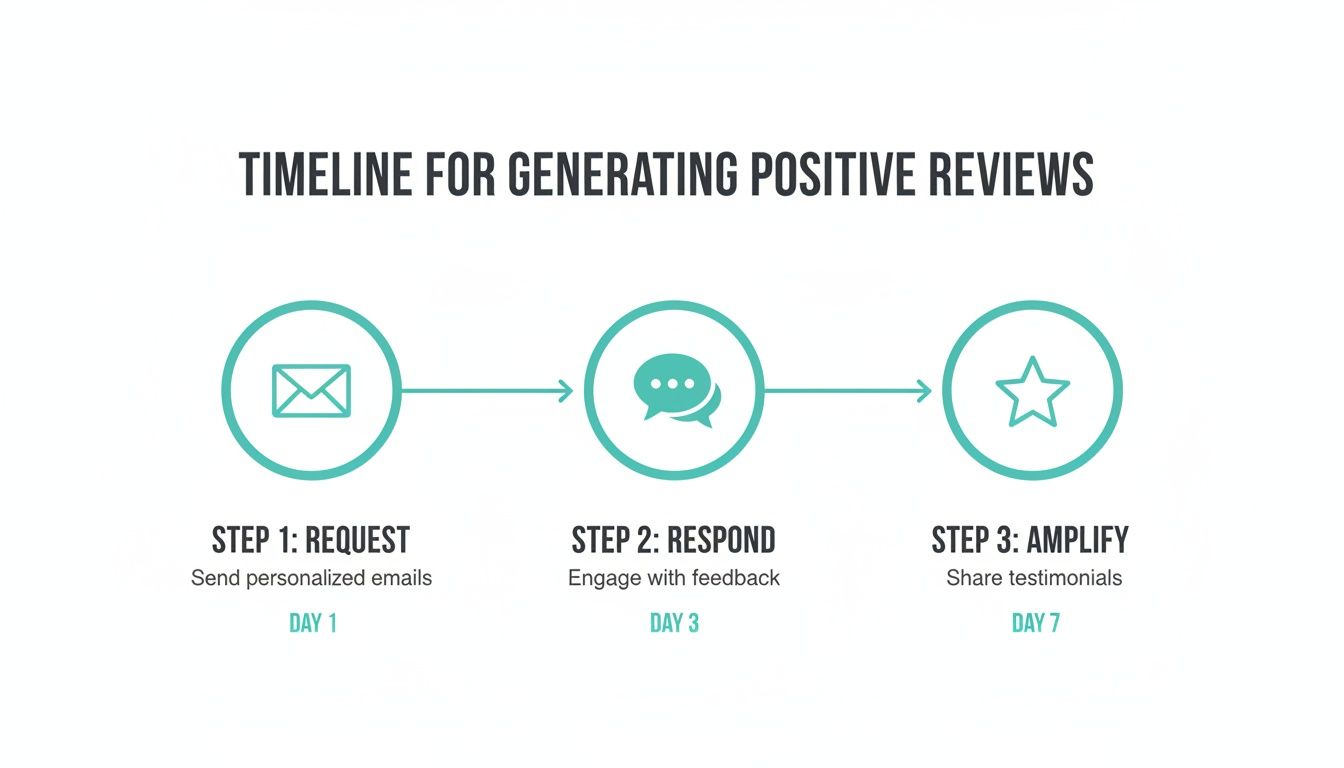
As you can see, it’s a constant loop: you ask for the review, you respond to what they say, and then you share that positive feedback to attract more great customers.
Field-Tested Templates for Requesting Reviews
Don't overcomplicate the ask. Keep your message short, personal, and to the point. Here are two templates I’ve seen work wonders for contractors in just about every trade.
Email Template:
Subject: How did we do with your [Service Type] project?
Hi [Client Name],
It was a pleasure working on your recent [Service Type] project. If you have a free moment, we'd be incredibly grateful if you could share your experience by leaving us a quick review on Google. Your feedback helps other homeowners in [Your City] find a reliable contractor.
[Direct Link to Your Google Review Page]
Thank you again for your business!
Sincerely,
[Your Name]
SMS Template:
Hi [Client Name], [Your Name] from [Your Company] here. Thanks again for trusting us with your project! Would you mind taking 30 seconds to leave us a review on Google? It helps our small business a lot. [Direct Link to Your Google Review Page]
These simple, no-pressure messages get great results because they're polite and respect the client's time. For a deeper dive into different asking strategies, check out our complete guide on how to get Google reviews from customers.
Always Respond to Every Review—Good and Bad
Getting the review is just step one. What you do next—how you respond—is just as crucial. Every reply you post is a public signal to potential customers that you're engaged, you're professional, and you actually care about the people you work for.
For Positive Reviews: Don't just say "Thanks!" Thank the customer by name and mention the specific job you did ("We're so glad you love the new kitchen lighting!"). It makes the exchange feel personal and even helps with a little keyword reinforcement.
For Negative Reviews: Jump on these fast. Acknowledge their issue, stay professional (even if they aren't), and immediately offer to take the conversation offline to solve the problem. This shows everyone else reading that even when things go wrong, you're committed to making it right.
Your 90-Day Reputation Turnaround Plan
Turning your online reputation from a liability into an asset doesn't happen overnight, but it also doesn't have to take years. What you need is a focused, methodical plan. Think of this as your 90-day playbook for taking back control of your search results and proving your quality to potential customers.
Let's break it down into a manageable, month-by-month sprint.
Month 1: The Audit and Foundation
The first 30 days are all about immediate triage and laying the groundwork for everything that follows. Forget about massive content projects for now; this is the time for smart, surgical strikes to stop the bleeding.
Weeks 1-2 (Audit & Dispute): Your first task is to get a clear picture of the battlefield. Conduct a "Past Year Review" of your company's online presence. Open a spreadsheet and create two simple lists: POSITIVE and NEGATIVE. Methodically search for your brand name on Google, Yelp, Angi, and other key platforms, logging every single mention. As you find negative reviews, immediately challenge any that clearly violate platform policies using the dispute tactics we covered earlier.
Weeks 3-4 (Secure Your Properties): It's time to claim and fortify your core digital outposts. This means getting full control of your Google Business Profile, Facebook page, Yelp profile, and any key industry directories like Houzz or the BBB. Go through each one and ensure your NAP (Name, Address, Phone) is 100% consistent across the board. Inconsistencies here confuse Google and dilute your authority.
Month 2: The Content Flood and Review Engine
With your foundation secured, you can finally go on the offensive. This month is all about creating a wave of positive content and kick-starting a system to generate a steady stream of authentic customer reviews. This is how you begin to physically push those negative results down the search page.
A common mistake is focusing only on removing the negative. That just creates a vacuum. You have to be proactive and fill that empty space with positive, high-quality assets that you control.
During this phase, think about shaping the narrative you want people to see. As part of your 90-day reputation turnaround plan, a focused personal branding experiment can provide a strategic playbook for shaping public perception. You’ll start publishing optimized blog posts that highlight your expertise and, just as importantly, begin systematically asking your recent happy customers for reviews.
Month 3: Refine and Amplify
In the final 30-day stretch, you’ll analyze what's working and double down on your most effective tactics. The goal here is to build sustainable momentum that makes your brand more resilient to any future negative feedback. By now, you should start seeing some encouraging movement in the search rankings.
Your job is to monitor your brand's search results weekly and see which of your new, positive assets are climbing the ranks. Is a particular blog post performing well? Great. Write another one on a similar topic.
Keep the review requests flowing, but now you can also start promoting your best five-star reviews and positive articles on your social media channels. This is how you turn a defensive reputation repair campaign into a powerful, proactive marketing engine.
Common Questions About Reputation Management
When you're trying to fix a damaged online reputation, you're bound to have some urgent questions. Getting straight answers is the first step to setting realistic goals and building a strategy that actually works to push those negative search results out of sight.
How Long Does This Take?
Let's be realistic: getting a negative article or review completely removed is rare, and there's no predictable timeline for it. It can happen, but you can't bank on it.
A much more reliable approach is a content suppression strategy. This is where we focus on burying the bad stuff with a flood of new, positive content. You’ll often start seeing initial, positive movement in the search rankings within 30-60 days.
As your new, positive assets gain authority, you can expect to see significant improvements on the first page of Google within 3-6 months. This is when the negative items really start to get pushed down and become irrelevant.
Can I Sue Over a Fake Review?
Technically, yes, you can file a lawsuit for defamation. But I almost always advise against it. It's an incredibly expensive, public, and slow-moving process that can easily backfire.
The very act of suing can draw more attention to the negative review you're trying to get rid of. It's a gamble with a low success rate.
Your time and money are far better invested in a suppression strategy. It’s faster, more predictable, and delivers a much higher return by focusing on what you can actually control: what your potential customers see on page one.
Will Buying Fake Reviews Help?
Absolutely not. This is one of the riskiest things you can do, and it can blow up in your face spectacularly.
Google, Yelp, and other platforms have sophisticated systems designed to sniff out and penalize fake reviews. If you get caught, you could end up with a public warning slapped on your business profile or even have your account suspended. That kind of damage is way worse than the one bad review you were trying to fix.
If you're tired of losing jobs to unfair reviews and negative articles, Impruview can help. We specialize in the exact content flood strategy that pushes negative results off page one, letting you take back control of your online reputation. Learn more about our reputation management services.