When someone's pipe bursts, they don't leisurely browse the yellow pages. They grab their phone and frantically search for an "emergency plumber near me." That exact moment is where local SEO for contractors stops being a marketing buzzword and becomes your most powerful tool for landing jobs.
It’s all about showing up in Google's local search results—specifically the Map Pack and the top organic listings—when a potential customer in your service area needs you right now. This isn't just about getting seen; it's about turning those urgent, high-intent searches into paying customers.
Why Local SEO Is Your Best Bet for High-Quality Leads
For any contractor, your digital storefront isn't just your website. It's that prime real estate in Google's Map Pack—the small, map-based box at the top of the search results. Think of it as the new front-page ad for home services. Being there means you’re one of the first names a homeowner sees when they're in a pinch.
It’s less about technical wizardry and more about being the go-to solution when a customer is ready to hire.
The Real-World Impact of "Near Me" Searches
These aren't just random clicks; they are real, valuable opportunities from homeowners who need a problem solved today.
Picture this: a major storm just rolled through town. Homeowners are immediately on their phones, searching for "roof repair near me." That single search is a direct line to a quote request or a phone call, turning your online visibility into actual work.
Don't just take my word for it. Google's own data shows that a massive 76% of people who search for something "near me" on their smartphone visit a related business within 24 hours. For an HVAC pro, a plumber, or a remodeler, that stat is pure gold. It highlights just how fast a local search can turn into revenue.
This is what sets local SEO apart from other advertising. You aren't trying to create a need; you're simply showing up as the best answer to a problem someone already has.
The real power of local SEO isn't just about visibility. It's about being the first and most credible option when a homeowner needs you most. Your ranking has a direct line to your bottom line.
Stop Losing Jobs to Your Competition
Every time a potential customer in your city searches for a service you provide and finds your competitor first, you just lost a job. It's that simple.
A solid local SEO strategy is your defense. It ensures you're grabbing the leads that should be yours. This is how modern homeowners operate—they use Google to vet local businesses, scrolling through reviews, checking service areas, and looking at project photos before they even think about making a call.
By getting your online presence in order, you build the trust and authority needed to win the job before your competitors even know it exists. To dive deeper into this topic, check out our comprehensive guides on contractor lead generation.
Building Your Digital Storefront with Google Business Profile
Think of your Google Business Profile (GBP) as your digital storefront. For a contractor, it’s not just some listing; it’s often the very first handshake with a potential customer. When someone in your town searches for "roofer near me" or "emergency plumber," the businesses that pop up in the Google Map Pack get the first look—and usually, the first call.
This isn't just a hunch; it's a hard fact in the world of local search. A big survey of top SEO experts confirmed that Google Business Profile signals are the single most important driver for local pack and map rankings. A well-maintained, active profile can have a bigger impact than even website links or reviews on other platforms. For any contractor trying to outrun negative feedback elsewhere, this is huge—a powerful GBP can literally push those bad reviews down in the search results. You can dig into the data yourself in this in-depth analysis of local search ranking factors.
The journey from a local search to a paying customer is surprisingly quick and direct.
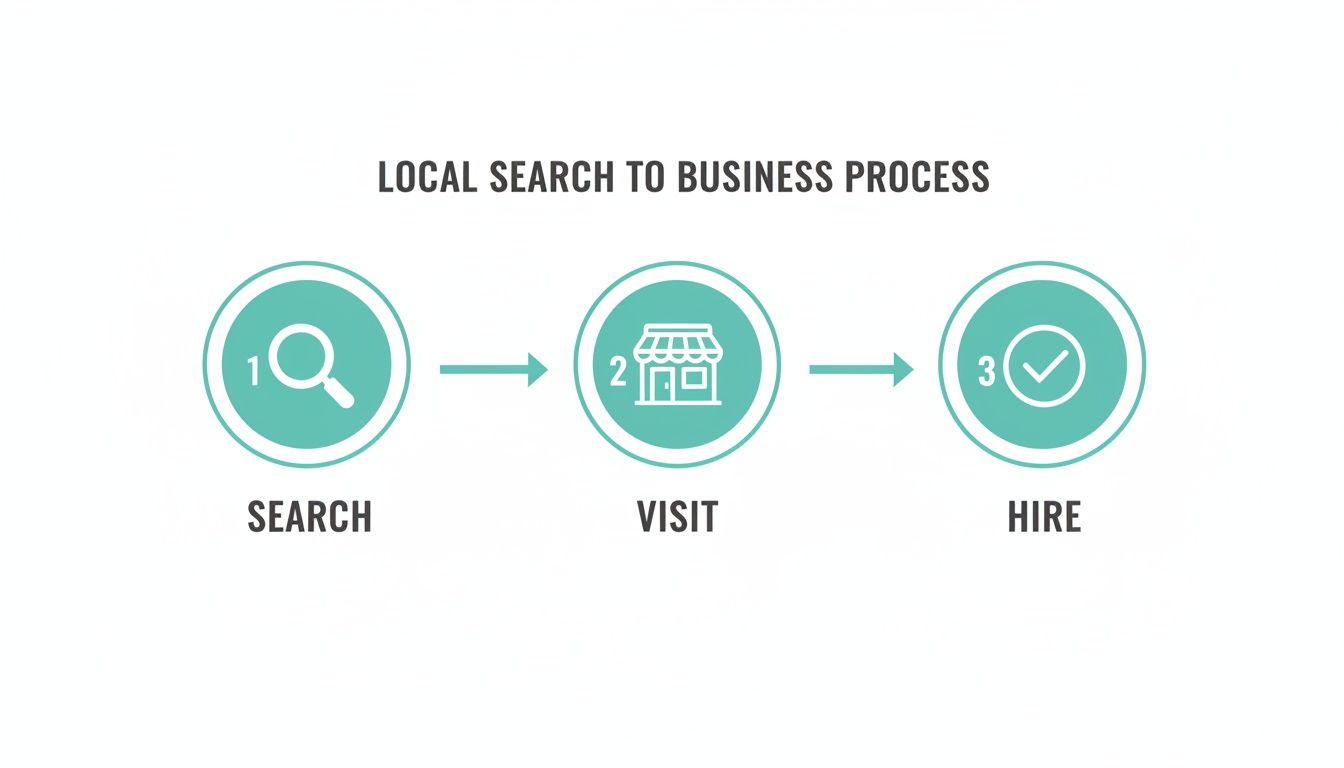
This simple path—from search, to visit, to hire—is exactly why your GBP is so critical. It’s your chance to grab high-intent customers right when they need you most.
Getting your profile into top shape isn't complicated, but it does require attention to detail. I've broken down the essential optimization steps into a simple checklist. Run through these items to make sure you're not leaving any opportunities on the table.
Google Business Profile Optimization Checklist for Contractors
| Optimization Area | Action Item | Why It Matters |
|---|---|---|
| Business Name | Ensure your name is your exact, legal business name. Do not add keywords like "Best Roofer." | Keyword stuffing your name can get your profile suspended. Consistency builds trust with Google and customers. |
| Address | Use a consistent address everywhere online. For service-area businesses, hide your address and set service areas. | Accuracy is a major local ranking factor. Mismatched addresses confuse Google and hurt visibility. |
| Phone Number | Use a primary, local business number. Avoid call-tracking numbers on your main GBP profile. | A consistent, local number is a key signal of a legitimate local business. |
| Categories | Select the most accurate primary category (e.g., "HVAC Contractor") and add all relevant secondary categories. | Categories tell Google exactly what you do, matching you to more specific customer searches. |
| Service Areas | Define the specific cities, zip codes, or neighborhoods you serve. | This is crucial for showing up in searches from customers in your target locations, even if you don't have a physical office there. |
| Business Description | Write a compelling, keyword-rich description focusing on your core services and primary service areas. | This is your elevator pitch. It helps both customers and search engines understand your value and location. |
| Services Menu | Add each individual service you offer with a brief description. (e.g., "Tankless Water Heater Installation"). | This creates highly relevant content on your profile, helping you rank for specific "long-tail" service queries. |
| Photos & Videos | Regularly upload high-quality, geotagged photos of your work, team, and vehicles. Add short videos. | Visuals build trust and prove your expertise. Geotagging photos sends a powerful local signal to Google. |
| Google Posts | Publish a new Post at least once a week showcasing a completed project, offering a special, or sharing a tip. | Consistent activity signals to Google that your business is active and engaged, boosting your ranking. |
| Reviews | Actively request reviews from happy customers and respond professionally to every single one (good and bad). | Reviews are a massive trust signal and a key ranking factor. Responses show you care about customer service. |
| Q&A Section | Proactively add and answer your own frequently asked questions. | Pre-empt customer questions and control the narrative. You can naturally include important keywords here. |
By methodically working through this checklist, you’re building a robust digital storefront that not only attracts customers but also tells Google that you are a legitimate, active, and authoritative contractor in your local area.
A Proactive Strategy for a 5-Star Reputation
Getting your Google Business Profile dialed in is how homeowners find your digital front door. But your online reputation? That’s what actually convinces them to open it and give you a call.
For contractors, online reviews are everything. They're the new word-of-mouth, the social proof that can either land you the next big project or send that same customer straight to your competitor.
Here’s the thing: just sitting back and waiting for reviews to happen on their own is a losing game. A single frustrated client is almost always more motivated to leave a review than a dozen happy ones. That's why you absolutely need a system—a repeatable process—to keep a steady flow of positive feedback coming in.

Timing is Everything When Asking for a Review
The golden moment to ask for a review is right after you've finished the job, during that final walkthrough. The customer is happy, the great experience is fresh in their mind, and the beautiful work you just completed is right there in front of them. If you wait even a day or two, that initial "wow" factor starts to fade.
Have your crew leader or project manager make the ask. It can be as simple as, “We’re so glad you love the new deck! It really helps other homeowners find us when they see great feedback. Would you mind sharing your experience on Google for us?” That personal, face-to-face request works far better than some automated email a week down the road.
Simple and Effective Ways to Ask
Making it dead simple for the customer is the key. Right after you ask them in person, send a quick text or email with a direct link to your Google review page. This removes all the friction. They just have to tap and type.
Here are a couple of templates we've seen work incredibly well in the field:
The Go-To Text Message (High Success Rate)
"Hi [Customer Name], this is [Your Name] from [Your Company]. It was a pleasure getting your new roof installed today. If you have a second, we'd really appreciate you sharing your experience on Google: [Direct Google Review Link]"
A Slightly More Formal Email
Subject: How did we do on your [Service Type] project?
Hi [Customer Name],
Thanks again for trusting [Your Company] with your project. We hope you're thrilled with how it turned out.
Honest feedback is a huge help to our business and to other homeowners in the community. When you have a moment, could you please leave us a review on Google?
[Direct Google Review Link]
We appreciate your time!
All the best,
The Team at [Your Company]
These scripts are polite, direct, and get the job done without being pushy.
You Have to Respond to Every Single Review
Responding to reviews—all of them—is non-negotiable. It sends a massive signal to both Google and future customers that you’re engaged, professional, and you actually care.
For the Good Ones: Thank the customer by name and mention a specific detail about their project. Something like, “Thanks, Sarah! We’re so happy you love the new kitchen remodel. It was a pleasure working with you over in the [Neighborhood Name] area.” This subtly reinforces your services and service area, which is a great little trick for local SEO for contractors.
For the Bad Ones: Act fast. Respond with professionalism and empathy. Acknowledge their issue, resist the urge to get defensive, and immediately offer to take the conversation offline. Give them a direct phone number or email to contact. This shows anyone reading that even when there's a problem, you're committed to fixing it. For a deeper dive on this, our guide on advanced reputation management services is a great resource.
Think of it this way: a consistent stream of new, positive reviews is your best defense against the occasional bad one. Over time, all that good feedback will bury any old negative comments, making them almost invisible.
By turning this into a system, you’re not just managing feedback. You’re building a rock-solid, 5-star reputation that actively works to win you more business and turns your happiest customers into your best salespeople.
Proving You're the Real Local Pro
Having a stellar Google Business Profile and a wallet full of five-star reviews gets customers knocking on your digital door. But to truly own your service area, you have to prove to both Google and local homeowners that you are the go-to expert in their specific neighborhood.
This is where your website's content strategy shifts from being a simple online brochure to your most powerful local marketing weapon.
So many contractors make the classic mistake of throwing up a single, generic "Services" page and hoping it magically ranks everywhere they work. That just doesn't fly anymore. If you want to win in local search, you have to get granular. Think street by street, neighborhood by neighborhood.
Stake Your Claim with Hyperlocal Service Pages
Instead of that one broad page, your goal is to build out a portfolio of dedicated pages for each service in each location you serve. Think of every page as a digital flag you're planting in a specific town, city, or even a large subdivision you want to dominate.
This isn’t about copying and pasting a template and just swapping out the city name. Each page needs to be a unique, genuinely helpful resource—somewhere between 500 and 1,200 words—that showcases your deep familiarity with that community.
What to pack into each hyperlocal page:
- Drop Local Landmarks: Reference well-known parks, schools, or community centers. A roofer might say, "We've replaced dozens of roofs in the homes just south of Lincoln Park." It shows you’ve actually been there.
- Name Specific Neighborhoods: If you're targeting a larger city, call out the specific areas you work in. A plumber could write about "providing emergency drain cleaning for the historic Victorians in the Old North End."
- Feature Local Job Stories: Briefly walk through a project you completed in that area. "Just last month, we finished a full kitchen remodel for a family on Maple Street, right here in Round Rock."
- Talk About Local Problems: Does a certain area have unique building codes, common architectural styles, or specific weather-related issues (like hail damage in one suburb but not another)? Addressing these details proves you're a true local expert, not just a company that happens to work there.
This strategy sends powerful relevance signals to Google. It makes it crystal clear that when someone searches for "AC installation in South Austin," your dedicated South Austin page is the most authoritative answer.
Fine-Tuning Your On-Page SEO
Writing great local content is half the battle; the other half is making sure it's structured in a way search engines can easily digest. This comes down to a few key on-page SEO elements you absolutely can't afford to skip.
Consider this: over 97% of homeowners now use Google to find local home services, but a staggering 75% never click past the first page of results. That's your entire battlefield. Unlike a retail store, you serve a wide radius, and Google needs you to prove it with locally-focused content. If you're interested in the data behind this, you can discover more insights about contractor SEO on egaradigital.com.
To make sure you land on that all-important first page, you need to dial in these technical signals.
Key On-Page Elements for Local Pages:
- Title Tags: This is the big blue, clickable headline in the search results. It has to include your main service and the specific location. For example:
Expert Furnace Repair in South Austin | Your Company Name. - Meta Descriptions: This is the short text snippet under the title. While it doesn't directly impact rankings, a good one convinces people to click on your link. Mention benefits and the location: "Need fast furnace repair in South Austin? Our certified techs offer same-day service. Call for a free estimate!"
- Location-Specific Headings: Use H2 and H3 headings to break up your content and reinforce your location. An H2 that reads "Your Trusted Remodeler in Round Rock" leaves no doubt in Google's mind.
Pro Tip: Don't forget your images. Before you upload them, name the files with local keywords, like
round-rock-kitchen-remodel.jpg. It’s another small but effective signal that screams local relevance.
For contractors, the difference between a generic SEO plan and a locally-focused one is the difference between getting lost in the noise and getting calls from down the street.
Local vs. General SEO Tactics for Contractors
| SEO Element | Generic SEO Approach | Local SEO Approach for Contractors |
|---|---|---|
| Keyword Strategy | Targets broad, high-volume terms like "kitchen remodeling." | Targets hyperlocal keywords like "kitchen remodeling contractor in Round Rock TX." |
| Content Focus | Creates general blog posts about "remodeling tips." | Develops dedicated service-area pages and case studies for specific towns. |
| Link Building | Seeks links from any high-authority national website. | Prioritizes links from local suppliers, community blogs, and business associations. |
| Technical SEO | Focuses on site speed and mobile-friendliness. | Adds LocalBusiness and ServiceArea schema to define the business territory. |
| Off-Page SEO | Builds a brand presence on national social media platforms. | Focuses on optimizing Google Business Profile and managing local citations. |
A generic approach might bring some traffic, but a targeted local strategy is what brings qualified leads who are ready to hire.
Speaking Google’s Language with Schema Markup
Finally, let's touch on a slightly more technical but incredibly powerful tool: Schema markup. Think of it as a special vocabulary you add to your website's code to help search engines understand your content perfectly. It’s like handing Google a neatly organized blueprint of your business information.
For any service-area business, two types of Schema are non-negotiable:
LocalBusinessSchema: This markup explicitly tells Google your business name, address (if you have one), phone number, hours, and the services you offer. It’s the foundational element that solidifies your identity as a legitimate local operation.ServiceAreaSchema: This is the game-changer for contractors who travel to customers. It lets you define the exact geographic areas you serve by listing cities, postal codes, or even entire counties. This removes any and all ambiguity about where you work.
When you combine hyperlocal content pages with sharp on-page SEO and the structured data from Schema, you build an undeniable case that you are the go-to expert in every corner of your service territory.
Taking Control of Your Branded Search Results
You can do everything right—optimize your Google Business Profile, collect dozens of five-star reviews—and still have one thing undermine it all: a negative Yelp page squatting on the first page of search results for your company’s name. It’s a gut punch. A potential customer Googles you, sees that one bad result, and the well is poisoned before you even get a chance to bid the job.
This is a scenario I see play out constantly with contractors. It's maddening because you can't just delete the bad review, and fighting with the platform is usually a waste of time. So, what’s the answer? Stop playing defense. It’s time to go on the offensive and seize control of the entire first page of Google for your brand name.
The strategy is something we call a "content flood." The idea isn't to pretend a bad review doesn't exist. It's to build such a powerful fortress of positive, high-ranking digital properties that you own and control, that the negative stuff gets systematically pushed down to page two, where it will almost never be seen.
Building Your Digital Fortress
A content flood is all about creating and promoting a portfolio of positive online assets all tied to your brand name. When you optimize them correctly, these assets will start to outrank the negative pages you don't control.
Think of each asset as a digital billboard that showcases your craftsmanship, your crew, and your commitment to quality. Before long, anyone searching for your business will find a first page dominated by your projects and your story—not some disgruntled customer's rant.
Here are a few high-value digital assets that work wonders:
- A Project Showcase Site: Spin up a simple, photo-first website on a platform like Squarespace or even on a subdomain of your main site (e.g., projects.yourcompany.com). Optimize every page with the project type and location, like "Master Bathroom Remodel in Scottsdale, AZ."
- Active Company Social Profiles: Don’t just create profiles—use them. Fully built-out and active pages on Facebook, LinkedIn, and especially YouTube can rank surprisingly well for your brand name. Post project photos and company updates regularly.
- Press Releases for Local Wins: Did you get a new industry certification or sponsor a local little league team? A professionally distributed press release can get picked up by local news sites, creating powerful, authoritative links and mentions.
- Video Testimonials on YouTube: A 60-second video of a genuinely happy client talking about their experience is pure gold. Be sure to optimize the video’s title and description with your company name, service, and city.
- In-Depth Project Case Studies: Use your main website's blog to write detailed posts about your most impressive or challenging jobs. These not only show off your expertise but can rank on their own for specific search terms.
By building out this diverse portfolio, you're not just crossing your fingers and hoping to outrank a bad review. You're proactively building a complete, positive narrative that you control from top to bottom.
Promoting Your Positive Assets
Just creating these assets isn't enough. That's only half the battle. The second, and just as important, part is promoting them so they gain the authority needed to climb Google's rankings.
You can't just hit "publish" and walk away. You need to send strong signals to Google that these new pages are important. That means getting links to them, sharing them, and making sure they get some initial traffic.
The core idea is simple: make your positive content more visible and authoritative to Google than the negative content you don't control. It’s a proactive strategy that puts you back in the driver's seat of your online reputation.
Start with the basics. Link to your new assets from the footer or "About Us" page of your main website. Share every new case study and video across your social media channels. Have a great relationship with a local supplier or a designer you work with? Ask if they’d be willing to link to one of your project galleries. In Google's world, every one of those links is a vote of confidence.
If you're ready to really dig into this, we've put together a comprehensive guide on how to bury negative Yelp reviews using these exact techniques.
This isn't an overnight fix. It takes time and consistent effort. But the payoff is a rock-solid online reputation where your best work—not someone else’s bad day—is what defines your brand.
Answering Your Top Local SEO Questions
Look, I get it. You're a contractor, not a marketer. Your time is better spent on a job site, not trying to figure out what all this local SEO stuff means. So, let's cut through the jargon and get straight to the questions I hear most often from guys in the trades.
Think of this as your quick-and-dirty FAQ for getting found online, handling your reputation, and turning those searches into actual paying jobs.
How Long Does This Actually Take to Work?
This is always the first question, and the honest answer is: it’s a marathon, not a sprint. While you can definitely see some quick wins, you need to think of local SEO as a long-term investment in your business. It's like building a foundation—it takes time but supports everything else.
In the first 30 to 90 days, you can usually see some real movement. This is when a fully optimized Google Business Profile and a solid push for new customer reviews start paying off. You'll likely see more visibility in Google Maps and the local "Map Pack."
But for the really competitive stuff—ranking for big-money terms like "plumber in Dallas" or "roofer in Austin"—you're looking at a more realistic timeline of 6 to 12 months of consistent work. A lot of things play into this: how tough your local competition is, what shape your website is in now, and how consistently you stick with it.
The real secret is consistency. A one-time fix won't cut it. The contractors who stay on the first page for years are the ones who do the work month in and month out.
Can I Just Get Rid of a Bad Review on Google or Yelp?
The short answer is almost always no. Trying to get a negative review removed from Google or Yelp is usually a waste of time. Unless the review breaks their specific rules—like using hate speech, being obviously fake, or posted by a competitor—it’s staying up. Just because you disagree with a customer's opinion doesn't give you grounds for removal.
Instead of chasing that long shot, put your energy where it actually counts: burying that bad review with a flood of good ones. This is the core of modern reputation management.
When you have a steady stream of new 4- and 5-star reviews coming in, that one negative review gets pushed further and further down the list. Its impact shrinks with every new positive one you get. Combine that with a content flood strategy, and you can even push a troublesome Yelp page completely off the first page of search results for your company's name.
What Numbers Should I Actually Be Watching?
It’s easy to get bogged down in a ton of data that doesn't matter. For a contractor, the only Key Performance Indicators (KPIs) that count are the ones that lead to phone calls and signed contracts.
Here are the critical metrics to keep an eye on. You can find most of this right inside your Google Business Profile dashboard:
- Search Views (Discovery vs. Direct): This is gold. It shows you how people found you. "Discovery" means they searched for a service you offer (e.g., "emergency AC repair") and you popped up. These are brand-new leads. "Direct" means they searched for your business name. A rising number of Discovery views is proof your SEO is working.
- Phone Calls: How many calls are coming straight from your Google listing? This is one of the most direct measures of new business.
- Website Clicks: This shows how many people are interested enough to click through to your site to learn more or fill out a contact form. It's a strong buying signal.
- Map Pack Rankings: Are you in the top 3 local results for your most important services in your key neighborhoods? Use a tool like BrightLocal or LocalFalcon to track this across different zip codes. It gives you a real-world picture of your visibility.
Focus on these four, and you'll have a clear, no-fluff understanding of how your local SEO for contractors is actually paying off.
Are unfair reviews on Google or Yelp costing you jobs? At Impruview, we specialize in helping contractors take back control of their online reputation. Our content flood strategy is designed to push negative results off the first page, so potential customers see your best work first. Stop losing leads and start building the 5-star reputation you deserve. Learn more about our proven process at https://www.impruview.com.