Let's get the big question out of the way first: can you, as a business owner, just delete a bad Google review? The answer is a hard no. You don't get a "delete" button for feedback left on your Google Business Profile.
But honestly, that simple "no" doesn't even begin to cover the chaos contractors are facing in 2026. The game has completely changed.
The Short Answer Is No, but It's Complicated
While you can't remove reviews yourself, Google certainly can—and their automated systems are getting more aggressive by the day. We're now seeing an environment where reviews, both legitimate five-star praise and unfair one-star attacks, are disappearing without any notice.
For a contractor, this is more than just an annoyance; it's a direct threat to your pipeline. The question has shifted from, "Can I delete this one bad review?" to a much more urgent one: "How do I build a reputation that can survive when Google keeps moving the goalposts?"
To quickly summarize what you can and can't do, here's a look at where your control ends and Google's moderation begins.
Business Control vs. Google Moderation
| Action | Can a Business Do This? | Key Takeaway for Contractors |
|---|---|---|
| Delete a review directly | No | You have no direct "delete" button for any review. |
| Respond to a review | Yes | This is your primary tool for managing your profile. |
| Flag a review for removal | Yes | You can report reviews that violate Google's policies. |
| Guarantee a flagged review is removed | No | The final decision rests entirely with Google's team. |
| Prevent good reviews from being filtered | No | Google's AI may mistakenly remove valid reviews. |
| Edit a customer's review | No | Only the original reviewer can edit or delete their post. |
This table makes it clear: you’re a guest on Google's platform. Relying on it entirely means your reputation is never truly secure.
The New Reality for Contractors
The old playbook for reputation management is broken. Flagging a nasty review and hoping for the best is like trying to fix a foundation crack with a coat of paint—it ignores the real, underlying problem.
Picture this scenario: you finish a major roof replacement, and the homeowner is thrilled. They leave you a detailed, glowing five-star review praising your crew's professionalism. A week later, it’s just… gone. Vanished. Why? Maybe Google's AI thought it was "too positive" or the customer used a word that triggered a spam filter.
Now you’re left with that bogus one-star review from a disgruntled prospect you never even did work for, and you've lost a powerful piece of social proof that could have landed you your next $15,000 job. This isn't a hypothetical; it's happening to contractors every single day.
The real threat isn't just negative reviews anymore. It’s the sheer instability of your entire online presence when it's built on someone else's property.
To stay in business and keep your lead flow consistent, you have to get proactive. It's time to stop playing defense, reacting to every puzzling review disappearance or unfair attack. You need to build a fortress of positive content and reviews on assets that you actually own and control.
This guide will walk you through how to escape this frustrating cycle. We’ll show you:
- Why your best reviews are now at risk: We’ll break down the hidden triggers that cause Google’s AI to remove legitimate, hard-earned feedback.
- How to navigate the flagging process: You'll learn the official steps for reporting a fake or unfair review, but we'll also give you a realistic view of your chances.
- A powerful, proactive strategy for 2026: Discover how to secure your brand and protect your lead flow, no matter what Google’s algorithm does next.
Understanding Google's New AI Review Moderation

If you’ve noticed reviews for your business—both good and bad—mysteriously disappearing, you’re not imagining things. Google has recently armed its platform with powerful AI, like its Gemini model, to police reviews more aggressively than ever before.
This isn’t just about catching obvious spam anymore. The new AI is like an overzealous security guard, looking for any subtle pattern that feels out of place. The problem is, it sometimes gets things wrong, tossing out genuine customer feedback right along with the fake stuff. For a contractor, this new reality is a game-changer.
The AI Is Watching More Than Just Words
Years ago, a human moderator might check a flagged review for profanity or a clear threat. That’s ancient history. Today's AI plays detective, digging deep into behavioral data and contextual clues that you and your customers would never think twice about. It's on the hunt for anything that its algorithm considers "unnatural."
The impact has been massive. In 2024, Google zapped over 240 million reviews, a staggering 41% jump from the 170 million it removed the previous year. The big shift happened in April 2024 when Gemini AI was fully integrated, boosting the system's ability to spot suspicious activity by 45%. Now, nearly 1 in 4 reviews gets filtered out before it even sees the light of day. For contractors who live and die by their reviews, this is a serious problem. If you want to dive deeper into the numbers, ReplyOnTheFly.com has some great data on these trends.
This super-smart AI is looking for several hidden triggers that can put even your best reviews on the chopping block.
Hidden Triggers That Put Your Best Reviews at Risk
That glowing five-star review from your happiest client can vanish overnight. It’s not because it was fake, but because something about it—something completely innocent—tripped one of the AI’s new digital tripwires. Knowing these triggers is your first line of defense.
Here are the most common reasons a perfectly good review might get removed:
- The Language Is Too Similar: Did a few customers mention that your "crew was professional and cleaned up nicely"? It's a common compliment in our industry, but to the AI, it can look like a coordinated effort to post fake reviews.
- Location and Network Data: This one is tricky. If two different clients happen to leave you a review from the same coffee shop Wi-Fi, the AI might flag it. Even worse, a customer leaving a review while connected to a public network at the job site can be misinterpreted as you posting from your own location.
- The Reviewer’s Account History: A customer who has never left a Google review before is so thrilled with your work that they write a detailed, glowing testimonial. To you, that’s gold. To the AI, it's a red flag—an unusual burst of activity from a new account that looks suspiciously fake.
- AI-Generated Text: With tools like ChatGPT being so common, some customers try to use them to write a more polished review. They mean well, but Google’s AI is incredibly good at sniffing this out and will often delete the review, assuming the business wrote it.
Think of it like this: your reputation is no longer just in the hands of your customers. It's now being co-managed by an unpredictable algorithm that values pattern detection over human intent.
This is exactly why the old advice to "just get more reviews" doesn't cut it anymore. The very testimonials you work so hard to earn are constantly at risk. Knowing you can't delete a Google review is one thing; understanding that Google's own AI can and will delete them for reasons that seem totally unfair is the other, more important, half of the story.
How to Flag a Review for Removal
So, you've got a review that's just plain wrong, and you want it gone. While there's no magic "delete" button you can press, Google gives you one official route to fight back: flagging the review for a policy violation.
Think of it like pulling a fire alarm. You’re alerting Google that there’s a problem, but it’s completely up to them whether they send the fire truck. It's your first, most direct line of defense, but you have to go in with realistic expectations. The truth is, the success rate isn't always great.
Google will only step in if a review clearly breaks one of their specific content policies. A review from a genuinely unhappy customer, even if you feel it's unfair, almost never gets taken down.
A Step-by-Step Guide to Reporting a Review
Ready to report a review you're certain violates Google’s terms? The process itself is surprisingly simple. You can do it right from your Google Business Profile.
Here’s exactly how to get it done:
- Log In: First things first, make sure you're logged into the Google account tied to your business profile.
- Access Your Profile: Head to Google Search and type "my business" or navigate directly to your Google Business Profile manager.
- Find the Review: Go to the "Reviews" tab and scroll until you find the specific one you want to report.
- Report the Review: Click the three-dot menu icon next to the review, then select "Report review" (sometimes it says "Flag as inappropriate").
- Choose a Reason: A menu will pop up asking you to explain why you're reporting it. This is the most important step in the whole process.
Once you hit submit, you've done your part. Google’s team will eventually look at your report, but this can take anywhere from a few hours to several weeks. Don't expect a notification about their decision; you'll just have to check back on your profile to see if the review has disappeared.
Which Violations Actually Matter to Contractors
Here’s where a lot of contractors go wrong. A review being negative isn't enough. To have any shot at getting it removed, you have to connect it to one of Google's specific policies. For contractors, a few of these violations pop up more often than others.
These are the most relevant policies you need to know:
- Conflict of Interest: This is a big one. If you can prove a bad review came from a disgruntled ex-employee or a rival contractor, you’ve got a solid case. Google’s rules are very clear about prohibiting reviews from anyone with a direct conflict.
- Spam and Fake Content: This is your go-to for reviews from bots or people who were obviously never a customer. A classic example is a review complaining about a roofing job you did in a city you don’t even work in. That’s a clear-cut fake. For more strategies on this, check out our guide on how to remove fake Google reviews.
- Off-Topic Content: A review should be about a customer's experience with your business. If it turns into a rant about local politics, your personal beliefs, or something completely unrelated to the work you did, it can be flagged as off-topic.
- Harassment or Hate Speech: This is for reviews that go way beyond negative feedback and become personal attacks, threats, or discriminatory rants. A customer saying your work was "shoddy" is one thing. Using slurs or threatening one of your crew members is a serious violation.
Remember, Google is the judge, jury, and executioner. Your job is to present a clear, factual case based on their rules, not your feelings. Document everything with screenshots before you flag the review—you might need that evidence later.
Even with a perfect reason, removal is never guaranteed. That’s why you should see flagging as just one small tool in your reputation management toolkit, not your entire strategy.
When to Consider Legal Action for a Defamatory Review
Let's be blunt: suing over a bad review should be your absolute last resort. After you’ve flagged a review and gotten nowhere with Google, the idea of getting lawyers involved might seem tempting. It feels like the ultimate way to fight back. But in reality, it's an incredibly difficult, expensive, and slow process.
Think of it less as a clear path to victory and more like a high-stakes gamble. This option is only for the most extreme cases where a review isn't just negative—it's actively and provably destroying your business.
Before you even pick up the phone to call an attorney, you have to get one thing crystal clear: the difference between an angry opinion and actual defamation. Defamation isn’t just someone being unhappy. It’s a false statement, presented as a fact, that torpedoes your reputation.
An unhappy customer saying, "This contractor's drywall work was sloppy," is just their opinion. But a customer claiming, "This contractor billed me for 20 hours but only worked 10," is a statement of fact. If you can prove it's false, you might be looking at defamation.
The High Bar for Proving Defamation
Winning a defamation case is tough. You can't just walk into court and say a review is unfair. The legal system sets a very high bar, and the burden of proof is entirely on you. You need to gather solid evidence to make your case.
Typically, you have to prove four specific things:
- A False Statement of Fact: You need undeniable proof that what they said is factually wrong. Their opinions or insults don't count.
- Publication to a Third Party: This one is easy—the review being live on Google takes care of it.
- Harm to Your Reputation: You have to show real, tangible damage. This means providing evidence of lost jobs, cancelled contracts, or other measurable financial losses directly because of that review.
- Negligence or Malice: This is often the hardest part. You must prove the person either knew what they were saying was false or said it with a reckless disregard for the truth, intending to cause harm.
Proving all of this is a tall order. Even if you know in your gut that the reviewer is lying, you need the documentation to back it up in court.
The Costly and Slow Legal Process
Even with a rock-solid case, the legal journey is a marathon, not a sprint. Your goal isn't really to get money from the reviewer; it's to get a court order that forces Google to remove the post. Google itself is protected from lawsuits over user content, but they will act on a valid court order.
Getting that piece of paper, however, is a major undertaking.
- Hiring an Attorney: First, you’ll need a lawyer who specializes in internet defamation. Just to get started, you're likely looking at legal fees in the $5,000 to $10,000 range.
- Filing a Lawsuit: Your lawyer will then file a lawsuit against the person who left the review, kicking off a formal legal battle that can easily drag on for months, sometimes even years.
- Obtaining the Court Order: If you manage to win the case, the court will issue the order. You can then submit this to Google's legal department, and they will finally remove the review.
The whole ordeal is a massive drain on your wallet, your time, and your sanity. For most contractors, the cost and stress of a lawsuit far outweigh the damage from one bad review. That’s why we almost always recommend focusing your energy on other reputation strategies first.
Why Playing Whack-A-Mole with Bad Reviews Is a Losing Game
If you've ever tried to get a negative Google review removed, you know what it feels like. It’s an endless game of whack-a-mole—you spend all this time and energy getting one taken down, only to see another one pop up a week later. For a contractor, where a single bad review can poison the well for new leads, this constant defensive battle is more than just frustrating; it’s a drain on your time and a direct hit to your bottom line.
The fundamental issue is you’re trying to build your company’s reputation on rented land. You simply don't control the platform. And it's gotten even more complicated. Google’s automated systems are now removing reviews like never before, and it’s not just the fake or negative ones. A major shift occurred in 2025 when legitimate, hard-earned five-star reviews began disappearing right alongside the bad ones, leaving business owners scratching their heads.
An industry analysis of over 60,000 Google Business Profiles revealed that contractors in fields like construction and home services are losing the most reviews. This volatility hits our industry especially hard. We all know a single one-star review can cost you a $10,000 job, but now even your best reviews—the ones that prove you do great work—can vanish because an algorithm had a bad day.
The AI Moderator Doesn't Care About Your Hard Work
The real kicker is the sheer unpredictability of Google's AI moderation. The system is designed to spot patterns, but it often gets things wrong. It might flag a review for sounding too similar to another one, using certain words, or even suspecting it was written by AI. That means a glowing, heartfelt testimonial from your happiest customer could get wiped off the map for no good reason.
This is exactly why so many contractors feel powerless. You play by the rules, you deliver top-notch service, and you earn fantastic feedback, only to have a faceless algorithm erase your hard-won proof. This is the core reason why obsessing over individual review deletions is a dead-end strategy. You're essentially betting your business's reputation on an algorithm you can neither predict nor control.
Chasing review removals is like patching a leaking roof one shingle at a time during a hurricane. The real solution isn't to keep patching, but to build a stronger structure that can withstand the storm.
For contractors in HVAC, plumbing, roofing, and other home services, the stakes are just too high to leave things to chance. Relying on Google reviews as your primary source of leads means your entire sales pipeline is constantly at risk. It's time to stop playing defense and start playing offense.
A Smarter Path Forward
Instead of fighting a battle you can't win on Google's turf, the goal should be to make those one-off negative reviews completely irrelevant. It's a simple shift in mindset that can transform your business. The question isn't, "Can a business delete Google reviews?" The real question is, "How can I build a digital presence so strong that one negative review barely makes a ripple?"
This flowchart breaks down the tough choice contractors face when a really damaging review hits.
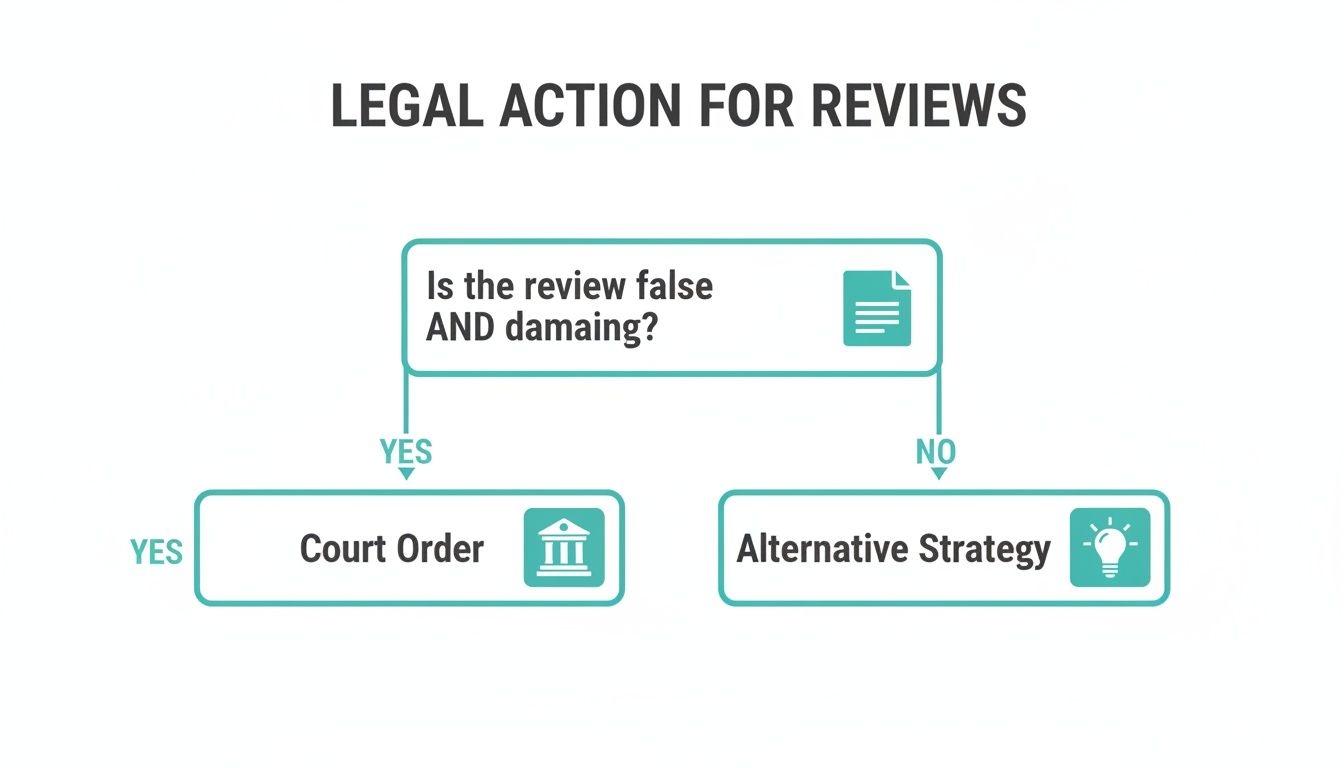
As you can see, the legal route is a long, expensive shot reserved for the most extreme, provably false cases. For everyone else, there's a much better alternative. Instead of fighting the negative review, you simply bury it. By building a fortress of positive content that you own and control, you get to decide what customers see first. This strategy allows you to push down negative search results and seize control of your brand's story, making your business resilient no matter what Google's algorithms do next.
The Content Flood: A Modern Reputation Strategy

After hitting the brick wall of Google’s "no-delete" policy, it’s easy to feel like you’ve lost control. But what if you could make a one-star review almost completely irrelevant? That's where a proactive strategy called the content flood comes in. This isn't about fighting Google—it’s about making Google’s own algorithm work in your favor.
Instead of gambling on the slim chance of getting a review removed, you take back control of your own story. The goal is simple: create and promote so much high-quality, positive content about your business that the negative stuff gets buried. When a potential customer searches for your company, you want them to see a digital wall of projects, expertise, and proof of your great work.
This strategy effectively shoves negative reviews down to the second page of Google, a digital wasteland where few customers ever go. It’s a powerful, reliable, and long-term solution that puts you firmly back in the driver's seat of your reputation.
Building Your Digital Fortress
The content flood strategy is all about creating digital assets that showcase your skills, professionalism, and successful jobs. For a contractor, these are the tools that build real trust—far more effectively than a simple star rating ever could.
Think about what a potential client actually wants to see. A 5-star rating is nice, but what they really want is proof that you can solve their specific problem. You give them that proof by building out a portfolio of compelling content.
- Project Showcases: Go beyond a simple gallery. Create detailed posts with high-quality photos and walk-throughs of your best work.
- Case Studies: Tell the story of how you tackled a challenging project for a client, from the first call to the final, successful handover.
- Blog Articles: Write helpful articles that answer the questions you get asked every day. This positions you as a go-to expert, not just another contractor.
- Video Testimonials: Nothing beats a happy client on camera sharing their positive experience.
When you create this kind of content, you stop reacting to what others say about you. You start proactively shaping the entire conversation around your brand. It’s important to see the bigger picture; it's not just about one review, but about understanding how reviews can affect your Local Search Engine Optimisation and your overall online presence.
Why This Strategy Is Essential in 2026
The content flood is more critical now than ever, especially with Google's increasingly unpredictable AI moderation. The shift in 2026 toward aggressive, automated filtering means even your best reviews can disappear overnight. Google's systems now hunt for patterns like multiple reviews from a job site's Wi-Fi or language that just hints at an incentive.
With Google already removing roughly 24% of all submitted reviews in 2024, you can't afford to build your reputation on such shaky ground. This is why focusing on assets you own and control is a much smarter play, especially in a business where a single lost job can cost over $500. You can see more on these trends and get the details on why Google's 2026 review deletion patterns are changing on Reviewsense.ai.
The content flood isn’t about hiding from criticism. It’s about ensuring that a single negative opinion doesn't drown out the overwhelming evidence of your quality work and expertise.
This approach brings the focus back to what you do best: delivering outstanding service. The content you create serves as a permanent record of that service, building a durable online reputation that doesn't depend on the whims of an algorithm. It's a cornerstone of any solid plan for content marketing for contractors aiming for sustainable growth. In the end, you transform your branded search results from a potential liability into your single most powerful marketing asset.
Your Top Questions Answered
When you're dealing with Google reviews, a lot of questions come up. You're not alone. Here are the straight-up answers to the most common things contractors ask us.
How Long Does It Take Google to Review a Flagged Review?
This is a classic "how long is a piece of string?" question. We've seen reviews disappear in a few hours, and we've seen them sit there for weeks on end.
It all comes down to how obvious the violation is and how swamped Google's team is at that moment. Honestly, don't hold your breath for a quick removal. The success rate for flagging is frustratingly low, which is why you can't rely on it as your only strategy.
What Should I Do If My Good Reviews Disappear?
First off, don't panic. This is happening to a lot of contractors right now, and it's almost certainly not your fault. Google's own AI spam filter has gotten incredibly aggressive, and it often flags perfectly legitimate reviews by mistake.
There’s no magic button to get them back. The best move you can make is to shift your focus to a reputation strategy you actually own, like building out content on your own website. This cuts down your reliance on Google's whims.
Thinking about suing over a bad review? Be prepared. The legal route is a high-stakes, expensive game. You have to prove a false statement of fact caused real, tangible harm to your business. The legal fees, time suck, and high burden of proof make it a non-starter for all but the most extreme cases.
Can I Sue a Customer for a Bad Review?
Technically, yes, but should you? Almost never. To win a defamation lawsuit, you have to prove the review contains a provably false statement of fact—not just an opinion—and that this lie directly cost you money.
With legal fees easily hitting $10,000 or more and a court process that can drag on forever, it's a massive gamble. For a single negative review, it's almost never worth the cost or the headache.
Is Buying Positive Reviews a Safe Alternative?
Let me be blunt: absolutely not. Buying reviews is one of the fastest ways to torpedo your business's online presence.
Google's algorithm is smarter than you think and is excellent at sniffing out fakes. When you get caught, the penalties are severe. They could wipe all your reviews—the good and the bad—or even suspend your Google Business Profile entirely. It's a cheap trick that will cost you dearly in the long run.
Are you tired of playing whack-a-mole with negative reviews and watching your best leads disappear? Impruview specializes in a content flood strategy that pushes negative search results off page one, putting you back in control. Stop losing jobs to unfair reviews and start dominating your brand's search results by visiting https://www.impruview.com.