If you’ve ever lost a job because of one bad review on Yelp or Google, you know how frustrating it is. It feels like your entire reputation is being held hostage. The gut reaction is to fight to get that review taken down, but that's a losing battle.
The real solution is to take control of what people see when they search for your company. It’s about using positive, helpful content to build a firewall around your brand.
Turn Negative Reviews Into Your Biggest Advantage

Go ahead, Google your company name right now. What shows up? If a nasty review on some third-party site is one of the top results, you are bleeding leads, period.
I’ve seen it countless times. Contractors spend weeks, even months, trying to get a single negative review removed. It’s slow, aggravating, and rarely works. A much smarter—and more powerful—approach is what I call the "content flood."
This strategy is all about proactively creating and publishing a steady stream of high-quality content that you own. The objective is simple: push the negative junk off the first page of Google by giving the search engine better, more relevant content to rank instead.
You're not hiding from a bad review; you're burying it under an avalanche of proof that you do great work.
Drowning Out the Noise with Value
The most successful roofers, plumbers, and HVAC pros I know use this exact method to build trust and attract the right kind of clients. This isn’t about being deceptive. It's about making sure your online presence actually reflects the quality service you provide day in and day out.
Sure, you still need to respond to reviews professionally, and if you need a hand with that, our guide on how to respond to negative Google reviews offers some solid templates. But this strategy puts you firmly in the driver's seat.
A content flood strategy shifts your focus from reacting to negativity to proactively showcasing your expertise. You make sure the excellent work you consistently deliver is what defines your brand online.
The Content Flood Strategy at a Glance
Let's break down how this modern approach stacks up against the old, reactive way of thinking.
| Strategy | Focus | Typical Outcome | Time to Results |
|---|---|---|---|
| Review Removal (Old) | Reactively deleting bad reviews | Low success rate, ongoing frustration | 3-6+ months, often never |
| Content Flood (New) | Proactively publishing positive assets | Suppresses negative results, builds authority | Visible changes in 30–60 days |
As you can see, the content flood is about playing offense, not defense. It’s a long-term asset-building play, not a short-term fix.
The Proven Impact of a Content-First Approach
This isn't just a nice idea; the numbers back it up. Content marketing generates 3x more leads than old-school outbound sales tactics and does it for 62% less cost.
This is especially true for contractors. Think about it: a homeowner or property manager will spend 3-6 months researching online before they even think about picking up the phone. They're looking for proof that you know your stuff, not just a star rating.
Ultimately, this is how you take back your brand’s story. While dealing with individual reviews is part of the game, a broader understanding of how to improve online reputation is what leads to sustainable growth. The rest of this guide is your step-by-step playbook to launch your own content flood and start winning online.
See Your Business Through Your Customer’s Eyes: A 30-Minute Reputation Audit
First things first: before we build anything, we need to survey the land. You have to know exactly what a potential customer sees the moment they Google your company's name. This isn't some complex, all-day affair. It's a quick, 30-minute audit that will become the bedrock of your entire strategy.
To start, you need a clean slate. Open an incognito or private browser window. This step is non-negotiable because it strips away your personal search history and gives you the same unbiased results a new customer would see.
How to Find Your Real Digital Footprint
People rarely search in one perfect, uniform way. To get the full picture, you have to think like a customer and try all the common ways they might look you up.
I recommend running searches for at least these variations:
- Your Exact Company Name: "Phoenix Premier Roofing LLC"
- Common Variations: "Phoenix Premier Roofing"
- Name + Reviews: "Phoenix Premier Roofing reviews"
- Name + City: "Phoenix Premier Roofing Phoenix AZ"
- Name + Common Complaints: "Phoenix Premier Roofing problems" or "Phoenix Premier Roofing scam"
While you’re doing this, pull up a simple spreadsheet. For every result on the first two pages of Google, log the URL, the type of site it is (Yelp, BBB, a local forum, etc.), and classify it as positive, neutral, or negative. This document is now your battle map.
Pinpoint Your Primary Threats
With all the results laid out, it's time to identify what’s actually costing you business. Is there a nasty one-star Yelp page staring you in the face? A lingering complaint on the Better Business Bureau website? Or maybe a negative thread on a neighborhood Facebook group that just won’t die?
Zero in on the search results for "[Your Company Name] reviews." This is a critical, high-intent search. The person typing this is likely on the verge of making a decision, and a negative result here is a direct shot to your lead flow. Your goal is to pinpoint the top 1-3 negative URLs that consistently pop up for your most important searches. These are your primary targets.
Don't let a few bad results discourage you. The point of this isn't to feel defeated; it's to gather intelligence. You're turning a vague, frustrating problem into a clear, actionable mission.
This audit is what separates a hopeful wish from a real business strategy. You're essentially setting SMART goals for your brand's reputation. You're no longer just saying, "I want more leads." Instead, you're defining a specific, measurable, and time-bound objective. It’s no surprise that 97% of B2B marketers now have a formal content strategy in place, with 61% reporting measurable improvements from it. A structured plan simply works.
Set a Clear, Measurable Goal
Once you have your target list, you can finally set a goal that means something. A powerful goal isn't a vague wish; it’s a specific target that dictates every move you make.
So, instead of thinking, "I need to fix my online reputation," your new mission becomes: "Push the negative Yelp review for Phoenix Premier Roofing from position #3 to the second page of Google within 60 days."
That single, focused objective is your north star. It tells you what content to create, where to promote it, and how to measure success. In the following sections, we'll dive into the exact content plan to make this happen. Properly managing this visibility is just as crucial as effective local listings management, because both determine whether customers can find and, more importantly, trust you.
Building Your Content Plan to Drown Out the Noise
You’ve done the audit and know exactly which negative reviews are hurting your business. Now it’s time to stop playing defense and start taking control. We're going to build a library of powerful content assets designed to systematically bury those negative search results and establish your brand as the top expert in town.
This isn’t about just pumping out random content. It’s a focused strategy to create high-quality, Google-friendly pages that you own. Every single piece has one job: to dominate the search results for your company’s name and bring in more of the right customers.
First Things First: Your Core Content Assets
Think of your content as a construction crew—everyone has a specific role. Some are the heavy lifters that do the direct ranking, while others are the skilled finishers that build trust and show off your quality. We'll start with the assets that give you the most bang for your buck right away.
Here’s the priority list I’ve seen work time and time again for contractors:
- Hyper-Optimized Service Pages: A single, generic "Services" page just won't cut it. You need a dedicated, detailed page for each major service you offer. Think "Commercial HVAC Repair in Denver" or "Kitchen Remodeling in Austin." Get specific.
- Detailed Project Galleries and Case Studies: This is where you show, not just tell. A great project gallery is more than a slideshow; it’s a story. For every project, list the location, explain the homeowner's problem, detail your solution, and show it off with incredible before-and-after photos.
- Authoritative Blog Posts Answering Customer Questions: Get inside your customer's head. What are they Googling before they call you? Create posts that answer those exact questions, like, "How much does a new roof cost in [Your City]?" or "Signs you need a plumber immediately."
- A Standalone Review Microsite: This is a seriously effective tactic that most contractors miss. A microsite is a small, separate website you own completely (think "[YourCompanyName]Reviews.com"). You can fill it with your best testimonials, project photos, and positive feedback, then optimize it to rank for searches like "[Your Company Name] reviews."
The best content marketing for contractors isn’t about becoming a professional writer. It’s about being a generous expert. You're just sharing what you already know to help a potential customer feel confident about hiring you.
Putting the Plan into Action
Let’s walk through a real-world example. Say you're a remodeler in Dallas, and a nasty review on a third-party site keeps showing up when people search for "Dallas Prime Remodeling reviews."
Here’s what your content counter-attack would look like:
- Asset 1 (Service Page): You'd build out a brand new, in-depth page called "Bathroom Remodeling Services in Dallas, TX." It would be packed with details on your process, the materials you prefer, and a gallery of your best bathroom projects.
- Asset 2 (Case Study): Next, you'd publish a blog post titled "Case Study: A Modern Farmhouse Kitchen Remodel in the Dallas Suburbs." This showcases your expertise on a specific project type and targets local search terms.
- Asset 3 (Microsite): Finally, you'd launch "DallasPrimeRemodelingTestimonials.com." This site would feature your best five-star video testimonials, screenshots of glowing Google reviews, and links pointing back to your main website.
This multi-pronged approach creates a "surround sound" effect on Google. You aren't just making one page and hoping for the best; you're launching a coordinated fleet of content to own as many spots as possible on the first page.
The diagram below shows the basic workflow for deciding which negative results to target with your new content.
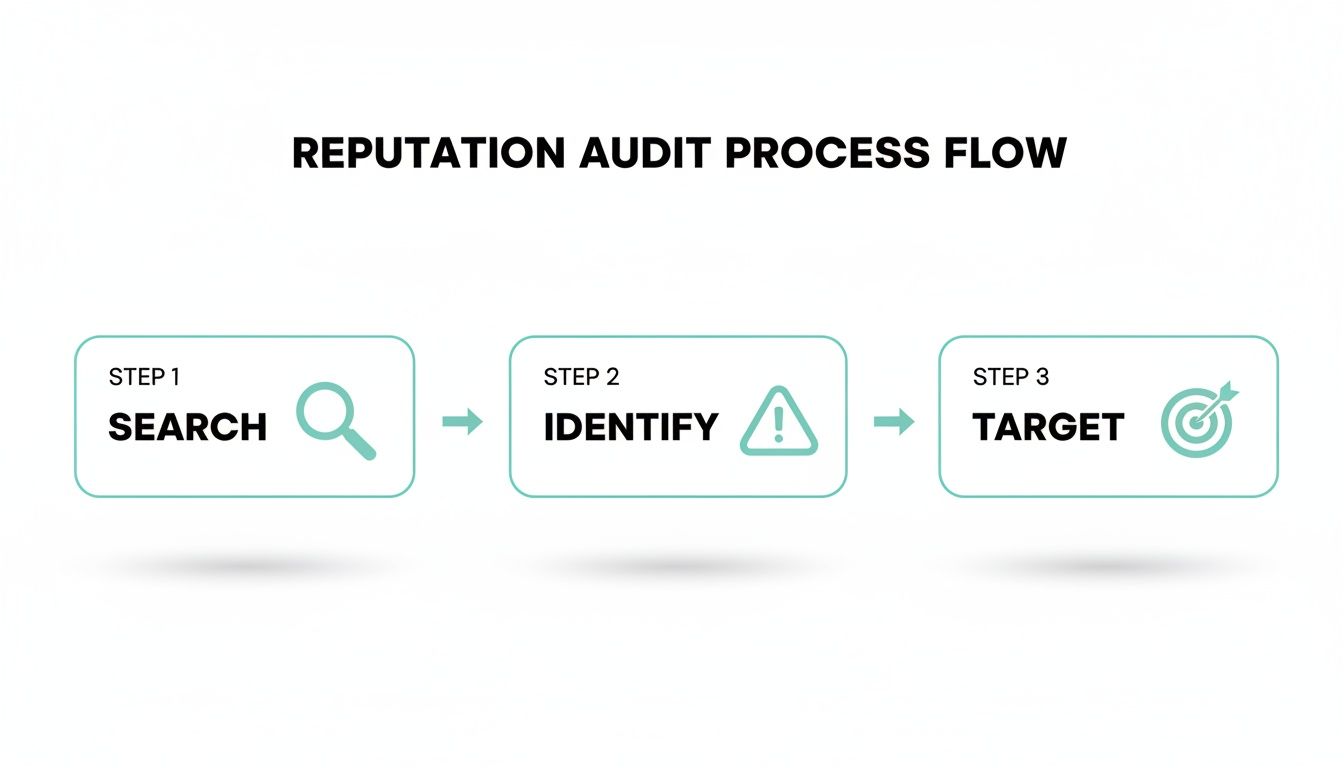
This simple process—search, identify, and target—keeps your efforts laser-focused on the URLs actually causing you problems.
The Power of Press and Local Media
Beyond the assets you build yourself, getting mentioned by local news or other media outlets can give you a massive authority boost. Google sees these links as highly credible, and they can rank for your brand name very quickly.
Keep an eye out for these kinds of opportunities:
- Charity or Community Work: Did your crew volunteer to fix up the local community center? A press release about that can get you some great local press.
- Company Milestones: Announce important anniversaries, a major new service offering, or a key safety certification your team just earned.
- Expert Commentary: Pitch yourself to a local news station as their go-to expert. Offer a story on "How Homeowners Can Prepare Their Pipes for Winter" right before a cold snap hits.
Every positive story on a news site or local blog is another digital asset working for you 24/7. By combining the content you create with the authority of earned media, you build a digital fortress that protects your brand from negativity and helps you land the jobs you actually want.
Dominate Local Search with Low-Effort Video
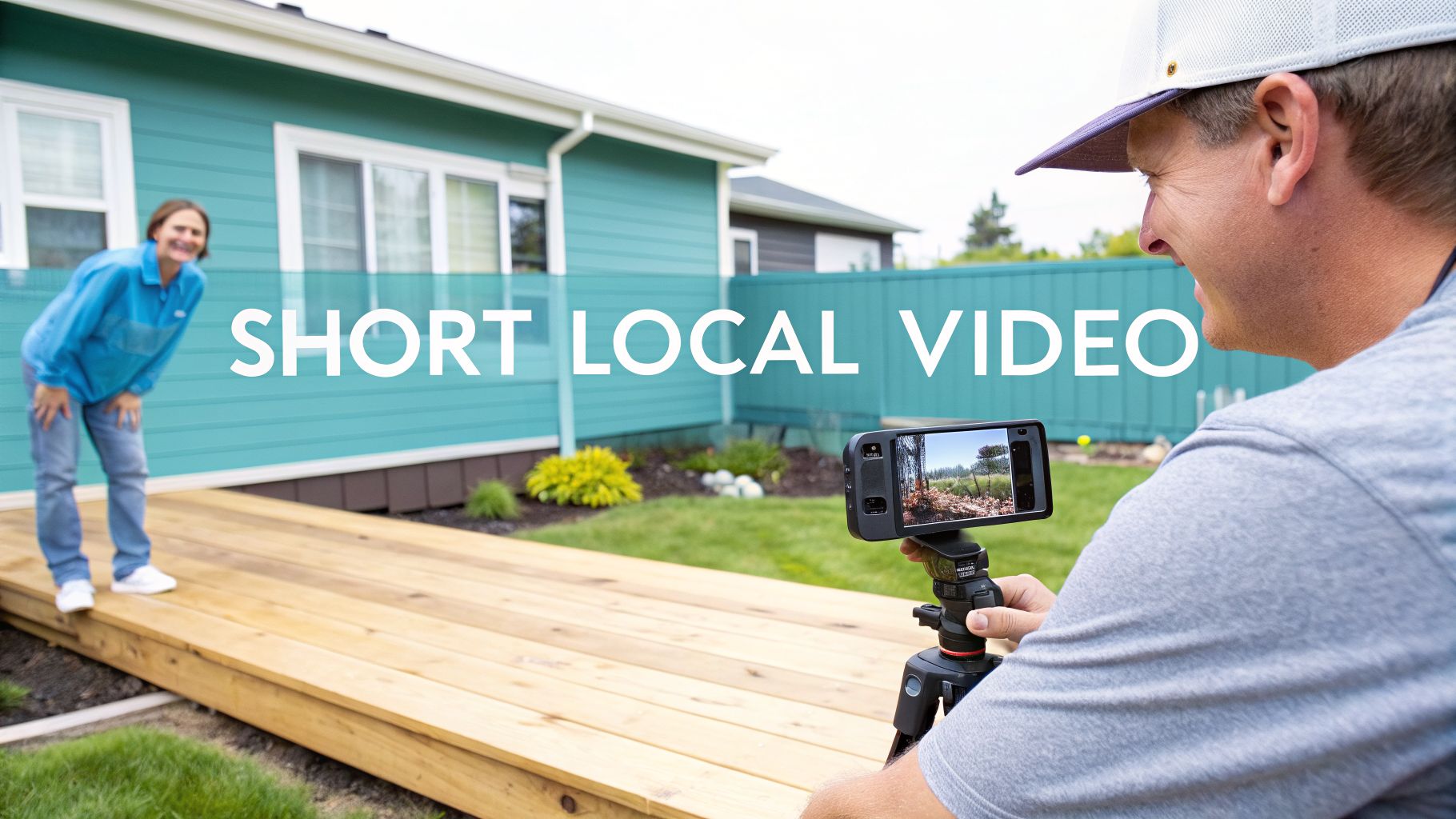
Let's clear the air: you don't need a film crew or a massive budget to make video work for you. The most powerful videos I see from contractors are shot with the phone that’s already in their pocket. That device has completely leveled the playing field, giving you the power to create a constant stream of content that connects with local homeowners.
Forget the slick, over-produced corporate videos. Your customers want to see the real you and the incredible work you do. I'm talking about quick, 30-second before-and-after clips of a deck remodel, a simple video explaining how to check a pilot light, or a heartfelt client testimonial filmed right on their lawn. This is how you build instant trust and authority.
Why Short-Form Video Is a Contractor's Best Friend
Platforms like Instagram Reels, YouTube Shorts, and TikTok aren't just for viral dances—they're becoming powerful local search engines. Homeowners are scrolling through these apps every day to find and vet contractors in their area. Seeing your face and your work creates a human connection that a text-based review simply can't match.
The beauty of this approach is its efficiency. It's fast, cheap, and surprisingly easy to produce. You can capture a dozen clips on a single job site and have enough content to post for weeks.
Video is the ultimate shortcut to building trust. It allows potential customers to meet you, see your work, and feel your professionalism before they ever pick up the phone. It’s the closest you can get to a word-of-mouth referral online.
Video is no longer a "nice-to-have" for contractors; it's your secret weapon. Short-form video consistently delivers the highest ROI of any content format, which is why 37% of marketers are boosting their video budgets.
I’ve seen firsthand how this can transform a business. One California contractor who implemented these exact tactics generated 540 leads in a single year, hit a 48% close rate, and had to hire more techs just to keep up with demand.
Low-Effort Video Ideas You Can Film This Week
Staring at your phone, not sure what to record? Don't overthink it. The key is to be helpful and authentic. Here are a few dead-simple ideas to get you rolling:
- Project Walkthroughs: Film a quick tour of a project in progress. Just talk about what you're doing and why. It's a simple way to show off your expertise.
- Before-and-After Reveals: This is your money shot. Nothing sells your services better than a dramatic transformation. Get a good "before" clip, do your magic, and then capture that stunning "after."
- Quick Tip Videos: Share a 60-second tip related to your trade. A plumber can show how to fix a running toilet; an HVAC tech can explain when to change an air filter. You're the expert, so share that knowledge!
- Tool of the Week: Briefly show off a specific tool you use and explain how it helps you deliver a higher quality job. This subtly positions you as a pro who invests in their craft.
- Client Testimonials: When a job is done and the client is beaming, just ask if they’d be willing to say a few words on camera. Authentic praise from a happy customer is pure gold.
Optimizing Your Videos for Local Search
Making the video is just the start. To make sure it’s actually working for you and helping you dominate local search, you need to optimize it. This is way simpler than it sounds and is a critical piece of your overall local SEO for contractors strategy.
When you upload your video to YouTube or social media, the title and description are your best friends. Put yourself in your customer's shoes—what would they type into Google?
Video Title Optimization:
| Bad Title | Good, Optimized Title |
|---|---|
| "Deck Project" | "New Trex Deck Build in Scottsdale, AZ |
| "Happy Customer" | "Client Review for HVAC Repair in Austin, TX |
| "Fixing a Leak" | "How to Fix a Leaky Faucet |
By packing your service and city right into the title, you're directly targeting homeowners looking for what you offer. This simple move tells Google exactly who the video is for, helping it rank higher in search results and push down any negative content. To really master this, it's worth reading an ultimate guide to small business video marketing to sharpen your skills.
Establish Your Content Publishing and Promotion Rhythm
You just spent hours putting together a fantastic case study or a gallery of your best work. That’s a huge accomplishment. But if you just hit "publish" and walk away, you've only done half the job.
Great content that nobody sees is a wasted effort. It can't bury negative reviews, and it definitely can't bring you new customers.
Think of it this way: your new content is a brand new, top-of-the-line work truck. Your promotion plan is the fuel, the GPS, and the driver. Without a solid routine for getting your content in front of the right people, that shiny new truck is just going to sit in the garage and collect dust.
The goal here is to create a "surround sound" effect. You want potential clients to stumble across your positive stories, project photos, and helpful advice everywhere they look—on Google, their Facebook feed, and even in local community groups. This is how you drown out the noise and speed up the process of pushing negative stuff down.
Your Publishing and Promotion Workflow
Consistency beats intensity every time. You don't need to block out hours every single day for this. What you need is a simple, repeatable workflow that turns promotion from a chore into a habit.
Every time you get a new piece of content ready—a blog post, a project gallery, a new video—run it through this basic distribution circuit:
- Post it to your website first. This is your home base. Every piece of content should have a permanent home on your own domain, where you have 100% control.
- Create a Google Business Profile post. This is a critical step that too many contractors skip. Grab a great photo from the project, write a quick summary, and link back to the full post on your site. This is a direct signal to Google that you’re active and relevant in local search.
- Share it across your social channels. Post to Facebook, LinkedIn, Instagram, or wherever you have a presence. But don't just drop a link. Write a unique caption for each platform that speaks to that audience and gives them a reason to click.
- Break it down and repurpose it. That one project case study is a goldmine. The before-and-after shots can become an Instagram carousel. A stellar client quote can be turned into a standalone graphic. You can get a week's worth of social media content from a single webpage.
A promotion routine is the only thing that separates a high-performing website from one that's just a digital business card. You have to deliberately put your expertise in the path of your potential customers.
High-Impact Promotion Tactics
Once you have the basic workflow down, it's time to get your content in front of people who are actively looking for your services. This is less about shouting from the rooftops and more about strategically joining conversations that are already happening.
Think locally. Add value first.
Let’s say you’re a remodeler and you just published a gorgeous case study of a kitchen renovation. Instead of just posting it to your own Facebook page, find a local group for real estate agents.
Share it there with a caption like: “For any agents with clients looking to boost their home’s value before a sale, here’s a look at the ROI from a kitchen remodel we just finished in the Northwood neighborhood.”
See the difference? You’re not selling; you’re providing valuable insight to a partner audience.
Here are a few more ideas you can steal:
- Local Community Groups: Is a cold snap in the forecast? Jump into your local neighborhood Facebook group and share a quick guide on "5 Steps to Winterize Your Pipes." You're the helpful local expert, not just another contractor trying to get a job.
- Local PR and Media: Did your company sponsor a little league team or help with a community cleanup day? Write up a short summary (it doesn't have to be a formal press release) and send it with a few photos to local news bloggers and reporters. Those mentions and links are pure gold for your authority.
- Your Email List: Don't forget about your past customers. Send your latest content to your email list. It’s a simple way to stay top-of-mind for referrals and repeat business.
This is how you systematically build a wall of positive content that not only suppresses negative reviews but also makes your phone ring.
How to Know This Is Working: A 30-60 Day Timeline
So, how do you know if all this effort is actually paying off? I've seen a lot of contractors get this wrong. They pour time and money into a content strategy and get discouraged when the phone isn't immediately ringing off the hook.
Let's be clear: the ultimate goal is more booked jobs, but that's not the first win you'll see. The first, most important victory happens much faster and is visible right on Google's search results page. Success in the first 30-60 days is about watching your positive content climb the ranks while those negative review pages get pushed down. This is the tangible proof that the strategy is working.
Your 30-Day Check-In: The First Signs of a Win
For the first month, your entire focus should be on your branded search results. Forget about lead-gen metrics for a minute. Your only job is to confirm that Google is finding and ranking the positive assets you just created.
Here’s a simple checklist to run through during that first month:
- Is Your New Content Indexed? You need to make sure your new project pages and galleries are even showing up on Google. A quick search using
site:yourwebsite.com "new project name"will tell you instantly. If they're there, you're in the game. - Are Negative Results Dropping? Was that annoying Yelp or BBB page stuck at position #3? If you check now and it's slipped to #5, that's a huge victory. Even a one or two-spot drop shows you're taking back control.
- What's Happening on Your GBP? Take a look at your Google Business Profile insights. An uptick in clicks to your website or more views on your photos is a great sign that your optimized posts and new images are grabbing attention.
The initial win isn't a flood of booked jobs; it's tangible proof that you are reclaiming your online shelf space. Seeing a positive case study you created jump from page three to page one is the first domino to fall.
Gauging Momentum at 60 and 90 Days
Once you hit that two-month mark, you should be seeing much more significant movement. That negative review you’ve been targeting should be well down the first page or, even better, pushed onto page two where almost no one will see it. Your own properties—your main website, the new review microsite, and your videos—should be locking down those top spots.
Now you can start paying attention to the metrics that lead to actual business.
Key Performance Indicators (KPIs) to Watch:
| Metric | What It Tells You | Where to Find It |
|---|---|---|
| Branded Search Position | If you're successfully burying the bad stuff. | Incognito Google Search |
| Time on Page | If people are actually engaging with your new content. | Google Analytics |
| Clicks on Project Galleries | If your visual proof is compelling enough to click. | Google Analytics |
| Video Views & Watch Time | If your video message is hitting the mark. | YouTube Studio |
This gives you a realistic roadmap. The first 30-60 days are all about cleaning up your reputation where it matters most. Once your positive content has cemented its place at the top over the next 90 days, you’ll start seeing that directly translate into more qualified calls and jobs on the schedule. It’s a process: clean, control, and then convert.
Common Questions About Content Marketing for Contractors
If you're like most contractors I talk to, the idea of "content marketing" probably sounds like a huge, complicated project you don't have time for. I get it. You're busy running a business, managing crews, and actually doing the work.
Let’s cut through the noise and tackle the real-world questions that pop up whenever I bring this strategy up with business owners. These are the same concerns I hear week in and week out.
"I Barely Have Time to Eat Lunch. How Much Time Does This Really Take?"
This is always the first question, and it's a fair one. The good news is, this isn't about adding another 20-hour-a-week job to your plate. Effective content marketing is about consistency, not a massive time suck.
Honestly, all you need is a sustainable rhythm. If you can dedicate just 2-3 hours per week to putting together one solid piece of content, you'll be miles ahead of your competition. We're talking about a simple project case study, a quick video tour of a finished job, or even just answering a common customer question on your blog. That’s it.
"But I’m a Roofer, Not a Writer."
Another big one I hear all the time. Let me be crystal clear: you do not need to be a great writer. In fact, trying to sound like a professional author can actually backfire.
Your customers aren't looking for fancy prose; they're looking for proof that you know your trade inside and out. Your expertise is what matters. If you can walk a homeowner through a project on-site, you have everything you need to create fantastic content. Your authentic voice is your biggest advantage, so don't polish it away.
The goal isn’t to win a writing award. It’s to be a generous expert. You are simply taking the knowledge you use every day on the job and making it available to help potential customers make a confident decision.
"Okay, But Where Do I Start if the Budget is Tight?"
When cash is tight, you have to be strategic. Forget trying to do everything at once. Your focus should be on the single most powerful, low-cost asset you can create: a project showcase.
Pick a recent job you’re really proud of. Take good before-and-after photos—your phone is fine! Write a few sentences describing the client's problem and how you solved it. Then, post that on your website as a portfolio piece and share it on your Google Business Profile.
This one simple asset does more heavy lifting than ten mediocre blog posts. It directly shows off your skill, builds immediate trust, and gives Google something positive and relevant to rank for your name.
Ready to stop losing jobs to bad reviews and take control of what customers see online? Impruview deploys a proprietary content flood strategy to push negative results off page one and showcase your best work. See visible improvements in 30–60 days. Learn more at https://www.impruview.com.