So, what does “measuring customer satisfaction” actually mean for a contractor on the ground? It’s not about some complicated, corporate-style report. It’s as simple as sending a quick text right after a job is done, asking how things went. This isn't just a nice-to-have; it's a core part of running a smart business.
Why Happy Customers Are Your Best Marketing Asset
For any home service business—whether you’re in roofing, HVAC, or plumbing—your online reputation is your lifeblood. I've seen it time and time again: a single nasty review can poison your lead pipeline, while a steady stream of 5-star feedback makes you the go-to contractor in town.
This is where measuring customer satisfaction becomes your secret weapon. It’s not just about getting a pat on the back. When you have a system for tracking how customers feel, you unlock some powerful advantages:
- Pinpoint Your Biggest Fans: You immediately know which customers are thrilled with your work and are prime candidates to sing your praises online.
- Intercept Bad Reviews at the Source: You get a heads-up on any negative experiences, giving you a crucial window to fix the problem before an unhappy customer vents on Google, Yelp, or Angi.
- Fuel Your Social Proof Engine: You create a direct path for guiding your happiest clients to leave those all-important positive reviews that build trust and win you more jobs.
The entire process is really a simple, powerful loop: you track the feedback, use it to generate glowing reviews, and watch as you start to dominate your local market.
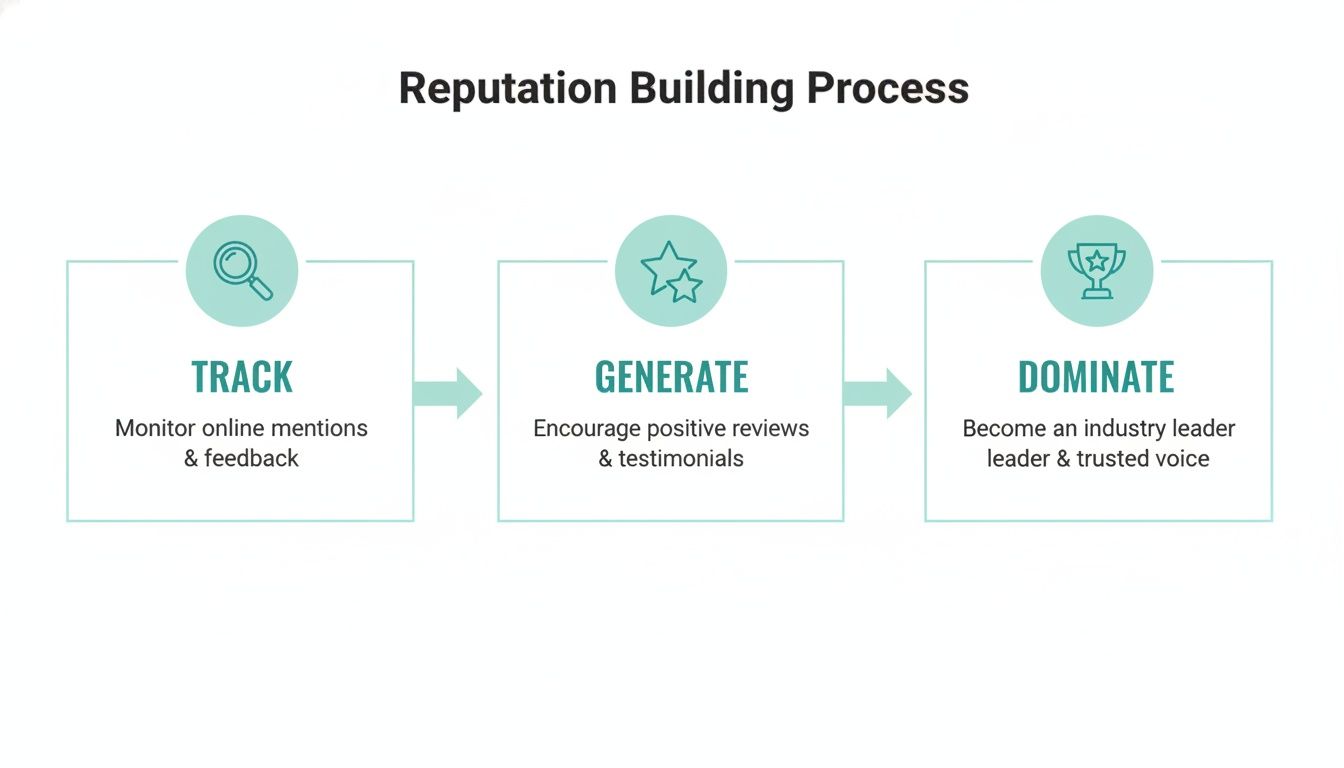
This flow isn’t just a concept; it’s a machine that turns private feedback into public praise. Getting this right means building a predictable, reliable source of high-quality leads.
Think about it. A Drive Research study confirmed that 89% of consumers are more likely to buy again after a positive experience. For a contractor, that positive feeling is what secures repeat business and, more importantly, valuable word-of-mouth referrals.
This feedback loop does more than just help you improve your service—it becomes your most effective and affordable marketing engine. When you know exactly who is happy, you can be incredibly strategic.
For every customer who gives you top marks, the next logical step is to gently guide them toward leaving a public testimonial. If you're looking for the right words, our guide on how to ask customers for testimonials offers scripts and templates you can put to work immediately.
Choosing the Right Metrics for Your Contracting Business

If you really want to know what your customers think, you can't just guess. You have to ask the right questions. But not all feedback metrics are created equal, especially in the trades where every job is a personal interaction at someone's home.
Let’s get practical and break down the three most important metrics you should know: NPS, CSAT, and CES.
Net Promoter Score (NPS) for Long-Term Loyalty
Think of the Net Promoter Score (NPS) as your gauge for long-term loyalty and the overall health of your brand. It answers the big-picture question: "Did we create a fan who will recommend our business to their neighbors?"
NPS is famously simple, based on a single question:
- "On a scale of 0 to 10, how likely are you to recommend [Your Company Name] to a friend or colleague?"
Based on their answer, you group customers into three distinct buckets:
- Promoters (9-10): These are your walking billboards. They’re the enthusiastic, loyal customers who will sing your praises and actively refer you to others.
- Passives (7-8): These clients are satisfied, but that’s about it. They aren't unhappy, but they won’t go out of their way to promote you and could easily be tempted by a competitor's offer next time.
- Detractors (0-6): These are your unhappy customers. They represent a real risk to your reputation, as they're likely to leave negative reviews and warn others away.
To get your final score, you just subtract the percentage of Detractors from the percentage of Promoters. The result is a number between -100 and +100. For a local contracting business, any score above 50 is solid. If you’re hitting 70 or more, you’re in an elite category.
Customer Satisfaction (CSAT) for Instant Job Feedback
While NPS looks at the big picture, the Customer Satisfaction (CSAT) score gives you an immediate snapshot of how a specific job went. It’s perfect for getting feedback right after your technician has packed up their tools and left the site.
A CSAT question is direct and to the point:
- "How satisfied were you with your service today?"
Customers usually answer on a 1-5 scale, from "Very Unsatisfied" to "Very Satisfied." Your score is simply the percentage of customers who gave you a 4 ("Satisfied") or a 5 ("Very Satisfied"). For a home service business, you should be aiming for a CSAT score above 80%.
This isn't just a vanity metric; it's tied directly to your bottom line. Research consistently shows a clear link between satisfaction and repeat business. One study found that 89% of consumers are more likely to buy again after a positive customer service experience. This really drives home how crucial that immediate feedback is for contractors who thrive on reputation and repeat jobs. You can find more data on this in a detailed Statista report on customer satisfaction.
Customer Effort Score (CES) for Service Friction
Finally, there’s the Customer Effort Score (CES). This metric measures one simple thing: how easy was it for the customer to get their problem solved? In a world of one-click ordering and instant communication, making your service feel effortless is a massive competitive advantage.
A typical CES question sounds like this:
- "How easy was it to get your issue resolved today?"
This is also measured on a simple scale (e.g., from "Very Difficult" to "Very Easy"). A poor CES score is a red flag that there’s friction somewhere in your process. Maybe your online booking form is clunky, or your communication is slow.
For a roofer, this could mean the client struggled to get a clear, easy-to-understand quote. For an HVAC company, it might mean the homeowner had to make multiple calls just to schedule an emergency repair. Focusing on making every step easy for your clients is one of the most powerful ways to stand out.
Which Customer Satisfaction Metric Should Your Business Use?
So, which metric is right for you? Honestly, the best approach often involves a mix. But if you're just starting out, this table can help you decide where to focus based on your goals.
| Metric | What It Measures | Best For… | Example Question for a Plumber |
|---|---|---|---|
| NPS | Overall customer loyalty and likelihood to refer. | Understanding long-term brand health and identifying your biggest fans (and critics). | "On a scale of 0-10, how likely are you to recommend our plumbing services to a neighbor?" |
| CSAT | Immediate happiness with a specific job or interaction. | Getting quick feedback on a technician's performance or a recent repair. | "How satisfied were you with the faucet installation we completed today?" (Scale: 1-5) |
| CES | The ease of the customer's experience. | Finding and fixing friction in your process, from booking to billing. | "How easy was it to schedule your emergency leak repair with us?" (Scale: Very Difficult to Very Easy) |
Think of it this way: CSAT tells you how well you did on today's job. CES tells you how easy you were to work with. And NPS tells you if that customer will be back next year—and if they’ll bring a friend.
Creating Simple Surveys Customers Actually Answer
Even the best customer satisfaction metric is useless if nobody answers your survey. The key to getting feedback isn't some big secret—you just have to make it dead simple for a busy homeowner to respond.
Forget those long, formal questionnaires that feel like a homework assignment. We're talking about surveys that take less than 30 seconds to complete. To do that, you have to be ruthless and stick to just one to three essential questions. Respect their time, and they'll give you the feedback you need.
Nail the Timing and Delivery
When you ask for feedback is just as critical as what you ask. You want to catch the customer right at that peak moment of satisfaction, which is almost always immediately after your tech has finished the job, cleaned up, and is walking out the door. The positive feeling is still fresh, making them far more likely to respond and respond well.
If you wait even a single day, you'll see your response rates plummet. The memory fades, life gets in the way, and the opportunity is lost. This is why SMS text messaging is your best friend here.
- It’s Instant: Everyone has their phone on them. Texts get opened almost 100% of the time, unlike emails that can sit unread for days.
- It’s Effortless: A customer can tap a link in a text and answer in seconds. There's no need to log into an email account or deal with a clunky website on their phone.
This one-two punch of perfect timing and easy access is how you get the volume of feedback needed to actually measure customer satisfaction accurately.
I’ve seen contractors boost their response rates from the single digits with email to over 30% just by switching to a simple, post-job text message. It meets customers where they are and shows you value their time.
How to Word Your Questions to Get More Reviews
Your survey questions shouldn't just be for gathering data; they should be a bridge that helps your happiest customers become your biggest advocates. The goal is to create a smooth, natural path from a high satisfaction score directly to a public review.
Here’s a simple, two-question flow that I’ve seen work wonders for HVAC, plumbing, and roofing companies:
The Main Satisfaction Question (CSAT or NPS): Start with your core metric. Keep it friendly and personal.
- CSAT Example: "Hi [Customer Name], this is [Your Name] from [Company]. Thanks for your business today! On a scale of 1-5, how satisfied were you with your service?"
- NPS Example: "Hi [Customer Name], this is [Your Name] from [Company]. We appreciate you choosing us! On a scale of 0-10, how likely are you to recommend us to a friend?"
The Follow-Up and Review Ask: This is where the magic happens. When a customer gives you a top-tier score (a 5 on CSAT or a 9-10 on NPS), you immediately trigger a second message. Thank them, then gently guide them toward leaving a review.
- Example Script: "That's fantastic to hear! We're so glad you had a great experience. Would you be willing to share your feedback on Google? It helps other homeowners find us. Here’s a direct link: [Your Google Review Link]"
This approach feels like a genuine, personal thank you, not some cold, automated demand. It effortlessly turns a happy customer into a powerful public advocate for your brand, transforming simple feedback into a real marketing asset.
Making Sense of Your Customer Feedback

Alright, you've sent out your surveys, and the responses are starting to roll in. This is where the real work begins—turning those numbers and comments into something you can actually use. Raw data is just noise; the goal is to find the story it's telling about your business.
First up, let's look at the numbers. With CSAT, the calculation is simple. You’re just looking for the percentage of customers who gave you a positive rating, which is typically a 4 or 5 on a 5-point scale. Think of it as a quick, direct grade for a specific job.
CSAT Formula:
(Number of "Satisfied" or "Very Satisfied" Responses ÷ Total Number of Responses) x 100 = Your CSAT %
For a home service business, anything over 80% is a solid score. It tells you that the vast majority of your customers felt good about the service they just received.
Turning Numbers into Actionable Insights
Now, for NPS. This metric does more than just give you a score; it sorts your customer base into three distinct and very important groups. Understanding each one is key to knowing where you need to focus your energy.
- Promoters (Scores 9-10): These are your champions. They’re the ones who will not only call you back for the next job but will also rave about you to their friends at the neighborhood barbecue.
- Passives (Scores 7-8): These folks are satisfied, but not blown away. The job got done, but the experience wasn't memorable. They're happy enough for now, but they could easily be swayed by a competitor's coupon.
- Detractors (Scores 0-6): This is your red-flag group. They had a bad experience, and they're the most likely to post a negative online review or tell others to steer clear of your company.
To get your NPS score, you simply subtract the percentage of Detractors from the percentage of Promoters. It’s a powerful, top-level indicator of customer loyalty.
Don't get fixated on just the final score. A drop in your Promoter count from 60% to 50% is a huge warning sign, even if your overall NPS only budged a little. It means you’re creating fewer true fans.
Paying close attention to these kinds of detailed feedback and satisfaction scores is what allows you to spot these subtle but critical shifts before they become major problems.
Don't Forget the Context
It’s also worth remembering that a "good" score can be relative. Research has shown that cultural norms can influence how people rate services. Customers in some areas might be more reserved and rarely give out a perfect 10, while in other places, it’s more common. What's important is to establish a baseline for your business in your service area and track your performance against it.
By checking these scores regularly—say, monthly or quarterly—you start to see trends. Did your CSAT score shoot up after you started sending automated "technician on the way" texts? Did NPS take a hit during that really busy month when you were short-staffed?
This is how you turn data into a real tool for improvement. It also gives you a perfect, data-backed list of your happiest clients, making it much easier to figure out how to get Google reviews from customers who you already know are thrilled with your work.
Turning Feedback into a Reputation-Building Machine
So, you've started collecting feedback. Now what? Those scores and comments are more than just numbers on a dashboard; they’re the raw material for a powerful reputation management system. This is where you put that data to work, turning private feedback into public praise and stopping bad reviews before they ever happen.
Think of your customer satisfaction data as a sorting hat. It automatically groups your clients into three distinct categories: your raving fans (Promoters), the quietly content (Passives), and the unhappy campers (Detractors). Each group needs a completely different approach.
Mobilize Your Promoters
Your Promoters are the customers who gave you a 9 or 10 on your NPS survey or a perfect 5-star CSAT score. These are your biggest fans, and they’re already primed to sing your praises. Your job is to make it dead simple for them to do it publicly.
Don't let that enthusiasm go cold. The moment you see that high score come in, you need to have an automated, yet personal, follow-up ready to go.
Example Script for a Roofing Company:
"That's fantastic to hear, [Customer Name]! We're so glad you're happy with your new roof. Reviews from great customers like you help others in our community find us. Would you mind taking 30 seconds to share your experience on Google? [Insert Direct Google Review Link]"
Notice how this feels like a natural part of the conversation, not some pushy, generic marketing blast. By giving them a direct link, you remove any and all friction. This simple step can dramatically boost the number of five-star reviews you get on the sites that count. How you frame the ask is everything, and you can see more detailed examples for responding to a positive review that will help you master this step.
Engage and Learn from Your Passives
Passives are the folks who scored you a 7 or 8 on NPS. They’re satisfied, but something held them back from being truly wowed. This is a goldmine for operational insights. The goal here isn't to chase a review—you’d likely get a lukewarm 3 or 4-star rating—but to figure out what that "something" was.
Their feedback is your direct roadmap for getting better. A simple, open-ended question is all you need.
- "Thanks for your feedback! We're always looking for ways to improve. Was there anything we could have done to make your experience a 10/10?"
More often than not, the answer will be a minor issue you can easily fix. Maybe the crew left a small mess behind, or communication was a bit spotty on a specific day. Fixing these small gaps in your service is exactly how you turn your next "passive" customer into a full-blown Promoter.
Immediately Address Your Detractors
A Detractor score—anything from a 0 to a 6—is a five-alarm fire. This isn't just a piece of feedback; it's a warning signal that a negative public review is probably on its way. Your response has to be fast, personal, and decisive.
This is not the time for an automated text or email. A manager or even the owner needs to pick up the phone and call that customer within 24 hours.
When you get them on the line, follow this game plan:
- Listen First. Just let them talk. Don't interrupt, don't make excuses. Let them get their entire story out.
- Apologize Sincerely. Acknowledge their frustration and genuinely apologize that their experience was a bad one.
- Ask to Make It Right. This is the crucial step. Use this exact phrase: "What can we do to make this right?"
This hands-on approach shows you're taking them seriously. I've seen it time and time again—this single phone call can be enough to completely defuse the situation, prevent a nasty review from ever seeing the light of day, and prove that you stand behind your work.
Common Questions About Measuring Customer Satisfaction

Once you start asking for feedback, you’ll find a few questions pop up again and again. Let's get straight to the point and tackle the big ones I hear from contractors all the time.
How Often Should I Survey My Customers?
For any service-based trade—plumbing, HVAC, electrical, roofing—the answer is simple: once per job. You need to get that feedback right after the work is done while the experience is still top of mind.
The sweet spot is an SMS text or a quick email sent within an hour of your tech leaving the job site. This isn't the place for quarterly or annual check-ins. You need transactional feedback to see how a specific job went and how a particular technician performed.
What Is a Good Satisfaction Score for a Contractor?
It’s easy to get hung up on benchmarks, but if you want a number, aim for an NPS score above 50 and a CSAT score over 80%. If you can push your NPS to 70+, you’re operating at a world-class level.
Honestly, though, the number that matters most is your own trend line. Are your scores getting better month after month? That’s the real sign of a healthy business. Focus on steady improvement, not just a static number.
A low score is a five-alarm fire. It’s a screaming signal that a bad review is on its way. Your immediate, personal response is often the only thing that can put out the flames.
What Should I Do After a Bad Score?
The owner or a senior manager needs to pick up the phone and call that customer, ideally within a few hours but no later than 24 hours. Do not text. Do not email. A phone call shows you’re taking it seriously and that their business actually matters to you.
When you get them on the phone, the game plan is straightforward:
- Listen first, talk second. Let them get it all out. Don't interrupt, don't get defensive, just listen to their side of the story.
- Offer a real apology. Acknowledge their frustration and sincerely apologize that their experience wasn’t what it should have been.
- Ask how to fix it. Use this exact phrase: "What can we do to make this right?" Then, be quiet and let them tell you.
This one action can stop a negative review dead in its tracks. More than that, it can sometimes turn an angry customer into one of your biggest advocates. If you're looking for more guidance, you can also explore other common questions and answers from experts.
Are bad reviews on Google and Yelp costing you high-value jobs? At Impruview, we specialize in helping contractors like you control your online narrative. We don't just chase removals; we build a fortress of positive content around your brand, pushing negative results off of page one.
Take back control of your reputation. Learn how Impruview can protect your business at https://www.impruview.com.