Let's face it—a couple of bad reviews on Google or Yelp can feel like a punch to the gut, directly hitting your bottom line. Your best defense is a strong offense, and that means mastering how to ask customers for testimonials. It all comes down to a simple formula I've seen work time and again: perfect timing, the right channel, and a script that feels natural.
Why Testimonials Are Your Best Sales Tool

For high-stakes trades like HVAC, plumbing, or roofing, testimonials aren't just a "nice-to-have." They are your single most powerful sales asset. When a potential customer is weighing their options for a big-ticket job, they aren't just buying a service; they're buying peace of mind. A solid bank of positive reviews is your shield against losing leads in a cutthroat local market.
Think about it. When you say your crew is reliable, that's just marketing. But when a past customer says it, that's proof. This is the social proof that convinces a hesitant homeowner to call you instead of the next guy on the list.
The Real-World Revenue Impact
Just imagine you're a busy HVAC contractor, but a few negative Yelp reviews are sitting at the top of your Google results. That's not just bad for your ego; it's costing you thousands in lost jobs every single month.
We know that a staggering 92% of customers read online reviews before pulling the trigger, making testimonials the ultimate trust signal for local service businesses. Especially for contractors handling jobs over $500, you can bet potential clients are digging through reviews to avoid the nightmare of a bad hire.
Positive reviews directly influence your visibility and credibility. They are a critical factor in how you rank and are perceived in local search results, directly impacting lead generation and revenue.
This is exactly why having a proactive strategy for getting testimonials is so important. A steady flow of positive feedback doesn't just build trust—it can dramatically improve your ranking in local searches. For a deeper dive, check out our guide on https://impruview.com/local-seo-for-contractors/.
More Than Just Star Ratings
The best testimonials do more than just give you a five-star rating. They tell a story about the customer's experience—how your team was professional, how you solved their problem without a hitch, or even how clean you left the job site.
These little narratives pack a big punch:
- Build an Emotional Connection: Stories resonate with people on a human level, making your business feel more relatable and trustworthy.
- Address Specific Concerns: A testimonial that specifically mentions "on-time arrival" or a "clear, upfront quote" directly tackles common homeowner fears.
- Boost Your Marketing: These quotes are pure gold. You can sprinkle them across your website, share them on social media, and even include them in your sales proposals.
To see just how effective this is, check out these 7 Powerful Testimonial Ad Examples That Convert to understand why social proof is your secret sales weapon.
Finding the Perfect Moment to Ask for a Review
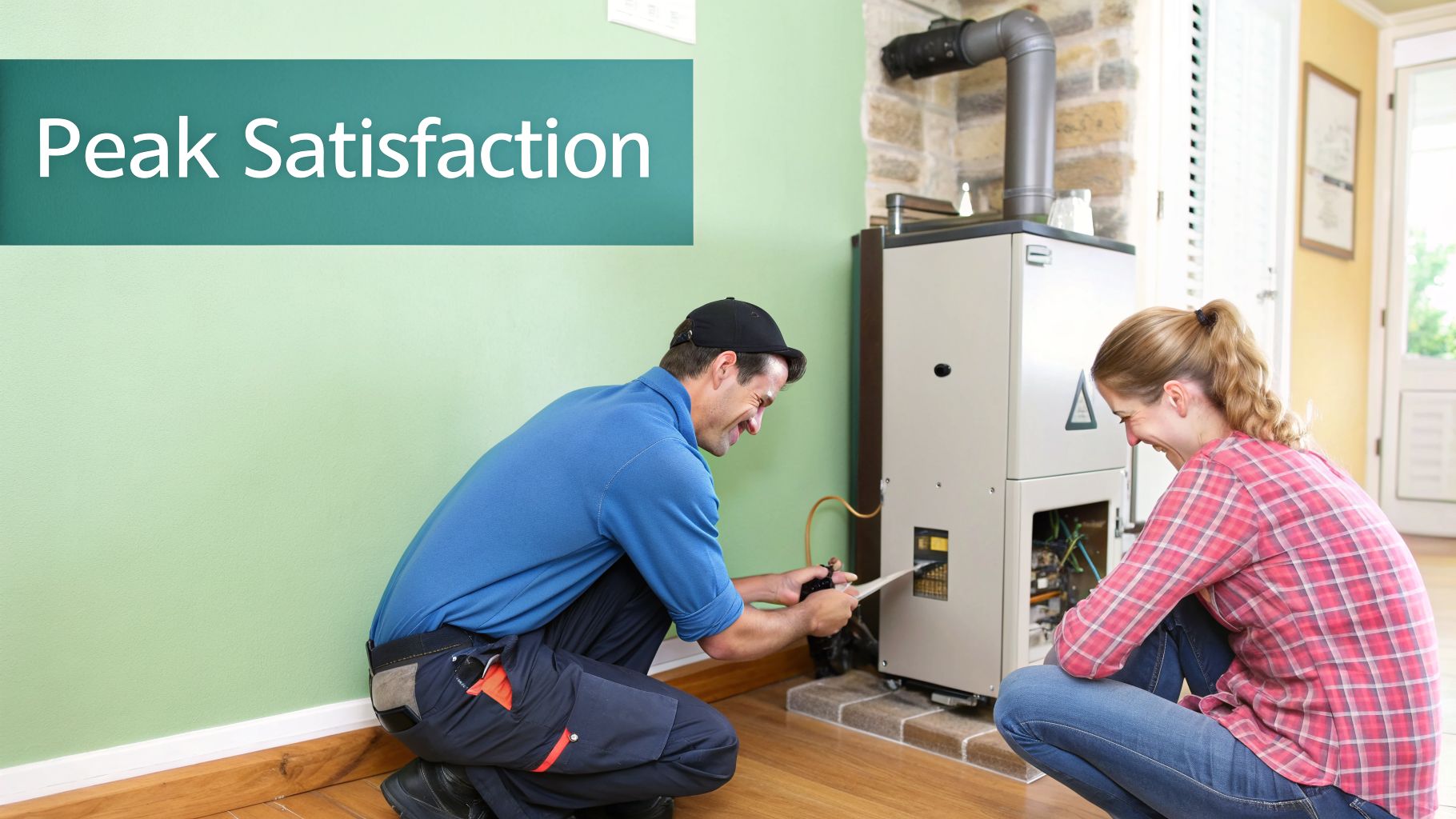
Timing is everything. Ask for a review at the wrong moment, and you come off as awkward or pushy. But ask at the right one, and it feels like the most natural thing in the world—a perfect end to a job well done. The real secret to knowing how to ask customers for testimonials is learning to spot those moments of peak satisfaction.
Think about it. You've just restored a family's heat in the middle of a cold snap. The relief on the homeowner's face is impossible to miss. That's a golden moment. Or picture the final walkthrough of a kitchen remodel, where the client sees the space they’ve dreamed about for years finally come to life.
In these moments, the customer is feeling genuine, powerful emotions. The value you’ve delivered is fresh in their mind, which is why asking for feedback right then and there produces the most authentic and compelling testimonials.
The In-Person Ask vs. The Digital Follow-Up
The single best time to plant the seed for a review is right after the job is finished, while your tech is still on-site. The key is to keep the conversation casual and low-pressure, not transactional.
For instance, your technician could say something like, “I’m so happy we got your AC back up and running before this heatwave hits. If you were happy with the service, would you mind sharing your experience on Google? It really helps other people in the neighborhood find us.” That immediate, personal ask is incredibly effective.
Of course, not every customer wants to stop what they're doing and type out a review on their phone right away. And that's okay. This is where a smart digital follow-up comes in. A simple text or email sent a few hours later (or first thing the next morning) acts as a convenient, no-pressure reminder.
The most successful strategy combines both. Your tech makes the ask in person when the customer is happiest, and the automated follow-up provides a super-easy link for them to click when they have a free moment.
This two-pronged approach respects the customer's time and convenience while seriously boosting your chances of getting that five-star review. You’ve successfully framed the request and then given them a simple, one-click path to do it.
Identifying Your Golden Moments
Your team is on the front lines every day, and they're the ones who will see these moments of peak satisfaction firsthand. You need to train them to spot these emotional cues and act on them.
Some classic golden moments for contractors include:
- The Problem Is Solved: Right after fixing a major headache like a burst pipe, a dead furnace, or a sparking electrical panel. The customer's sense of relief is at its absolute highest.
- The Big Reveal: That first moment a client sees their finished remodel or new installation. You're watching their vision become a reality.
- A Spontaneous Compliment: When a customer says something unprompted, like, “Wow, you all did fantastic work, and my house is cleaner now than when you got here!”
When you empower your technicians to recognize these opportunities, asking for a review stops feeling like a chore. It becomes a natural part of celebrating a job well done.
Where to Ask: Choosing the Right Channel for the Highest Response Rate
You’ve got the timing down, but how you ask is just as crucial. The goal is to slide your request into your customer's day so seamlessly that leaving a review feels like the natural next step, not a chore. The right channel makes all the difference between getting an enthusiastic response and getting lost in the noise.
For most contractors, especially after wrapping up a residential service call, SMS text messaging is king. Let's be real, your customers are busy. A text message with a direct link cuts through the clutter. It’s personal, immediate, and requires practically zero effort. With open rates as high as 98%, text messages completely smoke traditional email.
This is your best bet for capturing that "wow" moment right after you’ve worked your magic. When a customer is beaming over their new deck or relieved their AC is humming again, a quick text feels helpful, not pushy.
Pick the Right Tool for the Job
But SMS isn't a silver bullet. The best method really hinges on your customer and the scale of the project. A text is perfect for a quick faucet replacement, but a more formal email might be the better play for a long-term commercial client or a massive kitchen remodel.
Think about it this way:
- SMS Text: Your go-to for most residential jobs. The aim here is a quick, high-star rating and a sentence or two for your Google Business Profile. Fast and effective.
- Email: This works best for bigger projects or B2B clients. It gives you the space to ask for a more detailed, thoughtful testimonial you can feature as a case study on your website.
- Direct Link/QR Code: Sometimes the simplest approach is the most powerful. A technician can pull up a QR code on their tablet or phone right on-site. Having a simple, memorable link like YourWebsite.com/review also works wonders.
The name of the game is removing friction. No matter which channel you pick, the customer should be just one or two taps away from leaving their feedback. Never make them search for your Google or Yelp page.
To really nail this, our guide on how to get Google reviews from customers walks through even more specific tactics you can put into action today. Make it easy, and you'll see your response rates climb.
Testimonial Request Channel Comparison
Choosing between these options can feel like a tough call, but it really comes down to the situation. Each channel has its own strengths and weaknesses.
Here’s a quick breakdown to help you decide which channel fits the job.
| Channel | Pros | Cons | Best For… |
|---|---|---|---|
| SMS Text | Phenomenal open rates, feels immediate and personal, super high conversion. | Limited character count means you have to be concise. | Quick residential jobs, driving a high volume of Google reviews. |
| More professional, allows for longer and more detailed requests, easy to track. | Low open rates, easily ignored or sent to spam, feels less urgent. | Commercial/B2B clients, in-depth testimonials for your website. | |
| Direct Link/QR | The ultimate in convenience for on-site asks, captures immediate satisfaction. | Relies on the tech remembering to show it and the customer being willing to act on the spot. | In-person sign-offs right after project completion. |
Ultimately, a great testimonial strategy often involves using a mix of these channels. Start with what feels most natural for your business and your customers, then test and refine your approach over time.
Scripts and Templates That Get Results
You’ve nailed the timing and the channel. Now for the most important part: what do you actually say? Getting this wrong is the difference between a five-star review and a deleted message.
The best requests I’ve seen are short, friendly, and make the customer feel appreciated, not like they're being given a chore. Your goal is to make sharing their positive experience feel like a natural next step for them.
Let’s get into some proven, word-for-word scripts I’ve used and seen work wonders in the field.
The Low-Pressure Text Message Script
For most residential service calls, a text is your best bet. It feels personal, it's fast, and virtually everyone opens their texts. The trick is to be grateful, get straight to the point, and give them a single link to tap.
Scenario: Your tech just got a furnace working again on a cold day. The homeowner is thrilled.
Example Text Message Script:
"Hi [Customer Name], it's [Your Name] from [Your Company]. So glad we could get your heat back up and running for you! If you were happy with our service today, would you mind sharing your experience on Google? It really helps us out. Here’s the link: [Your Google Review Link]"
This works because it's polite and immediately reminds them of the positive outcome ("got your heat back up"). More importantly, it gives them a simple, one-tap task. The less friction, the higher your success rate.
The More Formal Email Template
When you wrap up a bigger project—a kitchen remodel, a new roof, a commercial fit-out—an email feels more appropriate. It gives you the space to be a bit more detailed and encourage a more in-depth testimonial you can use on your website.
A lot of the same psychology that goes into writing powerful email templates for sales that get replies applies here. You need to be personal, clear, and focused on the value you provided.
Scenario: You’ve just done the final walkthrough on a bathroom remodel, and the client is over the moon.
Example Email Template:
Subject Line: A quick question about your new bathroom
Body:
"Hi [Customer Name],
It was a real pleasure bringing your vision for the new bathroom to life. We're so thrilled with how it turned out!
When you have a moment, we would be incredibly grateful if you could share a few words about your experience working with us. Future clients find it helpful to hear about things like our process, communication, and the quality of the final result.
You can leave a review for us here: [Your Preferred Review Link]
Thank you again for trusting us with your home.
Best,
[Your Name]
[Your Company]"
This email is effective because it’s not just a generic request. It personalizes the opening, gently guides them on what to write about (process, communication, quality), and keeps the tone professional but warm.
The On-Site Verbal Script
Don't ever forget the power of asking in person. This isn't about pressuring someone on the spot. It's about planting the seed while their feeling of relief and happiness is at its peak. Train your team to read the room and use this when the moment feels right.
Scenario: Your plumber just fixed a nasty leak that had the homeowner completely stressed out.
Example On-Site Script:
"I'm so happy we could get that leak sorted out for you. I know how stressful that can be. Hey, if you have a second later today, would you mind leaving us a quick review on Google? Feedback from happy customers like you makes a huge difference for our business."
This is a soft ask. It’s empathetic ("I know how stressful that can be") and frames the request as a way for them to help a local business they’re happy with. This perfectly sets the stage for the follow-up text or email you’ll send shortly after.
Putting Your Testimonial System on Autopilot
Let’s be honest, chasing down every customer for a review is exhausting. You’ve got a business to run. If you’re relying on memory to ask for feedback, you’re leaving testimonials on the table. The only way to get a consistent stream of reviews is to build a simple, automated system that does the work for you.
This sounds more technical than it really is. You can often use the software you already depend on, like your customer relationship management (CRM) platform or even your invoicing software, to get the ball rolling. It's all about creating an automatic workflow that starts the second you finish a job.
Finding Your Automation Triggers
Think about your process. Your technician marks a job "complete" in their app. That's a trigger. The customer pays their final invoice. That's another great trigger. Instead of adding "ask for review" to your to-do list, this action tells your system to do it for you.
You can use a tool like Zapier to connect your different software systems. For instance, when an invoice is marked "paid" in QuickBooks, you can set a rule to send your review request email 24 hours later. That little delay is perfect—it gives the customer a day to admire your work but is still fresh in their mind.
This diagram shows how you can layer your requests, starting with the personal ask on-site and then following up with automated texts and emails.
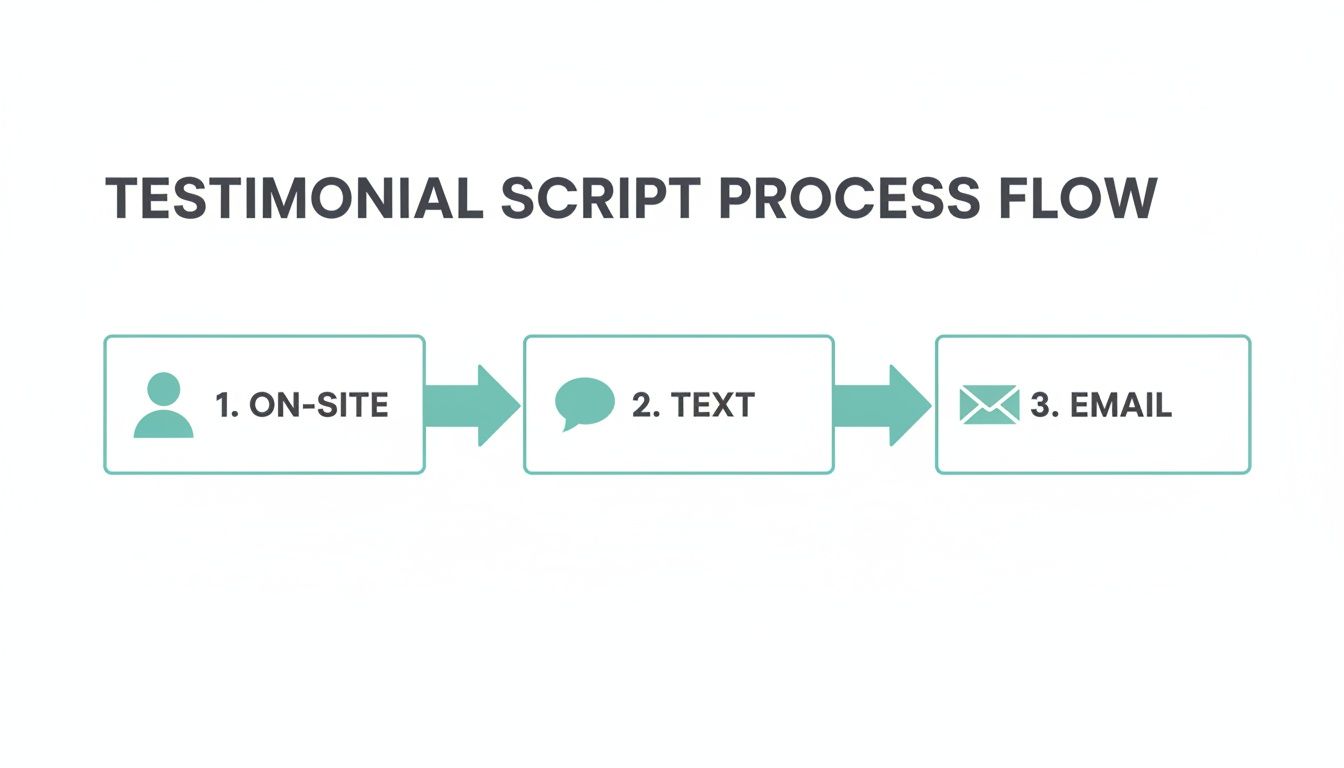
By hitting multiple channels, you meet customers where they’re at and make it as easy as possible for them to respond.
The Art of the Gentle Nudge
Even the happiest customers get distracted. Life happens. That's why your automated system needs to include a follow-up. Just one. Anymore and you risk being annoying, but a single, polite reminder can make a huge difference in your response rate.
Here's how to set it up: your system should check if the customer has clicked your review link within three to five days. If not, it automatically sends a second, slightly different message.
Don't just resend the original email. That feels lazy. Your follow-up should acknowledge the first message. Try something like, "Just wanted to quickly follow up on my last note. Your feedback means a lot to our small team and only takes a minute to share."
This kind of automation builds a review-generating engine that runs in the background. It makes sure every happy customer gets a chance to share their story, all without you lifting a finger. The result is a steady flow of powerful social proof that builds your reputation and brings in more work.
Turning All Feedback into a Business Win
Let's be honest: not every review will be a glowing five-star rating. And that’s perfectly fine. In fact, seeing a profile with nothing but flawless praise can sometimes feel less authentic to potential customers. What truly sets the top-tier contractors apart is having a solid game plan for handling all types of feedback.
Thanking customers for positive reviews is the easy part, but it's still crucial. A quick, personal reply shows you’re paying attention and that you genuinely appreciate their business. For some great tips on this, check out our guide on how to respond to a positive review with examples.
The real test, however, is how you handle neutral or even negative comments. This is where you can turn a potential negative into a public display of outstanding customer service that wins over future clients.
Responding to All Types of Feedback
Believe it or not, a professional and timely public response to a negative review can sometimes do more for your reputation than a dozen five-star ratings. It proves to anyone watching that if something does go wrong, you’re the kind of contractor who will step up and make it right.
The key is to respond, not react. Acknowledge the customer's frustration, take the conversation offline to resolve the specifics, and then follow up on the public review once the issue is solved. This shows you’re a problem-solver.
When you handle criticism with grace, you're not just trying to appease one unhappy client. You're demonstrating your company's character to every single person who reads that review. A complaint can become a powerful testament to your integrity.
Tracking the Metrics That Matter
To know if all this effort is actually paying off, you need to track the right numbers. Watching these metrics helps you see what’s working, what’s not, and where to fine-tune your strategy for asking for testimonials.
Keep a close eye on these key performance indicators:
- Average Star Rating: Your overall score across platforms like Google. You should be aiming for a steady, gradual increase over time.
- Review Volume: The total count of new reviews you're getting each month. The goal here is consistency.
- Response Rate: What percentage of reviews are you replying to? This one is simple: your goal should be 100%.
- Keyword Mentions: Are customers naturally using valuable terms like "on-time," "professional," or "clean" in their feedback? This is gold for your marketing.
Tracking these numbers gives you tangible proof that managing your reputation is directly impacting your business. It turns customer feedback from a simple opinion into a measurable asset.
Navigating the Tricky Situations
Even with a solid plan, you're going to run into some awkward moments when asking for testimonials. Let's talk through a couple of the most common questions I hear from contractors so you know exactly how to handle them.
What’s the Deal with Offering Incentives for Reviews?
I get this question all the time. It's tempting to offer a gift card or a discount to nudge a customer into leaving a review, but you're wading into murky water here.
Major platforms like Google and Yelp have strict rules against this. Why? Because paying for a review, even with a small incentive, can look like you're buying a positive opinion, and it erodes trust. You should never make a gift conditional on getting a review.
My advice? Focus on delivering service so good that customers want to talk about it. That’s the only incentive you really need. If you want to send a small, unexpected "thank you" gift after they've already left a fantastic review on their own, that's usually fine. But don't dangle a carrot to get the review in the first place.
What if They Just Say No?
It's going to happen, and it's not a big deal. If you ask for a testimonial and the customer declines or seems hesitant, the absolute best thing you can do is back off gracefully.
Don't push it. Don't ask why. Pestering them will only sour the great experience you just provided.
A simple, friendly response is all you need. Something like, “No problem at all! We were just happy to help out.” It shows respect for their decision and ends the conversation on a positive note. Remember, not everyone is comfortable leaving reviews, and that’s perfectly okay.
Are you tired of a few unfair reviews costing you business? The team at Impruview specializes in reputation management for contractors, using a proven strategy to push negative results off page one and highlight your positive feedback. Stop losing leads and start showcasing your true quality. Take back control of your online reputation by visiting us at Impruview.