So, can you actually remove negative Google reviews? The honest answer is yes, but it's a long shot. Think of it less like a standard customer service request and more like trying to win a small lottery—you only succeed if a review clearly violates one of Google's specific, narrow policies.
It’s definitely not as simple as asking for a takedown because the review feels unfair or is hurting your business.
The Reality of Removing Negative Google Reviews
From my experience working with contractors, I can tell you that the time and energy spent chasing deletions rarely pays off. Google’s main job isn't to play referee between you and a disgruntled customer; it’s to protect the integrity of its own platform.
What this means in practice is that a review expressing a negative opinion—even one you fiercely disagree with—will almost always stay online.
The platform’s automated filters and human moderators are hunting for clear, black-and-white violations, not getting into the weeds of subjective disagreements. That’s why you need to shift your mindset from deletion to management. Instead of fighting a battle you'll likely lose, you can use practical strategies to take back control of your online reputation.
Google's Shifting Takedown Trends
It's also important to know that Google's approach to moderation is always changing. For instance, recent analysis of over 60,000 Google Business Profiles showed a huge spike in review removals. But here's the catch: the removals hit both positive and negative reviews, and home service contractors were among the most affected.
This tells us Google's algorithms are getting more aggressive, but not necessarily in a way that helps business owners. It’s a machine doing its job, not a person taking your side.
The key takeaway here is simple: review removal is an unpredictable process completely outside of your control. Pouring resources into flagging a review that just details a poor customer experience is usually a waste of your valuable time.
But this doesn't mean you're powerless. The trick is knowing which reviews might actually be removable so you can focus your energy where it counts. To give you a clearer picture, I've put together a quick guide on what Google typically looks for.
Quick Guide: What Google Considers for Removal
| Can Potentially Be Removed | Will Not Be Removed |
|---|---|
| Spam or fake content (e.g., from a competitor). | A real customer's negative opinion. |
| Hate speech, harassment, or threats. | A detailed account of a bad experience. |
| Impersonation or conflicts of interest. | Disagreements over price or project timelines. |
| Off-topic rants unrelated to your business. | A review where you believe the customer is wrong. |
Understanding this distinction is the first step. For a deeper dive, you can also explore this excellent resource on whether a business can delete Google reviews. The goal isn’t to erase every bad comment but to strategically manage your online reputation for long-term success.
Identifying Reviews That Violate Google's Policies
So, when can you actually get a negative Google review removed? The first thing to get straight is that Google doesn't care if a review is unfair, frustrating, or even untrue. They care if it breaks their rules.
Think of Google as a referee. They won’t throw a flag just because a play went badly for your team. They only act on specific infractions, and you need to know exactly what those are. For a busy contractor, learning to spot these violations means you can focus your energy on the few reviews that are actually worth fighting.
Most of the negative feedback you get, even the stuff that makes your blood boil, is considered a legitimate customer opinion in Google's eyes. But a small fraction will cross a very clear line, and those are your targets. These are reviews that violate Google's prohibited and restricted content policy.
Spotting Clear Policy Violations
To have any shot at removal, you have to connect the review directly to one of Google's specific policy violations. Let’s walk through the most common ones you’ll see in the trades, with some real-world examples to help you spot them in the wild.
These are the violations that give you the best chance of getting a review taken down.
Conflict of Interest: This is a big one for contractors. A review is a conflict of interest if it's written by someone with a clear bias. Think of a disgruntled former employee posing as a customer, or that one-star review from a competing roofer down the street. That’s not a customer; that’s an attack.
Spam and Fake Content: This is any review that's obviously not from a real customer. Did you suddenly get hit with five one-star reviews in an hour from accounts with names like "John Smith" and no other review history? That’s a classic spam attack. Another dead giveaway is a "review" that’s just a promotional link to another business.
Off-Topic Rants: The review has to be about the customer’s experience with your business. If someone leaves a one-star review ranting about a local zoning law, the traffic near your job site, or a political bumper sticker on your truck, it's off-topic. Their personal gripes aren’t a reflection of your service.
Harassment or Hate Speech: This is the most serious violation, and Google takes it very seriously. Any review containing personal attacks, threats, slurs, or discriminatory language against you or your crew needs to be flagged immediately. There is zero tolerance for this.
It's crucial to understand that simply disagreeing with a customer's version of events is not grounds for removal. The review must contain content that directly violates one of these established policies.
If you’ve identified a review that fits one of these descriptions, you have a legitimate case. The next step isn’t just to hit the "flag" button. It’s to build a concise argument explaining exactly how the review breaks the rules when you submit it. The more specific you are, the better your chances.
How to Flag a Review and Build Your Case
So, you’ve found a review that clearly crosses the line and violates Google's policies. What now? Your first instinct might be to just hit the "report" button and hope for the best, but that rarely works.
Think of it less like a complaint and more like building a legal case. You're the prosecutor, and your job is to present Google’s moderation team with a clear, undeniable reason to act. A lazy flag gets a lazy response. A well-argued case gets results.
The whole process kicks off right from your Google Business Profile. Once you find the review, you’ll see the option to report it. But the real work isn't in the clicking—it's in how you frame your argument.
The Step-by-Step Flagging Process
Getting your request in front of Google is simple, but how you do it makes all the difference. Follow these steps to give your flag the best possible chance of success.
- Find the Review: Go to your Google Business Profile manager or find the review directly on your public listing.
- Flag It: Click the three dots next to the review and choose "Report review."
- Pick the Right Violation: This is the most critical step. Google gives you a list of policy violations. You must select the one that most accurately fits the situation, whether it’s "Spam," "Conflict of interest," or something else.
- Submit and State Your Case: Follow the on-screen prompts to submit. If you get a text box, keep it brief and factual.
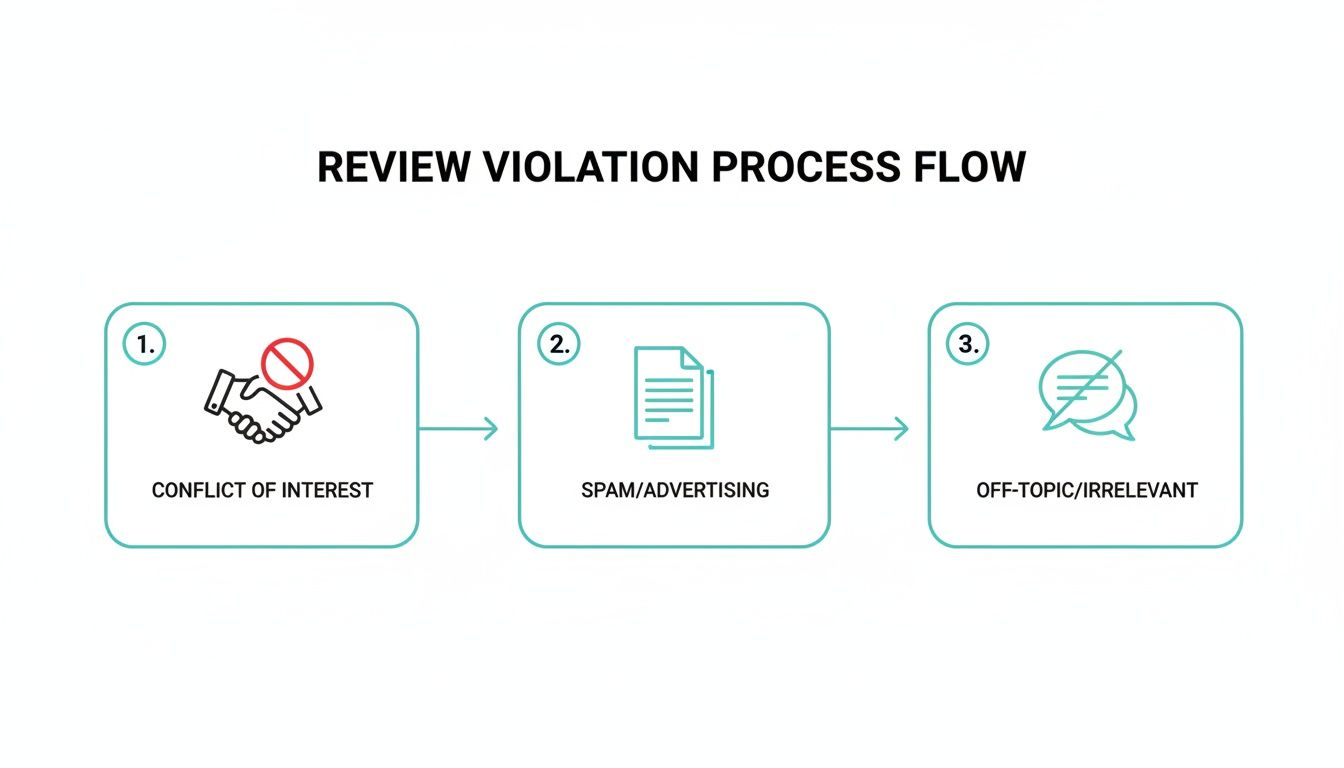
Choosing the correct category is everything. It determines which queue your request lands in and what criteria the moderator uses to judge it. Get this wrong, and you're setting yourself up for failure from the start.
When you make your case, stick to the facts. State the policy the review violates and briefly explain why. For example: "This review is a conflict of interest. The user is a former employee terminated on [Date] and has never been a customer."
Once you hit submit, the waiting game begins. Google can take anywhere from a few days to several weeks to get back to you, and even a solid case isn't a guaranteed removal.
If you’re facing a coordinated attack or a flood of suspicious feedback, you may need more advanced strategies. Our in-depth guide on how to remove fake Google reviews covers those tactics in detail.
What to Do When Google Rejects Your Request

So you flagged the review, made your case, and waited. Then, the email arrives: “After reviewing your request, we’ve determined the content does not violate our policies.” It’s a gut punch, and honestly, it's the most common outcome. It can feel like you’ve hit a brick wall.
This is the point where you have a choice. You can waste energy being angry at a system you don't control, or you can get strategic. Think of Google’s rejection not as a final verdict, but as a signal to change tactics—from fighting a losing battle over removal to actively managing your reputation.
From here, you’ve got two very different options. The first is something you can do right now: write a stellar public reply. The second is the nuclear option: taking legal action, which is a much heavier lift.
Master the Public Reply
A calm, professional response can do more for your business than getting a bad review taken down. Here’s why: your reply isn't just for the person who wrote the review. It’s for every single potential customer who will read it down the line. A well-handled response can actually win you more business than the negative review ever lost you.
For contractors, the financial impact of reviews is no joke. One study found that 86% of consumers look at reviews before committing to services over $500. And a single one-star review can drop your conversion rate by a staggering 25%. Since getting a review removed is a long shot, your public reply is your best and most reliable tool. For a deeper dive on this, Search Engine Land published a great piece on Google's review moderation trends.
Your goal is to show prospective clients that you are professional, responsive, and committed to customer satisfaction, even when things go wrong. A thoughtful reply demonstrates that you stand behind your work.
Here’s how you craft a reply that turns a negative into a net positive:
- Acknowledge and Apologize. Start by validating their feelings. A simple, "I'm sorry you had a frustrating experience" goes a long way. You aren't admitting guilt; you're acknowledging their disappointment.
- Take It Offline. This is crucial. Provide a direct contact—a name, a specific email, or a phone number—and ask them to reach out so you can make things right. It shows you're serious and moves any further back-and-forth out of the public spotlight.
- Never Argue. Don't try to correct the record or get into a he-said-she-said debate online. It makes you look defensive and unprofessional, even if you're 100% in the right.
Considering the Legal Route
The other path, pursuing legal action for defamation, is far less common for a reason. This is a last-resort measure, typically reserved for extreme cases where a review contains provably false statements of fact (not just opinions) that have caused measurable financial damage to your company.
This isn’t a DIY project. It means hiring an attorney, gathering evidence to prove the review is defamatory, and potentially getting a court order that you can then present to Google. The legal fees can easily climb into the thousands of dollars, and there’s absolutely no guarantee you’ll win.
Before you even think about going down this road, talk to a lawyer. You need to understand the high bar for proving defamation and the significant time and money involved.
A Smarter Strategy: Bury Negative Reviews with Positive Content

Chasing after a negative review removal is a frustrating game, one where you have almost no control. So, let’s talk about a strategy that puts you back in the driver's seat.
Think of it this way: you’ve got a stubborn weed popping up right in the middle of your front lawn. You could spend your whole weekend trying to dig it out, knowing it might just grow back. Or, you could get to work planting a lush, vibrant garden all around it. Before you know it, that single weed is completely overshadowed by beautiful flowers and healthy grass.
That’s the essence of modern reputation management. We call it content suppression. It’s not about deleting the negative; it's about overwhelming it with so much positive that it becomes irrelevant. Instead of playing Google’s low-odds removal game, you build an online presence that’s too strong for one bad review to tarnish.
Taking Control of Your Search Results
When a potential client googles your company name, what do you want them to find? Ideally, it’s a full page of glowing testimonials, impressive project photos, helpful articles you’ve written, and maybe even a feature in a local publication.
Each piece of positive content you create acts like a defensive lineman, pushing negative links further down the search results. Most people never click past the first page, so anything you can push to page two or beyond is practically invisible.
The best part? This approach works with Google's algorithm, not against it. Google wants to show searchers fresh, relevant, and authoritative content. When you consistently publish high-quality material about your business, you're giving the search engine exactly what it's looking for. This is how you see real progress, often much faster than waiting for a verdict on a removal request that may never come.
You’re not just reacting to a problem—you’re building a digital fortress. For a deeper dive, check out our guide on how to bury negative search results with positive content.
The Power of Proactive Reputation Management
Even when a review stays up, how you respond matters immensely. A professional, thoughtful reply can transform a complaint into a public display of great customer service. It shows you listen and you care. For some great templates, check out these actionable negative review response examples.
Simply removing the negative isn’t enough. That only creates a void. The key is to actively fill that space with positive assets that you own and control. Get positive things on the calendar, or they’ll be crowded out by noise.
Let’s look at how these two approaches stack up. One is a reactive game of whack-a-mole, while the other is a proactive strategy for long-term business growth.
Review Removal vs. Reputation Management
The table below breaks down the reality of spending your time trying to get reviews deleted versus investing that energy in building a positive brand. For a busy contractor, the difference is night and day.
| Metric | Chasing Review Removal | Proactive Reputation Management |
|---|---|---|
| Control | Low—dependent on Google's decision. | High—you control the content you create. |
| Success Rate | Very low, often less than 10%. | High, with consistent effort. |
| Timeline | Unpredictable (days, weeks, or never). | Visible results often in 30–90 days. |
| Long-Term Value | Minimal—removes one issue at a time. | Builds a lasting, resilient online brand. |
| Cost | Low financial cost but high time investment. | Requires consistent investment of time or money. |
At the end of the day, trying to remove every negative review is like playing defense the entire game—you’re just hoping the other team misses. A proactive reputation strategy lets you go on offense. You get to control the narrative, build trust, and create a brand that homeowners actively want to hire.
Building a Bulletproof Reputation for Your Business
After exploring all the ways to flag, appeal, and even legally challenge a bad review, you might be wondering what the best path to a five-star reputation really is. The answer isn’t just about deleting every negative comment that comes your way. It’s about building an online presence so solid that a few bad reviews barely make a ripple.
Think of it less as playing defense and more like going on offense. Instead of constantly reacting to problems as they pop up, you get to proactively shape the story people see about your business. Honestly, this is one of the most fundamental parts of running a healthy contracting company today.
Your Three-Part Game Plan
A rock-solid reputation is built on a simple, consistent plan. Here are the three core strategies every contractor should have in their playbook.
Systematically Ask for Positive Reviews: Don't just hope happy customers leave good feedback. Make it a standard part of your job wrap-up process. A steady stream of four- and five-star reviews will naturally bury the occasional negative one, pushing it down where few people will ever see it.
Respond to Every Single Review: Get in the habit of engaging with all feedback—the good, the bad, and the neutral. Thanking a customer for a great review makes them feel appreciated. Responding professionally to a negative one shows everyone else that you’re accountable and stand by your work.
Invest in Creating Positive Content: This is your long-term reputation insurance. You need to create and share content that you completely own and control. This means things like project galleries on your website, helpful how-to articles on your blog, and active social media profiles.
It’s not enough to just remove the negative; that only creates a vacuum. The real secret is to fill that space with positive assets that you own. If you don't schedule time to create positive content, it will always get pushed aside by the noise of the day-to-day.
To truly build a bulletproof online presence, you need to actively manage how your business is perceived everywhere, which includes mastering your social media reputation management. Every piece of content you control, from a detailed case study to a quick photo of a finished project, helps secure your reputation.
This shift in mindset—from chasing deletions to building assets—is how the most successful contractors win the online game. It's not a quick fix, but it is a sustainable strategy that pays off for years to come.
Common Questions We Hear About Google Reviews
When you're dealing with a bad review, a lot of questions pop up. It's frustrating, and you want answers fast. Let's walk through some of the most frequent questions contractors ask us about managing their reputation and getting rid of those pesky negative reviews.
How Many Negative Reviews Does It Take to Hurt My Business?
Honestly, just one can do damage. Think about it from a homeowner's perspective. When they're about to spend thousands on a new roof or a kitchen remodel, trust is everything. A single, prominent one-star review can plant a seed of doubt that makes them click away.
The real tipping point, however, is when your overall rating drops. Once you fall below a 4.0-star average, you'll likely see a noticeable drop in calls and leads. That's the threshold where customers start getting hesitant.
Can I Sue Someone for a Fake Google Review?
The short answer is yes, you can technically sue for defamation. If a review contains false statements of fact (not just opinions) that you can prove have caused financial harm to your business, you have a legal path.
But here’s the reality check: it’s an incredibly expensive, long, and difficult fight to win. You'll need to hire an attorney and gather rock-solid evidence, which is often harder than it sounds. It’s a last resort, really only worth considering in the most extreme and damaging cases.
A legal battle almost always costs more in time and money than the review itself. You'll get a much better return on your investment by focusing on proactive reputation management strategies instead.
Does Responding Make a Negative Review More Visible?
This is a myth we hear all the time, and it's a dangerous one because it stops business owners from taking the best possible action. Responding to a review—good or bad—does not make it more prominent in Google's algorithm.
In fact, a professional and helpful response is your single most powerful tool. It shows potential customers scrolling through your reviews that you are accountable, you listen, and you're committed to making things right. You can turn a negative into a public demonstration of great customer service.
Are unfair reviews on Google or Yelp costing you leads? Instead of chasing removals, Impruview uses a proprietary content strategy to dominate your search results and bury negative links. We help contractors take back control of their online reputation. See how we can improve your digital footprint.