That one-star review or nasty forum post isn't just a minor headache. It's a silent sales killer, actively diverting jobs and real money away from your business every single day. Learning how to bury negative search results isn't a vanity project; it's a core business skill you need to master so a single bad link can't tank your hard-earned reputation.
Why Negative Search Results Cost Contractors Real Money
For anyone in the trades—roofing, plumbing, HVAC, you name it—a bad online reputation hits the wallet, hard and fast. Your customers aren't casually browsing. They're dealing with an emergency. When a pipe bursts or the AC dies in July, they grab their phone for an immediate solution.
What they find in those first few seconds is everything. A negative review, a low star rating on Yelp, or an old complaint on a forum acts like a giant stop sign. The homeowner doesn't pause to read the details or consider the context. They just flinch and click on the next name on the list—your competitor.
The High Price of a Bad First Impression
It's easy to blow off a single bad review, but the financial damage adds up quickly. Globally, poor customer experiences are estimated to cost businesses $3.7 trillion annually. For you, a local contractor, that number becomes very real, very fast.
Research shows that 70% of consumers will jump to a competitor after just one bad experience. With the average home service job easily topping $500, losing even one lead a week to a bad search result means you're leaving a significant amount of cash on the table. You can explore more reputation management statistics to see the full financial picture.
Think about it this way: if you lose just three to five qualified leads a month because of what people find on Google, that's an annual revenue hit of $18,000 to $30,000. Suddenly, managing your online reputation becomes a financial priority.
The Psychology of the Snap Judgment
We're all trained to make quick decisions online. Your potential customer sees a 2-star rating next to your business and a 4.5-star rating next to your competitor's. In that split second, the decision is already made.
They don't have the time or interest to dig deeper and find out if that one-star review was from a disgruntled ex-employee or a client who had completely unrealistic expectations.
This is especially true when you consider that 95% of consumers read online reviews before making a purchase. The visibility of that negative result is a massive business liability. This is precisely why you need a strategy to push that content down. It’s not about being dishonest; it's about making sure the full, positive story of your business is what people see first.
Conducting a Full Audit of Your Online Reputation
Before you can start fixing a reputation problem, you have to know exactly what you’re up against. Just Googling your business name is barely scratching the surface. To really bury those negative search results, you need to do a deep, comprehensive audit to find every single piece of content that could be costing you jobs.
Think of this as mapping the battlefield. You’ll pinpoint the damaging links that need to be pushed down (your targets) and identify the positive content you already have that can be amplified (your assets). This is the foundational work that makes sure your time and money are spent effectively.
This isn't just about hurt feelings or pride. A bad online reputation hits you directly in the wallet.
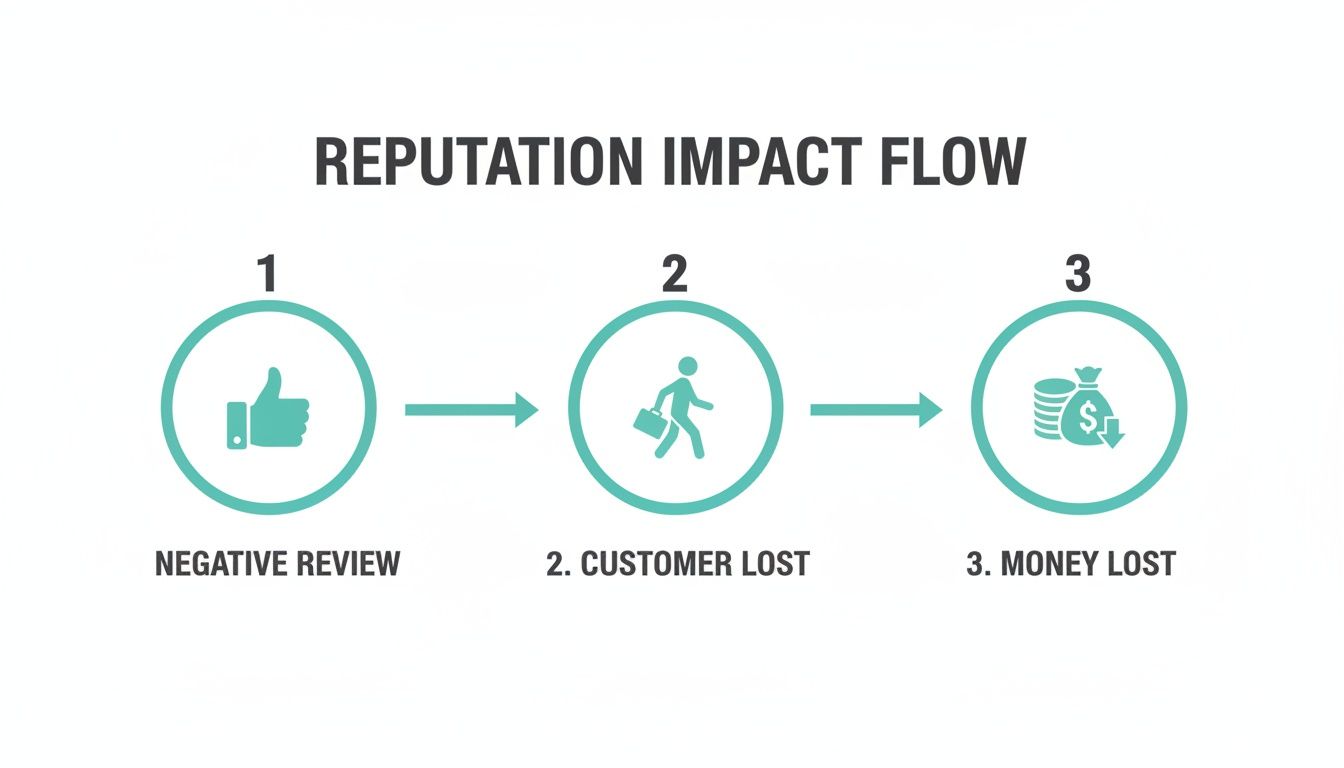
As you can see, it’s a straight line from a negative comment to lost revenue. Every bad review you don’t address is another potential customer calling your competitor instead of you.
Systematically Uncovering Every Mention
Let's get tactical. You need to run a whole series of specific Google searches. Go beyond your company name and start thinking like a potential customer who's vetting contractors for a big project, whether it's a kitchen remodel or a new roof.
To keep things organized, I always recommend using a simple spreadsheet. Log every URL you find on the first 2-3 pages of the search results. For each link, you'll want to note a few things: its rank, whether it's positive, negative, or neutral, and who actually owns the page (you, a review site, a local news blog, etc.).
This checklist breaks down the exact queries you should be using to get a full picture of what people see when they search for you.
Branded Search Audit Checklist for Contractors
| Search Query Type | Example | What to Look For |
|---|---|---|
| Broad Company Name | "Evergreen Roofing" | Your homepage, social profiles, business listings, and any major news or reviews. |
| Reputation-focused | "Evergreen Roofing reviews" | Direct feedback on sites like Yelp, Google, BBB, Angi, and industry-specific forums. |
| Problem-focused | "Evergreen Roofing complaint" or "scam" | The most damaging results—angry customer posts, official complaints, negative press. |
| Personal Name | "John Smith Evergreen Roofing" | Mentions tied to the owner or key personnel, both positive (awards) and negative. |
| Location-specific | "Evergreen Roofing Denver" | Results specific to your main service area, including local directories and blogs. |
This process is often an eye-opener. Seeing everything laid out in a spreadsheet really drives home the urgency of the situation and gives you a clear, actionable list to work from.
To effectively bury negative search results, a strong understanding of online reputation management is crucial. This Ultimate Guide to Online Reputation Management delves into actively shaping how your business is perceived online across reviews and search results.
Using Advanced Search Operators to Dig Deeper
Now, let's get a little more advanced. Google has "search operators"—special commands that let you filter your results and find things that a standard search would miss. Think of them as your digital magnifying glass.
For instance, the site: operator is incredibly useful. Let's say you know there's an old negative thread about your company on a local community forum. You can search site:localcommunityforum.com "Your Company Name" to see every single mention on that website alone.
Here are a couple more operators that are essential for a thorough audit:
- Quotes (""): Always put your business name in quotes, like
"Your Company Name". This forces Google to search for that exact phrase, filtering out irrelevant results. - Minus Sign (-): If your own website is cluttering up the first page, use the minus sign to exclude it. A search for
"Your Company Name" -yourwebsite.comwill show you what else is ranking for your name.
Using these simple tools turns a basic search into a forensic investigation. You’ll build a complete inventory of every online asset and liability tied to your brand. From there, you can start making smart decisions about which negative links to suppress and which positive ones to push to the top. This structured approach to your online properties is a core component of effective local listings management.
Creating Positive Content to Dominate Search Results

Alright, you’ve audited your search results and know what you're up against. Now the real work begins. It’s time to stop playing defense and go on the offensive. The best way to bury negative search results isn’t trying to get them deleted—that’s often a long, expensive, and fruitless battle. Instead, you need to create so much high-quality, positive content that the bad stuff simply gets pushed down where no one will ever see it.
Think of it like building a digital fortress around your brand name. Every new piece of content is another stone in that wall, making your online presence stronger and more resilient. The mission is to completely own the first page of Google for your company's name, leaving zero room for that one-star Yelp review or an old complaint to show up.
Your Content Creation Playbook
The strategy here is to build out a portfolio of web properties that you have 100% control over. When you own the website, you control the narrative. This puts you back in the driver's seat. Your main company website is the foundation, but to truly dominate the search page, you have to expand beyond it.
This is more than just churning out a few blog posts. You need a smart mix of different content types, and each one has to be optimized to rank for your brand name and related searches. This is how you systematically push the negative results off page one.
For contractors, a few types of content work exceptionally well:
- Detailed Project Case Studies: Don't just post a photo gallery. Write an in-depth story about your best projects. Talk about the initial challenge, how your team solved it, and showcase the incredible final results.
- Team Expertise Articles: You have experts on your team, so let them shine. Have your lead plumber write a guide on the benefits of tankless water heaters or your top roofer explain how to spot storm damage. This builds massive authority.
- Community Involvement Posts: Did your company sponsor a local little league team or volunteer for a park cleanup? Write a post about it, complete with pictures. This creates positive, local-focused content that Google loves.
Building Your Content Fortress
Your primary company website is the cornerstone of this entire strategy. It’s the most authoritative digital asset you own, and it needs to be packed with helpful, positive information. Updating it regularly with new projects and articles tells Google that your site is active and relevant.
From there, it's time to branch out. Think about launching microsites for specific services or even a personal brand website for the owner. For example, if the owner is a well-known figure locally, a simple website like JohnSmithRoofingExpert.com can rank surprisingly high for searches that include his name.
The more web properties you own and control that appear on the first page for your brand, the less real estate there is for a negative article or bad review to rank. You are literally pushing them off the digital stage.
Another powerful and often overlooked tactic is to create and fully optimize your social media profiles. Search engines give a lot of weight to major platforms. A completely filled-out LinkedIn profile for both your company and its owner can easily grab one of the top spots in search results. The same goes for Facebook, Instagram, and even YouTube.
Optimizing Every Asset for Maximum Impact
Just creating the content is only half the job. Every single piece you publish has to be optimized so Google knows exactly what it's about and why it should rank for your brand name.
For every piece of content, whether it's a case study or a new social profile, make sure you're doing the following:
- Integrate Your Brand Name: Use your full, official company name naturally in the page title (H1), subheadings (H2, H3), and throughout the text. Don't force it, but make it clear who the hero of the story is.
- Use High-Quality Visuals: Include sharp photos and videos of your team and your work. Critically, name the image files with your brand name and location, like
evergreen-construction-denver-kitchen-remodel.jpg. This is a simple but effective SEO trick. - Create Authoritative Content: Go for depth. A comprehensive, 1,500-word case study that breaks down a complex project will almost always outrank a short, angry 200-word review.
Think about it this way: a negative review is typically thin on detail and heavy on emotion. Your counter-attack is to flood the search results with content that is the complete opposite—incredibly detailed, professional, and showcasing undeniable quality and expertise. This sustained effort is the most reliable path to burying negative search results for good.
Generating and Promoting Five-Star Reviews

While the content you create is important, nothing buries bad search results faster than a flood of positive reviews. The authentic voice of a happy client is your single best asset. Good reviews are the ultimate social proof, directly neutralizing negative comments and sending a clear signal to both Google and potential customers that you’re a contractor they can trust.
Let's be honest—when you see two businesses, one with a 4.8-star average and another with a 3.2-star average, you've already made your choice. That's why a steady flow of fresh, positive reviews on sites like Google, HomeAdvisor, and Angi isn't just nice to have; it's essential for reclaiming your search page and winning jobs.
Your job is to build a simple, repeatable process that makes it incredibly easy for happy clients to leave that feedback. This isn't about being annoying or pushy. It’s about striking while the iron is hot.
Building Your Review Generation Machine
The biggest mistake I see contractors make is just waiting for reviews to happen. They won't. Your happy customers are busy people; they have families and jobs. They aren't thinking about your Google profile, but they are often happy to help if you just ask—and make it easy.
You need a simple, consistent system for requesting reviews right after a project wraps up and you know the client is thrilled.
This doesn't need to be some complex software setup. Often, the best approach is a simple follow-up email or text that goes out a day or two after the final payment clears. This message should do three things, and do them well:
- Genuinely thank them for trusting you with their project. A little gratitude goes a long way.
- Quickly confirm satisfaction. A simple, "Hope you're loving the new kitchen!" is enough. This also gives you a chance to fix any tiny issues before they become a problem.
- Give them one link. Don't make them search. Link them directly to the "Leave a Review" page on your Google Business Profile. The fewer clicks, the more reviews you'll get.
Simply asking isn't enough. You have to remove every single bit of friction. If a client has to Google your business name, find your profile, and then hunt for the review button, you’ve already lost them.
If you want to really dial this in, we walk through the specific templates and timing in our guide on how to get Google reviews from customers. It can make a huge difference in your success rate.
Don't Just Collect Reviews—Showcase Them
Getting that five-star review is only half the battle. Now you have to use it. Think of each glowing review as a marketing asset you can put to work.
Letting your best feedback just sit on your Angi profile is a missed opportunity. You need to plaster those great reviews everywhere to build a powerful feedback loop of trust. Every time you share a positive review, you're creating a new piece of positive content associated with your brand name, which actively helps push down the negative stuff in search results.
Where to Promote Your Best Reviews
To get the most out of every piece of positive feedback, make sure you feature them in these high-impact places:
- Your Website Homepage: Add a "What Our Clients Say" section right on the front page. Use their name, star rating, and the best quote from their review.
- Project Case Studies: When you create a portfolio page for a kitchen remodel, embed that client's glowing review right alongside the photos. It adds undeniable proof to your work.
- Social Media: Design a simple, branded graphic with the review text and post it on Facebook, Instagram, or wherever you're active. This creates more positive search "clutter" around your brand name.
- Email Newsletters: Feature a "Review of the Month" to constantly remind past clients and leads about the quality of your work.
By consistently asking for and promoting your reviews, you create a rising tide of positive sentiment that simply overwhelms a few negative remarks. It's the most effective way to take control of your online story and ensure new clients see the best, most accurate version of your business.
Give Your Content a Technical Edge
Creating a bunch of positive content is a great start. But just letting those new pages sit there, hoping they’ll eventually push down the bad stuff, is a slow, frustrating game. It's like having a powerful new truck but never taking it out of first gear.
To actually start climbing the search results and burying negative links, you need to get technical. This is where you give your positive content the authority it needs to beat out older, more established pages. We’re talking about technical SEO and link building.
These aren't super-complex coding tasks. They're specific, high-impact moves that send strong signals to Google, telling it that your new project showcases and blog posts are far more relevant than that one-off negative review.
Dialing in Your On-Page SEO
Think of on-page SEO as prepping your content so Google knows exactly what it’s about and why it matters. Every time you publish a new page, you have a chance to tune it for your brand name.
The single most important place to start is the title tag. That’s the blue, clickable headline in the search results. It absolutely must include your company name. So, instead of a title like "Kitchen Project," you’d use "Stunning Kitchen Remodel in Denver | Evergreen Roofing & Construction." This immediately ties a great project directly to your brand in Google’s eyes.
For every piece of positive content you create, make sure you hit these key spots:
- Meta Descriptions: This is the little blurb under the title in search results. Think of it as your 160-character ad. Write a quick, compelling summary that includes your brand name and makes people want to click.
- Header Tags (H1, H2, H3): Use your brand name in the main page title (your H1 tag) and, where it makes sense, in the subheadings. This reinforces the page's topic and gives it a clear structure.
- Image Alt Text: Never upload project photos with names like
IMG_4587.jpg. Name the file something descriptive, likedenver-hvac-installation-by-evergreen-heating.jpg, and use that same description for the "alt text." This helps your work show up in Google Image searches, creating yet another positive result.
When you sweat these small details, you're not just hoping to rank. You're giving Google a clear, unambiguous signal that your content is the most authoritative result for your business.
Create a Web of Internal Links
One of the most powerful and overlooked tactics is internal linking. It’s just what it sounds like: linking from one page on your own website to another. Each link you create passes a little bit of authority and relevance from one page to the next.
Let's say you just published a new case study about a beautiful deck you built. Go find an older blog post on your site—maybe one about "Choosing the Right Decking Material"—and add a link to your new project. You could add a sentence like, "You can see how we used composite decking in a recent project we completed in Aurora."
Doing this creates a strong, interconnected site that looks much more authoritative to Google than a single, flimsy negative review page. If you're not sure where to start finding these opportunities, a deep-dive analysis is the best first step. You can see what that involves in our guide to SEO audit services.
Earn Links That Build Real Authority
If internal links are you vouching for your own pages, backlinks are when other websites vouch for you. When another reputable website links to your content, it’s a massive signal of trust to Google. Getting even a handful of these can make a huge difference in how quickly your positive assets rank.
As a contractor, you have some unique opportunities to get these links that other industries don't.
- Your Suppliers: You buy thousands of dollars in materials. Ask your main suppliers if they'll feature one of your projects on their blog or add your website to a "Featured Contractors" page.
- Trade Associations: Are you part of a local or national builders association? They almost always have member directories and sometimes feature member projects. That’s a perfect backlink opportunity.
- Community Sponsorships: If you sponsor the local little league team or a charity 5k, make sure you ask for a link from their sponsors page back to your website.
This all starts with having a professional online presence worth linking to, which is why it's so critical to optimize your Google Business Profile. A well-managed profile acts as a central hub for your brand, making other businesses more likely to link to you. Every backlink you earn strengthens your entire website, making it that much harder for any negative result to stick on the first page.
Your Questions Answered: The Nitty-Gritty of Pushing Down Bad Results
Alright, you've got the playbook. But even with a solid plan, it’s easy to feel like you're staring up at a mountain. It’s totally normal to have questions buzzing around your head about how this all works and what you can realistically expect. Let's tackle some of the most common ones I hear from contractors who are ready to bury negative search results for good.
This isn't an overnight fix; it's a strategic campaign. Getting your head around the real-world timelines and outcomes is key to staying the course and reclaiming your company's narrative.
What’s a Realistic Timeline for Seeing a Change?
This is the question everyone asks first. While there's no single answer, you can generally expect to see the first signs of progress within 30 to 90 days. This is usually when your new, optimized content—like a new blog post or a project gallery—starts getting picked up by Google and begins its climb up the search results.
However, completely burying a really stubborn negative result, especially if it’s on a high-authority site like a news outlet or a major review platform, can realistically take 6 to 12 months of consistent work. Sometimes longer. The speed of your success really boils down to a few things:
- The Power of the Negative Site: Bumping a negative comment on a small-time blog is one thing. Trying to outrank a scathing article from a local news station is a whole different ballgame.
- How Common Your Business Name Is: If you're "Smith Construction," you're not just fighting the negative result; you're competing against every other Smith Construction out there for Google's attention.
- Your Own Consistency: This is a marathon, not a sprint. The more consistently you create positive content and earn genuine reviews, the faster you'll see that negative link start to sink.
Think of it this way: The goal isn't to make the bad review vanish overnight. It's about steady, forward progress. Each new positive article, review, or project you post is another asset pushing that negativity further down the page where no one will see it.
Can I Just Get a Bad Yelp or Google Review Removed?
Let me be straight with you: getting a bad review taken down is a long shot. Platforms like Google and Yelp have strict policies, and they just won't remove a review unless it clearly and provably violates their rules.
You might have a case for removal, but only in very specific situations. The review usually has to include:
- Hate speech or direct threats.
- Obvious spam or a fake review posted by a competitor.
- A post from a disgruntled ex-employee pretending to be a customer.
- Private information like your home address or personal phone number.
Unfortunately, a review that's just negative, exaggerated, or even flat-out untrue almost never meets their criteria for removal. And that's exactly why our entire strategy is built on suppression, not deletion. You can't control what one angry person says, but you absolutely can control the 20+ positive assets you build to make their voice irrelevant.
Is This a One-Time Fix or Do I Have to Keep Doing It?
Think of your online reputation like you think about your work truck. You don't change the oil just once and assume it's good for the life of the vehicle, right? Reputation management is an ongoing process, not a project you finish and forget about.
After you’ve successfully pushed that initial negative result off of page one, you need to keep the engine running, even if it's at a lower RPM. Continuing to post case studies, ask happy customers for reviews, and share project photos on social media will protect your top-ranking positions. This work creates a powerful digital shield, making it incredibly difficult for any future negative content to ever get a foothold and cause problems again.
Tired of that one bad review on Yelp or Google costing you jobs? Impruview helps contractors like you take back the narrative. We build a fortress of positive content that dominates your search results, pushing negativity out of sight so your excellent work can shine through. Find out how we do it at https://www.impruview.com.