It’s a gut-wrenching feeling every contractor knows. You check your Google Business Profile, proud of the five-star reviews you’ve worked so hard to earn, only to find some of the best ones have vanished into thin air.
You’re not going crazy. This is a real, and increasingly common, problem. It's not usually a competitor playing dirty or a customer having second thoughts. More often than not, the culprit is Google's own overzealous AI.
Why Your Best Reviews Get Flagged as Spam
Google's automated systems are on a constant mission to hunt down fake reviews. The problem is, they've become so aggressive that they often can't tell the difference between a genuine, happy customer and a spammer. This hits contractors hard, especially in trades like roofing, plumbing, or HVAC where it's normal to get a cluster of reviews after finishing a big job.
The AI is trained to spot patterns it thinks are suspicious, and unfortunately, many of these patterns look a lot like a successful business doing things right.
A few common triggers can get your legitimate reviews zapped:
- A sudden burst of positive reviews. You wrap up a large multi-unit project, and several happy clients leave you glowing reviews in the same week. The AI sees a spike and screams "spam!"
- Reviews from brand-new Google accounts. A customer might create a Google account specifically to praise your work. To the algorithm, this looks like a fake account created for a single purpose.
- Multiple reviews from the same location. If you remodel an office and a few employees review you from their work computers, the system can flag this as one person using multiple accounts from the same IP address.
This isn't just a fluke. In fact, a recent analysis showed that a staggering 89.6% of deleted reviews were top-rated ones. Google’s filters are actually more likely to target your best reviews because their patterns can mimic spam campaigns.
A Real-World Gut Punch
Let's put this into perspective. Imagine you're a roofer who just re-roofed an entire condo complex. The residents are thrilled. Over the next week, you get six new five-star reviews. Your rating jumps to a 4.9, the phone starts ringing off the hook, and new leads are flowing in.
Then, a month later, you log in to see your rating has dropped back to a 4.6. Five of those fantastic reviews are just… gone. Wiped out by an algorithm that decided your success looked too good to be true. That single automated sweep just cost you thousands in lost business.

From Fighting the System to Building a Fortress
This constant threat forces a major shift in how you should think about your online reputation. Trying to get a Google review removed is one thing when it's fake and negative, but chasing down every good review that Google deletes is an exhausting and losing battle.
The system is designed for continuous sweeps, which means a review that’s live today could be gone tomorrow. This volatility makes one thing crystal clear: you can't build your reputation on rented land.
While we'll cover how to fight illegitimate negative reviews later in this guide, the bigger strategy is to build a reputation that isn't completely at the mercy of Google's algorithm. It's about taking back control.
How to Flag and Dispute an Illegitimate Review
When a fake or malicious review lands on your profile, the first instinct is to get angry and want it gone—now. But here's the reality: you can't just delete a review you don't like. Google has a process, and your best shot at getting a review removed is to follow it methodically.
Think of it like you're building a case. Just yelling "this is fake!" into the void won't get you anywhere. You need to calmly and clearly show a Google moderator exactly which rule the review breaks.

Where to Start Your Report
You have two main ways to file your first report: directly from Google Maps or through your Google Business Profile dashboard. While flagging on Maps is fast, I always recommend going through your dashboard's Review Management Tool. It gives you a much better way to track your request and is essential for any appeals later.
First, find the review in question. Look for the small three-dot menu icon next to it and click "Report review." This is your starting line.
Once you click, Google will ask you why you're reporting it. This is the single most important part of the entire process.
Choosing the Right Violation
You have to pick the violation that fits the situation perfectly. Google's team isn't going to do the investigative work for you; they're looking for obvious policy breaches. Don't just default to "Spam" because it seems easy.
Here are the most common violations contractors run into and what they actually mean:
- Off-topic: The review is a rant about politics, mentions a different business, or has absolutely nothing to do with a service you provided.
- Spam: This is for reviews that are purely promotional for another business, posted multiple times, or clearly from a bot or fake account. It is not a catch-all for any review you think is fake.
- Conflict of interest: This is a big one for our industry. Use this when the review comes from a disgruntled former employee, a competitor, or even a competitor's family member.
- Harassment or hate speech: If the review contains personal attacks, threats, or discriminatory language against you or your crew, this is the one to use.
- Personal information: The reviewer posts a team member's personal phone number, home address, or other private data. This is a slam-dunk for removal.
My Pro Tip: Your first flag is just step one. Before you click submit, always take a screenshot of the review itself and your submission confirmation page. This paper trail is gold if you need to escalate your case down the line.
After you submit, it's a waiting game. Google's initial review, which is often automated, can take anywhere from 24 hours to a week or more. You won't get an email either way; you have to keep checking the review yourself to see if it's gone.
Building a Stronger Case for Your Appeal
If that first flag gets denied (and many do), don't give up. Your next move is to file a formal appeal using the Review Management Tool. This is your chance to provide context and evidence.
Keep your explanation direct and unemotional. Stick to the facts.
Example for a reviewer who was never a customer:
- Weak: "This is a fake review from someone we never worked with!"
- Strong: "This review violates the 'Spam' policy as the reviewer is not a customer. We have no record of 'John Doe' in our CRM, billing system, or project management software dating back to 2022. This person has never been a client."
Example for a review from a fired employee:
- Weak: "My ex-employee wrote this because he's mad I fired him."
- Strong: "This review violates the 'Conflict of Interest' policy. The reviewer, 'Jane Smith,' was a W2 employee terminated on [Date] for documented performance issues. This review was posted two days after her termination and does not represent a customer experience."
Your goal is to make the moderator’s decision easy. State the policy violation, provide concise evidence that proves it, and leave the emotion out. This simple, factual approach is what separates a failed attempt from a successful removal.
What to Do When Your Removal Request Is Denied
So, you got the dreaded "Report reviewed – no policy violation" email from Google. It's frustrating, and it feels like you've hit a dead end. But don't give up just yet.
Your first attempt was almost certainly shot down by an algorithm that can't grasp the nuances of your situation. The key now is to get your case in front of a real person. Don't just re-flag the review—that sends it right back into the same automated loop. You've got to escalate.
Appealing Google’s Decision
Your best next move is using Google's one-time appeal process. This is your single best chance to provide the context that the automated system missed.
You'll find this option back in the Google Business Profile Review Management Tool. Find the review you reported, which will be marked with the "no policy violation" status. You should see an option to submit an appeal. Clicking it opens a form where you can finally plead your case to a human.
This isn't the place to vent your frustration. Your appeal needs to be a short, direct, and evidence-based argument. The first report failed because the violation wasn't obvious. Now, you have to connect the dots for the moderator.
The trick is to provide new, concrete evidence that you didn't include before. Think of it as building a simple case file.
- For a fake customer review: State it clearly. "This individual is not in our customer database." Then, offer proof. "We've searched our CRM, Jobber project files, and QuickBooks records for 'Bob Smith' and found no service history, quotes, or payments."
- For a conflict of interest: Be just as direct. "This review violates the 'Conflict of Interest' policy. 'Jane Doe' is a former employee terminated on [Date], and this review was posted 48 hours later. We can provide employment records to verify this."
My best advice is to keep it professional and stick to the facts. The person reading this reviews hundreds of appeals a day. Make their job easy by stating the specific policy violation and giving them one powerful piece of evidence to justify the removal.
Contacting Google Business Profile Support
If even your one-time appeal gets denied, it’s time to try contacting Google Business Profile support directly. I’ll be honest, getting a live person is a challenge, but for complex cases, it can be the breakthrough you need.
Start at the Google Business Profile Help Center and find the "Contact Us" button. You’ll have to click through a maze of prompts about your issue. Be persistent. Your goal is to get to a page that offers a chat, email, or callback option. In my experience, chat is often the quickest path to an initial response.
When you finally connect with an agent, have your ducks in a row:
- Your exact business name and address
- The reviewer's name and the full text of the review
- A direct link to the review
- The Case ID from your denied appeal
- Your short, evidence-based argument, ready to copy and paste
The first support agent you talk to is usually a gatekeeper. Their job is to filter requests. Politely state your case, reference your Case ID, and explain why the previous decision was wrong. Ask them to escalate your case for a specialist to review.
The Legal Removal Request
There is one last option, but it's the nuclear one: submitting a legal removal request. This is a true last resort with a very high bar for success. This process is meant for content that is actually illegal, not just negative or unfair.
This tool is primarily for issues like defamation—when a reviewer makes a false statement of fact (not opinion) that damages your reputation. For example, "Their repair was overpriced" is an opinion and won't be removed. But a statement like, "The technician stole jewelry from my home," which is a factual claim that can be proven false, might qualify as defamatory.
Going down this path almost always requires consulting an attorney to make sure your claim meets the strict legal standards. For most contractors, the time and cost involved make this route impractical unless the review is causing severe, provable financial damage to your business.
Even after all this, some reviews just won't come down. That’s why it’s critical to also master how to respond to negative Google reviews, because your public reply is often the most powerful tool you have.
Knowing When to Stop Chasing Removals
You’ve done everything right. You flagged the review, filed a detailed appeal, and maybe even spent hours trying to get a real person from Google support on the line. And still, that one-star review is sitting there, mocking you. This is the point where you have to decide if the fight is still worth your time.
Frankly, some reviews are just permanent. If a review doesn’t blatantly cross a line into hate speech, spam, or sharing private info, Google will almost always protect it as the user's opinion. A customer can be wrong, frustrating, and totally unfair—but that doesn't mean their review violates Google's policies.
Recognizing a Lost Cause
Learning when to walk away from a Google review removal attempt is one of the most valuable skills you can develop. I've seen contractors waste weeks battling a single negative comment, and all that time and frustration costs them far more than the review ever could. You're not out there quoting jobs or running your business; you're stuck in a loop of digital paperwork.
It's time to be brutally honest with yourself. Ask these questions:
- Does this review clearly break a specific, provable Google policy?
- Have I already given Google every piece of evidence I have in my first appeal?
- Is the time and energy I'm pouring into this worth more than the damage of one bad review?
If you can't say "yes" to the first question, or if you've already exhausted your appeals, it’s time to change your game plan.
This decision tree shows the frustrating reality most business owners face after a removal request gets denied.
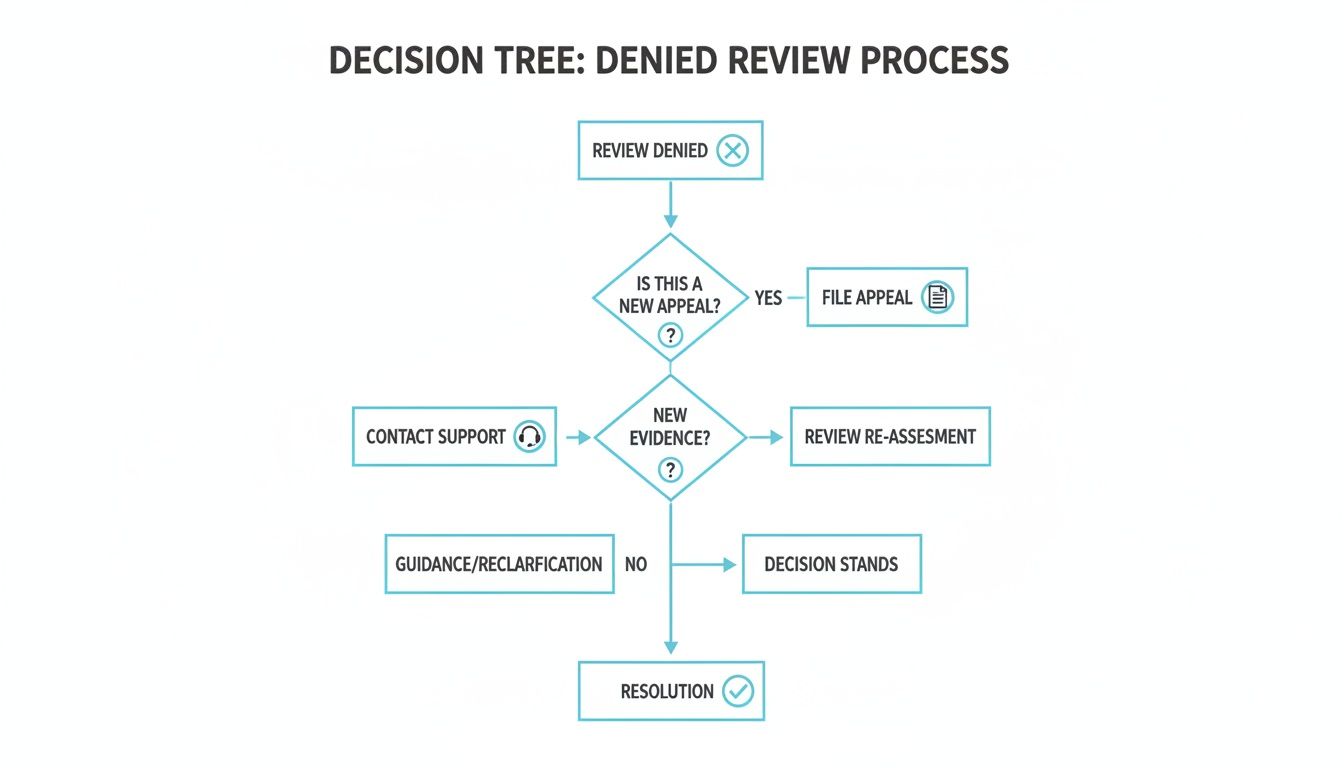
As you can see, every step forward offers a lower chance of success while demanding more from you. It’s a path that naturally pushes you toward a smarter alternative.
The Unreliable Game of Chasing Removals
The whole removal process isn't just tough—it's completely unpredictable. For contractors in the trades, recent data on review deletions paints a chaotic picture. One analysis of 50,000 removed reviews found something startling: 89.6% were 5-star reviews, not the 1-star headaches businesses were trying to get rid of.
Even crazier, 77.19% of those removals happened more than 10 days after the review was posted, which shows just how random the system is. As these findings about Google's review enforcement confirm, you’re often fighting a losing battle against an algorithm that’s just as likely to delete your best reviews as it is your worst.
This is a critical reality check. Your energy is your most valuable asset. Wasting it on a high-stress, low-reward process is a bad business move, especially when there's a much better way to handle it.
This is where you need to pivot. Stop playing defense and start playing offense. Instead of trying to erase one negative comment, your new mission is to bury it.
This shift in mindset opens the door to proactive reputation management. It’s a strategy that delivers a much higher return by focusing on what you actually control. You’re not fighting a losing battle anymore; you’re building a digital fortress so strong that one negative review becomes nothing more than a tiny blip on an otherwise flawless profile.
The Content Flood Strategy: A Smarter Alternative

If you've been fighting to get a bad review taken down, you already know the truth: it's a frustrating, uphill battle with no guarantee you'll win. So what's the better move? Instead of trying to erase a negative, you can bury it under an avalanche of positive, high-quality content that you control.
This is what we call the "content flood" strategy. It’s a proactive game plan. You shift your energy from defense to offense, building a digital fortress around your brand that makes you practically immune to the random potshots of a single bad review.
The goal is to dominate the first page of Google for your company's name. When a potential customer looks you up, they should find a wall of professional, positive assets that tell the real story of your business—not a distorted version from one unhappy client.
Auditing Your Digital Footprint
Before you start building, you need to see what your customers see. Open an incognito browser window (this gives you a clean, unbiased search) and type in your company name. What pops up?
You’ll likely see some combination of these:
- Your Google Business Profile, with that star rating right at the top.
- Your main company website.
- Review site profiles from Yelp, Angi, or HomeAdvisor.
- Your business Facebook page.
This is your current digital real estate. The content flood strategy is all about identifying the weak spots—like a low-rated profile on page one—and systematically creating better content to push them down and out of sight. This quick audit becomes your strategic roadmap.
Building Your Digital Moat
With your roadmap in hand, it's time to create the assets that will form your digital moat. Each piece of content you create is another opportunity to rank on page one and reinforce your good reputation. Think of it as building your own positive press.
For contractors, some of the most effective assets are:
- Detailed Project Showcases: Don't just have a generic gallery. Build out full pages on your site for specific jobs, complete with high-quality photos, a project description, and the location (e.g., "Custom Deck and Patio Installation in Anytown, TX"). These pages become powerful ranking signals for local searches.
- Video Client Testimonials: A video of a smiling customer talking about their great experience is pure gold. It’s authentic, builds instant trust, and is far more compelling than a simple written review.
- Local Press and Features: Did you sponsor a local charity run or get involved in a community event? Reach out to a local blogger or news site for a feature. A positive mention from a third-party source carries a ton of weight with Google.
- Helpful Blog Content: Write articles that answer the questions your customers are already asking. Think titles like, "What's the Best Roofing Material for High-Wind Areas?" This positions you as the go-to expert.
Instead of just fighting fires, a wider perspective on online reputation management tips can build long-term brand equity. This isn't just damage control; it's a forward-thinking investment in your business.
Promoting Your Positive Assets
Creating great content is just the first step. You have to actively promote it so that Google—and your customers—actually see it. By sharing these assets on social media and building links to them, you’re telling search engines that this content is valuable and deserves to rank high. This is exactly how you can effectively push down negative search results.
Over time, this process builds its own momentum. Your strong, positive assets gain authority and naturally displace the weaker, negative ones. That one-star review or unfair complaint gets bumped to page two of the search results, where it's basically invisible.
The real power of this strategy is that it transforms your online reputation from a liability you have to constantly defend into an asset that actively generates leads.
Recent data shows just how vital this approach is. In home services, where a single job can be worth thousands, trust is everything. Yet Google’s moderation is notoriously flawed—one analysis found that a staggering 73.1% to 89.6% of reviews removed by its filters were legitimate 5-star reviews. Contractors who get off this rollercoaster and focus on asset-building often see a noticeable difference within 30-60 days.
The content flood strategy puts you back in the driver's seat. You’re no longer waiting on Google's verdict. You’re building a resilient, powerful online presence that works for you 24/7.
Your Top Google Review Questions, Answered
Once you’ve gone through the process of trying to remove a Google review, a lot of questions pop up. It can be a frustrating and confusing experience, especially when you’re dealing with a comment that feels unfair or completely fake. Let’s cut through the noise and get you some straight answers based on years of experience with this stuff.
Think of this process as learning to see the situation from Google's point of view. It's less about demanding a result and more about building a solid case. If you're just dipping your toes into managing your online profile, it's worth taking a look at getting started with Google My Business to nail down the basics. A firm grasp of how the platform works is the foundation for managing your reputation effectively.
How Many Flags Does It Take to Remove a Review?
Let's bust a huge myth right away: there is no magic number of flags that will automatically get a review taken down. This idea that you can just get all your friends and employees to report a review is completely false.
A single report with clear, compelling evidence of a policy violation is infinitely more powerful than 100 flags with no proof. Google's system isn't a numbers game; it's designed to evaluate the quality of a report, not the quantity of clicks.
In fact, trying to game the system with mass flagging can seriously backfire. Google’s algorithms are sharp and can easily spot this kind of coordinated activity. They might just tag your efforts as spam, which could get your legitimate case ignored entirely.
Key Takeaway: Stop worrying about how many people report the review. Instead, concentrate on building one rock-solid case with undeniable proof. Your goal is to make it incredibly easy for the Google moderator to see the violation and agree with you.
Can I Sue Someone for a Bad Google Review?
Technically, yes, you can sue for a bad review. But the real answer is that it's a brutal, uphill battle that is incredibly expensive, drains your time, and rarely ends in your favor.
To have any chance of winning, you must prove the review is defamatory. This has a very specific legal meaning. It can't just be someone's opinion; it must be a false statement of fact that you can prove caused you tangible harm.
Let's look at an example:
- Opinion (Not Defamatory): "The plumber was rude and their work was sloppy."
- Potential Defamation (If Provably False): "The contractor stole my tools and never finished the job he was paid for."
The first one is just a customer’s subjective experience—you can't sue over that. The second makes a factual claim that can be proven or disproven. Even if you have proof, you're still facing a mountain of legal fees and a high burden of proof. Always talk to a lawyer first, but view legal action as the absolute last resort for only the most damaging and clearly false attacks.
Will Responding to a Review Help Get It Removed?
No. Your public response to a negative review has absolutely no impact on Google's removal decision. The team that investigates flagged reviews operates separately and doesn't consider your public reply as part of their evidence.
However—and this is important—you should absolutely still respond professionally to every negative review.
That response isn't for the reviewer or for Google's support team. It's for the hundreds of potential customers who will see that review in the future. A calm, respectful reply that acknowledges the feedback and offers a solution can completely defuse the situation. It shows prospective clients you stand behind your work and are committed to making things right. Your professional response often says more about your business than the original complaint.
If you're tired of battling unfair reviews and want to build a dominant online presence, Impruview can help. We use a proprietary content flood strategy to push negative results off page one and surround your brand with positive assets you control. Learn more at https://www.impruview.com.