Google Maps SEO services are all about getting your contracting business to show up in those top three map listings—what we call the "Local Pack"—when a customer in your area needs help now. It’s less about general website traffic and more about making your business the obvious choice for urgent, high-value service calls.
Why Google Maps SEO Services Matter for Contractors
Ever get that sinking feeling when you hear a competitor landed a big job you know you were qualified for? Chances are, they just showed up first on Google. That prime real-estate at the top of the search results, the Google Maps "Local Pack," isn't just for show. It's where the battle for local service calls is won or lost every single day.
For a contractor, showing up here is the difference between a phone ringing off the hook and a day filled with dead silence.
Think of Google Maps as the new Yellow Pages, but with a massive twist. Instead of flipping through pages, customers only see the top three businesses listed on the map. This is exactly where Google Maps SEO services come into play. It’s a very specific kind of marketing focused entirely on the signals Google cares about for local searches like "emergency plumber near me" or "roofer in Dallas."
The Unfair Advantage of the Local Pack
The data doesn't lie. A massive 46% of all Google searches have local intent, meaning nearly half of the people searching are looking for a business right in their neighborhood. But here’s the real kicker: that little map box at the top of the page captures an incredible 42% of all clicks.
The first organic result just below it gets a fraction of that traffic. If you're not in the Local Pack, you are literally invisible to a huge chunk of potential customers.
To really see what’s at stake, let’s compare the visibility and trust you get in the Local Pack versus showing up in the traditional search results below it.
The Local Pack Advantage at a Glance
| Metric | Local Pack (Top 3 on Map) | Traditional Organic Results (Below Map) |
|---|---|---|
| Click-Through Rate | Captures 42% of all local search clicks. | Gets significantly fewer clicks (under 10%). |
| User Intent | Catches users who are ready to call or visit. | Attracts users who might still be researching. |
| Visibility | Prime position at the very top of the page. | Positioned below the map, ads, and Local Pack. |
| Trust Signals | Prominently displays reviews, hours, and photos. | Relies on title and meta description alone. |
| Call to Action | Features a one-click "Call" button on mobile. | Requires users to click through to the website first. |
As you can see, the Local Pack is designed to connect ready-to-buy customers with local businesses instantly. It's a non-negotiable for any contractor looking for consistent, high-quality leads in 2026 and beyond.
This visibility is also your first line of defense. For contractors in trades like roofing, plumbing, or HVAC, your online reputation is everything. A targeted Maps SEO strategy ensures that when customers search for you, they see a 5-star profile, not one-off negative feedback. You can check out our in-depth guide on local SEO for contractors to get a better handle on building this kind of dominant presence.
Winning More Jobs Through Targeted Marketing
For contractors (or "tradies" as they're often called), getting a grip on digital marketing is the key to winning more local jobs. As a helpful guide on marketing for tradies points out, a strong presence on Google Maps is one of the most direct lines to more service calls and booked appointments.
It’s not just about getting found—it’s about being the business that customers choose when they’re ready to pull out their wallets.
The Core Pillars of Ranking on Google Maps
Climbing to the top of Google Maps isn’t about getting lucky—it’s about building a rock-solid foundation. If you really want to get into the weeds, this definitive guide to Local SEO Ranking Factors breaks down exactly how Google sizes up local businesses. But it all comes down to sending the right signals that prove your business is a legitimate, trusted, and relevant choice for customers in your area.
Think of it like building a house. Each of these pillars is a critical support beam. If one is weak, the whole structure feels shaky. The entire goal of professional google maps seo services is to systematically build and reinforce each one.
Pillar 1: Your Google Business Profile
Your Google Business Profile (GBP) is the absolute bedrock of your presence on the Map. It's not just another online listing; it’s your digital storefront, and it's the very first place Google looks for information about who you are and what you do. A neglected profile is like a shop with a busted sign and boarded-up windows—customers (and Google) will just keep on walking.
Getting this right means sweating the details and aiming for 100% completion. That includes things like:
- Nailing your primary category. Listing yourself as a "General Contractor" when you're really a "Plumber" is a surefire way to kill your chances of showing up for plumbing jobs.
- Listing all your service areas. If you work in three neighboring towns but only list your home base, you’re basically invisible to potential customers in those other areas.
- Uploading high-quality, geo-tagged photos. Pictures of your work, your team, and your branded trucks build instant trust and prove you're a real, active business in the community.
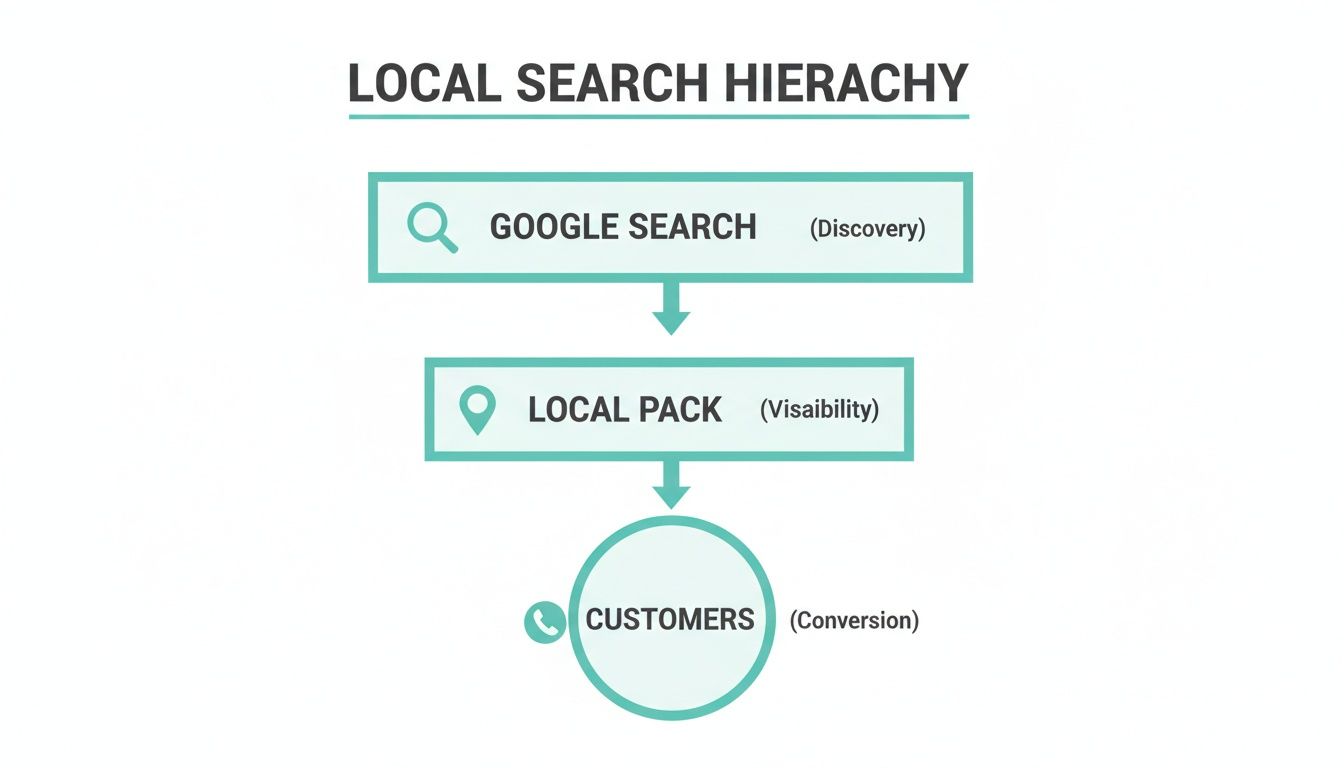
This flowchart shows exactly how local search funnels customers from a simple search right to your business via that all-important Local Pack. It proves that being visible there is the critical link between a customer's need and them picking up the phone to call you.
Pillar 2: Reviews and Reputation
If your GBP is the storefront, then your reviews are your reputation shouted from the rooftops. They are one of the most powerful trust signals you have, period. Google pays close attention to the volume, velocity (how fast you get them), and quality of your reviews. A steady stream of positive feedback tells the algorithm that you’re consistently making customers happy.
Think about it: Google treats reviews as free, user-generated content packed with valuable keywords. When a happy customer writes, "They handled our emergency AC repair in Phoenix perfectly," they've just helped you rank for that exact search term.
Simply having a great profile isn't enough; you have to keep it active. Businesses that post weekly updates and new photos can see 100-300% jumps in profile views and calls. This turns "near me" searches into actual jobs, especially since 76% of mobile local searchers will visit or contact a business within 24 hours. If you're ready to start building this crucial pillar, our guide on how to get Google reviews from customers is the perfect place to begin.
Pillar 3: Citations and NAP Consistency
A citation is just any mention of your business's Name, Address, and Phone number (NAP) online. Think of directories like Yelp, Angi, HomeAdvisor, and the Better Business Bureau.
When your NAP is perfectly identical across all of these important sites, it acts like a chorus of voices all confirming your business details for Google. This consistency builds a ton of credibility. But if the information is mixed up—a wrong phone number here, an old address there—it creates confusion and torpedoes your ranking potential.
Pillar 4: On-Site Signals and Local Content
Finally, your own website has to back all of this up by proving your local authority. This isn’t just about having a generic "services" page. It means creating specific pages dedicated to each service in each neighborhood you serve.
Pages like "Roof Repair in Scottsdale" or "Drain Cleaning in Mesa" directly connect your website's content to your Google Business Profile. This powerful one-two punch solidifies to Google that you aren't just a provider, you are the go-to expert for that service in that specific area.
What to Expect From a Google Maps SEO Service
Handing your business over to a Google Maps SEO service can feel a bit like a leap of faith. You know you need help, but what exactly are they going to do? A good agency won't operate in the shadows. They follow a clear, step-by-step process that starts with a thorough audit to get the lay of the land.
Think of it like a general contractor inspecting a property before starting a job. They’re not just going to start swinging hammers. First, they need to check the foundation, inspect the wiring, and see what the competition down the street looks like. This audit is that inspection, looking at your Google Business Profile (GBP), your online business listings, your customer reviews, and your local competitors. It’s all about spotting the weak points and hidden opportunities from day one.
This audit becomes the roadmap. Every item on the checklist, from your profile’s categories to the accuracy of your business info online, informs the strategy. It ensures the work is based on hard data, not just a hunch.
Foundational Optimization and Cleanup
With the audit complete, the real work begins. The first priority is to fix all the underlying issues uncovered in the initial inspection. It's the digital equivalent of renovating a property to get it up to code before you can even think about adding the fancy finishes.
This foundational work almost always includes:
- Total GBP Optimization: Every field in your Google Business Profile gets filled out with precision. This means choosing the most profitable primary category, listing every service you offer, and ensuring your hours and service areas are perfect.
- Citation Cleanup and Building: The team goes on a mission to find and fix any incorrect Name, Address, and Phone Number (NAP) details on sites like Yelp, Angi, and the BBB. Consistent information across the web is a massive trust signal for Google.
- Website and GBP Alignment: Your website’s service pages and contact information are fine-tuned to mirror and reinforce what’s on your Google profile, creating a consistent and trustworthy online presence.
If you want to dig deeper into why consistent business info is so critical, our guide on local listings management breaks down how these details directly influence your visibility.
Proactive Reputation and Review Management
Once your digital foundation is solid, the focus shifts to building an unbeatable reputation. A quality service doesn’t just cross its fingers and hope for good reviews. They set up a system to consistently generate positive feedback from your satisfied customers.
This is about more than just a five-star rating. Every new review is fresh, relevant content for Google, often packed with the exact keywords customers use, like "emergency AC repair" or "new roof installation."
A good service also takes charge of responding to all reviews—the good and the bad. Acknowledging feedback shows potential customers that you’re engaged and care about your clients, which builds trust and ultimately leads to more calls. This isn’t a one-and-done task; it’s an ongoing effort to keep your reputation sparkling and your phone ringing.
Real-World Contractor Scenarios and Solutions
Okay, enough with the theory. Let's talk about what this all looks like on the ground, where the jobs are won and lost. It’s one thing to understand the concepts, but it’s another to see how a smart Google Maps strategy can pull a business back from the brink.
Here are a couple of classic situations I’ve seen play out time and time again. These stories show just how much is at stake when it comes to your local online presence.
These aren't just hypotheticals. They’re based on the real struggles—and real victories—of contractors just trying to get their phone to ring in a competitive market.
Scenario 1 The Roofer Buried by One Bad Review
Picture this: a solid Dallas roofing crew. They do fantastic work, use top-shelf materials, and their team is solid. But the phone’s gone dead for the big-ticket roof replacements. Why? A single, nasty 1-star review from a client who was impossible to please is sitting right at the top of their Google profile. It’s torpedoed their average rating down to a painful 3.2 stars, scaring off new customers.
The Solution:
You can't just delete a bad review, so the goal wasn't to fight a losing battle. The strategy was to bury it with positivity.
- A Simple Review Push: We set up a simple system to automatically text every satisfied customer a direct link to the company's Google review page the moment the job was done.
- Active Reputation Management: The bad review was addressed publicly with a professional, calm response that showed they were listening. Just as important, every new positive review got a personal thank-you.
- Show, Don't Just Tell: We started uploading photos of their beautiful, recently completed roofing projects every single week. This showed Google—and potential customers—that they were active and doing quality work.
In just two months, this simple push brought in over 25 new 5-star reviews. Their rating rocketed to a much healthier 4.7 stars, and that one negative comment was pushed so far down the page nobody saw it. The phone started ringing again for the profitable jobs they were missing out on.
Scenario 2 The Invisible HVAC Company
Now let’s talk about a great HVAC company with a decade of experience but almost no online footprint. Their business was all word-of-mouth, which is fantastic but totally unpredictable. When a homeowner’s air conditioner died during a Texas heatwave and they searched "emergency AC repair near me," this company was nowhere to be found. They were completely invisible for the most urgent—and profitable—service calls.
You see this all the time. Home service businesses losing thousands a month in $500+ jobs because of a bad reputation on Google or Yelp. But a fully built-out Google Business Profile can drive 58% more direction requests. That’s real revenue. Polishing your online reputation can produce measurable results in 30-60 days, as you can see from these local SEO statistics.
The Solution:
For this company, it was all about building a digital foundation from square one.
- A Complete GBP Build-Out: We created and meticulously filled out their Google Business Profile. This meant adding every service they offered (like "AC Repair" and "Furnace Installation"), defining their exact service area, and uploading high-quality photos of their team and equipment.
- Building Local Trust Signals: Next, we got them listed in dozens of essential online directories like Yelp, Angi, and the BBB. The key was making sure their business Name, Address, and Phone number (NAP) were 100% consistent across the web.
The results were surprisingly fast. Within 60 days, they started popping up in the Google Map Pack for those critical, high-intent searches. Their phone began ringing with emergency calls from new customers who, just weeks before, had no idea they even existed. It was a direct, measurable boost to their bottom line.
Setting Realistic Timelines, Metrics, and Investments
Let's talk brass tacks. Starting a Google Maps SEO services plan without a clear timeline is like starting a kitchen remodel with no blueprint. You need to know what to expect and when. While you can see the needle start to move on some foundational fixes within 30 to 90 days, truly owning the map for competitive, high-value keywords is a longer game—think six months or more of consistent effort.
Think of it like building a reputation in a new town. At first, you're just getting your name out there, doing good work, and getting noticed. But to become the go-to contractor everyone recommends? That takes time, consistency, and a track record of excellence.
Measuring What Actually Moves the Needle
Success on Google Maps isn't just about hitting the #1 spot. The real win is when your phone starts ringing more often. Instead of getting hung up on a single ranking, a good marketing partner will focus on the metrics that actually put money in your pocket.
We're talking about tangible business results. These are the key performance indicators (KPIs) that show you're getting a real return on your investment:
- More Phone Calls: A measurable uptick in calls coming directly from your Google Business Profile.
- Driving Direction Requests: A surefire sign that a potential customer is planning to come to you.
- Clicks to Your Website: More qualified traffic heading from your map listing to your service pages.
- A Healthier Star Rating: Your overall rating climbing higher thanks to a steady flow of new, positive reviews.
The whole point is to turn those "plumber near me" or "roofer in [city]" searches into actual, paying jobs. All the action happens in the Google Maps "Local Pack"—those top three results get over 60-70% of all the clicks.
This is especially true for contractors. When a homeowner has a burst pipe, they aren't casually browsing. An incredible 76% of people who search for a local service on their phone visit a business within 24 hours. Many are ready to spend $500+ on the spot for an urgent fix, a point driven home in this breakdown on how to dominate local search results. That’s the real goal here.
Understanding What It Costs (and Why)
When it comes to pricing for Google Maps SEO services, there’s no getting around it: you get what you pay for. Those bargain-basement prices you see are almost always a red flag for automated, cookie-cutter tactics that do little for your business and can sometimes even get you penalized by Google.
A proper investment isn’t just about tweaking a few settings. It's about a comprehensive strategy that includes detailed manual work, expert content creation, and a proactive system for managing your reputation. Quality services cost more because that’s what it takes to attract the high-value clients who see your five-star presence and know you're the right choice. It’s not an expense; it’s an investment in your company's growth.
How to Choose the Right Google Maps SEO Partner
Picking a partner to handle your Google Maps SEO services is a big deal. You're not just buying a marketing service; you're investing in the future of your lead generation. Handing over the keys to your online presence requires real trust.
A bad choice can mean more than just wasted money. The wrong agency might use sketchy tactics that get your business profile penalized or even suspended by Google. The biggest red flag? Anyone who promises you a guaranteed #1 ranking. Don't fall for it. Real SEO is a steady process, not a magic button, and that kind of guarantee is the classic sign of a snake oil salesman.
A true partner won't hide behind jargon or mystery. They should be able to sit down with you and clearly explain their strategy, showing you exactly what they plan to do and why it will work.
Vetting Your Potential Partner
To make sure your investment is safe, you have to ask the right questions and dig a little deeper. Don't be shy about it. Any legitimate agency will welcome your questions because it shows you're serious about your business.
Use this checklist to screen any company you're considering:
- Can you show me case studies? Ask to see real-world examples of their work with other contractors. They need to show you measurable results—more calls, more clicks, more jobs—not just fluffy success stories.
- What does your reporting look like? A good partner gives you transparent reports that focus on what actually matters: calls from the map pack, requests for driving directions to a job site, and clicks to your website.
- How do you handle reputation management? Their plan must include a strategy for getting more positive reviews and responding to all feedback. This isn't just about rankings; it's about building trust before you even speak to a potential customer.
A truly effective Google Maps SEO service understands that your online reputation is just as important as your ranking. Their plan should reflect a dual focus on both visibility and building trust with potential customers.
By asking these direct questions, you can cut through the sales pitches and find a partner who is genuinely focused on getting you more business.
Frequently Asked Questions About Google Maps SEO
If you’re a contractor, you’ve got a lot on your plate. Figuring out online marketing can feel like a whole other job, so it's natural to have questions. Let's clear up a few of the most common ones we hear about Google Maps SEO services.
How Is Google Maps SEO Different From Regular SEO?
Think of it this way: regular SEO is like trying to become a famous fishing expert known across the country. The goal is to get your main website to show up for broad searches, establishing you as a national authority on a topic.
Google Maps SEO, on the other hand, is all about being the best fisherman in your local pond. It’s a specialized game focused on making you the go-to choice for customers right in your service area. The signals Google looks for aren't about national fame, but local trust.
It all boils down to three key things:
- Proximity: Are you physically close to the person searching?
- Relevance: Does your profile show you do the exact job the customer needs done right now?
- Reputation: What do your past customers say about you? This is where your reviews come in.
Can I Do Google Maps SEO Myself?
You absolutely can, and many contractors do. Taking care of the basics yourself—like filling out your Google Business Profile and starting to ask customers for reviews—is a fantastic way to get the ball rolling. If you're just starting out, this is a solid, no-cost first step.
The real value of professional Google Maps SEO services is speed and expertise. A seasoned pro can spot problems a busy contractor would miss, like messy business listings scattered across the web that are hurting your rank. They bring a proven system for generating reviews and creating the kind of local content that gets you noticed, saving you dozens of hours.
How Do I Remove a Bad Review?
This is a tough one. The short answer is, you usually can't. Google makes it incredibly difficult to get a negative review taken down unless it clearly breaks one of their specific content policies. Fighting it is often a long shot and a frustrating use of your time.
A much better strategy is to bury it. You can make one bad review irrelevant by drowning it in a flood of new, positive ones. This is what a good reputation management service is all about.
By consistently bringing in fresh 4- and 5-star reviews, you quickly boost your average rating. More importantly, you push that negative comment so far down the page that potential customers will likely never even scroll to it. You fix your reputation and improve your ranking at the same time.
Ready to stop losing jobs to unfair reviews and dominate your local search results? The team at Impruview specializes in building an unbeatable online reputation for contractors. Learn how we can push negative feedback out of sight and make your business the obvious choice for high-value customers. Discover our contractor-focused reputation solutions.