Think of an SEO audit service as a complete check-up for your website's health. It’s a deep dive that uncovers all the technical problems, content shortcomings, and even reputation dings that are secretly sabotaging your ability to rank on Google.
This process is the first step in creating a real-world strategy to boost your online visibility, fix what’s broken, and ultimately bring more paying customers through your door.
Why an SEO Audit Is Your First Step to Winning More Jobs
Imagine your website is supposed to be your best salesperson—out there 24/7, finding new customers and showing off your top-notch work. But what if that salesperson has a flat tire, a broken GPS, and is handing out business cards with the wrong phone number? That’s exactly what’s happening online when your website has technical glitches and can’t be found by potential customers.
So many contractors sink money into a beautiful website only to wonder why the phone isn’t ringing. The problem is almost always hidden beneath the surface, buried in the code and structure that search engines like Google use to decide who shows up first. Without a proper inspection, you’re likely losing business every single day and have no idea why.
The Blueprint for Your Online Success
You can think of SEO audit services like a thorough home inspection before you start a major renovation. You wouldn’t build a pricey new addition on a cracked foundation, right? In the same way, you shouldn't pour money into a marketing plan that’s built on a broken website. The audit gives you the blueprint for everything that comes next, making sure your time and money are spent effectively.
This diagnostic digs up all the "cracks in your digital foundation"—the kinds of issues that can be incredibly damaging but are often invisible to the average person.
- Technical Glitches: Things like slow loading speeds that make a potential customer with a burst pipe click away in frustration.
- Visibility Gaps: Missing local information that keeps you off Google Maps when a homeowner searches for a "roofer near me."
- Reputation Hazards: A single nasty review on Yelp that pops up before your own website when someone searches your company name, scaring off customers instantly.
An audit isn't just some techy report full of jargon. It's a business intelligence tool. It takes all that complex data and turns it into a straightforward action plan, showing you exactly what’s costing you jobs and how to fix it.
From Diagnosis to Dominance
At the end of the day, an audit’s main purpose is to give you a strategic plan that tackles these problems directly. This is especially vital for a local contractor trying to overcome a few unfair negative reviews. The audit pinpoints every single opportunity you have to build a stronger, more positive online footprint.
Instead of guessing what to do next, you get a clear, prioritized to-do list. For instance, an audit might show that your website doesn't answer the specific questions local customers are typing into Google, like "cost to replace an HVAC system." The plan would then be to create helpful content that answers that question, positioning you as the go-to expert in your area.
This proactive approach transforms your website from a simple online brochure into a powerful lead-generation machine. By getting to the root cause of why you’re not getting found, you can make targeted fixes that build trust, clean up your reputation, and start driving more qualified leads for your HVAC, plumbing, or roofing business. It’s the single most important first step toward winning online.
The 6 Core Pillars of a Contractor-Focused SEO Audit
A proper SEO audit for a local contractor isn’t some generic, one-size-fits-all checklist. It's more like a deep-dive diagnostic on your entire online presence. Think of it as a master mechanic looking under the hood of your digital marketing engine, checking every part to see what’s working, what's sputtering, and what’s just plain broken.
A truly comprehensive inspection drills down into six critical areas. These are the make-or-break factors that decide whether a potential customer finds—and trusts—you or your competitor down the street.
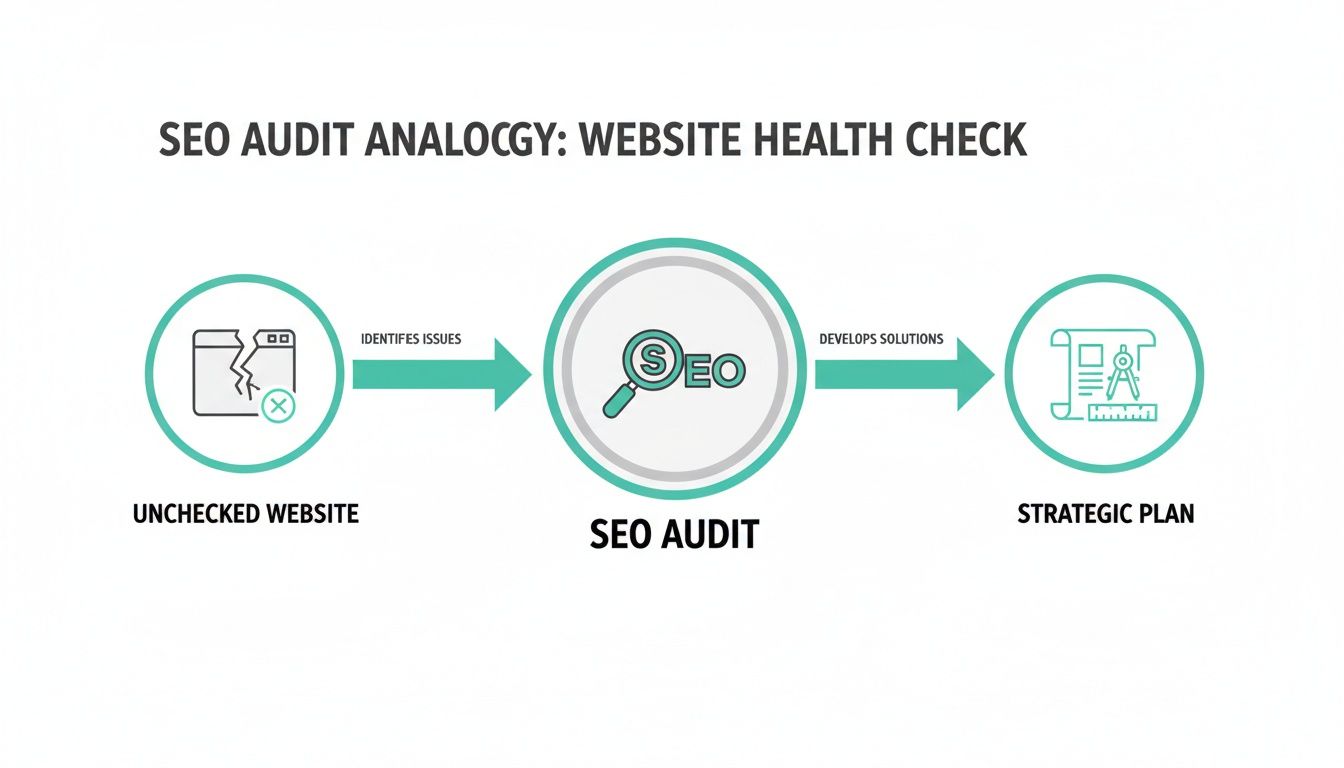
The audit process is what turns a messy, unpredictable online presence into a clear, strategic blueprint for growth. Each of these six pillars feeds into that final plan, ensuring no part of your digital foundation is left to chance.
For contractors trying to outrank bad reviews, understanding these six areas is the first step toward taking back control of your search results. The table below breaks down what each audit component looks at and why it's so important for your business.
Key Focus Areas in a Contractor SEO Audit
| Audit Component | What It Checks | Why It Matters for Contractors |
|---|---|---|
| Technical Audit | Site speed, mobile-friendliness, crawlability, security (HTTPS), and site structure. | A slow or broken site loses emergency jobs instantly. If a homeowner with a burst pipe can't load your site on their phone, they're gone. |
| On-Page Audit | Page titles, meta descriptions, headings, keyword usage, and internal linking. | This ensures you're showing up for what customers actually search for (e.g., "emergency AC repair" not "HVAC solutions"). |
| Content Audit | Quality, relevance, and originality of your service pages, blog posts, and project galleries. | Proves your expertise and builds trust. It's your chance to be the most helpful answer to a potential customer's problem. |
| Local SEO Audit | Google Business Profile optimization, local citations (NAP consistency), and geo-targeted keywords. | This is what gets you into the Google Map Pack. For a local service business, this is everything. |
| Backlink Audit | The quality and quantity of other websites linking to yours. | Good links from local suppliers or community sites are like trusted referrals. Bad links are like getting a bad reference—they hurt your credibility with Google. |
| Reputation Audit | Analysis of the entire first page of search results for your brand name. | Identifies negative reviews, bad press, or competitor attacks that are costing you business and helps create a plan to bury them. |
Each of these components gives you a piece of the puzzle. When you put them all together, you get a crystal-clear picture of where you stand and a step-by-step plan to dominate your local market.
Technical Audit: Is Your Site Built on Solid Ground?
Let's start with the foundation. The technical audit is all about the nuts and bolts of your website. If your site is slow, hard for Google to read, or doesn't work on a smartphone, everything else you do is a waste of time. It's like building a beautiful custom home on a cracked, unstable slab—it’s bound to fail.
This is especially true for contractors. A homeowner with a flooded basement isn't going to sit around waiting for a slow-loading website. They're on their phone and need help now. If your site takes more than 3 seconds to pop up, you've already lost that job. A technical audit flags these critical, money-losing issues.
- Mobile-Friendliness: Is your site dead simple to use on a phone, with a big, tappable "Call Now" button?
- Site Speed: How fast does your site load on a spotty 4G connection out in the suburbs?
- Crawlability and Indexing: Can Google actually find and understand your most important service pages?
On-Page and Content Audits: Are You Answering the Right Questions?
Next up, we look at the actual words and pictures on your website. The on-page and content audits examine everything from your page titles to your service descriptions to make sure your message is hitting home. Are you talking in industry jargon like "HVAC solutions" when your customers are frantically searching for "AC repair cost"?
This is where you win or lose in the regular search results. For example, research shows that simply having a target keyword in your URL can boost your click-through rate by 45%. And with Google rewriting 57% of meta titles it deems too long or unhelpful, getting this right is non-negotiable.
This isn't just about stuffing keywords into a page. It’s about proving your expertise and building trust before a customer ever picks up the phone. A great content audit ensures you become the most helpful, obvious choice to solve their problem.
Local SEO and Backlink Audits: Do You Own the Map?
For any local service business, the Local SEO audit is arguably the most important piece of the puzzle. This is what gets you featured in the Google Map Pack when someone searches for "plumber near me." This part of the audit is a deep-dive into your Google Business Profile, your listings in local directories (citations), and the quality of your customer reviews.
The Backlink Audit goes hand-in-hand with this. It looks at which other websites are linking to your site, essentially "vouching" for you. A link from the local Chamber of Commerce or a trusted supplier is like a gold-star referral in Google's eyes. On the flip side, spammy, low-quality links can actively harm your reputation. If you want to dig deeper, our guide on local SEO for contractors covers these strategies in detail.
Reputation Audit: What’s Your Digital First Impression?
Finally, the reputation audit ties everything together. It answers the single most important question: what do people see when they Google your company name? An SEO audit service shouldn't just look at your website; it must analyze the entire first page of Google for your brand.
This audit is designed to find:
- Negative Assets: Are there one-star Yelp pages, bad reviews, or negative news articles showing up?
- Positive Assets: What do you already control? This includes your website, social media profiles, and any good press.
- Opportunities: Where can you create new, positive content or profiles to push the negative stuff off of page one?
For a contractor, your reputation is your livelihood. This audit gives you the intel you need to take control of your online story and ensure that the first impression you make online is a five-star one.
Turning Audit Findings Into an Actionable Growth Plan
An SEO audit report stuffed with technical jargon and endless spreadsheets isn't just confusing—it's useless. The real magic of professional SEO audit services happens when all that complex data is translated into a clear, prioritized roadmap that actually helps you hit your business goals.
Think of it this way: a doctor could just hand you a lab report full of numbers. Or, they could sit down with you, explain what those numbers mean for your health, and lay out a step-by-step plan to get you feeling better. The audit should be the latter.
The final report you get shouldn't be a data dump. It needs to be a strategic blueprint for growth, designed to turn technical SEO issues into real-world results—like generating more qualified leads and burying those pesky negative reviews.

This plan is your guide to taking back control of your online reputation and turning your website into a machine that consistently brings in new jobs.
What a Quality Audit Delivers
A top-tier audit service doesn’t just point out what’s broken; it gives you a complete package built for action. You should walk away with a few key deliverables that all work together.
- A Comprehensive Report: This document should break down the audit’s findings in plain English, always tying technical problems back to your bottom line. Instead of saying, "Your site has a low domain authority," it should explain, "Because your website's authority is low, it’s easier for negative Yelp pages to outrank you for your own name."
- A Prioritized Task List: Let's be real—not all SEO tasks are equally important. A good plan will separate the urgent, high-impact fixes from the "nice-to-have" long-term goals. This lets you tackle the biggest problems first so you can see results faster.
- A Strategic Growth Plan: This is the most important piece of the puzzle. It connects the dots between the audit findings and a bigger strategy, explaining the how and why behind every recommendation.
For example, if the audit finds toxic backlinks from spammy websites, the plan will outline the exact process for cleaning them up. If it discovers that negative reviews are dominating your search results, the roadmap will detail a content-flooding strategy to create and promote positive web pages that you own and control.
Setting Realistic Timelines for Success
A good action plan will also give you a realistic timeline. SEO is a marathon, not a sprint, and any agency promising you instant first-page rankings is a major red flag. A credible plan will map out a phased approach.
A well-structured growth plan builds momentum. It starts with quick technical wins that can improve site performance in a matter of weeks, while simultaneously kicking off the larger, more sustained effort required for reputation management and content authority, which can take several months.
This dual-track approach is critical. It ensures you see some early progress, which builds confidence and lays the groundwork for the long-term strategy to pay off. For a contractor, this could mean fixing your Google Business Profile to get an immediate boost in local visibility, while simultaneously building out service pages that will eventually outrank any negative press.
To round out your strategy, you can also explore different methods of lead generation for contractors that work alongside your SEO efforts.
Ultimately, the goal is to get a document that empowers you, not overwhelms you. It should give you clarity, a clear direction, and a logical sequence of steps to turn your online presence from a liability into your most valuable asset.
Your Essential SEO Audit Checklist for Reputation Management
So, how can you tell if an SEO audit service is the real deal or just a cheap, automated scan dressed up to look impressive? The best way to vet a potential partner is to arm yourself with the right questions. You need to know what to look for to ensure they're focused on what actually matters to your business: your reputation.
This isn't a DIY guide for running your own audit. Think of it as your secret weapon. Use this checklist on sales calls to see how deep an agency’s expertise really goes. It’ll help you spot the difference between someone who just ticks boxes and a true partner dedicated to solving your core problem—building a five-star online reputation.

Reputation And Branded Search Audit
For any contractor battling unfair reviews, this is ground zero. A generic audit might gloss over this completely, but for you, it's the most important piece of the puzzle.
- Analysis of Page 1 Branded Search Results: Does their process include a manual review of the entire first page of Google when someone searches your company name? They should be able to identify every single positive, neutral, and negative result that shapes a customer's first impression.
- Identification of Negative Assets to Suppress: Will they pinpoint the specific negative URLs—think nasty Yelp pages, a low BBB rating, or an old news article—that need to be pushed off page one? A real reputation-focused audit is the blueprint for a suppression campaign.
- Competitive Branded Search Analysis: Do they look at what shows up for your top competitors? This is a goldmine of information, revealing what's working for them and where their weaknesses lie.
Technical SEO Audit
Think of technical SEO as the foundation of your house. If it’s cracked, everything you build on top of it—including all your positive content—is at risk of crumbling. A good audit must cover these basics.
- Mobile-First Indexing and Performance: Most customers find contractors on their phones, often in an emergency. Your site absolutely must be fast and easy to use on a mobile device. Ask if they specifically test for mobile speed and user experience.
- Crawlability and Indexability: Can Google and other search engines even find and understand your most important pages? The audit should uncover any "crawl budget" waste or indexing problems that are holding your site back from ranking.
- Website Security (HTTPS): A secure site (one with HTTPS) is a fundamental trust signal for both people and Google. It's a simple check, but a critical one.
Local SEO Audit
As a local service business, winning in your own backyard is everything. A thorough local audit is non-negotiable for driving qualified leads from your service area.
- Google Business Profile (GBP) Optimization: The audit has to include a deep dive into your GBP listing. They should check for accuracy and completeness and find opportunities to use features like Google Posts, Q&A, and services.
- Citation and NAP Consistency: Do they check that your Name, Address, and Phone number (NAP) are identical across all major online directories? Even small inconsistencies can confuse Google and tank your local rankings.
- Local Review Strategy Analysis: Will they analyze where your reviews are coming from, what people are saying, and how frequently you get them? This data is crucial for building a strategy to generate a steady stream of positive feedback. For a deeper look at this, our guide on reputation management services has you covered.
A proper audit doesn't just list problems; it connects them to business outcomes. For example, it should explain how inconsistent NAP data can prevent you from showing up in the Google Map Pack, directly costing you local jobs.
The global market for SEO audit services is exploding, expected to be a key part of a massive $203.83 billion industry by 2030. What’s driving this? The shocking fact that 96.55% of all web pages get zero organic traffic from Google, often because of simple, fixable issues an audit can uncover. This really drives home the value of choosing a comprehensive, strategic service over a quick, superficial scan. You can learn more about how a proper audit drives real results over at Whitehat SEO's blog.
Sample SEO Audit Checklist for Contractors
To help you visualize this, here’s a simplified checklist. Use these points as a starting point when talking to an agency to make sure they're covering the bases that matter most for a contractor's reputation.
| Audit Category | Key Checklist Item | Purpose |
|---|---|---|
| Reputation Audit | Manual review of page 1 for your brand name | To identify all positive and negative assets defining your current reputation. |
| Reputation Audit | Identify specific negative URLs for suppression | To create a targeted plan to push down damaging content. |
| Technical SEO | Mobile speed and user experience testing | To ensure your site works perfectly for customers searching on their phones. |
| Technical SEO | Crawlability and indexing analysis | To make sure Google can find and rank your most important pages. |
| Local SEO | Google Business Profile (GBP) deep-dive | To maximize visibility in local map searches and attract nearby customers. |
| Local SEO | NAP consistency and citation health check | To build trust with Google and solidify your local ranking signals. |
| Content Audit | Review existing content for reputation assets | To find opportunities to promote positive stories and testimonials. |
This table isn't exhaustive, but it gives you a solid framework. A truly valuable audit will expand on these areas, connecting each finding back to the primary goal: making your business the obvious and most trusted choice for customers in your area.
How to Choose the Right SEO Audit Service and Avoid Red Flags
Picking the wrong partner for an SEO audit can be a costly mistake. It's not just about the money you'll waste; it's about the months you'll lose while your online reputation problems get worse. The SEO world is full of agencies making flashy promises, but very few actually get what a local contractor needs to fix their online image.
Think of it like hiring a critical sub for a high-end remodel. You wouldn't just hire the cheapest plumber you could find and hope for the best. You'd find someone with proven experience, a solid reputation, and a clear plan. The same logic applies here. A cheap, automated scan will just spit out surface-level data, but a real, hands-on audit gives you the battle plan you need to solve real problems—like finally pushing that nasty Yelp review off the first page of Google.
Red Flags to Watch Out For
Keep an eye out for these warning signs. They usually point to inexperience, old-school tactics, or a focus on things that don't actually help your bottom line.
- Guarantees of #1 Rankings: This is the oldest snake-oil pitch in the SEO book. Nobody can promise you a specific spot on Google. The algorithm changes constantly, and anyone who says they can control it is either lying or naive. A real pro talks about improving your overall visibility and getting your phone to ring, not impossible guarantees.
- A Lack of Transparency: If an agency gets cagey about their methods and calls them "proprietary," you should be concerned. A trustworthy partner will walk you through their process, tell you what tools they use, and explain why they're recommending certain actions in plain English.
- Long-Term Contracts for an Audit: An SEO audit is a project with a defined start and finish. It’s a one-and-done service that delivers a strategic plan. If someone tries to lock you into a 12-month retainer just for the initial analysis, that's a major red flag.
Green Flags of a Great SEO Partner
On the flip side, a high-quality partner will show their value right from the first conversation. They'll act more like a consultant who’s invested in your success, not just a vendor selling a service.
Look for a provider who:
- Focuses on Your Business Goals: Do they start by asking about your lead targets and the specific negative reviews causing you headaches? Or do they just dive into jargon about keywords and backlinks? A great partner connects every single SEO task back to a real-world business goal.
- Provides Clear, Actionable Reporting: Ask to see a sample audit report. It should be easy to follow, clearly prioritize recommendations by impact, and explain the "why" behind every suggestion. You shouldn't need an SEO dictionary to understand it.
- Shares Relevant Case Studies: Can they show you how they've helped other local contractors? Seeing success stories from businesses just like yours is the best proof that they understand your unique challenges and have a playbook to solve them.
A top-tier SEO audit service is a strategic investment, not just a cost. The global SEO market is booming, and competition is fierce. The best providers deliver a custom roadmap designed to push negative reviews down and flood search results with the positive assets you control.
With the global SEO market projected to hit $143.9 billion by 2030, the demand for quality, in-depth audits has never been higher. Reputable firms often charge $100-$199 per hour for the kind of manual analysis that produces a real strategy—a world away from a cheap automated report. You can find more information about SEO audit company pricing and services on AccountabilityNow.net.
Common Questions About SEO Audits for Contractors
Even with a clear plan, it's smart to have questions before you invest in something like a professional SEO audit service. For contractors, every dollar and every lead is critical, so getting straight answers is non-negotiable. Here, I'll tackle the most common questions we hear from business owners just like you.
My goal is to give you clear, no-nonsense responses that address the real-world challenges you're facing, from dealing with a bad online reputation to seeing a real return on your investment.
How Often Does My Business Need an SEO Audit?
Think of your first big SEO audit as the full-blown property inspection you get before buying a house. It's a deep, foundational teardown that gives you the complete blueprint for your online marketing. You really only need this massive deep dive once, right when you're getting serious about your online presence and want to build everything on a solid foundation.
After that initial heavy lift and once you've fixed the most pressing issues, you won't need another audit on that scale for about 12 to 18 months. Your digital foundation should be pretty solid.
But that absolutely does not mean you can just set it and forget it. The smartest contractors we work with schedule quarterly "health checks." These are much quicker, more focused mini-audits that look at just a few key things:
- Reputation Monitoring: Are any new negative reviews or unflattering articles starting to creep up in your search results?
- Local Keyword Tracking: How are you ranking for your money-making local keywords, like "emergency plumber in Phoenix"?
- Technical Health: Have any new website errors or speed issues popped up since the last time we looked?
It's the difference between that one-time home inspection and the regular seasonal maintenance you do to keep your house from falling apart. The big audit sets the grand strategy, and the quarterly checks make sure you stay on course.
Can an SEO Audit Really Help with Bad Online Reviews?
Yes, it absolutely can—but it's so important to understand how. An SEO audit is not a magic wand that makes bad reviews vanish. Honestly, trying to get reviews removed is usually a dead-end street that just leads to frustration.
Instead, a real SEO audit is the critical first step in a powerful suppression and displacement strategy.
The audit serves as your strategic intelligence report. It finds every single digital asset you already have—your website, social media profiles, business directory listings, and any positive press you’ve ever gotten. More importantly, it uncovers all the opportunities to create new positive assets that you have complete control over.
The goal isn't to erase the negative; it's to bury it. An audit gives you the battle plan to create a flood of positive, authoritative content that is designed to outrank the bad stuff, pushing it down onto page two of Google where almost nobody will ever see it.
This means your audit's action plan will lay out exactly how to build and promote content that shines a spotlight on your five-star work, helping you win the war for the first page.
What Is the Difference Between a Free Tool and a Professional Service?
This is probably one of the most critical things to understand. Using one of those free online audit tools is like seeing your car's "check engine" light come on. It tells you that a problem exists, but it gives you zero helpful context. It can't tell you what's causing it, how bad it is, or what you need to do to fix it.
A professional SEO audit service, on the other hand, is like having a master mechanic hook your car up to a professional diagnostic computer. They don't just see the error code; they interpret all the data, run more tests, and then hand you a prioritized list of what needs fixing, why it matters, and what it'll take to get it done.
Here’s a quick way to see the difference:
| Feature | Free Automated Tool | Professional Audit Service |
|---|---|---|
| Analysis | Spits out generic data (e.g., "74/100 score") | Provides in-depth, manual analysis and interpretation |
| Context | Offers no business-specific context or "why" | Connects technical issues directly to business goals (e.g., lead loss) |
| Strategy | Delivers a generic, non-prioritized checklist | Creates a custom, prioritized action plan and strategic roadmap |
| Focus | Looks at surface-level technical metrics | Focuses on deep analysis, including reputation and competitor insights |
At the end of the day, a free tool gives you data. A professional service delivers business intelligence and a real strategy built specifically for your goals, whether that's burying bad reviews or just getting more qualified local leads.
How Long Does It Take to See Results from an Audit?
Results don't happen all at once. They come in phases. Think of it as building momentum over time—you'll get some quick wins early on, which pave the way for long-term dominance.
First, the audit itself is a careful, manual process. A truly comprehensive audit will take one to three weeks to complete. This ensures a deep analysis, not just a quick, automated scan.
Once you start putting the audit's action plan into motion, the timeline for results usually looks something like this:
- Quick Technical Wins (First 30-60 Days): You can often feel the first positive impacts almost immediately. Fixing critical technical problems like a slow website, broken links, or messy local business listings can give you a nice, quick boost in both performance and visibility.
- Strategic Content and On-Page Results (2-4 Months): As you start rolling out better on-page SEO and publishing new, optimized content, you'll begin to see your rankings climb for your most important service keywords.
- Reputation Management and Authority Building (3-6+ Months): The really big, game-changing results—like successfully pushing a negative review off of Google's first page—take more time and consistent effort. That’s because it takes time for your new, positive content to earn the authority it needs to outrank those older, negative pages.
It's a strategic investment in your business's future. The initial fixes stop the bleeding right away, while the long-term strategy builds an online reputation that's powerful and built to last.
Are you tired of losing jobs to unfair reviews? At Impruview, we specialize in helping contractors take back control of their online reputation with a proven content flood strategy. We start with a comprehensive audit to build your custom roadmap to a five-star presence.