If you want to rank higher on Google Maps, your entire strategy starts and ends with your Google Business Profile (GBP). This isn't just another online directory; for a home service business, it’s your digital storefront, your first impression, and often the deciding factor for a homeowner needing immediate help.
A complete, active, and meticulously managed profile signals to Google that you're a legitimate, trustworthy business worth showing to its users.
Build Your Foundation for Google Maps Dominance
Think of it this way: your Google Business Profile is the foundation of your online presence. Everything else—your website, your ads, your social media—builds upon it. If that foundation is shaky, the whole structure can crumble. For contractors, I've seen it time and again: the companies that dominate the local map pack are the ones who treat their GBP with the seriousness it deserves.
This is especially true when you consider how modern customers find services. They aren't just searching for "plumber"; they're on their phones looking for help right now. This is the power of 'near me' searches and Google My Business, and a well-built profile puts you right in front of those high-intent customers.
Nail Your GBP Categories and Attributes
Here's where most businesses make their first mistake: choosing the wrong categories. This is non-negotiable.
Your primary category must be the single most accurate description of your main service. If you're an HVAC company, choose "Heating contractor" or "Air conditioning contractor." Don't get cute and pick something broad like "Home services"—that tells Google almost nothing.
Once your primary category is locked in, add secondary categories for your other major service lines. Think "Air conditioning repair service" or "Furnace repair service." These are crucial for capturing searches specific to those jobs.
Now for the details that seal the deal: service attributes.
- Offerings: Do you offer free estimates? What about 24-hour emergency services? Add them. These are powerful filters for customers in a pinch.
- Planning: Let people know if appointments are required or if they can get an online estimate.
- Business Details: Are you veteran-led or women-owned? These attributes are becoming more prominent in search and can create a strong connection with certain customers.
Getting this level of detail right is how you show up for a search like "emergency hvac repair with free estimates near me" instead of just disappearing into the crowd.
Keep Your Profile Active and Visually Engaging
A "set it and forget it" approach is a death sentence for your Google Maps ranking. Google wants to see that you're an active, breathing business. The two best ways to signal this are by consistently adding new photos and creating Google Posts.
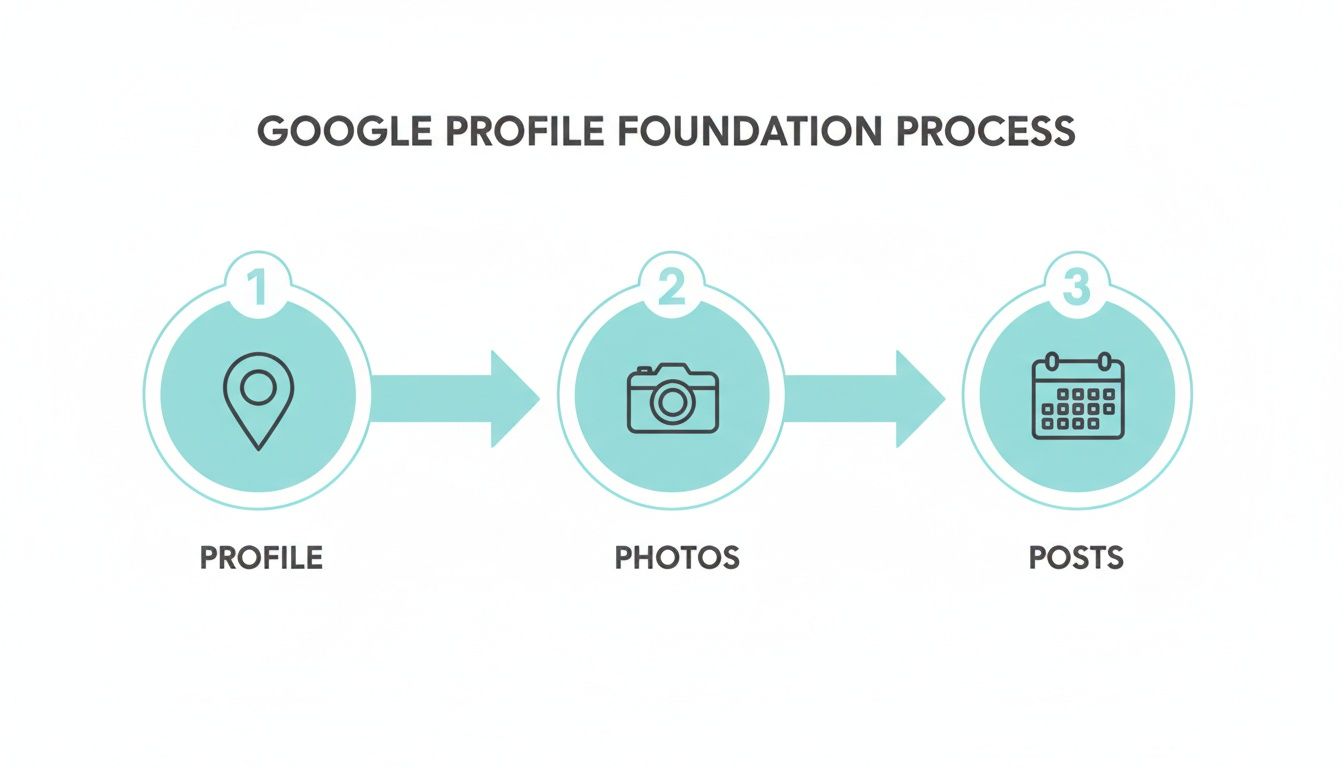
This simple three-part process—a solid profile, fresh photos, and regular posts—is the engine of your Google Maps strategy.
For a contractor, photos are your most powerful tool. They offer visual proof of your craftsmanship and build trust before a customer even picks up the phone.
Expert Tip: Don't just upload professional, staged shots. Snap photos on your phone of every completed job—a newly installed water heater, a freshly repaired roof, a tidy electrical panel upgrade. These real-world images feel authentic and show Google your business is active this week, not just last year.
Profiles with a steady stream of fresh photos consistently get more calls and clicks. It’s a simple, powerful tactic. Of course, your GBP is only one piece of the puzzle. All this effort needs to be supported by a strong website, which is a core part of local SEO for contractors.
Building Authority With Citations And On-Page SEO

Think of your online business information as a set of fingerprints. If those prints are smudged or inconsistent across different websites, Google's algorithm gets confused. That confusion chips away at its trust in your business, and your Google Maps ranking is what suffers.
To climb the ranks in the local pack, you have to build undeniable trust with search engines. This comes down to two critical pieces of the puzzle: consistent citations and smart on-page local SEO. Let's walk through how to get both right.
Nail Down Your NAP Consistency
Your NAP—Name, Address, and Phone Number—is the foundation of your digital identity. It needs to be an exact match everywhere. I mean everywhere.
I’ve seen contractors’ rankings torpedoed by something as simple as using "St." on one directory and "Street" on another. Even "Co." versus "Company" can throw a wrench in the works, creating conflicting signals that hurt your authority.
A classic mistake is using different phone numbers across platforms, like a call-tracking number here and a main line there, or mixing in a toll-free 800 number. Google often sees this as a red flag and heavily prefers a local area code that confirms your physical location. One wrong phone number on a major directory can undo weeks of hard work.
Your first job is to audit your listings on the directories that matter most for home services:
- Yelp: A non-negotiable. It's a huge source of reviews and a powerful citation for Google.
- Angi: Absolutely essential for anyone in the home services industry.
- Yellow Pages: Believe it or not, it’s still a relevant data source that Google crawls regularly.
- Industry-Specific Sites: Don't forget local builder's associations, trade groups, or supplier directories.
The goal is a perfect mirror. Your business name, street address, and local phone number must be identical to what you have listed on your Google Business Profile.
A consistent NAP isn't just about playing defense to avoid penalties. It’s an offensive strategy to build trust. Every time Google finds your correct information on a reputable site, it’s another vote of confidence that proves you're a legitimate local business. That's what moves the needle on your map ranking.
Cleaning up these citations can feel like a grind, but it pays off. Some analyses have shown that fully optimized profiles with consistent local keywords can rank up to 50% higher in Maps results. It’s a foundational step that directly impacts your visibility. You can read the analysis on WordStream to see the data for yourself. For contractors wanting to get this done without the headache, a local citation builder can be a huge time-saver.
To put this in perspective, here's a look at how different signals stack up and the common stumbles I see contractors make.
Local SEO Signal Impact Comparison
This table breaks down some of the most important local SEO signals, showing where they have the biggest impact and the easy-to-make mistakes that can hold you back.
| SEO Signal | Impact on Google Maps Rank | Common Contractor Mistake | Quick Fix |
|---|---|---|---|
| NAP Consistency | High | Using different phone numbers or address variations (e.g., St vs. Street). | Perform a citation audit and correct all inconsistencies to match your GBP. |
| Google Reviews | High | Ignoring negative reviews or not asking for new ones consistently. | Set up a simple system to request reviews from every happy customer. |
| GBP Categories | High | Choosing overly broad or incorrect business categories. | Select the most specific primary category (e.g., "HVAC Contractor" not "Contractor"). |
| On-Page Local SEO | Medium | Having a single "Services" page for all cities you serve. | Create separate, geo-targeted pages for each core service in each main city/area. |
Getting these basics right separates the businesses that show up on the first page of Google Maps from the ones that don't. It's all about sending clear, consistent signals to Google about who you are, where you are, and what you do.
Tune Up Your Website for Local Signals
Once your online fingerprint is clean and consistent across the web, it's time to make sure your own website is sending the same strong signals. Your site needs to shout "I am a local business that serves this specific area!" This goes way beyond just sticking your address in the footer.
A game-changing tactic here is creating geo-targeted service pages. Instead of a generic "Roofing Services" page, you build out pages like "Asphalt Shingle Repair in North Austin" and "Metal Roof Installation in Round Rock." This strategy tells Google with extreme precision not only what you do, but where you do it.
Reinforce Geographic Relevance on Your Site
Here are a few actionable ways to beef up the local signals on your own website:
- Page Titles and Headers: Your main
H1andH2headings are prime real estate. An H1 could be "Expert Electrical Services in Phoenix," followed by an H2 like "Your Trusted Residential Electrician in Scottsdale." - Embed a Google Map: On your contact page or your primary service area page, embed the actual Google Map of your business. This creates a direct, powerful connection between your website and your Google Business Profile.
- Create Local Content: Write blog posts about projects you’ve completed in specific neighborhoods, with photos. Talk about local events your company sponsors. Or address issues relevant to your local climate, like "How to Prepare Your Plumbing for a Dallas Winter Freeze."
When your on-page tactics and your off-site citations are all telling Google the same story, you create a powerful, unified signal. That synergy is exactly what you need if you want to know how to rank higher on Google Maps and, more importantly, stay there.
Using Reviews to Boost Your Rankings and Reputation
Reviews are the modern-day word-of-mouth for contractors. They're not just a way to build trust with potential customers; they're one of the most powerful signals you can send to Google's ranking algorithm. A consistent stream of positive feedback tells Google that you're a prominent, relevant business that people trust.
Think about it from Google's perspective. Its entire job is to connect a user with a problem—like a burst pipe at 2 AM—with the best possible solution. What's a better sign of a great local business than a history of happy customers? That's why reviews have such a heavy influence on who shows up in the coveted local 3-pack.
Why Every Review Matters to Google
Google doesn't just glance at your star rating and call it a day. Its algorithm digs much deeper, analyzing several aspects of your review profile to figure out where you should rank. If you want to know how to climb higher on Google Maps, you need to know what it's looking for.
Here’s what Google’s algorithm is really paying attention to:
- Review Volume: This is your total count. A business with 150 reviews simply looks more established than one with 15.
- Review Velocity: This is the pace at which you're getting reviews. A plumber getting five new reviews every month sends a much stronger signal than a roofer who got 20 reviews three years ago and has been silent ever since. Freshness matters.
- Review Quality: Your average star rating is obviously huge. Google wants to recommend top-rated businesses.
- Review Content: The actual words customers use are gold. When someone writes, "They were the best emergency HVAC repair I could find in South Austin," it directly reinforces your service and location for that exact search term.
Google's algorithm for local prominence leans heavily on reviews. We've seen that businesses able to maintain a 4.5+ star average and generate consistent monthly reviews often dominate the map pack. A deep dive into over 8,000 businesses showed that both the star rating and the specific keywords in reviews—like a customer mentioning 'fast drain cleaning in Midtown'—can directly push rankings up, sometimes by as many as 20-30 positions.
A realistic target for most home service companies is to aim for 5-10 new reviews each month. This consistent activity proves to Google that you're still in the game and keeping customers happy. We've consistently seen that contractors with this steady flow outrank competitors who let their reviews go stale. For a deeper look at how these factors work, you can explore the comprehensive analysis on mapranking.com.
Systematize Your Review Generation
Hoping and praying for reviews isn't a strategy. The only way to get a steady flow of feedback is to build it right into your workflow. You need a simple, repeatable process that makes it incredibly easy for happy customers to share their experience.
One of the most effective tactics I've seen is a simple text message follow-up. The moment a job is done and you know the customer is happy, have your tech or someone in the office send a quick text with a direct link to your Google review page.
Example Text Message You Can Use Today:
"Hi [Customer Name], it's [Your Name] with [Your Company]. Thanks again for trusting us with your project today! If you have 30 seconds, we'd be grateful if you could share your experience on Google. Here's the link: [Your Google Review Link]."
This works so well because it's immediate, personal, and catches people right on their phones. To see more techniques, check out our guide on how to get Google reviews from customers.
Respond to Every Single Review
This is probably the most overlooked part of managing your online reputation, but it's absolutely critical. You need to reply to every review you get—the good, the bad, and the neutral.
For Positive Reviews:
A simple "Thanks!" is okay, but a personalized response is far better. Mention the service they got or the technician by name. This shows you're actually listening and it's a great chance to sneak in more keywords. For example, "Thanks, Sarah! We're thrilled our team could get your new tankless water heater installed so quickly."
For Negative Reviews:
This is your moment to shine. A bad review isn't a disaster; it's an opportunity to publicly demonstrate outstanding customer service. Always respond promptly and professionally. Acknowledge their frustration, apologize that their experience wasn't perfect, and offer to resolve the issue offline. Future customers see these responses, and how you handle problems can be more persuasive than a dozen 5-star reviews.
Make no mistake, Google is watching. An owner who actively engages with all reviews, especially within a few hours, signals a customer-focused business. And Google rewards businesses that care.
Advanced Tactics For Competitive Markets

Once you've nailed the fundamentals—your GBP is dialed in, your citations are clean, and you have a good review process—it's time to pull away from the competition. In crowded markets for trades like roofing or plumbing, just doing the basics means you're just one of the crowd.
The contractors who truly dominate the Google Map Pack are the ones playing a different game. They've moved beyond the checklist and are using smarter, more nuanced strategies to build a competitive moat. Let's dig into the tactics that will get you there.
Create Hyper-Local Service Pages
One of the most common mistakes I see on contractor websites is a single, generic "Services" page that lists everything they do. This is a huge missed opportunity. If you want to own the map, you need to prove your relevance street by street, not just city-wide.
The solution is to build out dedicated, geo-targeted pages for each service in each key location. Instead of a single "HVAC Services" page, think more granularly:
- "Emergency AC Repair in Scottsdale"
- "Furnace Installation for Mesa Homes"
- "Ductless Mini-Split Services in Tempe"
Each page should be a deep dive. Talk about the specific challenges in that area—maybe older homes in Tempe need different HVAC considerations than new builds in North Scottsdale. Mention local landmarks or neighborhoods. Feature a testimonial from a client in that exact zip code. This tells Google you aren't just available in that area; you are the established expert there.
Take Control of Your GBP Questions & Answers
Your Google Business Profile's Q&A section is a public forum that most of your competitors are completely ignoring. Here's a pro tip: you don't have to wait for customers to ask questions. You can—and absolutely should—populate this section yourself.
Think about it. What are the top 5-10 questions your office manager fields every single day? Ask those questions on your profile, and then answer them yourself from your business account. This lets you get ahead of common concerns and frame the conversation.
A few proactive Q&A examples:
- Question: "Do you offer financing for a new roof installation?"
- Answer: "Absolutely. We offer several flexible financing options to fit your budget. We believe every family deserves a safe roof, and you can even get pre-qualified right on our website."
- Question: "Are your electricians licensed and insured?"
- Answer: "Yes, 100%. All of our electricians are fully licensed, bonded, and insured for your peace of mind. Our license number is [Your License #]."
By seeding your Q&A, you’re providing instant answers, building trust, and naturally weaving in important keywords. Google sees this as a sign of an engaged, helpful business, which directly contributes to your profile's authority.
Remember, the GBP Q&A is a living FAQ that Google's algorithm pays close attention to. By pre-filling it with high-value information, you're not just helping customers; you're building a powerful asset that helps you rank for a wider range of searches on Google Maps.
Earn High-Authority Local Backlinks
Think of backlinks as votes of confidence from other websites. When another site links to yours, it's a signal to Google that you're a credible and important part of the local community. But not all links are created equal. A link from your local Chamber of Commerce website is worth 100x more than a link from a random, low-quality directory.
So, how do you get these powerful local endorsements? Get involved in your community.
- Sponsor a local event like a little league team, a charity 5K, or a high school fundraiser. These organizations almost always have a sponsors page with links back to their supporters.
- Team up with non-competing local businesses. A great roofer can be a valuable partner for a real estate agent, an insurance agent, or a property manager. You can co-author a blog post or simply agree to feature each other on your respective "partners" pages.
- Join professional and business associations. Your local Chamber of Commerce, BNI chapter, or trade-specific association is a fantastic source for an authoritative link.
Pursuing these links is about more than just SEO. It’s about weaving your business into the fabric of your community. Google rewards businesses that are genuinely local authorities, and these are the types of real-world signals that are impossible for out-of-town competitors to fake.
For a deeper dive, many successful contractors eventually explore advanced local SEO lead generation strategies that build upon these foundational link-building tactics to create a predictable flow of inbound leads.
To help you put these ideas into action, we've created a checklist of advanced tactics that can give you a serious competitive advantage. Some are easier than others, but all of them contribute to building a stronger local presence.
Advanced Local SEO Tactics Checklist
| Tactic | Difficulty | Potential Impact | Implementation Tip |
|---|---|---|---|
| GBP Q&A Seeding | Easy | Medium | Dedicate 30 minutes to list your top 10 customer questions and post them with helpful answers. |
| Hyper-Local Pages | Medium | High | Start with your highest-value service in your most profitable neighborhood. Build one new page per week. |
| Local Sponsorships | Medium | High | Look for community events or youth sports leagues. The cost is often low and the marketing/SEO benefit is high. |
| Video Testimonials | Medium | Medium | Use your phone to capture a quick 30-second video of a happy client at the job site. Post it to your GBP and website. |
| Guest Posting | Hard | High | Partner with a local real estate agent and offer to write a blog post for their site on "5 Things to Check Before Buying a Home." |
| Host a Local Workshop | Hard | High | Partner with a hardware store to host a free "DIY Basics" workshop. Promotes your brand and earns local media attention. |
Don't feel like you need to tackle all of these at once. Pick one or two that feel achievable and start there. Consistent effort on these advanced strategies, on top of a solid foundation, is what separates the businesses that just show up from the ones that truly own their local market on Google.
Tracking Your Success And Measuring What Matters
So you've put in the work. You’ve polished your Google Business Profile, hunted down and fixed every last citation, and have a steady stream of five-star reviews coming in. But here's the million-dollar question: is any of it actually working?
You can’t improve what you don’t measure. Plowing ahead without tracking your performance is like driving without a dashboard—you might feel like you're moving, but you have no idea how fast you're going or if you're about to run out of gas. Let's stop guessing and start using the hard data Google gives you to make smarter decisions that lead directly to more calls and booked jobs.
Diving Into Your Google Business Profile Insights
Think of your Google Business Profile dashboard as mission control. The "Performance" tab, in particular, is a goldmine of information, showing you exactly how potential customers are finding you and interacting with your business on Google Search and Maps.
This isn't about vanity metrics. We're talking about tracking the specific actions that put money in your pocket. The trick is knowing what to look for and what it all means.
Here are the numbers that truly matter for a home service business:
- Business profile interactions: This is your big-picture number, a total of all the actions people took on your profile. It’s a great way to gauge your profile’s overall engagement at a glance.
- Calls: For any contractor, this is a bottom-line metric. It counts every person who tapped that call button right from your profile. More calls usually mean more leads.
- Website clicks: This shows how many people clicked through to your website. They’re likely looking for more details on your services or trying to find a contact form.
- Directions: This tracks requests for driving directions to your business. While it’s more critical for businesses with a physical showroom, it’s still a positive signal that someone is engaged.
These metrics tell a story. If your calls are climbing month after month, it’s a great sign your optimizations are attracting high-intent customers. But what if website clicks are up, but calls are flat? That might point to a problem on your landing page—maybe the phone number is hard to find or the page is slow to load on mobile.
Understanding How Customers Search For You
Beyond just counting clicks and calls, it’s vital to understand how people are finding you in the first place. The Performance report gives you a clear breakdown that reveals the health of both your brand and your local SEO.
Direct Searches vs. Discovery Searches
| Search Type | What It Means | Why It Matters for Contractors |
|---|---|---|
| Direct | Someone searched specifically for your business name, like "Impruview HVAC." | This reflects your brand strength. These are often repeat customers, referrals, or people who saw your truck. |
| Discovery | Someone searched for a service you offer, and you showed up. Think "emergency plumber near me." | This is where your SEO efforts shine. A high number of discovery searches means you’re winning new customers who didn’t know your name before they needed your help. |
A healthy business has a good mix of both. Discovery searches are your engine for growth, proving that you're successfully ranking for the valuable, non-branded keywords that bring new clients through the door.
Visualizing Your Rank With Geogrid Tools
While GBP Insights are fantastic, they have one big blind spot: they don't tell you where you rank on the map for your most important keywords. For that, you need a specialized tool.
A geogrid tracking tool is an absolute game-changer for any contractor operating in a specific service area.
Instead of giving you a single, vague "average rank," a geogrid tool runs searches from dozens of different points across your city. It then builds a visual heat map of your rankings, showing you exactly where you appear in the coveted 3-pack and where you're basically invisible.
A geogrid report might show you're crushing it—ranking #1 for "AC repair"—in the neighborhoods right around your office. But just three miles away, you drop to position 15. This data is pure gold. It tells you precisely which areas need more love, maybe through geo-targeted service pages or a new set of localized customer testimonials.
This level of granular insight lets you be surgical with your local SEO. You can see the direct impact of your strategy in different zones, double down on what’s working, and stop wasting time and money on tactics that aren't moving the needle where it counts.
Clearing Up Your Google Maps Ranking Questions
Even with the best action plan, you're bound to have questions. When it comes to ranking on Google Maps, it can feel like there are a million little details and "gotchas" that can trip you up.
I get these questions from contractors all the time, so let's clear the air on a few of the most common roadblocks I see business owners hit.
Can I Use a PO Box or Virtual Office for My Google Business Profile?
I see this one a lot, and the temptation is understandable, but the answer is a hard no. Trust me, trying to use a PO Box or a mailbox at the local UPS store is one of the fastest ways to get your Google Business Profile suspended.
Google's entire local search system is built on trust and verifying real, physical business locations. A PO Box screams "I don't actually have an office here," and Google will flag it almost instantly. The same goes for most virtual office addresses. While it might seem like a smart workaround, Google has gotten very good at sniffing these out, and it's simply not worth the risk of suspension.
Don't try to outsmart Google on this. Your business address has to be a real, physical place you own or lease where you can get mail.
If you run your service business from your house, that's perfectly fine! Just register your home address during setup. You can then select the option to hide the address from your public profile and show a service area instead. This keeps you in Google's good graces while making sure you show up for customers in all the right places.
How Long Will It Really Take to See My Rankings Improve?
This is the big one, isn't it? The honest, no-fluff answer is: it depends. Think of local SEO as a long-term investment, not an overnight fix. While you can see some quick wins, climbing to the top of the map pack and staying there takes consistent work.
Here’s a timeline I typically give my clients:
- Months 1-3: Right after we do a full sweep of your Google Business Profile—fixing the address, adding great photos, and getting those first few reviews in—you should feel some momentum. You might see a bump in discovery searches or your phone might ring a little more often. This is the foundation.
- Months 3-6: Now we're building on that foundation. As you get a steady stream of reviews, clean up your business listings across the web, and start publishing content for your specific service areas, your visibility will become more solid. You'll start to see your rankings climb on the geogrid, especially in the zones closest to you.
- Months 6-12 (and beyond): This is where the real dominance begins. The long-haul efforts—like earning links from other local businesses and consistently adding fresh content—start to pay huge dividends. After about six months of steady work, you should see a major improvement in your rankings across your entire service area, cementing your status as the go-to expert.
It's like building a reputation in real life. It doesn't happen overnight, but consistent, quality work always wins in the end.
Is It a Bad Idea to Have Multiple Google Business Profiles?
Yes, it's a very bad idea. Creating multiple profiles for one business location is a classic black-hat tactic that Google cracked down on years ago.
Some folks are tempted to create a profile for each service—like "Impruview Plumbing" and a separate "Impruview Drain Cleaning"—thinking it'll help them rank for more keywords. It won't. In fact, it will do the exact opposite.
Google will spot these duplicate listings, and the penalty is severe: suspension of all your profiles. Imagine your business vanishing from Google Maps entirely. Instead of trying to cheat the system, channel that energy into making one profile an absolute powerhouse.
- Stick to one verified profile. This is your digital storefront.
- Use your secondary categories. You can add "Drain cleaning service" and other specialties as secondary categories to your main plumbing profile.
- Detail everything in the "Services" section. List out every single service you offer right within your main profile.
A single, strong, authoritative profile will always crush multiple weak, spammy ones. Your legitimacy is reinforced when you have one consistent presence across the board, from Google to Bing Places and Apple Maps. Many small businesses actually find that having a clean and accurate listing on these other platforms brings in valuable leads, too.
The secret isn't a secret at all: build one powerful, trustworthy online presence instead of looking for shortcuts that will only get you burned.
If you're tired of seeing unfair negative reviews hurt your business and want a proven strategy to control your online reputation, Impruview can help. We specialize in helping contractors dominate their branded search results. Learn more at https://www.impruview.com.