Let's get one thing straight: if you're trying to figure out how to remove negative reviews, you're asking a question that almost always leads to a dead end. The honest truth is, you usually can't just delete them. Platforms like Google and Yelp are built to protect user opinions—even the ones that feel deeply unfair.
Why Chasing Removal Is a Losing Battle
For a contractor in a high-stakes trade like roofing, HVAC, or remodeling, a one-star review is more than just an insult. It's a gut punch. It’s the first thing potential customers see, and it can instantly poison a lead before you ever get a chance to talk to them. The first instinct is always the same: get it taken down.
But pouring all your time and energy into removal is an exercise in frustration. These platforms have a business to protect, and their entire model is based on being a trusted source for consumer feedback. That means they will almost always side with the reviewer's right to share their experience.
The Real Cost of a Bad Review
That single negative review isn’t just an attack on your pride; it's a direct hit to your bank account. A homeowner about to spend $15,000 on a new roof isn't going to take a chance on a company with reviews complaining about shoddy work or ghosting clients. The financial fallout is real and immediate.
This is where you need to shift your thinking. Instead of obsessing over how to remove negative reviews, the more powerful question is, "How do I take back control of my company's story?"
The goal isn't just to erase a bad comment, which only leaves an empty space. The real strategy is to proactively fill that space with so many positive, authentic customer stories that one negative voice becomes irrelevant.
A Smarter Reputation Strategy
While you can’t just click a button to delete bad press, you can absolutely build a better defense. A proactive approach is about learning how to improve your online reputation from all angles. This isn’t about ignoring the problem—it’s about building a fortress of positive proof around your brand, making any single negative comment look like the outlier it is.
This playbook is designed to help you stop chasing deletions and start building a reputation that works for you. We'll walk through what to do, step-by-step.
Here's what's ahead:
- Damage Control: How to craft a public response that neutralizes a bad review’s venom.
- Platform Disputes: The right way to flag reviews that are genuinely fake or violate platform rules. If Google is your main problem, our guide on how to remove Google reviews has specific instructions.
- Going on Offense: How to bury negative search results by flooding the internet with positive content, testimonials, and project showcases that you control.
It’s time to stop letting one unhappy customer define your business online. Let's get to work and take back the narrative.
Your Immediate Action Plan for a Bad Review
It’s a gut-punch every contractor knows well. That sinking feeling when you spot a fresh, one-star review popping up on your Google or Yelp profile. The first instinct is often to fight back or rush to get the negative review removed.
Hold on. Your first move in this "golden hour" is the most important one you'll make, and it’s probably not what you're thinking.

The best defense is a calm, professional, and public response. Forget about winning an online argument. The real goal is to show every future customer who stumbles upon that review that you're a reasonable, accountable, and professional business owner.
Think of it this way: your response isn't really for the angry customer. It's for everyone else looking in.
A quick, well-crafted reply immediately de-escalates the situation, proves you're listening, and starts the process of moving the conversation offline. This one step can often neutralize a review’s negative impact far more effectively than getting it removed ever could.
How to Craft the Right Response
Of course, not all negative reviews are created equal. A legitimate customer complaint needs a different approach than a review you’re pretty sure is from a competitor. Your response has to fit the situation.
Let's walk through a few common scenarios and the right way to handle them.
The Valid Complaint
This is when a customer is genuinely unhappy, and you know there’s some truth to their story. Maybe a project ran over schedule, or there was a simple communication breakdown. Accountability is your best friend here.
- Example Response: "Hi [Customer Name], thank you for bringing this to our attention. We're sorry to hear your experience didn't meet your expectations or ours. Our goal is 100% satisfaction, and it's clear we missed the mark. I want to personally understand what happened and work toward a resolution. Please call me directly at [Your Phone Number]."
This template works because it validates their frustration and apologizes for the experience without getting into a public back-and-forth about specific details. Most importantly, it gives a clear, direct path to take the conversation out of the public eye.
Handling Fake or Inaccurate Reviews
What about those reviews that just feel… off? Maybe you have no record of the customer, or they're describing work you don’t even do. These situations call for a firm, but still professional, reply.
If you’ve searched your records and can’t find a customer with that name or project description, the review might be fake.
- Example Response: "Hello, thank you for taking the time to leave your feedback. We take all comments very seriously, but after checking our records, we can't seem to locate a customer matching your name or the project details you've described. We would appreciate the chance to look into this further. Could you please contact our office at [Your Phone Number] so we can verify the details?"
This approach politely and professionally questions the review's legitimacy without making aggressive accusations that could backfire. You're putting the ball back in their court while showing potential customers that you're thorough and fair. For a deeper dive, our guide on how to respond to a negative Google review has more advanced strategies.
Sometimes, the review is from a real person but contains glaring factual errors, like mentioning a service you don't even offer.
- Example Response: "Hi [Customer Name], thank you for sharing your thoughts. We wanted to clarify one of the points you mentioned. Our company specializes in residential HVAC and does not handle the commercial plumbing work described. It's possible there might be some confusion with another contractor. If you believe we've made an error, please reach out to me directly at [Your Phone Number] to discuss it."
The key takeaway is simple: respond publicly, but resolve privately. Your public response is a billboard for your professionalism. It shows potential customers how you handle adversity, which can be more powerful than a perfect 5.0-star rating.
Chasing removals can also be a dead end. An interesting analysis by Localo of 50,000 deleted Google reviews revealed a surprising trend: owner responses were actually more common on removed positive reviews than on negative ones.
That's because platform algorithms are aggressively hunting for inauthentic praise, with nearly 90% of the most glowing reviews being deleted for seeming fake. This just goes to show why putting your energy into a solid public response strategy is a much more reliable use of your time.
How to Navigate the Platform Dispute Process
While a professional public response should always be your first move, some negative reviews are more than just an unhappy customer's opinion. They’re outright violations of a platform’s rules. In these specific cases, you need to know how to use the platform's own dispute process to get the review taken down.
This isn’t about winning an argument over whether the customer was right or wrong. It's about showing a platform moderator, in black and white, that a review breaks their terms of service. Let’s be clear: success is never a guarantee. But when you have a legitimate case, you owe it to your business to fight it.
Do Your Homework Before You Click "Report"
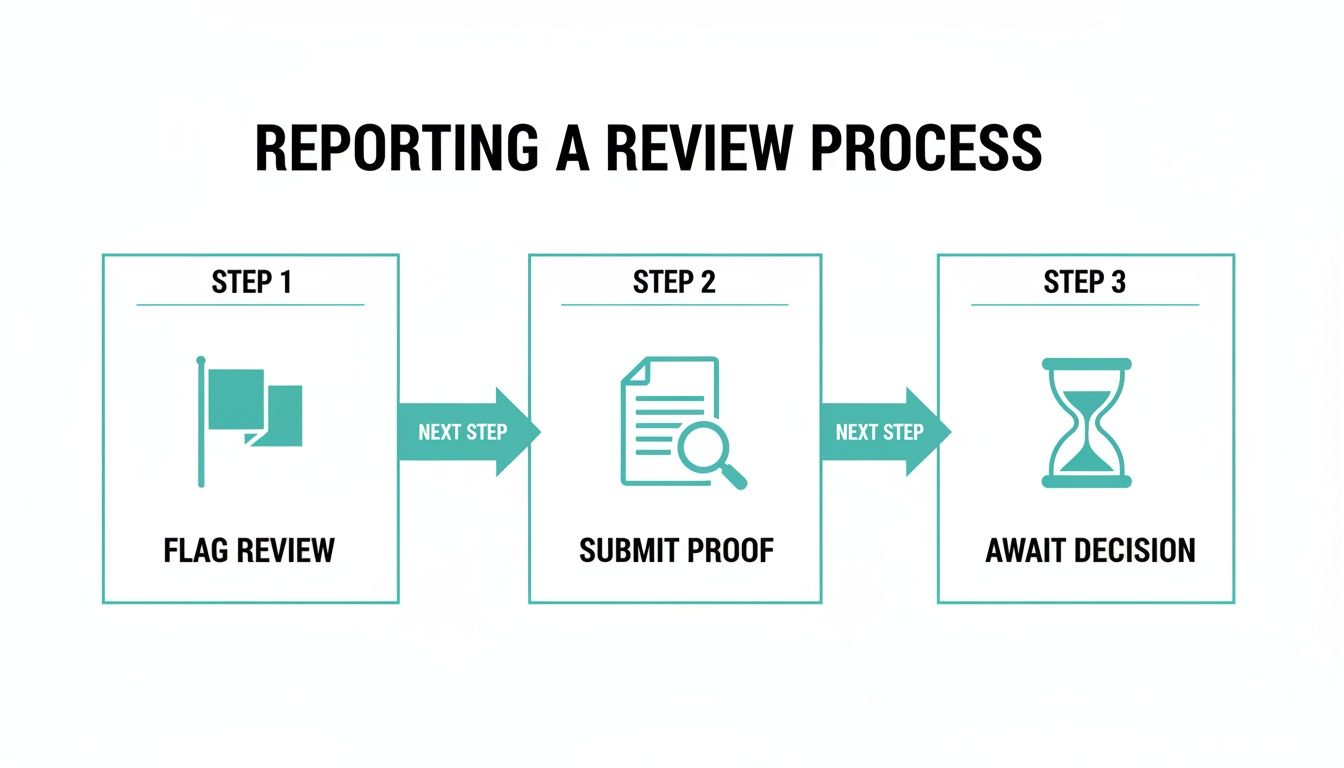
Resist the urge to immediately hit that "flag as inappropriate" button in a fit of frustration. A rushed, emotional report is a one-way ticket to rejection. The moderators on the other end are sifting through hundreds of these claims a day; they’re looking for cold, hard proof of a policy violation, not your side of the story.
Your job is to make their decision as easy as possible. You want to hand them an open-and-shut case.
Here’s the evidence you need to line up before you submit anything:
- Pinpoint the Exact Violation: Get specific. Don't just say a review is "unfair." You need to find the exact rule it breaks in the platform's terms of service and cite it. Is it spam? A conflict of interest (like a review from a disgruntled ex-employee)? Off-topic? Name the violation.
- Pull Your Internal Records: Gather every piece of documentation you have related to the supposed job—invoices, contracts, work orders, emails, and text messages. This is your proof that either you have no record of this person as a customer, or their claims directly contradict the facts.
- Get Your Screenshots Ready: Take clear screenshots of the review itself. If you can find other relevant online interactions, grab those too. For example, if you notice the reviewer has a pattern of leaving malicious reviews for other local contractors, documenting that can strengthen your case.
This prep work is everything. A well-organized submission with clear evidence is what gets a real person to actually look at your claim.
The Reporting Process: Google vs. Yelp
Once you’ve got your documentation in order, you’re ready to file the dispute. The basic idea is the same for Google and Yelp, but the steps look a little different on each platform.
Disputing a Review on Your Google Business Profile
Head over to your Google Business Profile dashboard and click into the "Reviews" section. Find the review you’re targeting, click the three-dot menu next to it, and choose "Report review."
Google will then ask you to select the reason for your report. Be precise and pick the option that best matches the evidence you collected. If a former employee left a fake one-star review, that’s a "conflict of interest." After submitting, you can monitor the status using Google's Review Management Tool, which is incredibly helpful for tracking your flagged reviews.
Flagging a Review on Yelp
Inside your Yelp for Business Owners account, go to the "Reviews" tab. Locate the review, click the three-dot menu, and select "Report Review."
Yelp provides a list of potential violations. Just like with Google, pick the one that directly applies to your situation. Use the text box to give a brief, factual summary of why the review violates their policy. Submit it and wait for Yelp's moderators to take a look.
Expert Tip: The person reading your report is overworked and has seen it all. Be brief, direct, and factual. Your report should simply state: "This review violates policy [X], and here is the attached proof." That’s it.
Setting Realistic Expectations
Now for a dose of reality: getting a negative review removed is tough. Platforms are built to protect user-generated content, even when it's misleading.
However, a focused and persistent approach can work. Some reputation management specialists have seen success rates of over 70% in removing defamatory reviews, but that’s over a year of sustained, professional effort. Timelines can also be frustratingly long, often stretching from 14 to 60 days, especially on Google. You can learn more about the realities of professional review removal on ReputationAmerica.org.
This is not a quick fix. Think of the dispute process as just one tool in your toolbox. Sometimes, even with a rock-solid case, your dispute might get denied or, in rare cases, trigger a larger issue like an account suspension. In those high-stakes situations, knowing your next move is vital. For example, if your business also sells on other platforms, knowing how to reinstate your Amazon seller account is the kind of backup knowledge that can save your business.
Persistence and documentation are your best assets here. If your first request is denied but you know your case is strong, don't be afraid to try again with more focused evidence.
When to Consider Legal Action for Defamation
Most negative reviews, no matter how infuriating, are just opinions. But every once in a while, a review crosses the line from a customer’s bad experience into outright defamation. Knowing when that line has been crossed is crucial, as it unlocks legal options that go far beyond just flagging a review on Google or Yelp.
Let’s be clear: suing a customer is a last resort. This isn't a strategy for every one-star review that makes your blood boil. Legal action is reserved for situations where a review isn't just negative—it’s provably false and actively hurting your business. We're not talking about someone saying your work was "subpar." We're talking about them stating a false "fact," like claiming you never showed up when you have GPS logs, timestamps, and photos proving you were on-site all day.
Defining Business Libel
In the business world, this is called libel: a false statement, published in writing, that damages your company's reputation. For a review to be considered libelous, it generally needs to hit a few specific marks.
The biggest distinction is fact versus opinion. "The paint job was sloppy" is an opinion and is protected speech. But "The contractor used the wrong brand of paint and thinned it with water" is a statement of fact that can be proven or disproven.
To build a case, you have to show that:
- The statement is presented as a fact.
- The statement is demonstrably false. This is the most important part; you need hard evidence.
- The statement caused you tangible harm, like lost contracts or measurable financial damage.
- It was "published" to a third party, which any public online review easily satisfies.
Your feelings don’t win court cases—documented facts do. Understanding this difference is the first step in figuring out if you even have a leg to stand on.
Steps to Take Before Calling an Attorney
So you think you have a legitimate case for defamation. What now? Before you even think about getting a lawyer on the phone, you need to get your ducks in a row. Doing this work upfront will save you a fortune in legal fees and is exactly what any attorney will ask for first.
Your immediate first move should be to preserve all evidence. Screenshot everything: the review itself, the reviewer's public profile, and any other comments they've made about your business. Then, pull together all your internal records for that project—the signed contract, invoices, change orders, all email and text correspondence, and especially any photos or logs that directly contradict their claims.
Once you have your evidence, consider sending a formal cease and desist letter. This is a letter, usually drafted by a lawyer for maximum effect, demanding the reviewer remove the defamatory statement and warning of legal action if they don't. You'd be surprised how often the threat of a lawsuit is enough to make a fake or exaggerated review disappear.
A legal battle over a review is a business decision, not an emotional one. You must weigh the high cost and time commitment against the potential outcome. Is the damage from this one review significant enough to justify a fight that could last months or even years?
Before any legal escalation, you should always start with the platform's built-in dispute tools. This is your first line of defense.
Whether you're dealing with Google's moderators or a judge, your success will ultimately hinge on one thing: the quality and clarity of the proof you provide.
Go on the Offensive: Bury Bad Reviews with a Content Flood

You’ve responded, you’ve tried to dispute it, and the negative review is still live. It's a frustrating spot to be in, and it's where most contractors give up. But this isn't the end of the road; it's a turning point.
When you can’t get a review taken down, you have to make it irrelevant. It's time to stop playing defense. You're going on the offensive to take back control of your online reputation.
The game plan is what we call a content flood. The idea is to strategically create and publish a wave of positive, high-value content that pushes the negative stuff down—and ideally, right off the first page of Google. When a prospect searches for your business, you want them to find a wall of positivity that you built and that you own.
This isn't about shady SEO tricks. It's a systematic approach to showcasing the quality of your work and the happy customers you've served. You're going to define your reputation, not let one unhappy client do it for you.
Know Your Battlefield: Run a Search Audit
First, you need a clear picture of what you're up against. Open a private or incognito browser window (this prevents your past search history from influencing the results) and run these three searches:
- "[Your Company Name]"
- "[Your Company Name] reviews"
- "[Your City] [Your Service] reviews" (e.g., "Austin Kitchen Remodeling reviews")
Take a hard look at the entire first page for each search. What do you see? You should own your website and your Google Business Profile. But what else is there? That’s your battlefield. You'll likely see Yelp, Angi, maybe a BBB profile, and the negative review that started this whole process. Your mission is to create your own digital assets that outrank these third-party sites.
Build Your Positive Review Engine
Your best weapon is a consistent flow of genuine, positive reviews from real customers. This sounds obvious, but I see contractors get this wrong all the time. They're reactive, only thinking about reviews after a problem comes up. You have to be systematic.
Create a simple, repeatable process for requesting a review from every single happy customer. This could be an automated email or text that goes out 24 hours after a job is marked as complete in your system. Keep the message personal—thank them for their business and give them one, single link to leave a review on your Google Business Profile.
Simply getting rid of the negative review isn't the full solution; that just leaves a vacuum. You have to proactively fill that space with positive, authentic proof of your work. This only works when it becomes a non-negotiable part of your daily operations.
By making review requests a standard part of your workflow, you create a steady stream of positive feedback. This not only buffers your star rating but also feeds Google’s algorithm fresh, relevant content, which helps suppress old, negative results over time.
Create Digital Assets That Rank
Reviews are crucial, but you also need to publish content on platforms you control—starting with your own website. This is your home turf, and you can build content specifically designed to rank for searches of your own brand name.
Here are a few high-impact content ideas I've seen work for contractors time and again:
- In-Depth Project Showcases: Don’t just throw up a few photos in a gallery. Write a full blog post for a recent, impressive job. Tell the project's story. What was the customer’s problem? What was your solution? Show high-quality before, during, and after photos. End with a glowing quote from the client. Title it something like: “A Full Bathroom Remodel in Hyde Park: A [Your Company Name] Case Study.”
- Helpful "Best Of" Listicles: This is a power move. Write an article titled something like “The 8 Best Roofing Contractors in [Your City] for 2024.” Include your company, of course, but also list a few other well-regarded (but not direct) competitors. This positions you as a trusted local authority, not just a salesman.
- Hyper-Local Service Pages: If you serve multiple towns or even specific neighborhoods, create dedicated pages for them on your website. For example, a page for "Siding Repair in North Austin" optimized with testimonials from clients in that exact area.
The goal here is to create content that is genuinely valuable to a potential customer doing their research. As you build this library of positive assets, you'll begin to dominate the search results for your own name. For a more detailed playbook on this, check out our complete guide on how to bury negative search results and take back your online narrative.
A content flood puts you back in the driver's seat. Instead of fighting a losing battle to remove a bad review, you’re building an online presence so strong and positive that one or two negative comments become nothing more than a footnote. It’s a long-term strategy, but it’s the one that delivers lasting results.
Straight Answers to Your Toughest Review Questions
When you're running a contracting business, dealing with online reviews feels like a distraction you can't afford. You've got jobs to finish and crews to manage. You don't have time for guesswork—you need straight answers.
We've pulled together the most common questions we hear from contractors trying to handle negative reviews. Here’s the no-nonsense advice you need to take control of your reputation.
How Long Does It Actually Take to Get a Review Removed?
This is always the first question, and the honest answer is frustrating: it's a waiting game, and the odds aren't in your favor. Once you flag a review and send your evidence, you're on the platform's schedule.
With Google Business Profile, you might hear back within a few days, but it’s more realistic to expect a two to four-week wait. We've seen complex cases drag on for over a month. Yelp operates on a similar, unpredictable timeline. The best you can do is use their tracking tools and be patient. Whatever you do, don't get antsy and resubmit your request—that can knock you to the back of the line.
Let's be blunt: getting a review removed is a slow, bureaucratic process that rarely works. That’s why your first move should always be posting a professional public reply and getting new, positive reviews. You can't control the platforms, but you can control that.
Bottom line: you can't afford to just sit and wait for a removal that might never happen. It's time to go on the offense.
What's the Quickest Way to Fix My Star Rating?
If you can't get a bad review taken down, the next best thing is to drown it out. A single 1-star review stings a lot less when it’s buried under a pile of 5-star feedback.
The math is simple and powerful.
- A single 1-star review can tank a perfect 5.0 rating down to a 4.5.
- But getting just four new 5-star reviews will push that 4.5 right back up to a 4.8.
The trick is to have a system. Don't just ask for reviews when you feel like it. Make it a standard part of your job wrap-up process. As soon as a project is successfully completed, have a simple text or email automatically sent to the happy customer with a direct link to your Google review page. This steady stream of positive feedback is your most reliable tool for fast-tracking your rating back to where it belongs.
Is It Worth Paying a Service to Remove Reviews?
You've probably seen the ads—companies guaranteeing they can scrub negative reviews for a fee. Tread very, very carefully here. While there are legitimate reputation management firms, many others are just selling digital snake oil. Google and Yelp have strict rules against paying for review removal, and getting caught can get your profile penalized or even suspended.
Instead of a "removal service," look for a "reputation management" expert. A real pro will focus on the strategies we've been talking about:
- Helping you craft the perfect public responses.
- Building a reliable system for generating authentic, positive reviews.
- Creating positive content (like project case studies or blog posts) to outrank the negative stuff in search results.
You’re hiring a marketing strategist, not a hitman. A legitimate firm will be upfront about their methods and will never promise guaranteed removal. They know the real value is in building a strong online presence that makes one or two bad reviews completely irrelevant.
Can I Really Sue Someone Over a Bad Review?
Technically, yes, you can sue for a defamatory review. The real question is, should you? Taking someone to court is a massive undertaking—it's expensive, public, and incredibly time-consuming. It’s the nuclear option, and you should only consider it in the most extreme situations.
Before you even think about calling a lawyer, the review must qualify as libel. This means it can't just be an opinion ("I thought their work was sloppy"). It has to be a statement presented as fact that you can prove is false ("The contractor used pine when the contract specified oak"). You'll need airtight evidence like contracts, photos, and emails that flatly contradict what the reviewer claimed.
Even if you have a slam-dunk case, filing a lawsuit can backfire by drawing way more attention to the bad review—a phenomenon known as the Streisand Effect. It’s a high-stakes move that you should only make after getting advice from a qualified attorney and seriously weighing the potential fallout for your business.
Are you tired of losing high-value jobs because of unfair Yelp or Google reviews? Impruview was built for contractors like you. We don't make empty promises about removal. Instead, we deploy a proven content flood strategy to dominate your branded search results, pushing negative platforms off page one and putting you back in control of your online reputation.
See how we can transform your online presence by visiting us at https://www.impruview.com and schedule your free reputation audit today.