Let's be honest. You could be the best plumber in town, but one angry customer with a keyboard can do more damage in five minutes than a positive word-of-mouth referral can fix in five months. That’s the reality we’re dealing with.
So, what is Search Engine Reputation Management (SERM)? It's not some abstract marketing jargon. It’s the practical, hands-on work of controlling what potential customers see when they Google your company's name. It's about making sure your hard-earned reputation is reflected online, not buried under a single, misleading complaint.
Why Your Digital Handshake Matters

Before a homeowner picks up the phone to ask for an estimate, they’re doing their homework. They’re typing your business name into Google. What pops up on that first page is their first impression of you—it's your digital handshake.
This search for your exact company name is what we call your ‘branded search’. It's the most valuable digital real estate you have. A glowing page-one builds instant trust. But a negative review, an old news story, or a complaint forum sitting on that first page? It's a digital roadblock, turning away good customers before they even get to your website. Having a solid reputation management strategy isn't optional anymore; it's fundamental.
The Real-World Impact on Your Bottom Line
Think about it from a customer's perspective. It's a scorching summer day in Phoenix, and their AC just died. They search for a local HVAC company and get a few recommendations. The first thing they do is vet those names on Google.
The difference between the top result and the bottom of the page is staggering. That #1 spot on Google pulls in a massive 27.6% of all clicks, while the tenth spot gets a measly 2.3%. Now, what if a negative review is one of the first things they see? Research shows that 86% of potential customers will simply move on if a business has poor reviews or a star rating below 4.
This isn't about protecting your feelings; it's about protecting your bank account. Your star rating has a direct, measurable impact on your revenue.
The Financial Impact of Your Star Rating
This table shows just how much your star rating can affect customer trust and, ultimately, your bottom line. It’s a clear look at why investing in your online reputation pays for itself.
| Star Rating | Customer Trust Level | Estimated Revenue Impact |
|---|---|---|
| 4.5 – 5.0 | High Trust – Seen as a top-tier, reliable choice. | Maximum lead flow and conversion rates. |
| 4.0 – 4.4 | Good Trust – Considered a safe and solid option. | Steady business, but may lose customers to 5-star competitors. |
| 3.5 – 3.9 | Caution – Perceived as average or inconsistent. | Significant drop in leads; price becomes the main factor. |
| Below 3.5 | Low Trust – Viewed as risky or unprofessional. | Severe lead reduction; customers actively avoid. |
As you can see, dropping below that 4-star threshold is where things really start to hurt. A positive online presence doesn't just feel good; it's a powerful tool that:
- Builds instant credibility before you even speak to a prospect.
- Keeps leads in your funnel instead of letting them get poached by a competitor’s ad or a bad review.
- Warms up your prospects, leading to higher conversion rates from call to job.
This connection between reputation and lead flow is a core part of a strong digital presence, which we cover more deeply in our guide to local SEO for contractors.
This playbook isn’t about trying to get every negative review taken down—that's often a losing battle. Instead, it’s about a proactive strategy: taking control of your online story so your digital first impression truly reflects the quality of your work.
Performing Your Digital Reputation Audit
To fix your online reputation, you first have to see it exactly as a potential customer does. This is where a digital audit comes in. Think of it as creating a "before" photo of your company's search results—it’s the only way to know what you’re up against and measure your success later on.
The process is simple, but you have to be brutally honest with yourself. You need to see the good, the bad, and the ugly to know where to direct your energy. First things first: open an incognito or private browser window. This step is crucial because it prevents your personal search history from skewing the results, giving you a clean, unbiased look.
Identifying Your Branded Search Landscape
Now, it's time to play detective. Systematically search for your business, but don't stop at just your official company name. Homeowners might misspell it, use a nickname they’ve heard, or even search for you, the owner, directly. I recommend firing up a simple spreadsheet to track what appears on the first two pages of Google for every search.
Your search list should include variations like these:
- Official Business Name: e.g., "Prestige Roofing & Construction"
- Common Abbreviations: e.g., "Prestige Roofing"
- "Reviews" Queries: e.g., "Prestige Roofing reviews"
- "Complaints" Queries: e.g., "Prestige Roofing complaints"
- Owner's Name: e.g., "John Doe plumber"
As you go through each search, log every single result. Note the positive, the neutral, and most importantly, the negative ones. Keep a sharp eye out for high-authority review sites that Google loves to rank, as they are your main battlegrounds. This usually means Yelp, the Better Business Bureau (BBB), and Angi, but can also include local news articles or random forum threads.
For every negative result you find, log its URL, where it ranks on the page, and a quick summary of the problem. A scathing one-star review sitting at the top of page one is infinitely more damaging than a minor grumble on page two.
Key Takeaway: Your goal here is to build a hit list—a definitive catalog of the negative search results actively hurting your business. This list is the entire foundation for your search engine reputation management plan. It tells you exactly what needs to be buried.
This audit brings immediate clarity. You might find an old, unresolved complaint on a consumer forum you never knew existed is ranking #4 for your business name. That one result could be quietly costing you tens of thousands in lost jobs every single month.
By documenting everything, you turn that vague, anxious feeling of "we have some bad reviews" into a concrete, actionable to-do list. This is the first real step to taking back control of your story online.
Building Your Digital Fortress of Positive Content
Alright, you've audited your search results and know where the damage is. Now it’s time to go on the offensive. Instead of just playing whack-a-mole with negative comments, a real search engine reputation management strategy is about flooding the zone with positive content you create and control.
The goal here is simple: build a digital fortress of websites and profiles that all sing your praises. Think of each one as a property you own, designed to rank for your company’s name.
This approach works because it speaks Google’s language. The algorithm loves seeing comprehensive, authoritative information from multiple sources. By building out this network, you’re creating a powerful defense. Every positive asset that cracks the first page of Google is another blow to that stubborn, negative Yelp page or angry forum post you can’t get rid of.
The need for this is more than just theory. For a local contractor, a reputation crisis can happen in a flash. In fact, 74.5% of small businesses now call it 'critically important,' yet so many are stuck reacting on fragmented platforms like Google and Yelp, which just leads to slow responses and lost trust. This is what modern SERM is all about—proactively shaping the story so you own the search results for your name.
Your Core Digital Assets
Your website is the heart of your operation, but to truly dominate your brand’s search results, you have to expand your digital footprint. Think of each of these assets as a pillar holding up your reputation. Your first move should be to claim and flesh out profiles on platforms Google already sees as high-authority.
These are your absolute non-negotiables:
- Google Business Profile (GBP): Don't just claim it—complete it. Every single section. Add a ton of high-quality photos of your team and your work, write detailed service descriptions, and use the "Posts" feature to share updates or special offers. Your GBP is often the very first impression a customer gets.
- Key Contractor Directories: Get on Angi, Thumbtack, and the Better Business Bureau and build out robust, detailed profiles. These sites are magnets for contractor searches, and having a strong presence ensures you're the one telling your story on their platform.
- Major Social Media Platforms: At a minimum, lock down your exact business name on Facebook and LinkedIn. If you take lots of project photos, an Instagram or YouTube channel can be a goldmine. Fill out every field on every profile.
Owning these profiles is like claiming strategic territory online. By filling them with positive, branded content, you're creating multiple opportunities to occupy the top spots on Google for your company name, leaving less room for negativity.
Expanding Your Fortress with Owned Content
Once you’ve got those core profiles locked down, the next layer of your fortress is content that lives on platforms you completely own. This is where you get to tell your story, your way, and really showcase your expertise.
Your company blog is hands-down the most powerful tool for this. It lets you create a consistent stream of positive, keyword-rich articles about your business. This is a fundamental part of learning how to push down negative search results.
Here are a few ideas that work wonders for contractors:
- Project Showcases: Write a detailed post about a recent HVAC installation or a tricky roofing job. Use plenty of "before and after" photos, talk about the challenges you overcame, and show off the happy result.
- Helpful How-To Guides: Create guides like "How to Prepare Your Plumbing for a Hard Freeze" or "5 Telltale Signs Your Roof Needs a Professional Inspection." This immediately positions you as a trusted expert, not just another contractor.
- Community Involvement Posts: Did your company sponsor the local little league team or volunteer at a community event? Write a short post about it. This builds local goodwill and creates positive, "newsworthy" content that Google loves.
Each one of these posts becomes another digital asset for Google to find and rank. When you consistently publish useful information and learn how SEO and SEM work together for better results, you're building a fortress of positive content that’s simply too strong for one or two bad reviews to breach.
Turn Happy Clients Into Your Best Marketers
All the positive content you create is crucial for search engine reputation management, but it's only solving part of the problem. The other, arguably more important, piece of the puzzle is the authentic social proof that comes from your actual clients. Think of a steady stream of positive reviews as your best defense—a constant flow of fresh, positive signals that Google loves to see.
Too many contractors cross their fingers and hope for good reviews, or maybe they remember to ask once in a while. That's not a strategy. What you need is a dead-simple, repeatable process that turns happy customers into vocal advocates for your business. The trick is to make it completely effortless for them right at the peak of their satisfaction.
The Right Moment and The Right Method
When is the perfect time to ask for a review? It’s that exact moment after you’ve solved their crisis and they’re thanking you profusely. You just brought their AC back to life on a 100-degree day, or you stopped a leak that was flooding their basement. That sigh of relief is your cue. They’re genuinely grateful and most willing to help you out.
Don't let that moment pass. Sending a request a week later just doesn't have the same impact.
How you ask is just as important. An email request is better than nothing, but it often gets buried. For a contractor who’s always on the move, nothing beats a simple text message.
- SMS (Text Message): It’s direct, it feels personal, and it has an almost 100% open rate. A quick text with a direct link to your Google Business Profile review page removes every bit of friction.
- QR Codes: Put a QR code on the final invoice or a leave-behind magnet. This gives your technicians an easy way to capture that goodwill on the spot before they even leave the driveway.
When you build this into your standard "job complete" workflow, you create a powerful engine for generating positive feedback. If you want to dig deeper into this, our guide on how to get Google reviews from customers has even more practical tips.
Responding to Every Single Review is Non-Negotiable
Getting the review is just the start. You amplify their power by responding—to all of them, both the good and the bad. Remember, your replies aren't just for the person who wrote the review; they're public statements for every potential customer who comes after them.
A professional, timely response to a review—whether it's glowing or critical—shows you're accountable and committed to customer satisfaction. That act alone can be more persuasive to a new customer than the original review itself.
When you get a 5-star review, go beyond the generic "Thanks!" and get specific. Try something like, "John, we're so glad we could get your AC running again before the heatwave hit! Thanks for trusting us with your home." It feels genuine because it is.
Negative reviews require an even more careful touch. The key is to stay calm, professional, and empathetic. Acknowledge their frustration publicly and immediately move the conversation offline. A simple, "We're very sorry to hear about your experience. We want to understand what happened and make this right. Please call our office at…" shows everyone that you take problems seriously and handle the details privately.
Alright, let's transform this from a generic set of instructions into a real-world, actionable playbook. Here’s a version written from the perspective of someone who's been in the trenches and knows what actually works for contractors.
Your 60-Day SERM Action Plan
Theory is great, but you can't build a business on it. You need a plan that gets you results, and that’s exactly what this is. We’ve mapped out a practical, 60-day roadmap specifically for busy contractors who need to see a real difference in their search results—fast.
Think of this as a week-by-week playbook. Each step builds on the last, giving you momentum so you can see tangible changes to your online reputation in about two months. No fluff, just focused action.
This timeline gives you a bird's-eye view of how the pieces fit together, moving from the initial research phase to actively promoting your brand.
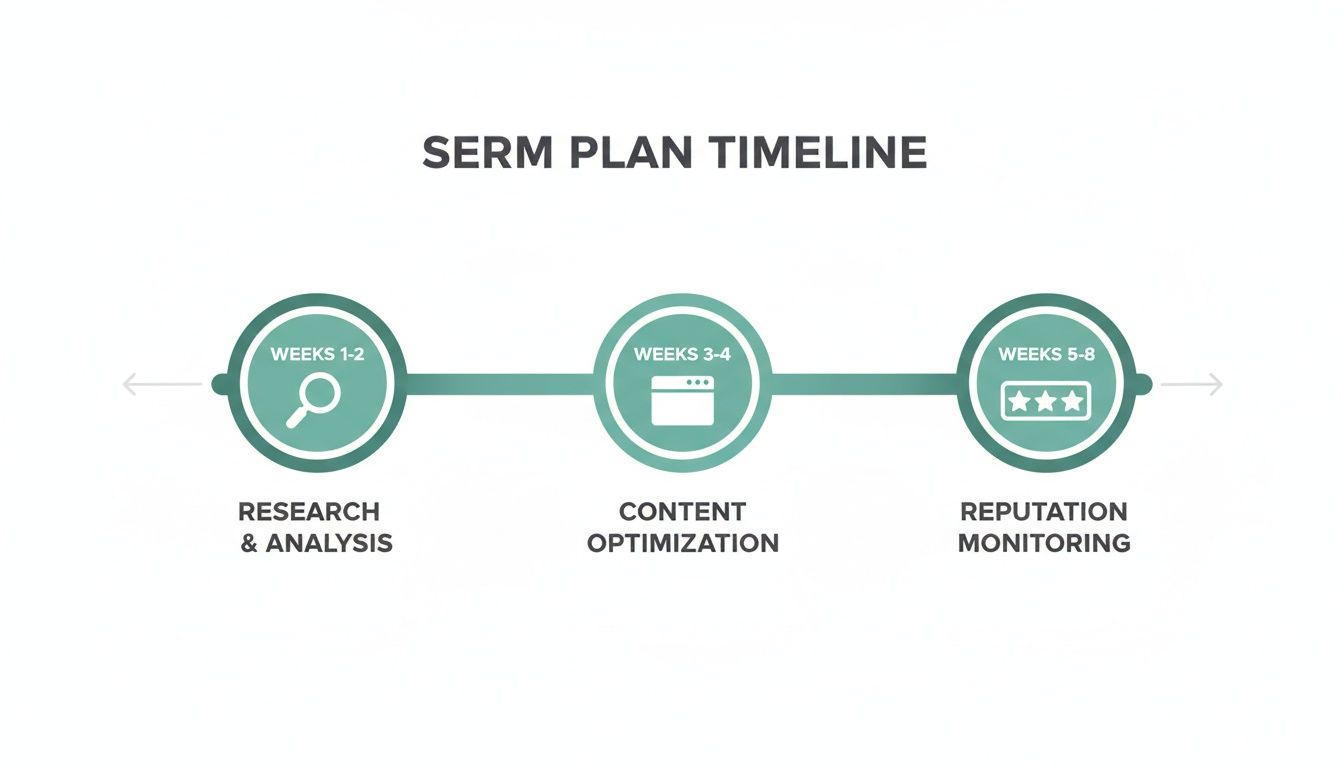
As you can see, the foundational work you do in the first month is what makes the reputation-building efforts in the second month so effective.
Weeks 1-2: Audit and Foundation
The first two weeks are all about laying the groundwork. You’re not creating any new content just yet. Instead, you're getting a clear picture of the problem and locking down your most valuable digital assets.
Here’s what you need to focus on:
- Run a Full Reputation Audit. Open an incognito browser window and search for your company name, "Your Company reviews," and other branded terms we discussed. Log every single negative or neutral result you find on the first two pages of Google in a spreadsheet. This is your hit list.
- Claim and Optimize Your Core Profiles. This part is non-negotiable. You have to own your space. Get control of your Google Business Profile, Facebook page, LinkedIn company page, and the big contractor directories like Angi and the BBB. Make sure your business name, address, and phone number are identical everywhere.
By the end of week two, you'll know exactly what you’re up against and have control over the key online properties that Google trusts most.
Weeks 3-4: Launch the Content Flood
Now it’s time to go on the offensive. With your core profiles secured, you can start publishing the positive content that will eventually push those negative results down. The objective here is to create a first wave of high-quality assets optimized for your brand name.
Your checklist for this phase:
- Publish Two In-Depth Project Showcases. Pick two recent jobs and write up detailed case studies on your blog. Use lots of photos, explain the customer’s problem, and walk through how your team solved it. Give them strategic titles, like "Emergency Furnace Replacement in Springfield by Acme HVAC."
- Write an 'Expert Guide' for Homeowners. Create a genuinely helpful article that answers a common customer question, like "5 Warning Signs Your Water Heater is About to Fail." This helps establish you as the go-to expert, not just another contractor.
- Get Your Company on YouTube. You don’t need a film crew. Just create a company YouTube channel and upload a simple video introducing your team or showing off a recently completed roofing project. It’s another powerful asset you can own.
After the first month, you'll have a small but mighty arsenal of positive content that’s ready for promotion.
The point isn't just to make content; it's to create digital assets that Google can actually rank. Every blog post, every video is another soldier fighting for a spot on page one for your brand name.
Weeks 5-8: Promote, Harvest Reviews, and Monitor
The final month is all about amplification. You'll push your new content out into the world and fire up your review generation machine.
- Set Up a Simple Review Request System. Start systematically asking every happy customer for a review. The most effective way I've seen is a simple SMS message with a direct link to your Google review page, sent shortly after the job is done.
- Promote Your New Content. Don't let your new blog posts and videos just sit there. Share them on your company's Facebook and LinkedIn profiles. This sends positive social signals back to Google and gets more eyes on your good work.
- Keep an Eye on the SERPs. Once a week, run your branded searches again. Track where the negative results are and, more importantly, where your new, positive content is starting to appear.
Your 60-Day SERM Action Timeline
To make this even simpler, here’s a week-by-week checklist that turns this entire strategy into a manageable set of tasks. Follow this, and you'll be taking control of what customers see when they search for you.
| Timeline | Key Actions | Primary Goal |
|---|---|---|
| Week 1 | Perform branded searches in incognito mode. Create a spreadsheet to log all negative/neutral results on pages 1-2. | Establish a baseline and identify all negative assets that need to be pushed down. |
| Week 2 | Claim and fully optimize Google Business Profile, Facebook, LinkedIn, Angi, and BBB profiles. Ensure consistent branding. | Secure control over your most authoritative and high-ranking digital properties. |
| Week 3 | Write and publish the first project showcase blog post. Brainstorm topics for the expert guide. | Begin the "content flood" with a highly-relevant, brand-optimized asset. |
| Week 4 | Write and publish the expert guide article. Create and set up the company YouTube channel. | Establish expertise and create another digital property you own and control. |
| Week 5 | Publish the second project showcase. Film and upload a short introductory video to YouTube. | Reinforce positive content and add a new media type (video) to your assets. |
| Week 6 | Implement a system (SMS or email) to ask every customer for a review. Start sharing your new content on social media. | Kickstart review generation and begin promoting your positive content. |
| Week 7 | Continue requesting reviews. Reshare older content on social media. Monitor SERP rankings for any changes. | Maintain momentum on reviews and promotion while tracking progress. |
| Week 8 | Analyze SERP changes from Week 1. Plan the next wave of content (new case studies, guides, etc.). | Measure initial results and develop a plan for ongoing reputation management. |
By following this 60-day plan, you’re no longer just reacting to a bad review or a negative article. You’re proactively building a digital fortress around your brand name, one piece of positive content at a time.
Common Reputation Questions We Hear All the Time
When you start digging into search engine reputation management, a few key questions always pop up. As a contractor, you don't need marketing jargon; you need straight answers that help you decide what to do next. Let's tackle the ones I hear most often from business owners just like you.
"Can't I Just Get That Bad Yelp Review Taken Down?"
This is always the first question, and I get it. The gut reaction is to want that negative review gone, deleted, erased from existence. The honest answer, though, is probably not.
Platforms like Yelp are legally protected and have very rigid policies. They rarely remove a review unless it's a blatant violation, like hate speech or clear proof it came from someone who was never a customer. Spending your time and money trying to force a removal is almost always a dead end.
A much smarter play is to focus on what you can control. Instead of trying to delete the negative, you bury it. By creating a flood of positive, high-quality content that you own—like your blog, project galleries, and social profiles—you can push that one bad review off of page one. That’s where it loses all its power.
"How Long Until I See a Difference?"
This isn't a year-long waiting game. With a consistent and focused effort on creating positive content, most contractors start seeing real changes in their search results within 30 to 60 days.
The first thing you'll notice is your own properties—your website, a new blog post, maybe a well-optimized Facebook page—beginning to climb onto the first page for your company's name. That's the initial win. Pushing down a really stubborn negative review from a major site might take a few more months of work, but you'll see progress much faster than you think.
The key is consistency. A single blog post won't change your reputation, but a steady stream of positive assets and reviews will absolutely shift the balance of power in your favor over time.
"Is Responding to Negative Reviews Really That Important?"
Yes. Absolutely, unequivocally, yes. It's one of the most critical things you can do.
Here's the secret: your reply isn't really for the person who left the bad review. It's for every single prospect who reads it afterward. A calm, professional response that offers to make things right shows you stand behind your work and take customer service seriously. It's a public demonstration of your character.
Think about it from a homeowner's perspective. Who would you rather hire? The contractor who ignores complaints, or the one who addresses them head-on? Data shows that 88% of consumers are more likely to choose a business that responds to all its reviews. It’s one of the most powerful and overlooked tools you have.
Tired of seeing a single unfair review cost you valuable leads every month? The team at Impruview specializes in taking back control of your branded search results. We use a proven content strategy to build a digital fortress around your brand, pushing negative results off of page one so your true reputation can shine. Learn more and see how we can help your business at Impruview.