So, what do online reputation management companies actually do? For a contractor, they're the team you call to make sure that when a potential customer Googles your business, they see the five-star work you do—not that one-star review from a job that went sideways.
They work behind the scenes to push positive feedback to the top and suppress the negative stuff, ensuring your online first impression is a great one.
The True Cost of a Bad Reputation for Contractors

Let's be blunt—a bad online reputation isn't some fuzzy marketing problem. It's a direct hit to your bank account.
Every high-value project, whether it's a kitchen remodel, a new roof, or an emergency HVAC replacement, starts with a potential client doing one thing: searching for you online. What they find in those first few seconds determines if they call you or click over to your competitor.
Ignoring what they see is like leaving cash on the table every single day.
From Star Ratings to Lost Revenue
We see it all the time. A great plumbing company with a solid crew gets hit with a single, nasty 2-star review on Yelp. It was a complicated job with a difficult client, but now that review is the first thing people see when they search the company’s name.
A homeowner needs an emergency water heater replacement, a job worth $2,500. They search for the plumber by name, see that 2-star review, and immediately lose confidence. They click the back button and find another local plumber with a 4.8-star average. Your phone never even rings.
This silent lead-killer works against you 24/7. It’s not just one lost job; it's a constant drain on your potential earnings.
The financial impact is brutal: each additional star in your overall rating can boost revenue by 5-9%. A single star drop could slash your sales by thousands of dollars every month, especially when your average job ticket is over $500.
And the data doesn't lie. With Google handling 89.8% of all searches, it's the only game in town. A whopping 27.6% of people click the very first result, but only a measly 2.3% click the tenth. When a negative review sits in that top spot, it’s actively shoving customers away. For a deeper dive into the numbers, check out this detailed statistical breakdown.
The table below breaks down these common headaches and shows how a solid reputation management strategy provides the cure.
Reputation Problems and Their Solutions for Contractors
| The Problem You're Facing | The Financial Impact | The Reputation Management Solution |
|---|---|---|
| A negative review or article dominates your branded search results. | Leads dry up as potential clients lose trust and choose competitors. | Push down negative content with a "content flood" of positive, optimized assets like articles, press releases, and new profiles. |
| Your star rating on key sites (Google, Yelp, Angi) is below 4.0. | You're automatically filtered out by 68% of consumers who won't consider businesses with lower ratings. | Implement a system to consistently generate new, positive reviews from happy customers to raise your average score. |
| Your business has very few or no recent reviews. | You look unpopular or out of business. 47% of consumers ignore companies with fewer than 20 reviews. | Create an ongoing review acquisition campaign to ensure a steady stream of fresh, relevant customer feedback. |
| Competitors with better reviews are showing up above you. | They are capturing market share and leads that should have been yours. | Build a stronger review profile and online presence to outrank them and become the go-to choice in your area. |
Ultimately, these solutions work together to protect your lead flow and ensure your online presence accurately reflects the quality of your work.
Branded Search Dominance Is Non-Negotiable
For contractors, controlling the first page of Google for your company’s name—what we call branded search—is absolutely essential for survival. You simply cannot afford to let a random forum, an angry blogger, or a review site define your entire business.
Think about how these common issues bleed revenue:
- Low Star Ratings: As mentioned, a huge portion of customers won't even consider a business with fewer than 4 stars. 68% of them only look at companies rated 4 stars or higher.
- Negative "Snippets": Google often pulls a preview of a review right into the search results. If that snippet is negative, the damage is done before anyone even clicks.
- Lack of Recent Reviews: A profile with no new reviews for six months looks abandoned. Nearly half of consumers (47%) will skip a company if it has fewer than 20 reviews.
This is exactly why proactive reputation management isn't just an expense; it’s an investment with a clear and measurable return. By getting the right help, you take back control of your story, protect your leads, and make sure your digital handshake is firm and confident.
Your DIY Reputation Audit Before Hiring Help
Before you even think about picking up the phone to call any online reputation management companies, you need a clear picture of what you're dealing with. Taking the time to do your own audit puts you in the driver's seat. You’ll be able to have a smart, direct conversation with any potential agency, avoid paying for services you don’t need, and zero in on a firm that can fix your actual problems.
Think of it as casing your own joint. You're mapping out your digital footprint to find the weak spots. This information isn't just for you; it's your leverage when you start talking to the pros.
See What Your Customers See: The Branded Search
The best place to start is right where your customers do: Google. You need to see exactly what they see when they look you up. To do this, always use a private or "incognito" browser window. This strips away your personal search history and gives you a clean, unbiased look at your search results.
Fire up an incognito tab and run these searches, one by one:
- "[Your Company Name]"
- "[Your Company Name] reviews"
- "[Your Company Name] complaints"
- "[Your City] [Your Service]" (for example, "Denver roofing")
Document what you find on the first page or two of Google for each search. Don't just skim—look closely at the star ratings, the little preview "snippets" Google shows, and any third-party sites that pop up.
A single bad review on Yelp or a negative article showing up in the top five results is more than just an eyesore. It's a flashing red light that is actively costing you qualified leads, day in and day out.
Analyze the results. Do you own the page with your website and social media profiles? Or are review sites and other platforms dominating the conversation? This is what we call branded search dominance, and it’s a huge piece of the puzzle when evaluating your online health.
Dig Into the Key Review Platforms
For any contractor, a handful of websites hold incredible sway over your business. Your audit needs to go deep on these platforms. Don't just stop at the overall star rating; you have to read the reviews and understand the context.
Focus your energy on the profiles that matter most for local service businesses:
Google Business Profile (GBP): Is all your info correct? What’s the story your star rating is telling? Read through your last 10-20 reviews, paying close attention to the dates and the general tone. A long silence with no new reviews can be almost as bad as a few negative ones.
Yelp: This one is a common headache for contractors because it ranks so well in search results. Check your overall score, but also dig into the "not currently recommended" reviews. You'll often find legitimate customer feedback there that potential clients can still easily find and read.
Angi/HomeAdvisor: Their impact can vary by market, but these trade-specific sites are still part of your reputation. Make sure your profile is complete and see what customers are saying.
Better Business Bureau (BBB): For homeowners about to make a big investment, a low BBB rating or a history of unresolved complaints can be a deal-breaker.
To get a head start, you can run your profile through a specialized Google Business Profile audit tool for a more technical breakdown of your standing.
Hunt Down Other Negative Content
Your work isn't done once you've checked the big review sites. Damaging content can lurk in less obvious places, like old forum discussions, local news stories, or even angry blog posts. A quick search for these can uncover problems you didn't even know you had.
Once you’ve gathered all this intel, you’re no longer just another potential customer for an agency. You're an informed buyer. You can walk into a conversation with any of the top online reputation management companies and say, "Here's what I found, and here's the proof. How, specifically, are you going to fix it?"
How to Vet Online Reputation Management Companies
So, you've done your own audit and have a clear picture of what people are saying about you online. Now it's time to find a partner to help fix it. Be warned, though—not all online reputation management companies are the same. This industry is packed with generalists who slap the same strategy on every client, whether they're a roofer or a restaurant. As a contractor, you absolutely need a specialist who gets the home services world.
This isn't a step you can afford to gloss over. The online reputation market is booming, expected to swell to USD 14.01 billion by 2031. That growth points to a tough reality for contractors: a bad online image kills business. In fact, 70% of consumers will walk away from a brand after just one bad experience, costing businesses trillions. You can dig deeper into these numbers in this in-depth industry report. Finding the right firm is your best defense against becoming a statistic.
Before you even start calling agencies, make sure you've completed your own assessment. This flowchart maps out a solid DIY audit process—it's the critical first step.
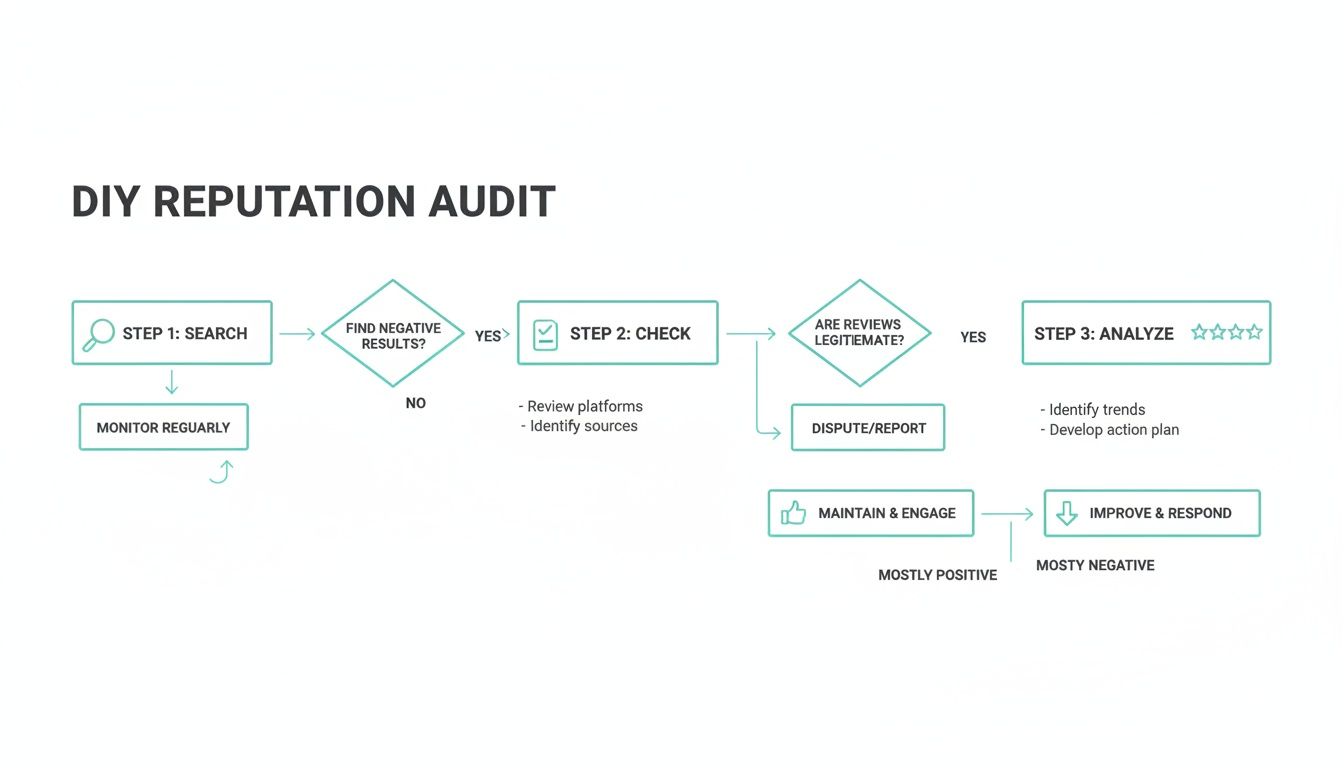
The idea is to systematically search for your brand, check the major review platforms, and get a real feel for the sentiment out there. This homework makes your conversations with potential partners much more productive.
The Right Questions to Ask Potential Partners
Forget the generic interview questions. To find out if a firm really knows its stuff, you have to ask pointed questions that force them to prove their experience in the trades. Ditch "What's your process?" and start asking things like this:
- "Show me a case study from another roofing or plumbing contractor you've worked with." If they don't have a relevant example, they don't have relevant experience. It's that simple.
- "Walk me through your specific strategy for suppressing negative Yelp results for a contractor." Their answer here will tell you everything. A real pro will have a plan; a pretender will give you vague promises.
- "How do you generate new, positive reviews for a service-based business like mine?" You're listening for a systematic, professional approach, not just "well, we ask your customers for reviews."
- "How do you measure success, and what metrics will I see in my reports?" You want to hear about concrete KPIs—branded search rankings, aggregate star rating improvements, and positive content visibility. If they talk about "impressions," they're focused on vanity metrics, not business results.
An agency’s hesitation or inability to answer these questions is a huge red flag. A true expert has been there, done that, and will be excited to show you how.
Critical Red Flags to Watch For
Knowing the right questions is half the battle. The other half is spotting the warning signs of a bad actor. The reputation management space, unfortunately, has its share of operators who talk a big game but can't deliver.
Be on high alert for these red flags:
- Guaranteed Review Removal: This is the biggest tell. Removing a legitimate negative review from Google or Yelp is next to impossible unless it clearly violates their terms of service. Good firms focus on suppressing negative results by burying them with positive ones, not making false promises about removal.
- Lack of Transparency: If they get cagey about their methods, calling them "proprietary" or a "secret sauce," walk away. A partner you can trust will be open about their strategies, like explaining how a content suppression campaign works.
- High-Pressure Sales and Long-Term Contracts: A firm that’s confident in its ability to get results will be fine with a month-to-month agreement. If they're pushing you to sign a 12-month contract right out of the gate, they’re more interested in your money than your success.
Look for a Specialist, Not a Generalist
Your mission is to find a firm that lives and breathes the unique challenges contractors face every day. A generalist agency might know some basic SEO, but do they understand the gut punch of a one-star Angi review? Do they get that a plumber's entire business is built on trust, and their online presence has to reflect that?
A specialist understands your customers, your business model, and the platforms that actually matter to you. They speak your language because they’ve developed a playbook for businesses just like yours. This deep industry knowledge is exactly what makes our reputation management services for contractors so effective.
When you choose a partner who truly gets the trades, you’re not just hiring another vendor. You’re adding a dedicated expert to your team.
Understanding Contracts, Pricing, and Timelines
Alright, let's talk about the money and the timeline. When you start getting quotes from online reputation management companies, you’ll quickly notice that the prices are all over the map. That’s because the cost is directly tied to how deep the reputational hole is and how aggressively you need to dig your way out.
For a contractor, this kind of investment can feel steep. But it’s nothing compared to the revenue you’re losing from a bad online presence. Just a one-star drop in your average rating can gut your revenue by 5-10%. Think about it: higher-rated competitors are getting the clicks, even if they're ranked lower than you in search. With brand reputation expected to make up 30-40% of a company's total value by 2026, you can't afford to get this wrong. For a deeper look at the data, you can explore detailed online reputation management statistics.
So, it's crucial to understand exactly what you're paying for and what you should realistically expect in return.
Decoding Pricing Models and What to Expect
Most firms will pitch you one of two payment structures. It’s important to know the difference, especially in a business like contracting where cash flow can be seasonal.
Common Pricing Structures:
- Monthly Retainers: This is the industry standard. You pay a flat fee every month for ongoing work. For a typical contractor, retainers run anywhere from $1,000 to $5,000+ a month. The lower end usually covers basic review monitoring and generation, while the higher end funds a full-blown campaign to bury negative content.
- Project-Based Fees: Some agencies will quote you a one-time fee to tackle a specific problem, like pushing down a single bad article. It sounds simple, but reputation management is almost never a one-and-done fix. This model often falls short because it doesn't account for the constant effort needed to maintain a positive presence.
I’ve seen this play out time and again: flexible, no-long-term-contract models are a contractor’s best friend. A company that knows it can get results won't try to lock you into a 12-month contract. Month-to-month keeps them on their toes and proves they’re working to earn your business every single day.
For a more granular look at what these services typically cost, our guide on online reputation management costs for contractors breaks down the numbers further.
Setting Realistic Timelines for Results
One of the biggest mistakes you can make is expecting your reputation problems to vanish overnight. While you can get some quick wins, real reputation repair is a marathon, not a sprint. Any agency promising a complete fix in a week is blowing smoke.
Here’s a more realistic look at what a solid campaign timeline involves:
- The First 30-60 Days: You should start seeing the needle move. This could be new, positive content showing up in search results or a small bump in your average star rating. The goal here is to build a foundation and get some momentum going.
- Months 3-6: By this stage, a "content flood" strategy should really be making an impact. Negative search results should be dropping further down page one of Google, getting replaced by the positive articles, profiles, and other assets your agency is creating. Your flow of new reviews should also be consistent.
- 6+ Months: This is where you start to truly own your search results. The objective is to control most, if not all, of the first page for searches of your company name. The heavy lifting is mostly done, but maintaining that control will require ongoing work.
Key Elements of a Solid Service Agreement
Before you sign on the dotted line, read that service agreement carefully. It’s the blueprint for the entire partnership and should spell out the scope, deliverables, and how success is measured. If it's full of vague language and confusing corporate jargon, that’s a major red flag.
Make sure the contract you sign includes these specifics:
- Clearly Defined Scope: What, exactly, are they going to do? Is it review generation? Content suppression? Social media monitoring? It needs to be written down.
- Key Performance Indicators (KPIs): The agreement has to define how you'll measure success. Look for metrics that actually impact your business, like your rankings in branded search, your star rating on key review sites, and the number of positive assets they create.
- Reporting Frequency: How often will they update you? A good partner provides a detailed report at least once a month, tracking progress against the KPIs you agreed on.
- Termination Clause: The contract must clearly state how either party can end the relationship. A transparent company will have a simple 30-day notice period for their month-to-month plans.
The Content Suppression Strategy to Bury Negative Results

For any contractor, there’s nothing worse than seeing a negative review as the first thing potential clients find when they Google your business. It’s a gut punch. For years, the only advice was to try and get it removed, but that’s a slow, frustrating process that almost never works.
Smart online reputation management companies have moved on to a much better strategy: suppression.
This approach isn't about deleting the negative comment; it's about burying it. You do this by creating a flood of positive, well-optimized content that you own and control. This is what we in the industry call a "content flood" or suppression campaign.
Instead of trying to fight a losing battle on one negative page, you build a fortress of positive content around it. You publish so much high-quality, authoritative material that it shoves the bad stuff off the first page of Google—where over 90% of people will never find it. It's about playing offense instead of defense.
How a Content Flood Works
Think of your branded search results (what shows up for "[Your Company Name]") like a city block. The goal is to own all the real estate. A content flood is the strategy for systematically building and promoting new digital properties to take over those top spots.
It’s a multi-front attack, not a single shot. You’re building a diverse portfolio of positive online assets, and each one is another chance to tell your story the right way while pushing the negative result further down the list.
A good campaign will build and optimize a mix of assets, such as:
- New Social Media Profiles: Getting active on LinkedIn, Facebook, and even contractor-specific sites expands your digital footprint.
- Press Releases: Did you partner with a local charity or launch a new service? A press release can get picked up by news outlets, creating powerful links back to you.
- Industry Blog Posts: Writing articles for trade publications or online magazines positions you as a true expert.
- Positive Video Testimonials: Nothing beats a professionally shot video of a happy customer. It’s compelling and can even rank on its own in search results.
The real key is that every piece of content is created with a purpose and optimized for search engines. This isn’t about just throwing mud at the wall; it’s about strategic placement.
A common misconception is that this is simply "more content." In reality, it's about creating the right content on the right platforms with the right SEO to outrank a specific negative result. Each asset is a tool designed for a specific job.
The process is methodical. An agency will first analyze the negative post to see why Google ranks it so high. From there, they build a custom content plan to create new assets with even more authority, forcing the unwanted page down and out of sight. For a much deeper dive, you can learn more about how to bury negative search results in our dedicated article.
The SEO Tactics That Make Suppression Possible
At its core, suppression is just smart SEO. You're playing by Google's rules to control what people see when they search for your name. Experienced online reputation management companies have this down to a science.
They use a combination of proven SEO tactics to give your positive content an almost unfair advantage over the negative stuff.
Key SEO Elements for Suppression:
| SEO Tactic | How It Helps | Why It Works for Contractors |
|---|---|---|
| Keyword Optimization | Every new asset is tuned for your company name and related search terms, telling Google it’s highly relevant. | This directly targets what potential customers are searching for right before they decide to call you. |
| High-Authority Backlinks | The agency gets links from other respected websites pointing to your new positive content, which is a huge signal of trust to Google. | Links from the local chamber of commerce or a trade group tell Google you’re a legitimate, trusted local expert. |
| Domain Authority | By publishing on established, trusted platforms (like major blogs or news distribution networks), your content gets a head start. | This allows brand-new content to rank quickly—sometimes in weeks, not months. |
| Content Diversity | Google’s algorithm loves showing a mix of results, like articles, videos, and social profiles. A content flood gives Google exactly what it wants. | This builds a rich, impressive first page that showcases your work from every angle and builds massive trust. |
When you combine these tactics, you create a powerful force. You aren't just crossing your fingers and hoping the negative result vanishes. You are systematically and aggressively replacing it with a narrative that you control—one that truly reflects the quality of your work, not one person's bad day.
Common Questions About Reputation Management for Contractors
Even with a solid plan, a few questions always pop up. When you're looking at different online reputation management companies, you want to be 100% sure you're making the right investment. Let's clear the air and tackle the most common questions I hear from contractors just like you.
My goal here is to cut through the sales pitches and give you straight answers on what you should actually expect.
Can You Really Get a Bad Review Removed?
This is always the first question, and the honest answer is: probably not. Getting a review taken down from Google or Yelp is a long shot. It only really happens if the review is an obvious violation of their rules, like containing hate speech or being completely unrelated to your business.
So instead of wasting time trying to get reviews deleted, a real pro focuses on a strategy that actually works: suppression. The idea is to create a flood of positive, well-written content that you own and control. This new content is designed to outrank the negative stuff, pushing it down and eventually off the first page of Google. It's a much more predictable and effective approach.
How Long Does Reputation Management Take to Show Results?
Be very wary of anyone promising instant results. While a strong suppression campaign can start showing some positive movement in your search results within 30 to 90 days, taking back full control of your online image is an ongoing process.
You'll often see new, positive articles and profiles start to rank fairly quickly. But to really move the needle on your overall star rating and bury a stubborn negative review for good, you're looking at a commitment of several months. It's a marathon, not a sprint.
What Should a Contractor Budget for This Service?
The cost really depends on how deep the hole is and how much work it'll take to dig out. For most contractors trying to fix a few negative reviews, monthly retainers typically land somewhere between $1,000 to $5,000+.
Your top priority should be finding a partner with clear, transparent pricing. Steer clear of anyone trying to lock you into a long-term contract right out of the gate. A good agency is confident enough to earn your business month after month by delivering results you can see.
Is Hiring an Agency Better Than Doing It Myself?
You can—and absolutely should—handle some of the basics yourself. For example, every contractor needs to know how to respond to a negative Google review, but that’s just one piece of a much larger puzzle.
A full-blown "content flood" strategy needs a ton of technical SEO knowledge, content creation resources, and consistent effort to work. For a busy contractor, trying to do it all yourself is a recipe for burnout and mediocre results. Hiring an expert not only saves you a massive amount of time but also ensures the job gets done right, and faster. It lets you get back to what you're best at: running your company.
If you're a contractor tired of seeing unfair reviews cost you jobs, Impruview can help. We specialize in a content flood strategy designed to push negative results off page one and put you back in control of your online first impression. Learn how we can help you dominate your search results.