When a harmful page pops up on Google, it can feel like a direct threat to your contracting business. Your first instinct might be to panic, but what you really need is a clear plan.
The most important question to ask right away isn't what the page says, but where it lives.
First Move: Do You Own the Website?
Before you do anything else, you have to figure out who controls the website where the problem page is hosted. Are you trying to get rid of an old service page with outdated pricing on your own site? Or are you dealing with a negative review on a third-party directory you don't control?
The answer changes everything.
One path gives you direct, immediate control. The other requires a different set of tools, more patience, and a bit of strategy. Think of it as the difference between renovating your own property and trying to convince a neighbor to fix their broken fence.
This chart lays out the two main paths you can take.
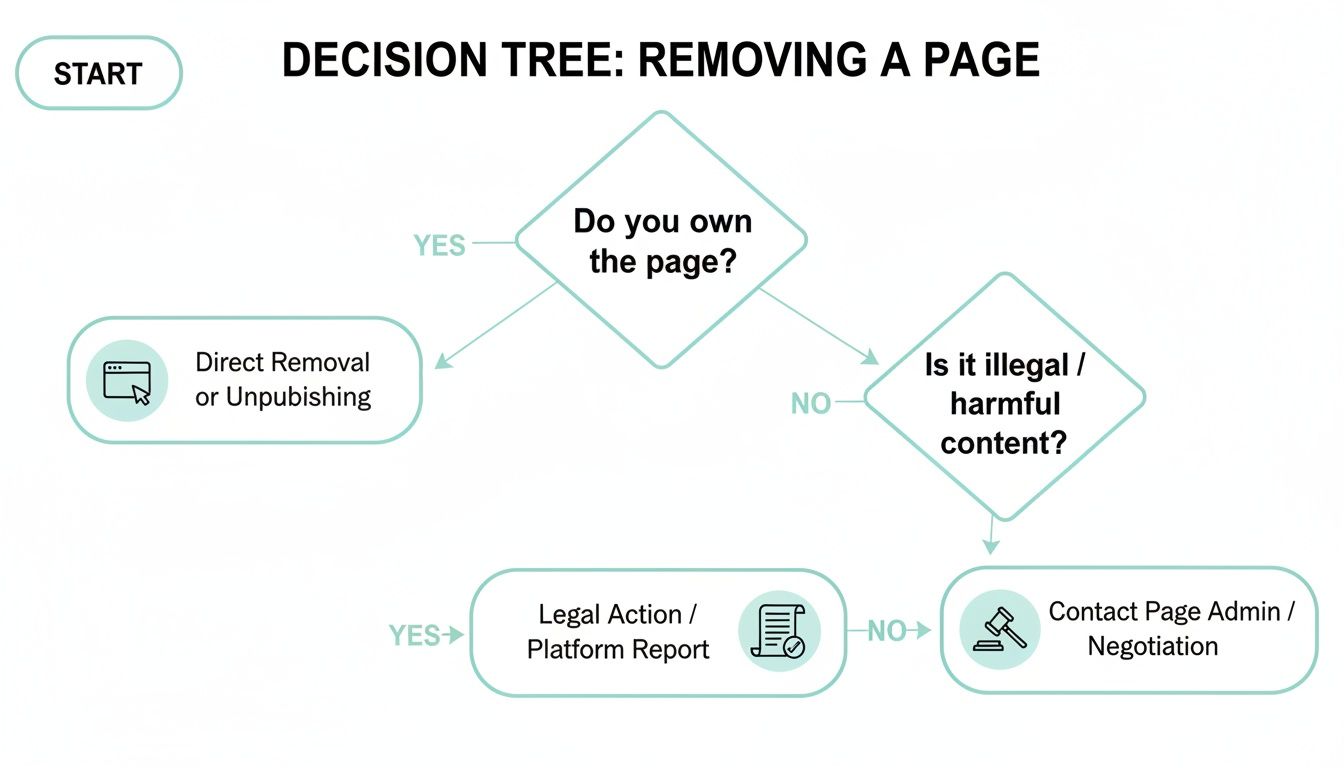
As you can see, your options diverge dramatically based on who holds the keys to the website. Let's break down what those options actually are.
Google Page Removal Options at a Glance
To help you decide on the right approach, it’s useful to see all your options laid out side-by-side. The method you'd use to remove an expired coupon page is completely different from the one you'd use to fight a misleading blog post written by someone else.
This table compares the most common methods for getting a page removed from Google's search results.
| Method | Best For | Speed | Permanence | Who Can Use It |
|---|---|---|---|---|
| GSC Removals Tool | Temporarily hiding pages on your own site from search results. | Fast (24-48 hours) | Temporary (approx. 6 months) | Site Owners Only |
| "noindex" Tag | Permanently removing pages on your own site from Google's index. | Slow (Weeks to months) | Permanent (as long as tag is present) | Site Owners Only |
| Contacting Site Owner | Requesting removal or correction of content on third-party sites. | Highly Variable | Variable (can be permanent if removed) | Anyone |
| Legal/DMCA Request | Removing content that infringes on copyright or violates the law. | Slow & Complex | Permanent (if successful) | Anyone (with legal basis) |
See the pattern? The tools you have direct control over are almost always faster and more reliable.
When you're trying to influence a website you don't own, you're playing by someone else's rules. That’s why figuring out ownership first is so critical—it sets realistic expectations and helps you choose the right tool for the job from the very start.
Removing Pages from Your Own Website

When the problem page lives on your own website, you're in the driver's seat. This is the best-case scenario. Whether you're dealing with an old blog post giving outdated advice or a service page for a line of products you no longer carry, you have complete control to get it out of Google's search results.
Having this control is a huge advantage. You have a couple of go-to methods, and picking the right one comes down to a simple question: do you need it gone right now, or do you need it gone for good?
The Fast but Temporary Fix
Let's say you're a plumbing contractor who just ran a big "emergency service" discount over a long weekend. Monday morning rolls around, the promotion is over, but that page is still ranking on Google and confusing potential customers. You need that page to vanish, fast.
This is the perfect job for Google Search Console's Removals tool.
Using this tool is like telling Google, "Hey, can you hide this URL for me?" It's incredibly quick, and you'll often see the page disappear from search results in under 24 hours.
- Best for: Expired promotions, seasonal offers, or pages where you might have accidentally published sensitive info.
- The catch: This is only a temporary blindfold. The removal lasts for about six months. After that, if the page is still live and accessible, Google can—and will—find and index it again.
To get it done, you just log into your Google Search Console, go to the Removals section, and paste in the exact URL. It’s a great emergency button, but it isn't a long-term strategy to remove a page from Google.
The Permanent Removal Solution
Now, think about a different situation. Maybe you’re a roofer who's decided to stop offering a specific type of shingle you've sold for years. The service page for it is now totally obsolete and just clutters up your site. A temporary fix isn't going to work here.
For permanent removals, the professional's choice is the noindex tag.
This little snippet of code goes into the <head> section of your webpage's HTML. It’s a direct, clear instruction for search engines that says, "You can look at this page, but do not include it in your search results."
A
noindextag is the cleanest and most definitive way to de-list a page. Simply deleting the page creates 404 "not found" errors, and blocking it with a file called robots.txt can be unreliable. Thenoindextag lets Google see the instruction and gracefully remove the page from its index.
Putting this tag in place is usually simple, especially on modern website builders.
- WordPress: If you use an SEO plugin like Yoast or Rank Math, just go to the page editor. In the "Advanced" tab for the plugin, you'll find a simple checkbox to apply the
noindextag. - Wix/Squarespace: Find the "SEO Settings" or "Advanced SEO" panel for the page you want to remove. There will be an option to hide the page from search results, which does the same thing.
Once the tag is live, Google will spot it on its next crawl and will begin the removal process. Be patient here—it's not instant. It can take anywhere from a few days to a couple of weeks, all depending on how often Google's bots visit your site.
For contractors wanting to do some spring cleaning on their website, running a content audit to find these old, underperforming pages is a great move. If you're not sure where to start with that, it can be helpful to understand how a professional SEO audit works.
At the end of the day, the Removals tool gives you speed, but the noindex tag gives you the permanent, clean solution you need for proper, long-term website management.
Handling Unwanted Pages You Don't Control
The real challenge starts when the problem page isn't even on your own website. For a contractor, this is a familiar nightmare. It could be a misleading profile on a trades directory, a scathing review on Yelp, or an unfair article from a local news blog.
This is where the easy fixes run out. You can't just hop into your site's backend and add a noindex tag. You can't use your own Google Search Console to yank it down. Suddenly, you're not in the driver's seat anymore. You’re left asking—or in some cases, demanding—that someone else fix the problem. This is the single biggest hurdle in trying to remove a page from Google when you don't own it.
When Legal Action Is Your Only Option
In very specific, narrow situations, you might be able to force a removal. Google has official channels for legal requests, but let's be clear: the bar is incredibly high. These aren't for pages you simply dislike or think are unfair.
The most common reason for a successful legal removal is copyright infringement.
- Scenario: A local competitor rips off your website, copying a detailed project case study—text, photos, the whole nine yards—and passes it off as their own work on their blog.
- Action: In this case, you can file a Digital Millennium Copyright Act (DMCA) takedown notice with Google. If your claim holds up, Google will de-index the URL that's hosting your stolen content.
This is a formal process, and you’ll need to prove you own the original work. It’s a powerful tool against content theft, but it’s completely useless for fighting a negative opinion or a review that, while damaging, is factually accurate.
Using Google's Outdated Content Tool
Google offers another tool, but its purpose is often misunderstood. The Outdated Content Removal tool is only useful when a page's content has already been changed or removed by the site owner, but Google’s search results are still showing the old, incorrect information.
Let’s say a directory site listed the wrong phone number for your business. You called them, and they finally updated it. But when a potential client searches your company name, Google’s little search snippet still shows the old, disconnected number. That's when you use this tool.
This tool does not ask Google to remove a live page. It only asks Google to refresh its memory after a page has already been fixed at the source. It’s a clean-up tool, not a removal tool.
This distinction is crucial. Most of the time, the problem contractors face—like a bad review—is live content that the site owner has no intention of taking down.
The Hard Truth About Negative Reviews
When it comes to most negative content, especially reviews and articles, you're going to hit a brick wall. Direct removal is almost impossible. Website owners are often protected by free speech laws, and platforms like Yelp or Google have policies that favor keeping user-generated content public unless it clearly violates their terms of service (like hate speech or outright spam).
Trying to get these pages taken down is usually a frustrating dead end. This is why a different approach is essential. Implementing strong online reputation management tips is almost always a better use of your time and energy. Since you can't just erase the negative, you have to bury it with an avalanche of positive content.
This reality is why suppression, not removal, is often the go-to strategy. For an in-depth look, read our guide on how to push down negative search results when you can't get them taken down.
The Hidden Crisis Facing Contractors on Google
You’re probably here because you want to know how to remove a page from Google. But I have to tell you, there's a much bigger, more unpredictable threat to your contracting business that’s already taking root. The game has changed. It's no longer about just one bad review or an unflattering article.
The very foundation of trust you've built with Google reviews is cracking.
For years, the advice was simple: get as many five-star reviews as you can. It made sense. But today, following that same advice can actually get your business flagged. Google's all-out war on spam and fake reviews has become a serious problem, and honest, hardworking contractors are getting caught in the middle.
The Great Review Disappearance
So, what's at the heart of this mess? It all comes down to Google's own automated systems. In a massive effort to clean house, Google is now deleting huge numbers of reviews, and its algorithm is anything but precise. We're not just talking about it flagging a few suspicious, one-star rants from fake profiles.
It's also deleting genuine, well-deserved five-star testimonials from your happiest customers.
Imagine this: a client is absolutely thrilled with the new deck you just built. They take the time to write a glowing, detailed review, praising your crew's professionalism and craftsmanship. A week later, it's just… gone. Vanished without a trace, no notification, no explanation. This isn't a weird one-off glitch. For thousands of businesses, especially in home services, this is the new reality.
And the problem is getting worse. We saw a huge spike in Google’s review removals throughout 2025, and it hasn't slowed down in 2026. Our analysis shows that home services and medical practices—two industries that live and die by their reputations—are getting hit the hardest. Shockingly, a huge chunk of these deleted reviews are five-star ratings. One business owner we tracked had 76 deleted reviews over four years, and most of them were overwhelmingly positive. You can dive deeper into this alarming trend and what it means by reviewing the full report on Google's review removals.
This means your most powerful marketing assets—the social proof that convinces a homeowner to call you instead of the other guy—can be wiped out by a system that can’t tell a real customer from a bot.
The real danger isn’t a single bad search result anymore. It’s the instability of your entire online reputation. That five-star rating you worked so hard to build is now a fragile thing, vulnerable to forces completely outside of your control.
Why Contractors Are Especially Vulnerable
This issue hits contractors harder than almost anyone. A local coffee shop might get a dozen reviews in a day. As a roofer or remodeler, you might only get a few high-quality reviews a month. Each one is gold, especially when your average job ticket is over $500.
Here’s why your business is directly in the algorithm's line of fire:
- High-Stakes Services: Nobody spends thousands on a new HVAC system or a kitchen remodel without obsessing over reviews. Losing just a few of your best testimonials can have a direct, measurable impact on your lead flow.
- Geographic Review Patterns: It’s completely normal for a contractor to do several jobs in the same subdivision and get a cluster of reviews from one neighborhood. But to Google's algorithm, a sudden burst of reviews from the same geographic area can look like a suspicious, "unnatural" campaign, triggering a filter.
- "Review Gating" Paranoia: Here’s the ironic part. If your reviews look too good—a perfect 5.0 rating with nothing but five-star praise—Google's systems might flag your profile for "sentiment manipulation." You can be penalized for being too good at your job, even when every single review is legitimate.
This isn't about fighting one bad link anymore. It's about learning to operate in a new environment where your own success can be mistaken for a violation. The old strategy of just collecting positive reviews is broken. You need a reputation strategy that's resilient enough to withstand Google’s unpredictable nature.
It’s a strange thing to say, but all the hard work you’ve put into building a great reputation could be the very thing that gets your contracting business in hot water with Google. In a frustrating twist, looking too good has become a major red flag for their algorithms.
This creates a real catch-22. Your best efforts to encourage happy customers to leave feedback can completely backfire. We’re no longer just talking about how to remove a page from Google that’s negative; now, you have to worry about your positive reviews triggering penalties.
The Problem with a Perfect Record
For years, the game plan was straightforward: get a flawless five-star rating. As a contractor, hitting a couple hundred glowing reviews on your Google Business Profile with no bad feedback in sight felt like you’d won the lottery. In 2026, that same profile can make you a target.
Google’s AI has gotten much more skeptical of perfection, partly because it's been tasked with cracking down on what they call "sentiment manipulation." They're also taking cues from the U.S. Federal Trade Commission, which has signaled that businesses selectively showing only positive reviews could be misleading the public.
A profile that looks too good to be true is now a prime candidate for an algorithmic review. When Google’s AI sees hundreds of 5-star ratings without a single blemish, it can trigger a "Shadow Ban," freezing your ability to get any new reviews for 30 to 90 days.
That’s right. The very act of successfully getting happy customers to share their great experiences can get you penalized, killing your momentum. Your success gets mistaken for manipulation.
Unnatural Growth Spikes and Algorithmic Suspicion
Another huge penalty trigger is any review activity that Google’s algorithm flags as an "unnatural" pattern. This puts seasonal businesses and any contractor experiencing a growth spurt directly in the crosshairs.
Imagine you run an HVAC company and a freak summer heatwave hits. You’re swamped with service calls, and your team is crushing it. Naturally, this flood of work results in a flood of legitimate customer reviews. It’s the sign of a healthy, thriving business.
To Google's algorithm, however, it can look an awful lot like spam.
A sudden spike in reviews, even if every single one is genuine, can set off the automated tripwires designed to stop fake review farms. The system is built to see the pattern, not the real-world context behind it.
Here’s what gets you flagged:
- Sudden volume increases: You normally get two reviews a week, but after a big hailstorm, you get ten in one day.
- Time-based clustering: Your office manager follows up with all of yesterday's happy customers in the morning, and five reviews pop up within an hour.
- Geographic concentration: You just finished a big roofing project for five houses on the same block, and they all leave reviews.
Every one of these is a normal scenario for a contractor. But to Google, they’re classic red flags.
The result? Those hard-earned reviews might vanish without a trace, or worse, your entire profile could get hit with a temporary suspension. It has created a minefield for any contractor who’s good at their job. You can get a deeper look into how Google’s enforcement has made contractors so vulnerable by exploring the details on 2026 review removals.
Why Old Advice Is Now Dangerous
The old reputation management playbook is officially obsolete. The standard advice to just "get more good reviews" to bury the bad ones is now dangerously oversimplified. In fact, following it could actively hurt your business.
An aggressive push for reviews, even with the best of intentions, could be the very thing that trips the algorithmic wire you’re trying to avoid.
This new reality requires a much smarter, more delicate approach. It’s no longer about sheer volume; it’s about maintaining a natural, steady, and authentic-looking stream of feedback. Pushing too hard can make your legitimate success look like a black-hat scheme to an algorithm that can't tell the difference. You now have to manage your success just as carefully as you manage your failures.
Build a Digital Fortress Instead of Chasing Removals
Trying to force a page off Google often feels like a losing battle. It’s a frustrating game of Whac-A-Mole; the second you get one negative result taken care of, another seems to pop up. I’ve seen countless contractors spin their wheels on this.
A much smarter strategy is to stop chasing removals and start building a digital fortress of positive content you actually own and control.
This approach is known as suppression. Instead of trying to erase negative mentions, you create a tidal wave of positive, high-ranking assets that push the bad stuff down. This effectively buries damaging pages where they become invisible—after all, a staggering 92% of people never click past the first page of search results.
Shift Your Focus to Asset Creation
The goal is pretty straightforward: when a potential client searches for your company, you want them to see a wall of professional, positive content that you put there. This isn’t about hiding from criticism. It’s about ensuring one unhappy customer or a misleading article doesn't get to define your entire brand story.
So, what does that look like in practice for a contractor?
- Detailed Project Showcases: Don't just post a "before and after." Walk people through the entire job. Highlight the quality materials you used, the craftsmanship involved, and the happy client at the end.
- Expert "How-To" Guides: A roofing company could create a definitive guide on spotting storm damage. A plumber could write about winterizing pipes. This builds trust and positions you as the go-to authority in your area.
- Team Biography Pages: Introduce your crew. Putting a face to the name helps build a personal connection and shows you’re a real, local business, not a faceless corporation.
- Positive Press and Local Awards: If you were featured in a local publication or won a "Best of" award, that needs to be front and center online. Make a big deal out of it.
This proactive approach puts you back in the driver's seat. You stop reacting to problems and start actively shaping your own online reputation.
By building a fortress of controlled content, you’re not just playing defense. You’re launching an offensive campaign to define your own brand story, making any single negative page an irrelevant footnote rather than the main headline.
Navigating Google's Unpredictable Environment
This fortress strategy has become non-negotiable. The March 2026 Google Core Update threw search results into chaos, and new AI-powered tools are changing how customers find services entirely. For contractors, a strong review profile isn't enough anymore, especially when AI Overviews can slash clicks to your website by a jaw-dropping 58%. If you haven't seen it yet, you should review the latest insights on Google's updates to understand what's happening.
Building out your digital assets is no longer just a reputation management tactic; it’s a core part of modern SEO. To stay ahead, you need to be aware of the top reputation management trends for 2026.
Ultimately, all these positive assets should work together as part of a strong search strategy. We cover how to integrate them in our complete guide to local SEO for contractors.
Got Questions About Page Removals? We've Got Answers.

When you're dealing with an unwanted search result, there's a lot of conflicting information out there. I get it. To cut through the noise, here are straight-to-the-point answers to the questions we hear most from contractors trying to clean up their online presence.
This will help you set realistic expectations and figure out the best move when you need to remove a page from Google.
How Long Does It Take to Get a Page Off Google?
This is the big one, and the honest answer is: it depends completely on whether you control the website the page is on.
If it's a page on your own site, you can get it hidden from search results very quickly—often in less than a day—using Google Search Console. But keep in mind, that's just a temporary fix. For a permanent removal, you have to also delete the page or apply a noindex tag. Google will then process that change the next time it crawls your site, which could take a few weeks.
Now, for pages on third-party sites you don't own? The timeline is anyone's guess. Success is never a sure thing, and the process can drag on for months with no guarantee of a positive outcome.
Can I Pay a Company to Guarantee a Bad Review Is Removed?
No. Full stop. Be extremely wary of any company that guarantees it can remove negative content from a site like Google or Yelp. In my experience, this is one of the biggest red flags in the reputation management industry.
A legitimate firm will never promise to remove content they don't own. Instead, they focus on what they can control: burying negative results by building a portfolio of positive content that outranks it.
Am I Stuck If I Can't Remove a Negative Page?
Not at all. While you often can't force a third-party site to delete a page, you can absolutely make that page irrelevant. The most powerful strategy here is what we call a content flood.
Think of it as fighting fire with water. You create and promote so much high-quality, positive content about your business that the negative result simply gets pushed down and out of sight.
This includes building out assets you own and control:
- In-depth content on your own website
- Detailed project galleries and case studies
- Expert blog posts that showcase your knowledge
- Active and positive social media profiles
This wave of good information effectively buries the bad stuff on page two or three of the search results—a place very few potential customers ever venture. This is the foundation of smart, effective reputation management in 2026.
If you're a contractor tired of letting negative results define your business, Impruview can help. We specialize in building a digital fortress around your brand, putting you back in control of your story. Learn how we can protect your online reputation.