That one-star alert feels like a gut punch. We've all been there. But before you do anything, know this: you can't just delete a bad Yelp review because you disagree with it. The only way to get a review taken down is to prove it violates Yelp's specific Content Guidelines. This isn't about arguing your side of the story; it's about building a logical, evidence-based case for removal.
Your First Move When a Bad Yelp Review Hits
That notification can derail your entire day, but a knee-jerk, emotional reaction will only dig a deeper hole. The first 24 hours are critical, not for firing back a response, but for a cool-headed, strategic assessment. Rushing to reply or flag the review without a plan is a recipe for getting your request denied.
The single most important first step? Take a breath and walk away. Let that initial wave of anger or frustration pass so you can approach this with a clear mind. This brief "cool-down" period stops you from posting a defensive, emotional rant that you'll regret later. Once you’re calm, your job is to become a detective, not a defendant.
The Objective Review Checklist
Your goal is to shift your mindset from "This is unfair!" to "Does this actually break the rules?" It's a subtle but powerful change. Pull up Yelp’s Content Guidelines on one screen and the negative review on another. Now, go through the review line by line, looking for a clear, undeniable violation.
You're hunting for a slam-dunk case, not a gray area. Ask yourself these questions:
- Is this a real customer? Check the name and the details of their story against your CRM or job records. A review from someone you have no record of ever working with is a major red flag for a fake or competitor review.
- Is there a conflict of interest? This is a big one. It covers reviews from disgruntled ex-employees, current or former business partners, or direct competitors trying to sabotage your rating.
- Is it secondhand information? Yelp's rules are clear: the review must be based on the writer's own direct experience. A post that says, "My neighbor told me your roofing crew left a huge mess," is a classic violation of this policy. It's hearsay, not a firsthand account.
- Is it completely irrelevant? The feedback must be about the customer's experience with your service. Rants about your political yard signs, the price of lumber in general, or other topics unrelated to the job you performed are often removable.
- Does it contain private information? Posting a customer's full name, private phone number, or home address is a strict and fast violation of Yelp's privacy standards.
This methodical check is your reality check. It helps you determine if you have a legitimate case for removal or if you need to pivot to a different strategy. And let's be honest, most negative reviews, while painful, are just someone's opinion and won't be removed.
Removable vs. Non-Removable Yelp Reviews
To make it even clearer, here's a quick cheat sheet for spotting a potential violation versus a legitimate, though negative, customer opinion. This table can help you quickly size up a review and decide if it's worth the effort to report.
| Violation Type (Potential for Removal) | Description & Contractor Example | Non-Removable Criticism (Must Be Addressed) | Description & Contractor Example |
|---|---|---|---|
| Conflict of Interest | The review is from someone with a clear bias, like a competitor or ex-employee. | Subjective Opinion | The customer is expressing their personal, legitimate dissatisfaction with the service. |
| "This plumber is a rip-off. Go to my business, 'Best Pipes Plumbing,' instead!" | "The plumber quoted us one price but the final bill was higher. I felt misled." | ||
| Secondhand Experience | The reviewer wasn't the actual customer and is recounting someone else's story. | Service Quality Issues | The feedback, while negative, describes the customer's direct experience with your work. |
| "My brother hired them to fix his deck, and he said they did a terrible job." | "The crew left sawdust all over our furniture and didn't clean up after themselves." | ||
| Irrelevant Content | The review focuses on things that have nothing to do with the consumer experience. | Communication Problems | The customer is unhappy with how they were treated or the information they received. |
| "I don't like this company's political donations. Don't hire them." | "I called three times for an update and no one ever called me back." | ||
| Private Information | The review includes sensitive, non-public details about an individual. | Pricing Disagreements | The customer believes they were overcharged or that the value wasn't there. |
| "The owner, John Smith at 123 Main St, is a crook!" | "Their quote was 30% higher than two other companies for the same siding job." |
Understanding this distinction is the key. Yelp protects a consumer's right to share their experience, even if you feel it's unfair, as long as it doesn't cross into one of these policy-violating categories.
Don't Forget About Yelp's Filter
It also helps to understand that Yelp has its own automated systems working in the background. The platform’s algorithm plays a huge role in which reviews are prominently displayed.
A significant number of reviews never even appear on your main profile. Yelp places them in a separate "not currently recommended" section, where they don't factor into your overall star rating.
This filter is designed to catch reviews from new users with no track record, posts that seem suspicious, or low-quality rants. Out of the 308 million Yelp reviews accumulated as of 2024, only about 76% are actually "recommended" by Yelp's software and count toward a business's star rating. Knowing that not every negative review carries the same weight can give you some much-needed peace of mind.
By focusing on clear policy violations first, you save your time and energy for the fights you can actually win. This initial assessment is the foundation of your entire strategy and a critical part of any successful contractor's approach to local SEO and online reputation management.
Building a Bulletproof Case to Get a Yelp Review Removed
So, you’ve found a review that looks like it breaks Yelp’s rules. What now? Your next move is everything.
Just flagging a review and typing "this is fake" into the comment box is a surefire way to get your request ignored. Yelp’s moderators aren't on your side or the customer's side; they're neutral referees who only care about one thing: proof. You have to build a case so clear, so concise, and so undeniable that removing the review becomes the only logical choice for them.
This isn't the time for a long, emotional story about how the review is unfair. Think of yourself as a detective, not a defendant. Your job is to gather the cold, hard facts that prove a violation occurred. It’s just like preparing a change order for a client—you need the documentation to back up the request.
Assembling Your Evidence Dossier
First things first, create a dedicated folder on your computer for this specific review. Your mission is to dig up every single internal record that pokes a hole in the reviewer's story. The more factual and specific your evidence, the better your odds.
Here's the kind of documentation you should be hunting for:
- Communication Records: Get into your emails, text message logs, and phone records. If a reviewer swears you ghosted them, a log showing three calls you made to their number is knockout evidence.
- CRM Notes: Your Customer Relationship Management (CRM) software is a treasure trove. Pull up any notes detailing conversations, project updates, client sign-offs, or issues that came up. A simple entry like, "Client approved final walkthrough on May 15th," completely dismantles a claim that the job was never finished.
- Financial Documents: Invoices, proof of payment (or lack thereof), and signed contracts are as good as gold. If someone who has never paid you a dime leaves a review, it’s a massive red flag that they weren't a real customer.
- Project Management Files: For contractors, this is your bread and butter. Dated photos of the job site, signed work orders, and even internal notes between your team members can be the linchpin of your case.
A Yelp moderator might not take your word for it, but they will absolutely take your records seriously. A timestamped photo or a signed PDF is often the one piece of proof that gets a bogus review taken down.
When you gather these documents, you shift the argument from a messy "he said, she said" situation to one based on verifiable facts. This methodical approach is the only way to successfully remove a negative Yelp review that violates their policies.
Connecting Your Evidence to a Specific Violation
Okay, gathering the files is only half the job. Now you have to connect each piece of evidence directly to a specific violation of Yelp’s Content Guidelines. You can't expect the moderator to piece it all together for you. You need to spoon-feed them the argument.
Let’s walk through a few real-world examples from the field.
The Scenario: A reviewer claims your HVAC technician showed up "five hours late" and rushed through the job.
Your Evidence: Pull the dispatch log from your scheduling software showing the tech arrived within the confirmed two-hour window. Then, attach the signed work order where the customer initialed the completion time and checked the "satisfied with service" box.
The Scenario: A review from "John D." blasts your roofing company for leaving nails in his yard and breaking a gutter. The problem? You’ve never had a customer named John D.
Your Evidence: Take a screenshot of your CRM search results for "John D." showing "0 clients found." State it plainly in your report: "We have no record of ever providing service to an individual with this name or at any associated property."
The Scenario: Someone alleges your plumbing company massively overcharged them for shoddy work.
Your Evidence: This is a classic. Submit a copy of the initial signed estimate, the final invoice that breaks down the exact parts and labor they agreed to, and the "after" photos from your plumber's phone showing a clean, professional installation.
In every one of these cases, the evidence isn't just a jumble of random files. It's a curated package of proof designed to systematically take apart the reviewer's claims. Make the moderator's job easy, and they'll be far more likely to make your day.
The Official Process for Flagging and Escalating a Review
So, you’ve gathered your evidence and you're ready to make your move. A lot of contractors make the mistake of just hitting the "Flag Review" button and hoping for the best—that’s a quick path to getting your request denied. You need to treat this like you’re presenting a formal case to a neutral moderator. This is your best shot, so you have to make it count.
The whole process starts inside your Yelp for Business dashboard. Head over to the "Reviews" section and track down the one you want to challenge. You'll see an icon with three dots; click that and choose "Report Review."
Now, this is where the strategy begins. Yelp will show you a list of reasons why a review might be removed.
Choosing the Right Violation
Picking the most accurate violation is absolutely crucial. You can't just say the review is "unfair." You have to connect your evidence directly to one of Yelp's specific Content Guidelines.
Some of the most common and effective ones for contractors include:
- It contains false information. This is your go-to if you have an invoice, text message, or photo that directly disproves a factual claim in the review.
- It's from a competitor or ex-employee. Perfect for clear-cut conflicts of interest where you can prove the reviewer’s relationship to your business.
- It doesn't describe a personal consumer experience. Use this for secondhand stories ("my neighbor said…") or rants about your pricing philosophy instead of their actual project.
- It includes private information. If a reviewer posts a technician's full name, a personal cell number, or a home address, this is usually a fast and easy removal.
Writing a Compelling Note to the Moderators
After you select a reason, Yelp gives you a small text box to plead your case. Do not skip this step. Sending a report with no explanation is a massive missed opportunity. This is where you concisely lay out your proof.
Your note needs to be professional, factual, and completely free of emotion.
Think about it from the moderator's perspective—they look at hundreds of these reports every single day. Make their job easy, and you’ll have a better chance.
A simple, effective structure looks like this:
- State the Violation: Start by naming the specific rule the review breaks. "This review violates Yelp's guidelines regarding conflicts of interest."
- Present Core Evidence: Give them the facts in one or two sentences. "The reviewer, 'John S.,' is a former subcontractor whose contract we terminated for poor performance on May 15, 2024."
- Reference Your Documentation: Tell them what you have to back it up. "We can provide the signed termination agreement and related email correspondence as proof."
This straightforward, evidence-first approach works far better than telling a long, emotional story about the customer.
Keep your note to the moderator under 100 words. The goal is clarity and speed. A concise, fact-driven report is always more persuasive than a lengthy rant about who was right or wrong.
This decision tree really sums it up: having solid proof is the only reliable path to getting a review removed.
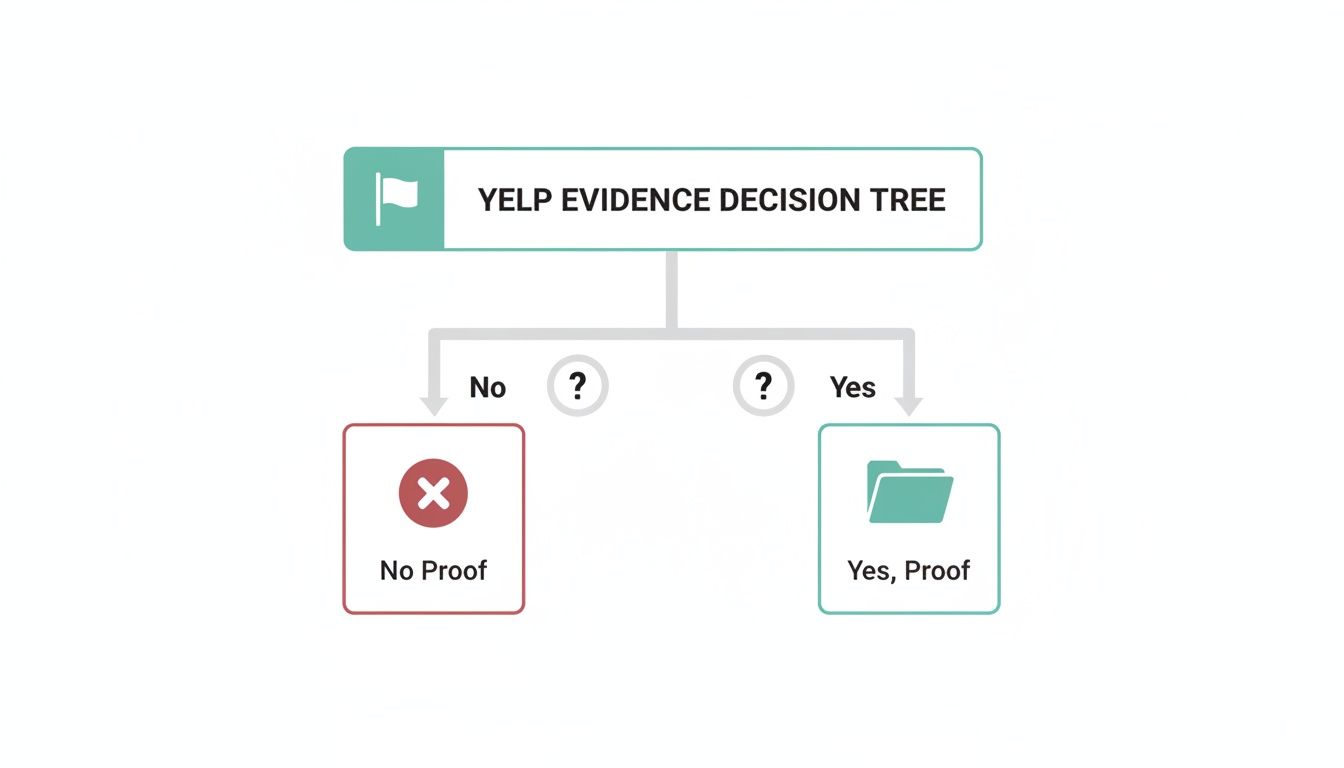
Without something tangible to show the moderators, flagging a review is basically a coin toss. That’s why getting your documents in order before you click "report" is so important.
When Your Initial Flag Is Denied
It’s frustrating, but it happens. Yelp might deny your request, often with a canned response about how the review doesn't violate their policies. If you're dealing with a truly serious issue—like defamation or harassment—you have one more official move you can make: an escalation.
This isn’t for run-of-the-mill disagreements over a one-star review. You save this for severe violations where you have significant, often legally-backed, evidence. For these cases, Yelp provides a specific Legal Support Portal.
Consider this route only if the review involves:
- Defamation: The review contains verifiably false statements of fact (not just opinions) that have caused measurable harm to your business.
- Harassment or Threats: The content includes direct threats of violence or shows a clear pattern of targeted harassment against you or your team.
- Intellectual Property Infringement: The reviewer stole and used your copyrighted job site photos or your company logo without permission.
When using the Legal Support Portal, you'll need to lay out your case with even more precision. This is pretty much your final stop before calling a lawyer, so make sure your evidence is irrefutable. After you submit the report, you can track its status. Expect to wait anywhere from a few days to a week for a response, and try to be patient—sending multiple follow-ups won't speed things up.
How to Respond to Negative Reviews You Cannot Remove
So you’ve gone through all of Yelp’s official channels, and the review is still up. It's a tough pill to swallow, but the reality is some negative reviews are there to stay. Yelp fiercely protects a customer's right to share their firsthand experience, even if you feel it's unfair or doesn't capture the whole story.
Once you realize a review can't be taken down, your public response becomes your most important tool. This isn't about winning a fight online; it’s about damage control. Your goal is to show the hundreds of potential customers reading that exchange that you are a professional, reasonable business owner.
A well-written reply can completely neutralize a bad review, and I’ve even seen it tip the scales in a contractor's favor.
The Anatomy of a Powerful Response
After years of helping contractors navigate this, I’ve found a simple three-part approach that works almost every time. It’s designed to de-escalate, professionally present your side, and prove to future clients that you’re the kind of business they want to hire.
Here’s the breakdown:
- Acknowledge and Apologize First: Always start by acknowledging their frustration. A brief, professional apology goes a long way. This isn't about admitting you were wrong. Something as simple as, "We're sorry to hear your experience didn't meet your expectations," validates their feelings without agreeing with their claims.
- State the Facts Calmly: This is where you briefly and factually state your side of the story. No emotion, no defensiveness. For example, instead of getting into a "he said, she said" about timelines, you can say, "Our records show the project was completed on the agreed-upon date of May 15th." Keep it short and stick to what you can prove.
- Take the Conversation Offline: Your number one goal is to get this argument out of the public eye. Always end by offering a direct line to resolve the issue privately. Give a manager’s name, a direct email, or a specific phone number.
This structure tells prospective customers that you’re engaged, in control, and committed to making things right. That's a powerful message.
Critical Mistakes to Avoid in Your Reply
How you respond is just as critical as what you say. One wrong move can pour gasoline on the fire, making you look unprofessional and instantly validating everything the reviewer claimed.
The single worst thing you can do is get into a public argument. Post your one professional response and then walk away. Your job in that public forum is done. Never, ever get drawn into a back-and-forth debate.
Here are the absolute "don'ts" of responding to a negative review:
- Never Offer a Refund for Review Removal: This is a huge red flag for Yelp and a direct violation of their terms. They can and will put a "Consumer Alert" badge on your profile, which is far worse than the original review. Handle any financial talks offline, completely separate from the review itself.
- Don’t Use Canned, Corporate Jargon: Avoid generic, copy-and-pasted responses that scream "I don't care." Mention one specific detail from their review so they know a real person actually read it.
- Avoid Emotional or Defensive Language: Sarcasm, blaming the customer, or making personal attacks will only sink your reputation. Stick to the facts and keep your cool.
- Don't Share Private Customer Information: Never post a customer's full name, address, or specific invoice details. This is a massive breach of privacy and makes you look vindictive.
By steering clear of these common mistakes, you stay in control of the narrative. Even when the review is negative, your calm, professional response can leave a lasting positive impression. For a deeper dive, check out our other resources on effective review management strategies.
Contractor Response Templates for Negative Reviews
Let's put this framework into practice. Every contractor has faced these situations. Instead of getting flustered, you can have a go-to response ready. Below are some plug-and-play templates designed for the real-world scenarios you’ll actually encounter.
Contractor Response Templates for Negative Reviews
| Review Scenario | Do Say This (Template) | Don't Say This (Mistake to Avoid) |
|---|---|---|
| Cost Dispute | "Hi [Name]. We're sorry to hear you were unhappy with the final invoice. Our goal is always to be transparent with pricing, which is why we provide a detailed, signed estimate before any work begins. We would be happy to review the invoice with you again. Please call our office and ask for [Manager's Name]." | "The price was exactly what you agreed to in the contract you signed. You're just trying to get out of paying your bill." |
| Workmanship Disagreement | "Hi [Name]. Thank you for the feedback. We stand by our work and want every client to be completely satisfied. Our project manager, [Name], would like to schedule a time to come out and inspect the areas you mentioned. You can reach him directly at [Phone Number]." | "We've been doing this for 20 years and never had a complaint. The work is perfect; you just don't know what you're looking at." |
| Project Delay Complaint | "Hi [Name]. We sincerely apologize for the delay you experienced. The unexpected material shortage did push our timeline back, and we regret the frustration this caused. We've since updated our supplier communication process to prevent this from happening again. We appreciate your patience." | "It wasn't our fault! The supply company was late. Everyone is dealing with delays right now." |
Having these templates on hand ensures that even when you're frustrated, your first public reaction is a strategic one. You can always adjust the details, but the professional, de-escalating tone should remain the same. This approach protects your reputation and shows potential customers you're a contractor they can trust.
Drown Out the Noise with a Content Flood
Trying to fight every single negative Yelp review is an exhausting, uphill battle you’ll rarely win. While you should absolutely flag and respond when necessary, the best long-term strategy isn't about playing defense—it's about going on offense.
It’s time to build an online fortress so strong that one bad Yelp review just bounces right off. I call this the "Content Flood."

The goal here is simple. When a potential customer Googles your company name, you want them to see a first page dominated by positive, five-star assets that you control. This shoves that negative Yelp link down to the second page of Google, where over 90% of people will never even see it.
This is how you take back the driver's seat. It's a fundamental shift from just reacting to bad press to proactively shaping what people see when they look you up.
Start by Building Your Digital Assets
First things first, you need to create a portfolio of high-quality digital properties you either own or directly influence. Think of each one as a digital billboard for your best work. The more of these you have, the more real estate you own on Google’s first page.
Your own website is always ground zero. It's the foundation of your online presence and the one place where you call all the shots.
Focus your energy on building out these key assets:
- Your Website's Project Gallery: Don’t just throw up a few photos. Build out detailed pages for your best jobs. Include killer before-and-after pictures, a quick case study of the work you did, and mention the town or neighborhood.
- Location-Specific Service Pages: This is a huge one. Create pages on your site for each service in each major area you cover, like "Roof Replacement in Springfield." This helps you show up in local searches and gives Google more positive pages to rank for your brand.
- Company Blog Posts: Write articles that answer the questions you get from customers all the time. A post like "Case Study: A Complete HVAC System Overhaul in Meadowbrook" is another powerful, positive asset that can rank for your company name.
Expand Your Reach Beyond Your Own Site
Once your website is a fortress of positive content, it's time to expand. You need to build strong, positive profiles on other platforms to diversify your search results and add some serious social proof.
Look at other high-authority platforms where customers are searching:
- Houzz or Angi Profiles: If you’re in home services, a maxed-out profile on these sites is gold. Pack them with your best project photos, write detailed descriptions, and start asking for reviews there, too.
- Better Business Bureau (BBB): An A+ rating from the BBB is a massive trust signal that often ranks very well in search results. Make sure your profile is claimed and accurate.
- YouTube Channel: This is easier than it sounds. Get your phone out and shoot simple video testimonials with happy clients or do quick walk-through videos of finished projects. Google loves video, and it can push other results down the page fast.
The trick is to treat each of these profiles like a primary marketing channel, not some chore you have to do once. A really well-built profile on a major platform can often outrank a negative Yelp page all by itself.
By creating and promoting these assets, piece by piece, you're building a protective buffer around your brand. This is the heart of effective online reputation management for contractors, which is all about control and promotion, not just damage control.
Open the Floodgates with New Reviews
The final, crucial piece of this strategy is to get a steady stream of new, positive reviews coming in. A constant flow of four and five-star feedback doesn't just bump up your average rating; it tells Google your business is active and customers love you. This, in turn, helps all your positive profiles rank higher.
You need a simple, repeatable system. You can't just cross your fingers and hope happy customers leave a review. You have to make it dead simple for them.
Here's a basic system any contractor can put in place tomorrow:
- Find the "Happy Moment": The absolute best time to ask is right after the job is done and the customer is smiling, telling you how great everything looks.
- Send a Direct Link: Don't just say, "Please review us on Google." That's too much work. Send them a text or email with a direct link that takes them straight to the review page.
- Follow Up (Just Once): If you don't hear back, it's okay to send one polite follow-up message a few days later. Life gets busy.
This consistent effort is what ensures your good reviews will eventually overwhelm and bury the bad ones. It’s the combination of creating positive assets and generating real, positive feedback that makes the content flood so powerful. You stop looking for a magic button to delete bad reviews and instead build a reputation so strong they become completely irrelevant.
Frequently Asked Questions About Managing Yelp Reviews
Dealing with Yelp reviews can feel like walking through a minefield. Even when you have a plan for flagging, responding, and building up your positive presence, you're bound to run into some tricky situations. Let's tackle the most common questions we hear from contractors trying to get a handle on their reputation.
How Many Flags Does It Take to Remove a Yelp Review?
This is one of the biggest myths out there. The truth is, there's no "magic number" of flags that gets a review taken down. A single, well-documented flag that points to a specific violation of Yelp's own rules is a thousand times better than a dozen vague reports from your team or friends.
Yelp’s moderators are looking for proof, not a popularity contest. Their entire job is to measure the review's content against their official guidelines. In fact, getting a bunch of people to mass-flag a review can seriously backfire. It looks like you're trying to game the system, which hurts your credibility. Your best bet is to focus on building one rock-solid case.
Can I Sue Someone for a Bad Yelp Review?
The short answer is yes, you can technically sue a customer for defamation. But the real-world answer is that it's an incredibly expensive, long, and uphill battle that almost never makes sense for a contractor to fight.
To even have a shot at winning, you'd have to prove three things:
- The review contains a statement that is factually false, not just an ugly opinion.
- That false statement caused you direct financial harm.
- The reviewer posted it with malicious intent.
Opinions like "the contractor's work was shoddy" are protected speech, making them nearly impossible to fight in court. Worse, filing a lawsuit can trigger the "Streisand effect"—where trying to hide something just draws a massive amount of unwanted attention to it. The legal bills and potential for a PR nightmare almost always outweigh any victory you might hope for.
Does Responding to a Negative Review Make It More Visible?
This is another myth that paralyzes a lot of business owners. The fear is that engaging with a bad review bumps it to the top of the list. While new activity might give a review a tiny, temporary nudge in Yelp's algorithm, the long-term value of responding professionally is infinitely more important.
An unanswered one-star review is a permanent, one-sided accusation. Your professional reply is your chance to show every future reader that you are engaged, reasonable, and committed to doing things right.
Think of it this way: your response isn't just for the unhappy customer. It's for every single potential customer who reads that review from now on. You're showing them you stand behind your work. A slight, temporary bump in visibility is a small price to pay for that.
Should I Offer a Refund to Get a Customer to Remove a Bad Review?
No. Absolutely not. This is a bright red line you should never cross.
Directly offering money, a discount, or any other compensation in exchange for a customer removing or changing their review is called review gating. This is a major violation of Yelp's terms of service.
If Yelp catches on, they can slap a nasty "Consumer Alert" banner on your profile. This alert tells everyone visiting your page that you've been caught trying to manipulate your reviews, which does way more damage than one bad review ever could.
By all means, work to resolve customer issues offline—that's just good business. If a genuinely satisfied customer later decides on their own to update their review, that's great. But never, ever make your help conditional on them changing what they wrote.
Are unfair reviews on Yelp and Google costing you leads every month? Impruview deploys a proprietary content flood strategy to dominate your brand's search results, pushing negative reviews off the first page where they can't do any more damage. Learn how we help contractors take back control of their online reputation.