If your phone isn't ringing, it's a sign that your marketing plan needs a serious overhaul. Getting more plumbing leads means taking an honest look at what customers see online—you’ve got to fix your reputation, show up in local searches, and make sure your website turns visitors into paying customers. This is your playbook to stop losing business to the competition down the street.

Diagnose Before You Spend
Before you throw another dollar at ads, we need to figure out what’s working and what’s broken. I’ve seen too many plumbers get burned by marketing agencies that jump straight to paid ads without fixing the foundational issues first. It’s a classic mistake that just wastes money.
This isn't about marketing fluff; it's a practical triage for your business. We'll start by auditing your current lead flow to see exactly where you're losing potential customers.
The 3 Big Lead Killers In Plumbing
From my experience, almost every lost job can be traced back to one of three problems. Pinpoint which one is hitting you the hardest, and you'll know exactly where to focus your energy for the biggest return.
- A Busted Online Reputation: A few bad reviews on Google or Yelp are like a giant "Do Not Enter" sign for anyone needing a plumber.
- Being Invisible in Local Search: If you’re not in the top 3 on Google Maps when someone searches “plumber near me,” you might as well not exist.
- A Website That Doesn't Convert: You get clicks, but the phone stays silent. This is usually due to a slow-loading site, confusing layout, or no clear way for a customer to call you right now.
The U.S. is packed with over 132,000 plumbing businesses fighting for a piece of a market expected to hit $169.8 billion. Yet, a massive 70% of plumbers who hire marketers end up dissatisfied. Why? Because the agency ignored the real problem—like that one-star Yelp review that scares everyone away.
When 69% of smartphone users (the people driving most local searches) see bad reviews, they immediately move on. That’s thousands in lost revenue right there.
My Take: Spending money on ads before you fix your reputation is like pouring water into a leaky bucket. You have to patch the holes in your reputation and local search visibility first.
Audit Your Marketing Channels
To get started, let’s run a quick diagnostic on your most important lead sources. This table will help you spot the weak points in just a few minutes.
Lead Generation Channel Diagnostic
| Channel | What to Check | Red Flag (You're Losing Leads If…) | Green Flag (You're Gaining Leads If…) |
|---|---|---|---|
| Google Business Profile | Your star rating, recent reviews (good and bad), and map ranking for "plumber in [your city]". | Your average rating is below 4.5 stars, or you have negative reviews with no company response. | You rank in the top 3 map results and have a steady stream of 5-star reviews every month. |
| Your Website | Is your phone number huge and at the top of every page? Does the site load in under 3 seconds on a phone? | The phone number is hard to find, or your "Request Service" button is buried at the bottom of the page. | Your phone number is "click-to-call" and impossible to miss. Your site is clean, fast, and mobile-friendly. |
| Local Search (SEO) | Search for "emergency plumber" or "drain cleaning" in your service area. Where do you show up? | You're not on the first page of Google for your main services—either in the map pack or organic results. | You consistently appear on the first page, giving you free visibility and clicks 24/7. |
| Online Reviews | Check your profiles on Google, Yelp, and Angi. What’s the overall sentiment? | You haven’t gotten a new review in over 3 months, or old, negative reviews are the first thing people see. | You have a system to ask every happy customer for a review, and your recent feedback is overwhelmingly positive. |
This quick audit gives you a clear, honest starting point. You now have a diagnosis. For a deeper look into building a comprehensive client acquisition strategy, check out these proven lead generation best practices.
Dominate Local Search and Get the First Call
When a pipe bursts, homeowners aren't casually browsing websites. They’re grabbing their phone and frantically searching “plumber near me.” Getting more plumbing leads is all about making sure your business is the one they see—and trust—in that moment of panic. This is how you win the local search game and get that first call.
Your Google Business Profile (GBP) is your most valuable asset here. It's not just another listing; it's your digital storefront right on Google Search and Maps. Getting it right isn't optional.
Let's face it, this is a tough business. The industry is projected to hit $169.8 billion by 2026, and you're competing with over 132,000 other plumbing companies. In this crowded market, 69% of customers pick companies with great mobile presence and stellar reviews, instantly dismissing anyone with negative feedback. A few bad reviews can literally cost you thousands each month.
Your Google Business Profile Is Your Best Salesperson
I like to think of a Google Business Profile as a mini-website that Google personally favors. A properly tuned profile can land you in the coveted "Map Pack," the top three results everyone sees first.
Here’s how to put your profile to work:
- Fill Out Everything: Don't get lazy here. Complete every single field—your services, service areas, hours (especially 24/7 emergency availability), and write a solid business description that tells people what you're about.
- Get Your Categories Right: Your primary category has to be "Plumber." But don't stop there. Add secondary categories like "Water Heater Installation & Repair Service" or "Drain Cleaning Service" to show up for more specific searches.
- Show Off Your Work: Post high-quality photos. I’m talking about your team, your clean and branded trucks, and plenty of before-and-after shots. This stuff builds trust instantly and screams professionalism.
The biggest mistake I see plumbers make is treating their GBP as a "set it and forget it" task. You need to stay active. Use Google Posts weekly to share special offers, highlight a service, or post a quick tip. It signals to Google that you’re open, active, and relevant.
I tell every plumber I work with: your Google Business Profile is a lead generation machine that works for you 24/7, for free. Neglecting it is like leaving money on the table. Treat it with the same seriousness you give a high-value job.
Keep Your Business Information Consistent
Inconsistent business info across the web confuses both customers and Google. Your NAP (Name, Address, Phone Number) must be identical everywhere. Even a tiny difference, like "St." versus "Street," can knock you down in local search rankings.
Start by making sure the NAP on your own website is perfect. Then, tackle the most important local directories for plumbers.
Make sure your NAP is exactly the same on these key platforms:
- Google Business Profile (This is your master copy)
- Yelp (Still a huge player for reviews and visibility)
- Angi (Formerly Angie's List)
- HomeAdvisor
- Your company's Facebook page
- Better Business Bureau (BBB)
Getting this right builds a rock-solid foundation for your local search presence. If you want to go deeper, our guide on https://impruview.com/local-seo-for-contractors/ explains how to build out these foundational signals in more detail.
Master Your Online Reviews
Reviews are the ultimate social proof. When a potential customer is staring at a flooded basement, they need to make a fast decision, and your star rating is often the only thing they look at.
Getting More Positive Reviews
You have to ask. The absolute best time is right after you’ve solved their problem and they’re breathing a sigh of relief. Train your techs to make it a natural part of wrapping up a job. A simple script works wonders:
- "I'm so glad we could get this fixed for you. If you have a minute, a review on Google would really help our small business. I can text you the link."
Handling Negative Reviews Professionally
A bad review isn't a disaster—it's an opportunity. How you respond is more important than the review itself. Always reply publicly, keep it professional, and do it fast. Never get defensive.
- "[Customer Name], thank you for your feedback. We're sorry to hear your experience didn't meet our standards. We take this seriously and would like to make it right. Please call me directly at [Your Number] so we can resolve this."
This kind of response shows everyone else that you stand behind your work and genuinely care about your customers. To really get a handle on this, you might want to check out a contractor's guide to local SEO for home services for an in-depth look at dominating local search.
Turn Your Website Clicks Into Profitable Jobs
Getting traffic to your website is one thing. Turning those visitors into paying customers is a completely different game. Your website is your best salesperson, working 24/7. Its only job is to convince a homeowner—who's probably stressed out about a leak or a clogged drain—that you're the right person to call.
If your site can't close the deal, all the money and effort you spent on ads and SEO goes right down the drain. A thoughtfully designed page is often the only thing standing between a quiet phone and a packed schedule.
Build Trust in the First Five Seconds
When someone lands on your site, you’ve got about five seconds to earn their trust. They need to see, instantly, that you’re a legitimate, professional, and reliable plumber.
This isn’t about flashy design. It’s about clear signals that tell a potential customer, "You're in the right place. We can solve your problem." A site that looks cheap, outdated, or untrustworthy will send them straight to your competitor’s page.
Here are the absolute must-haves your site needs to display front and center:
- Your Phone Number: Make it huge and impossible to miss at the top of every single page. On a phone, this has to be a click-to-call button. No exceptions.
- Proof of Legitimacy: Your license number, "Licensed & Insured" badges, and any BBB or local chamber of commerce logos should be easy to spot. This immediately puts people at ease.
- Real Photos: Ditch the generic stock photos. Customers are inviting you into their homes, and they want to see the real you—your actual team, your branded trucks, and your real work.
A customer with a flooded basement is in panic mode. They aren't going to dig around for your phone number. If they can't find your contact info and see that you're trustworthy in a few seconds, they'll hit the 'back' button and call the next guy on the list.
Create Specific Pages for Specific Problems
One of the biggest mistakes I see plumbers make is sending every click—from every ad and every search—to their generic homepage. That’s a huge waste of money. To really get more plumbing leads, you need dedicated landing pages for each of your high-value services.
Think about it from the customer's point of view. Someone searching for "emergency leak repair" wants to see a page that speaks directly to that urgent problem. They don't want to sift through information about garbage disposals and faucet installations.
Key Ingredients for a High-Converting Service Page
Here's a simple blueprint for a service page that actually works. We'll use "Tankless Water Heater Installation" as our example.
- A Killer Headline: Start with a headline that grabs their attention and solves their problem. Something like: "Get Endless Hot Water with Expert Tankless Water Heater Installation in [Your City]."
- An Obvious Call to Action (CTA): Right below the headline, you need a big, bold button. Make it say something direct like "Get a Free Estimate Now" or "Call for Same-Day Service."
- Focus on Benefits, Not Just Features: Don't just list specs. Tell them what's in it for them. Talk about the lower energy bills, the space they'll save, and the luxury of never running out of hot water again.
- Show Off Your Social Proof: Sprinkle in a few testimonials from actual customers who are thrilled with their new tankless system. A real quote is pure gold: "They installed our new tankless heater in a single day, and our gas bill dropped by $30 the very first month!"
- Outline Your Simple Process: Briefly walk them through the steps. For instance: "1. Free In-Home Consultation. 2. Fast, Professional Installation. 3. Full Clean-Up & Final Walkthrough." This builds confidence by showing them you have a professional system.
Making these tweaks can fundamentally change how many visitors turn into paying customers. If you feel like your website is leaking potential leads, a deep dive can reveal exactly where the problems are. Exploring a professional SEO audit service is a great way to diagnose the technical issues that might be holding your site back.
Run Paid Ads That Bring in Profitable Calls
SEO and a solid website are your long game, but when you need the phone ringing right now, paid advertising is your on-demand lead faucet. It's the fastest way to put your company in front of homeowners with an urgent problem who are ready to hire someone immediately. This is how you open the floodgates for qualified, profitable jobs.
For plumbers, this really boils down to two main players: Google Local Services Ads (LSAs) and the traditional Google Ads we all know (often called PPC). Knowing when and how to use each one is key to making sure your ad budget actually turns into profit, not just clicks.
Why the "Google Guaranteed" Badge is Your Best Friend
You’ve seen them yourself. Search for a local service, and right at the very top of Google, you'll see three profiles with a green checkmark and the words "Google Guaranteed." Those are Local Services Ads, and for a plumber, they are pure gold.
Unlike a standard ad where you pay every time someone clicks, LSAs operate on a pay-per-lead model. You only open your wallet when a potential customer actually calls or messages you directly through the ad. This alone can save you a fortune by cutting out wasted spending on clicks from tire-kickers or people who aren't serious.
That "Google Guaranteed" badge does more than just look nice. It's a huge trust signal. It tells a frantic homeowner that Google itself backs your work with a satisfaction guarantee, which can cover claims up to $2,000. When someone's basement is flooding, this instantly makes you the safest, most credible choice on the page.
Getting the badge requires you to go through Google's screening process, which includes background checks on your technicians and verification of your license and insurance. It’s a bit of upfront work, but the payoff is massive: you get the best real estate on Google and a direct line to high-intent customers ready to book a job.
Choosing Your Weapon: Google Ads vs Local Services Ads for Plumbers
You might be thinking, "If LSAs are so great, why bother with traditional ads?" That’s a fair question, and the answer comes down to strategy. LSAs are fantastic for getting a steady stream of calls for general repairs, but traditional ads give you the control to go after specific, high-margin jobs.
Here's a quick comparison to help you decide where to put your money.
Google Ads vs Local Services Ads for Plumbers
| Feature | Google Local Services Ads (LSAs) | Traditional Google Ads (PPC) |
|---|---|---|
| Best For | Generating immediate, verified phone calls for common emergency and repair services. | Promoting specific, high-profit services like trenchless sewer repair or whole-home repiping. |
| Payment Model | Pay-per-lead (you pay for a phone call or message). | Pay-per-click (you pay when someone clicks your ad, whether they call or not). |
| Targeting | Limited to service categories (e.g., "Plumber") and service areas (zip codes). | Highly specific keyword targeting (e.g., "Rinnai tankless water heater cost") and audience demographics. |
| Effort to Manage | Lower. Set your budget and let it run. Google handles much of the optimization. | Higher. Requires ongoing keyword research, bid management, and ad copy testing. |
Ultimately, a smart plumbing business uses both. You can run LSAs to capture all those urgent "burst pipe" and "clogged drain" calls while running separate, highly-targeted traditional Google Ad campaigns for bigger projects like tankless water heater installations or sewer line replacements.
Hyper-Targeting Your Google Ad Campaigns
With traditional Google Ads, precision is everything. One of the costliest and most common mistakes plumbers make is wasting money on clicks from people outside their service area or those just looking for DIY videos. To run a campaign that actually makes you money, you have to get surgical.
Hunt for High-Intent Keywords: Put your budget on the keywords that scream "I need a plumber NOW!" Think like your customer. They aren’t searching "plumbing theory"; they’re frantically typing "emergency plumber near me" or "cost to fix leaking water heater." These longer, more specific phrases almost always convert better.
Build a Strong Negative Keyword List: This is just as critical as picking the right keywords. You have to actively tell Google what searches you don't want to show up for. Be sure to add negative keywords like "jobs," "school," "DIY," "parts," and "salary" to filter out searchers who will never become paying customers.
Zero In on Your Zip Codes: Don't just target a whole city or county. Define your exact service area by targeting only the specific zip codes you work in. This simple step ensures every ad dollar you spend is aimed directly at a homeowner you can actually serve, driving up the profitability of every call.
Bury Bad Reviews with a Reputation Flood
Let's be honest—a single angry review on Google or Yelp can be a lead-killer. It sits there like a roadblock, turning away good customers right before they pick up the phone. In a business built on trust, a tarnished online reputation can literally cost you thousands in lost jobs every single month.
Trying to get a negative review removed is a losing battle. The smarter play? Make it irrelevant. This is where a Reputation Flood comes in.
The idea isn't to pretend bad feedback doesn't exist. Instead, you're going to drown it out with a tidal wave of positive, authentic content that you actually control. When you do this right, anyone searching for your company name will find a first page dominated by your professionalism and expertise—not one disgruntled customer's rant from two years ago.
Taking Control of Your Digital Narrative
A reputation flood is just a game plan for creating and promoting a bunch of different online assets that all rank for your business name. The goal is to push the negative stuff down to page two or three of the search results, where fewer than 1% of people ever look. It puts you back in the driver's seat.
So, what does this wave of positive content actually look like?
- Optimized Blog Posts: Think articles on your own website with titles like, "Why [Your Company Name] Is the Top Choice for Emergency Plumbing in [Your City]."
- Local Press Mentions: Getting featured on a local news blog or a community website for sponsoring a little league team or hitting a business milestone.
- Professional Profiles: Building out rock-solid profiles on sites like LinkedIn, the Better Business Bureau (BBB), and other trade directories.
- Video Content: Nothing builds trust faster than video. This could be a quick video testimonial from a happy customer or a "meet the team" clip that puts a human face to your brand.
By building out these assets, you create a digital fortress around your brand name, making it far more resilient to any negative hits down the road. This strategy is all about building momentum, as you can see in the timeline below.
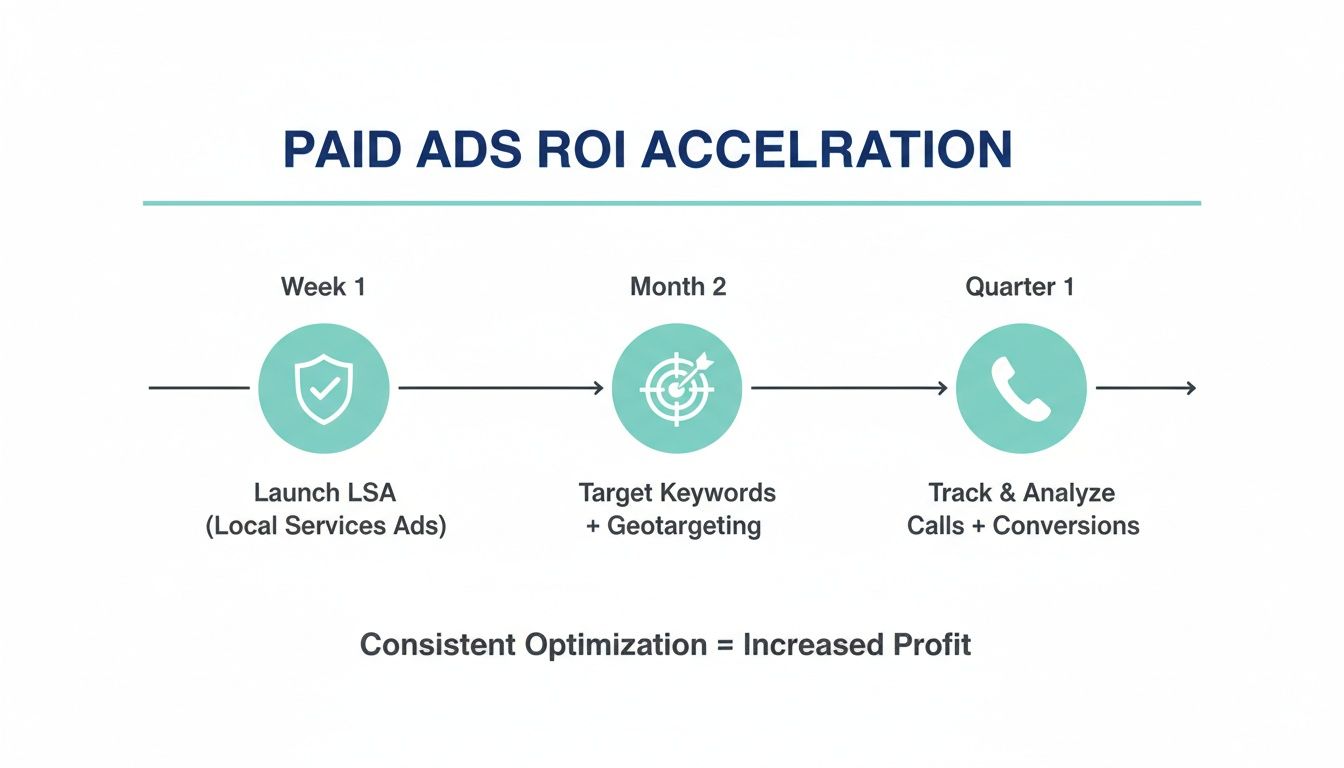
The point is, a coordinated approach—from the ads you run to how you track results—is what really speeds up your return and cements your spot as a local leader.
Your 30-Day Reputation Flood Action Plan
You can make a huge dent in just one month if you're consistent. Here’s a simple, week-by-week plan to start generating positive content and burying the bad stuff.
Week 1: The Foundation and Quick Wins
- Action: Go create (or fully flesh out) your company's LinkedIn and BBB profiles. Add your full company story, list of services, and professional photos of your team and trucks.
- Why it Works: These big, authoritative sites rank extremely well for brand names. They're low-hanging fruit for claiming valuable page-one real estate.
Week 2: Create Your Own Asset
- Action: Write and publish your first blog post on your own website. Title it something like, "The [Your Company Name] Difference: Our Commitment to [Your City] Homeowners."
- Why it Works: This creates a powerful asset that you own and control completely. It's your platform to tell your story, your way.
Week 3: Add Video and Social Proof
- Action: Grab your smartphone and film a simple, authentic video testimonial with a happy customer. It doesn't need to be fancy. Post it to YouTube and embed it on your website.
- Why it Works: Google loves video, and so do potential customers. A real person vouching for your work is one of the strongest trust signals there is.
Week 4: Turn Up the Review Volume
- Action: Put a simple system in place to ask every happy customer for a review. Have your techs mention it at the end of a job, then follow up with a text message that links directly to your Google review page.
- Why it Works: A steady flow of new, positive reviews is the backbone of a great reputation. Remember, studies show 85% of users trust online reviews as much as a recommendation from a friend.
This isn't about being deceptive. It's about ensuring the complete picture of your business—the one your hundreds of happy customers know—is what people see first. A couple of sour grapes shouldn't get to define your company's hard-earned reputation.
Build a Referral Network for a Steady Stream of Quality Leads
While you're working hard on your online presence, don't forget one of the oldest and most powerful sources of jobs: referrals. I've seen plumbers build entire empires on word-of-mouth alone. A solid network of other local professionals can become a lead-generating machine that consistently sends high-quality, ready-to-buy customers your way, often at little to no cost.
Just think about who else interacts with homeowners right before they realize they have a plumbing problem. We're talking about electricians, HVAC techs, roofers, painters, and even real estate agents. They aren't your competition—they serve the exact same people you do. This is a goldmine.
Build Your Own Local Lead-Sharing Crew
Putting these partnerships together isn't as formal or complicated as it sounds. It really just starts with a conversation. You're looking for a simple, mutually-beneficial agreement: you send them work, and they send you work.
A real estate agent might stumble upon a leaky sink during a final walkthrough, or an HVAC tech could spot a rusty, failing water heater on a routine maintenance call. If you're their go-to plumber, that lead comes straight to you. In return, your techs can be their eyes and ears, pointing out flickering lights that might need an electrician or a suspicious water stain on the ceiling that signals a roofing issue. It’s a two-way street that helps everyone involved.
Here’s a simple script your team can use when they run into other trades on a job site:
"Hey, you guys do great work. We're always looking for solid HVAC pros to refer our customers to. If you ever run into a plumbing mess you can't sort out, here’s my card. We'd be happy to send business your way, too."
This isn't a hard sell. It's a collaborative, low-pressure way to plant the seed for a real partnership. You’re just building genuine connections that will pay off for years.
Turn Happy Customers Into Your Best Sales Force
Don't overlook the referral potential sitting right in your existing customer base. After you've swooped in and solved a stressful plumbing disaster, that homeowner is often incredibly grateful. They're primed and ready to sing your praises; you just have to make it easy for them.
The key is to train your technicians to ask for a referral as a natural part of finishing a successful job. It’s all about the timing and the tone. Once the leak is fixed, the drain is clear, and the customer is smiling, that's your moment.
Here are a few pointers:
- Be Direct and Thankful: "We're really glad we could get this sorted out for you today. A huge part of our business comes from word-of-mouth from happy customers. If you know anyone else who needs a plumber they can trust, we'd be grateful if you sent them our way."
- Pair It with a Review Request: This is the perfect time to also ask for an online review. As you get more practice, you'll see that learning different ways to ask customers for testimonials can seriously boost both your online and offline reputation.
- Offer a Small Thank You: A simple incentive can go a long way. Think about offering a $25 gift card or a small discount on a future service for any referral that turns into a paid job.
By doing this, you're turning your satisfied clients into a motivated, proactive sales team. It creates a self-sustaining cycle of high-quality plumbing leads that just keeps growing.
Common Questions I Hear from Plumbers
Over the years, I've heard the same questions pop up again and again from plumbing business owners. You're not alone in wondering about this stuff. Here are some straight-shooting answers to the most common questions I get.
How Long Does It Take to See Results?
This is the big one, and the honest answer is: it depends on your approach. Some tactics get the phone ringing almost immediately.
For instance, if you get your Google Business Profile tuned up and flip the switch on Local Services Ads, you can see calls coming in that same week. That "Google Guaranteed" badge works wonders for building instant trust, especially for those frantic emergency calls.
Other, more foundational work takes a bit more patience. If you're tackling a "reputation flood" to bury some old, negative reviews, you'll likely see a real shift in your search ranking and call volume within 30 to 60 days. And building a solid referral network? That's a long game, but one that pays off with incredible momentum over months and years.
I'm a Plumber, Not a Marketer. How Hard Is This?
Look, this whole playbook was designed for you—the business owner who's busy running a crew and fixing leaks, not someone who wants to become a marketing guru.
A lot of the foundational steps are things you can knock out yourself. Updating your Google profile, sending a quick text to ask for a review—that's all very manageable. You can start there today.
When it comes to the more involved strategies, like managing a full-blown ad campaign or executing a reputation flood, you've got options. You can follow the steps we've laid out or bring in a specialist to handle it for you. The most important thing is simply to get started.
The single biggest mistake I see plumbers make is paying for ads before fixing a bad online reputation. Dropping thousands on ads that send potential customers right to a page full of 1-star reviews is like pouring water into a bucket riddled with holes. You have to fix the leaks in your reputation first, then turn on the ad faucet.
If you're tired of watching a few bad reviews scare away good customers, Impruview can help you take back control. We build a powerful, positive online story that pushes down those unfair reviews so you can attract the high-quality plumbing leads you deserve. Find out how we do it.