So, can you actually remove a bad Yelp review? Let's cut right to the chase: for a business owner, getting a negative review taken down is almost impossible. Unless that review is a clear-cut violation of Yelp's content policies, it’s staying up.
The Hard Reality of Removing a Yelp Review
I get it. For a contractor—whether you’re a plumber, roofer, or HVAC pro—a single scathing review feels personal. It can cost you real money, potentially thousands in lost jobs, and the immediate instinct is to just make it disappear.
But you have to understand Yelp’s position. Their entire business is built on being a trusted platform for customer opinions. To do that, they have to fiercely protect the reviews people leave, even the ones that sting.
Think of Yelp less like a customer service desk and more like a library. They are curators of public opinion, not mediators in a dispute. Their priority is preserving their collection of reviews, and their system is built with powerful automated software and rigid rules to do just that. A simple disagreement over the facts of a job or a customer’s unhappiness isn’t going to be enough to get a review pulled.
The Narrow Window for Removal
There is a small, specific window for getting a review removed, but it's not about whether the review is "fair." You have to prove it breaks one of Yelp’s specific rules. This could mean things like:
- Hate speech or threats
- A clear conflict of interest (e.g., a review from a direct competitor or a disgruntled ex-employee)
- Posting someone’s private information
The bar for removal is incredibly high, and the responsibility to prove your case falls squarely on your shoulders.
To put this in perspective, let’s look at what typically happens to reviews on Yelp. The numbers show just how slim the chances of removal really are.
Yelp Review Outcomes at a Glance
This table breaks down the statistical probability of where a review ends up. As you'll see, outright removal is the least common outcome.
| Review Status | What It Means | Approximate Percentage |
|---|---|---|
| Recommended and Public | The review is considered legitimate by Yelp's algorithm and is shown publicly. | ~78% |
| Not Recommended/Filtered | The review is hidden behind a link because Yelp's software thinks it might be biased or unhelpful. | ~13% |
| Removed by Yelp | The review was found to violate Content Guidelines and was permanently deleted by moderators. | ~9% |
The data is pretty clear: the vast majority of reviews, good or bad, are either displayed publicly or filtered by the algorithm—not removed.
This flowchart maps out the journey, and it paints a pretty stark picture.
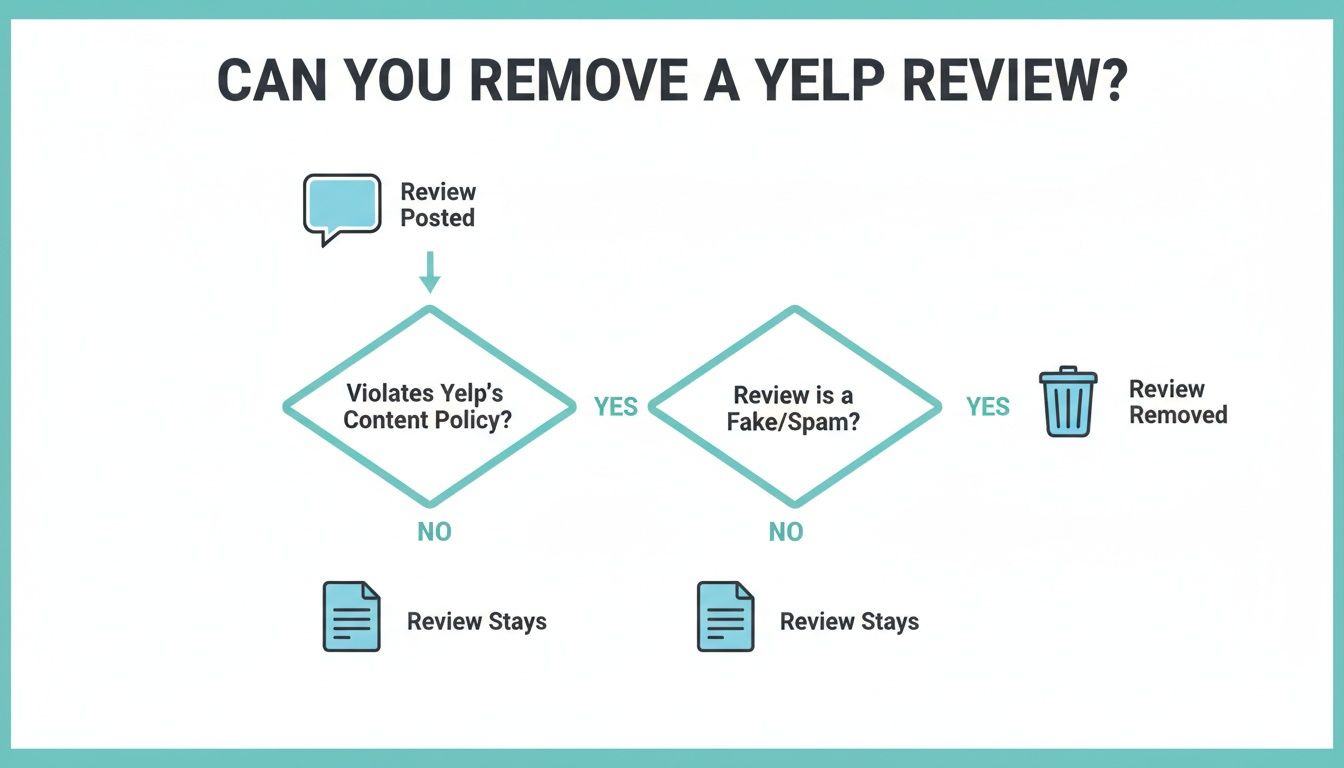
As you can see, almost every path leads to the review staying on the platform in some form. Knowing this upfront is key, because it keeps you from pouring time and energy into a fight you’re unlikely to win. The smarter move is to change tactics and focus on actions that give you back control over your reputation.
Why Yelp Almost Never Removes a Bad Review
Let's get straight to the point. The first thing you have to accept when a bad Yelp review pops up is that getting it removed is incredibly difficult. To understand why, you need to see Yelp not as a partner, but as a business with one core mission: protecting its credibility with the public.
Yelp’s entire business model is built on trust. People go there because they believe they're getting the real, unfiltered story from other customers. That trust is what makes their massive library of over 308 million reviews valuable. If businesses could just delete any review they didn’t like, that trust would vanish overnight, and Yelp would become worthless.
So, when you flag a review, you're not just making a simple customer service request. You're asking Yelp to act against its own fundamental business interest.
Think of Yelp as a Stage Manager, Not a Judge
Here's an analogy that helps. Imagine Yelp is managing a massive open-mic night. Their only job is to make sure nobody sets the stage on fire or starts screaming obscenities. They give the microphone to anyone who wants to share a story about their experience.
The stage manager isn't there to fact-check every story. They won't cut the mic just because a performer says something you think is unfair or even untrue. They only step in when someone breaks the house rules—like using hate speech, threatening someone, or promoting their own business instead of telling a story.
That's exactly how Yelp's moderators operate. They aren't judges trying to figure out who was right or wrong in your dispute with a customer. They are simply enforcing their Content Guidelines. Understanding this mindset is the first step to setting realistic expectations.
The Bottom Line: Yelp’s refusal to remove a negative review isn't a personal attack on your business. It's a business decision to protect their platform's integrity. For a review to be taken down, it has to violate a specific, written rule—it can't just be negative, unfair, or even factually incorrect from your perspective.
What Actually Breaks Yelp’s Rules?
So, what does it take to get a review removed? The bar is much higher than most people think. A review has to cross a very clear line and violate one of Yelp's specific policies.
Here are the main violations that might actually lead to a removal:
- Conflicts of Interest: The review comes from a competitor, a disgruntled ex-employee, or someone else with an obvious agenda. The catch is, you need to provide some real proof of this conflict.
- Irrelevant Rants: The review has nothing to do with the customer experience. For example, it’s a political tirade or a complaint about your company’s parking lot.
- Threats or Hate Speech: This is a clear one. Any review containing threats, harassment, lewdness, or bigoted language is against the rules.
- Privacy Violations: The reviewer posts private information, like an employee's full name, a home address, or a personal phone number.
- Blatant Advertising: The post isn't a review at all but is just a promotion for another company.
Here’s the tough part that frustrates so many contractors: a customer's opinion is protected, even if you can prove it's wrong. If they say your price was "a ripoff" or the "workmanship was sloppy," Yelp considers that their personal experience. Even if you have invoices and photos to prove otherwise, it doesn't violate Yelp's guidelines, and the review will almost certainly stay up.
Look, while getting a negative review taken down by Yelp is a real long shot, you still need to know how to play the game. Going through the official reporting process is something you have to do to cover all your bases before you can move on to other, more effective strategies.
Think of it as due diligence. You have to follow Yelp's official channels, even if you’re pretty sure the outcome won’t be in your favor.
Your entire case with Yelp boils down to one simple thing: can you prove the review breaks a specific rule in their Content Guidelines? Just telling them a review is "unfair" or "not true" is a waste of your time—they'll dismiss it out of hand. You need to build a solid case that lines up perfectly with their black-and-white policies.
So, before you even think about clicking that report button, your first job is to get all your evidence in order. This isn't optional.
Gather Your Evidence First
Yelp’s moderators are dealing with a flood of reports every single day. If you submit a vague complaint with no proof, you’re just making it easy for them to deny you. Your goal is to make their decision as simple as possible by handing them a clear, documented reason to remove the review.
Here’s the kind of documentation you should be pulling together:
- Screenshots: Grab a shot of the review itself, the reviewer's profile (especially if it looks fake or new), and any other weird online activity you can connect to them.
- Customer Records: Pull up any invoices, work orders, or contracts. These can prove someone was never a customer to begin with, or that their claims are flat-out contradicted by the facts of the job.
- Communication Records: Do you have emails, texts, or (where legal) recorded calls? These are golden if they show harassment, extortion attempts, or other bad behavior.
- Proof of a Conflict of Interest: Can you prove the reviewer is a competitor, a disgruntled former employee, or maybe their spouse? A little digging on social media or other public records can sometimes unearth this connection.
Remember, the burden of proof is 100% on you. The more organized and compelling your evidence, the better your (admittedly slim) chances are.
Let’s be realistic for a moment. A critical reality check comes straight from Yelp's own data. The removal process is incredibly tough. As of late 2026, only about 9% of all contributed reviews ever get removed. For a contractor, that means even with rock-solid evidence, the odds are not in your favor. This just underscores why you need other reputation management strategies in your back pocket. You can see more on these challenging stats over at Wytlabs.
Step-by-Step Guide to Flagging a Review
Once you have your evidence organized and ready to go, you can finally start the official reporting process. Following these steps to the letter ensures your report actually gets submitted correctly and seen by a moderator.
- Log In to Your Yelp for Business Account: You can only report a review from your official business dashboard.
- Navigate to the Reviews Section: Go to the "Reviews" tab on the left-hand side and find the one you want to report.
- Find the "Report Review" Option: To the right of the review, you'll see three little dots. Click them to open a small menu.
- Select "Report Review": Clicking this takes you to a new page where you'll have to explain why you're flagging it.
- Choose the Most Accurate Violation: Yelp will show you a list of reasons for reporting. Don’t just guess. Pick the one that directly matches the evidence you’ve collected. The strongest cases usually involve things like hate speech, threats, private information, or a clear conflict of interest.
- Write a Concise Report: You get a small text box to make your case. Keep it brief, professional, and stick to the facts. Don’t get emotional or write a novel about your side of the story. Simply state which rule was broken and reference the proof you have.
After you hit submit, your report is in the hands of Yelp's moderation team. It usually takes a few days for them to make a decision, and you can track the report's status in your business account. Whatever you do, don't report the same review over and over—that can backfire and make you look like the problem.
For a deeper dive into handling negative feedback, check out our guide on how to remove negative Yelp reviews.
If Yelp denies your request, that’s pretty much the end of the line for getting it officially removed. Take it as a clear sign to stop wasting energy fighting a battle you can't win and pivot to strategies that let you control your own online story.
Exploring Legal Action for Defamatory Reviews

When a review feels less like feedback and more like a deliberate attack, it's natural to think about fighting back with legal action. But before you even think about calling a lawyer, it's crucial to understand that this is the absolute last resort. Suing a reviewer is a difficult, expensive, and incredibly slow path reserved only for the most clear-cut cases of defamation.
Most negative reviews, even the infuriating ones, are just opinions. "The plumber was overpriced" or "The roof repair looks sloppy" are subjective judgments. They're protected as free speech, and there's nothing you can do about them legally.
For a review to be legally actionable, it must cross a very specific line—from opinion to a provably false statement of fact. For example, if a reviewer claims, "This contractor is unlicensed," but you hold a valid, current license, that is a false statement of fact. If you can then prove this lie directly cost you business, you might have a case.
The High Bar for Proving Defamation
Even when a review contains a blatant lie, proving it in court is another story entirely. The legal standard for defamation is incredibly high, and the burden of proof is squarely on you. Your word against theirs simply isn't enough.
A court will require you to prove several key things:
- A False Statement: You need rock-solid evidence that a statement of fact in the review is completely untrue.
- Publication to a Third Party: The review being posted on Yelp automatically satisfies this.
- Fault: You have to show the reviewer was, at a minimum, negligent in publishing the lie.
- Damages: This is often the hardest part. You must prove you suffered specific, quantifiable financial losses because of that review.
It's a complex legal area, especially when you're trying to determine if Is a competitor defaming your business?. Getting legal counsel is non-negotiable if you’re seriously considering this route.
The Reality of a Lawsuit
So, what does a lawsuit actually accomplish? A common misconception is that you sue Yelp to force them to take down the review. That's not how it works. Federal law—specifically Section 230 of the Communications Decency Act—protects platforms like Yelp from being held responsible for content posted by their users.
Your lawsuit is against the individual reviewer, not the platform.
The goal of a lawsuit is to get a court order that legally compels the reviewer to remove their defamatory post. You then take that court order to Yelp, and they will almost always comply.
The reality, however, is that this process is brutal. Legal fees can easily spiral into the tens of thousands of dollars, and the fight can drag on for months or even years. All the while, the review stays up, potentially harming your reputation. For most contractors, the cost of the legal battle far outweighs the revenue lost from a single bad review, making it a poor business decision in all but the most extreme situations.
So, you’ve learned that getting a negative Yelp review taken down is a long shot, and legal action is an expensive, uncertain rabbit hole. It’s easy to feel stuck. What’s the next move when a damaging review is just sitting there, scaring away good customers?
You have to stop playing a game that's rigged against you. The real solution isn't about removal—it's about making that one bad review irrelevant. You need to take control of what people see when they search for your company online.
Think of it like this. Trying to force Yelp to remove a review is like trying to pull one giant, deep-rooted weed out of an open field with your bare hands. You can pull and sweat and curse, but chances are, that weed isn't going anywhere.
The smarter play? Become a master gardener. Instead of fixating on that single ugly weed, you get busy planting a garden so full of beautiful, healthy flowers that the weed gets completely lost in the scenery. You cultivate so much positive growth that the negative thing is drowned out, and it's certainly not the first thing anyone notices.
Drown It Out With a Content Flood
This "gardening" strategy is what we call a content flood. The goal is straightforward: create and publish so much high-quality, positive content about your business that the negative Yelp review gets buried deep on the second or third page of Google.
When a potential customer looks you up, they won't find that one person's complaint. Instead, they'll be met with a wall of professionalism, great work, and happy clients.
Don't underestimate the financial hit from a single prominent bad review. For contractors—roofers, remodelers, electricians—with job tickets often over $500, a negative review can cost you thousands in lost business every single month. We know that even a one-star increase in your average rating can boost revenue by 5-9%. With Yelp hosting over 308 million reviews and about 26,000 more being added every hour, that pool of permanent negative feedback is only getting bigger.
This is your chance to write your own story instead of letting an angry customer (or a competitor) write it for you. By building out your own digital assets—project galleries on your website, video testimonials, detailed case studies, or even local press mentions—you create a powerful online presence that you own and control. For more ideas on proactively managing your brand, check out these 8 Simple Online Reputation Management Tips.
Taking Back Your Name in Search Results
At its core, the content flood is an SEO strategy. You're simply optimizing your own positive content to outrank the negative Yelp page when someone searches for your company's name.
And here's the good news: this is completely doable. Google actually prefers to show a variety of results for a branded search, not just a page from a single review site. You have a home-field advantage.
Key Takeaway: The goal isn't to erase the past but to build a better future. By flooding the internet with positive, relevant content about your work, you make that one negative review statistically irrelevant. You control the narrative.
Every new piece of high-quality content you create—a blog post about a challenging project, a new page on your site detailing a specific service, a video tour of a finished job—acts like another positive voice vouching for your business. Each one pushes that negative review further and further down into obscurity.
This is where effective content marketing for contractors becomes your most powerful tool. It’s about creating materials that not only showcase your incredible work but are strategically built to dominate search engine results. This approach flips the script, putting the power back in your hands and ensuring that when customers look for you, they see the brand you've worked so hard to build.
How to Bury Negative Yelp Reviews with a Content Flood
Let's be realistic: getting a negative review taken down from Yelp is a long shot. So, instead of trying to fight a battle on their turf—one you're almost guaranteed to lose—it's time to change the battlefield. We're going to take the fight to Google, where you have the home-field advantage.
This strategy is called a content flood. The idea is to create so much positive, high-quality content about your business that the negative Yelp page gets drowned out and pushed off the first page of Google. When a potential customer searches for your company, they should find a wall of your successful projects, happy client testimonials, and professional profiles, not that one bad review.
Trying to force a removal is usually a dead end. Yelp’s system is built to keep reviews up. While their filters do catch millions of fake reviews, our data shows that only about 9% of reviews are ever fully removed by the platform. This is especially tough for contractors, since home services make up 21% of all reviewed businesses on Yelp—the fastest-growing category. You're on the front lines, and a bad review can stick around for good.
First, See What Your Customers See
Before you can start building your defense, you need to know what you’re up against. The first step is to see your business through a potential customer's eyes.
Open a new "incognito" or "private" browser window. This is crucial because it gives you a clean, unbiased look at Google's search results, without your own search history influencing them. Now, search for your exact business name.
Take a hard look at everything on that first page. What’s there? Make a list.
- Your company website
- Your Google Business Profile
- Review sites (Yelp, Angi, Houzz, etc.)
- Social media accounts (Facebook, Instagram, LinkedIn)
- Business directory listings
- Any news articles or blog posts
This simple audit is your starting point. It shows you which online properties you already control and, more importantly, where that negative Yelp review is currently sitting. The goal is to create and boost enough positive links to push that negative one onto page two, where almost no one will ever see it.
Build Your Portfolio of Positive Content
Now for the fun part: creating the "flood." Your job is to build an arsenal of positive, optimized content that shows off your skills and happy customers. This goes way beyond just writing a few blog posts. We’re talking about creating a diverse range of assets that Google will recognize as credible and valuable.
Think about the best ways to showcase your work:
Project Galleries: Don't just upload photos. Create dedicated pages on your site for individual jobs. Feature stunning "before and after" shots, a solid description of the work you did, and the project’s location (for example, "Custom Deck Build in Scottsdale, AZ").
Case Studies: Take it a step further than a gallery. Tell the story of a project. Describe the client’s problem, how you came up with the perfect solution, and the fantastic result. Top it off with a direct quote or testimonial from the thrilled client.
Video Testimonials: Nothing beats a video of a happy customer genuinely talking about their experience with your company. It's authentic and incredibly persuasive. Post these on YouTube and embed them right on your website.
Detailed Service Pages: That simple "Our Services" list isn't cutting it. Build out individual, in-depth pages for every single service you provide. A page focused entirely on "Tankless Water Heater Installation" will rank higher and provide far more value to a potential customer than a single bullet point.
Every new piece of content is another soldier in your army, ready to outrank that negative review. For a much deeper dive into the mechanics of this strategy, check out our complete guide on how to bury negative search results. Once you control what people see on Google, the question of whether you can remove a Yelp review becomes totally irrelevant.
Frequently Asked Questions About Yelp Reputation

Even after mapping out a plan, you're bound to have some questions about dealing with your reputation on Yelp. Let's walk through some of the most common hurdles contractors like you face when a bad review pops up.
Can I Sue a Customer for a Bad Yelp Review?
The short answer is yes, you can technically sue, but it's an incredibly tough, expensive, and risky road to take. To have a leg to stand on, the review can't just be an opinion; it must contain a provably false statement of fact that you can show directly cost you money.
Someone calling your work "sloppy" is just their opinion and is protected speech. But if they claim you stole materials—and you can prove you didn't—that's a different story. Even then, legal fees can easily climb into the tens of thousands, often eclipsing the revenue you might have lost from that single review. It's truly a last resort for only the most extreme and clear-cut cases of defamation.
Does Responding to a Negative Review Help or Hurt?
Responding publicly can be one of the most powerful tools in your arsenal, but only if you do it right. A calm, professional, and genuinely helpful response shows every potential customer reading it that you take feedback seriously and are committed to making things right. It can absolutely neutralize a review's sting.
On the flip side, an emotional, defensive, or argumentative reply is a disaster. It just makes you look unprofessional, validates the original complaint in the eyes of other readers, and will absolutely scare away new clients. Always keep your cool.
Remember, a thoughtful response isn't really for the person who wrote the review; it's for every single future customer who reads it. You're demonstrating your character and showing them you're the kind of business that solves problems, which builds a ton of trust.
Is It Worth Paying for Yelp Ads to Hide Bad Reviews?
No, this is one of the biggest myths out there. Paying for Yelp Ads does not give you any power to remove, hide, or change negative reviews. Yelp's advertising platform and its content moderation team are two completely separate worlds.
While ads can get your profile in front of more people, they do nothing to solve the core problem of a damaging review sitting on your page. That advertising budget is far better invested in a proactive strategy like a content flood, which actually buries the negative results and puts you back in control of your online search results for the long haul.
If you're tired of losing out on good jobs because of unfair or misleading reviews, Impruview can help. We skip the dead-end chase of trying to remove reviews and instead build a wall of positive content that buries negative Yelp pages for good. Visit us at https://www.impruview.com to take back control of your online reputation.