Tired of seeing your competitors dominate the top spots on Google? I get it. When over 90% of home buyers start their search online, being invisible isn't just a missed opportunity—it's a critical business flaw. This playbook is built for home builders and contractors who are ready to stop guessing and start turning their website into a reliable lead-generation engine.
Your Blueprint for Digital Dominance

Let's ditch the generic advice you've read a dozen times. We're diving into real-world strategies that work specifically for the building trade. I’m talking about how to properly showcase high-value custom projects, attract clients in your exact service areas, and manage your reputation in an industry where trust is everything.
Think of this as your plan for getting found by the right clients—the ones who appreciate quality and are ready to build. A solid SEO strategy ensures they find you at the exact moment they're looking for a builder. It’s about building a predictable pipeline of qualified projects that flows right from a Google search.
Why Your Online Footprint Is Non-Negotiable
The numbers don't lie. That 90% of home buyers starting their journey online is a massive shift. With the home services market having already surpassed $800 billion annually in the US, ignoring your search presence is like leaving the front door open for your competition to walk in and take your best leads.
I’ve seen smart builders completely flip the script. They audit their online presence, take control of their brand search results with positive content, and meticulously respond to every single review. They build unwavering trust before a prospect even picks up the phone.
Building a Foundation for Growth
Your ultimate goal is to become the go-to builder in your local market. This isn’t about just one thing; it’s about a cohesive plan that pulls together a technically sound website, sharp local search tactics, and content that actually connects with people. For a wider look at what goes into a winning strategy, these tips on effective marketing for builders are a great starting point.
Here's what we'll be tackling:
- How to attract high-value clients looking for projects in your specific towns and counties.
- The right way to structure a website that turns casual visitors into concrete leads.
- Strategies to own the Google Map Pack for critical local searches like "custom home builder near me."
- Methods for building a brand reputation that does the selling for you.
Think Like Your Client, Not a Builder: Uncovering How Your Best Customers Search
Let's get one thing straight. The most common mistake I see builders make with their websites is thinking like a builder. You're an expert in permits, materials, and timelines. Your clients? They're experts in their own dreams and anxieties. Effective SEO starts the moment you switch hats and think like them.
This isn't about guessing what people search for. It’s about digging into the exact language your high-value clients use when they’re past the "dreaming on Pinterest" phase and are seriously looking to hire a professional. They're not just typing "home builder" into Google. Their searches are much, much more specific.
The Power of Search Intent
The single most important concept to grasp is search intent—the why behind a search. Someone searching for "modern farmhouse floor plans" is just gathering ideas. But the person searching for a "luxury home contractor in Aspen" is holding a wallet. You want the second person.
Your entire goal is to show up for these high-intent searches. These are the people ready to make a decision, and capturing their attention is what turns your website from a digital brochure into a lead-generation machine.
After years of doing this, I can tell you one thing for sure: high-intent searches are almost always longer and more specific. They include a service, a location, and often a word that signals quality or a unique need, like "historic" or "sustainable."
Where to Find Your Golden Keywords
So, how do you find these money-making phrases? The best clues are already inside your own business. You just need to know where to look.
- Listen to Your Phone Calls: Pay attention to the exact words new prospects use. When they call, what's the first thing they say? "We're looking for a firm that handles major kitchen remodels in the North End," or "Do you have experience with design-build on waterfront properties?" Those are your keywords.
- Review Your Best Jobs: Think about your most profitable projects from the last few years. What kind of job was it? Where was it? You’ll start to see patterns, like "historic home renovation specialist [city]" or "custom build on a sloped lot [county]." Target more of what already works.
- Embrace "They Ask, You Answer": If you've been asked a question once, I guarantee hundreds of other people are typing it into Google. Questions like, "What's the real difference between a custom and semi-custom build?" or "How do I finance a home addition in Texas?" are pure gold for blog posts and service pages.
When you gather keywords this way, you're not just guessing. You're building your strategy on a foundation of real-world, proven language that attracts your ideal client.
Turning Keywords into a Winning Website Plan
Once you have your list of high-value keywords, don't just throw them all onto a single "Services" page. That’s a massive missed opportunity.
The next step is to map these keywords to a smart site structure. This means creating a dedicated page for each core service you offer and for each primary city or neighborhood you serve. A focused page will always outperform a general one.
To see how a potential customer's journey evolves, let's look at the different kinds of keywords they might use.
High-Intent Keyword Examples For Home Builders
| Keyword Type | Example Keyword | User Intent |
|---|---|---|
| Broad Informational | "home building process" | Learning and Research |
| Specific Informational | "how much to build a custom home in Denver" | Budgeting and Planning |
| High-Intent Transactional | "design-build firm in Cherry Creek CO" | Ready to Contact |
| Specialty Niche | "sustainable home builders Boulder County" | Specific Project Requirement |
This journey from broad research to a specific, ready-to-buy search is exactly what you want to capture.
Imagine a potential client in an affluent suburb searches for "custom home builder in [their suburb]." They click on your site and land on a page dedicated specifically to your work in their town. It's filled with photos of projects you've completed nearby and testimonials from their neighbors. That immediate, hyper-local relevance is what makes them pick up the phone. You're no longer just a builder; you're their local expert.
Mastering the Local SEO Game

Let's be blunt: for a home builder or contractor, the best leads are right in your backyard. When a potential client searches for "custom home builder in [Your Town]," you absolutely have to show up in the Google Map Pack. This is where the highest-value local projects are won or lost, day in and day out.
Your Google Business Profile (GBP) is your digital storefront. It's often the very first interaction a client has with your brand. Think about it—an incomplete or outdated profile suggests you don't care about the details. For a builder, that's a terrible first impression to make.
Treat Your Google Business Profile Like a Show Home
Getting your GBP in order is probably the single most effective thing you can do for your local visibility, and it doesn't cost a dime. You just need to be as meticulous with it as you are with the finish work on a high-end kitchen.
It all starts with your NAP: your business Name, Address, and Phone number. These three things must be identical everywhere they appear online. I mean identical. If you use "St." on your GBP, don't use "Street" on Yelp. This consistency is non-negotiable for Google.
Once the basics are locked down, you can start optimizing the rest of the profile to really stand out.
- Primary Category: Choose "Custom Home Builder" or "Home Builder." Don't get creative here; pick the most accurate primary option.
- Secondary Categories: Now you can add everything else you do. Think "Kitchen Remodeler," "Bathroom Remodeler," "General Contractor," and so on. Be thorough.
- Service Areas: Get granular. List the specific towns, counties, and even the zip codes you work in. Simply putting your state is too broad and won't help you.
- High-Quality Photos: This is your chance to shine. Upload your best professional shots of completed homes. Make sure you have at least 30-50 photos to start, and categorize them (interiors, exteriors, kitchens, etc.).
I’ve seen builders double their inbound calls simply by treating their GBP photo gallery like a project portfolio. Regularly upload new, high-resolution images of your latest work. It shows you're active, in-demand, and proud of your craftsmanship.
Getting Active to Climb the Map Pack
A perfectly filled-out profile is the starting line, not the finish. To really start ranking higher on Google Maps, you need to show Google that your business is active and engaged.
A massively underused feature is Google Posts. Treat these like free micro-ads right on your business listing. Did you just break ground on a new development? Post about it. Finish a stunning kitchen remodel? Share the photos. Each post gives you a little boost, so aim to publish something new every week.
Also, pay close attention to the Q&A section. Potential clients ask questions here all the time. Don't wait for them. Go in and post the common questions your sales team gets, then answer them yourself. It’s a simple way to control the conversation and give people the info they need immediately.
Cementing Your Local Authority with Citations
Your GBP is the main event, but it needs a strong supporting cast. That’s where local citations come in—mentions of your business's NAP on other relevant websites and online directories. Each citation is like a vote of confidence that tells Google you’re a legitimate, local operation.
You'll want to build these citations on two main types of sites:
- General Directories: This includes the big players like Yelp, Apple Maps, and Bing Places. You have to be on these.
- Industry-Specific Sites: This is where you gain a real edge. A profile on Houzz, BuildZoom, or Porch tells Google you're a serious player in the construction industry.
Again, consistency is everything. Use a tool to run an audit of your existing citations and hunt down any old addresses or phone numbers. It can feel like tedious digital paperwork, but cleaning this up is crucial for building the local authority that gets you found. For a deeper dive into this, our guide on local SEO for contractors has more advanced strategies you can use.
Building a Reputation That Sells For You
In the home building and renovation game, your reputation isn't just a nice-to-have; it's the foundation of your entire business. Every completed project and client handshake contributes to the story people find when they search your name online. That digital footprint—the content you publish and the reviews you earn—is your most tireless salesperson, working around the clock to either build confidence or raise red flags.
This is where we move past basic SEO and start talking about building true brand authority. It’s about turning your portfolio from a simple photo gallery into a set of powerful, rank-worthy stories. Even more, it’s about seizing control of your online reputation before one angry comment can jeopardize a six-figure contract.
Turn Every Project Into a Local SEO Powerhouse
Your finished work is gold. Those projects are tangible proof of your skill, and they should be the cornerstone of your content strategy. Instead of lumping all your photos onto a single portfolio page, give each significant project its own dedicated project case study page.
This simple shift gives you a huge SEO advantage. Each case study page can be fine-tuned to rank for the long, specific search phrases that serious clients use. Think about it from their perspective: a page titled "Modern Farmhouse Custom Build in Franklin, TN" speaks directly to a potential client in that area in a way a generic gallery never could.
To make these case studies work for you, structure them for maximum impact:
- Project Title: Get specific with the project type and location. Something like "Historic Tudor Renovation in a Boston Suburb" is perfect.
- The Challenge: Briefly set the scene. What did the client want? "The homeowners wanted to expand their kitchen while preserving the home's 1920s character."
- The Solution: This is your time to shine. Explain your process and highlight what makes you different. "Our team sourced period-appropriate materials and designed a seamless addition that…"
- High-Quality Visuals: Go beyond a few glamour shots. Use a mix of professional photos, before-and-after sliders, and even short video walkthroughs.
- Client Testimonial: Nothing is more powerful than social proof. Embed a direct quote from the happy homeowner right there on the page.
Following this strategy will steadily populate your website with hyper-local, service-specific content that Google absolutely loves. You’ll demonstrate real-world experience in specific neighborhoods and with particular building styles, building instant trust.
Taking Control with a Reputation Flood Strategy
So, what do you do when an unfair, one-star review pops up on Yelp or Houzz? Wasting time trying to get it removed is almost always a losing battle. The better move is to play offense with a proactive reputation flood strategy.
The concept is straightforward: you create and promote so much positive, high-quality content about your company that any negative outliers get pushed down and off the first page of search results for your brand name. You're not hiding it; you're drowning it out with an overwhelming amount of good.
Your branded search result—what people see when they Google your company name—is your digital business card. A reputation flood ensures that card is polished, professional, and free of smudges from a single disgruntled source.
This is about making sure one negative data point doesn’t define your entire body of work. Our complete guide on professional reputation management services details how this proactive mindset protects the hard-earned value of your brand.
Executing Your Content Flood
To successfully push negative results down, you need to unleash a wave of positive assets that can rank for your brand name. Think of each new piece of content as another soldier fighting for a top spot on Google's front page.
Your content arsenal should include:
- Optimized Project Case Studies: As we just covered, these are your primary weapons.
- Company Blog Posts: Write about your team, your process, community involvement, or industry awards you've won.
- Press and Media Features: A feature in a local magazine or business journal is a high-authority asset that can rank very well.
- Video Testimonials: A video of a client raving about their new home is incredibly persuasive and gets great visibility in search results.
This ties directly into your review generation efforts. In the world of SEO for home builders, customer reviews are a non-negotiable part of the formula. Contractors who maintain a 4.5+ star average consistently see a lift in their local search and Map Pack rankings. But as of 2026, it's more than just stars; Google is clearly rewarding video testimonials and detailed, keyword-rich responses to reviews. This shows active engagement. For a deeper dive, learn how contractors can rank higher with these strategies on reachdigitalgroup.com. This is how you polish your branded search results and ensure the positive narrative you've earned is the one everyone sees.
Technical SEO That Actually Matters for Builders
Technical SEO can feel like a black box, but for builders, it’s not about becoming a coder overnight. It’s about understanding the handful of technical details that directly impact whether a potential client finds you or your competitor.
Think of it like the foundation of a house you're building. If that foundation is cracked, no amount of high-end finishes will matter. The same goes for your website. A shaky technical foundation makes all your other marketing efforts—from gorgeous portfolio galleries to glowing testimonials—far less effective.
Master the Mobile Experience
Let's get real: your next client is probably looking at your website on their phone. They could be scrolling on their lunch break or doing a quick search after driving through a neighborhood they love. If your site is a clunky, pinch-and-zoom nightmare on a smartphone, you’ve already lost their trust.
This is exactly why Google now uses mobile-first indexing. It means Google’s search engine primarily looks at the mobile version of your site to decide how to rank it. A bad mobile experience doesn’t just frustrate people; it actively tells Google your site isn't worth showing.
Your site absolutely must be responsive, meaning it automatically adapts to any screen, from a desktop monitor to an iPhone. Don't just take your developer's word for it. Pull up your site on your phone. Or, on your computer, just grab the edge of your browser window and make it smaller. If text gets cut off or images break, you have a critical problem that's costing you leads right now.
Speed Is Not a Luxury, It’s a Necessity
Nobody waits for a slow website, especially when they’re looking to make a six-figure investment in a new home or renovation. Website speed is a direct Google ranking factor, and for good reason. A slow site feels unprofessional and untrustworthy—two labels you can't afford in this business.
How slow is too slow? If your site takes longer than three seconds to load, you're losing a huge chunk of your visitors before they ever see a single photo of your work. Every second of delay is a lead walking out the door.
For builder websites, the speed-killers are almost always the same:
- Uncompressed Images: Your stunning, high-resolution project photos are fantastic, but they are massive files. They have to be compressed for the web without sacrificing visual quality.
- Bloated Code: Clunky website themes and piling on too many plugins can bog down your server, slowing everything to a crawl.
- Cheap Hosting: That bargain-basement hosting plan might save you a few bucks, but it’s costing you thousands in lost business from poor performance and downtime.
Fixing your site speed is one of the highest-impact technical changes you can make. It immediately improves the user experience, boosts your search rankings, and helps turn more visitors into actual, paying clients. If you’re not sure where to start, getting a professional analysis can give you a clear roadmap; our SEO audit services are designed to pinpoint and solve these exact problems.
Using Schema to Speak Google's Language
Imagine you could add little labels to your website's code that told Google, "Hey, this is a home builder," or "This is a photo gallery of a completed kitchen remodel." That's exactly what Schema markup does. It’s a specific vocabulary that helps search engines understand the context of your content.
For a builder or contractor, this is an incredible advantage. You can use schema to explicitly tell Google that:
- Your business is a "HomeBuilder" or "GeneralContractor."
- A specific page is a "Project" with corresponding photos.
- Your star ratings are "Aggregate Ratings" from real clients.
When you do this, Google can reward you with rich snippets in the search results. You might see your star rating, project photos, or even FAQs appear right there under your link. This makes your listing stand out, grabbing a searcher's attention and making them far more likely to click on your site instead of the one above or below it.
This is where technical SEO delivers a clear return. Good SEO can drive over 5x more traffic than paid ads for builders, and I've seen home service clients slash their cost-per-lead by 42% after implementing a solid strategy. As one industry analysis points out, optimized SEO is key to fixing common site issues.
Your Actionable 90-Day SEO Roadmap
All the SEO theory in the world doesn't mean a thing if you don't have a game plan to put it into action. So let's cut through the noise and build a practical roadmap for the next 90 days.
This isn't about doing everything at once. That’s a recipe for burnout. Instead, we'll focus on a logical sequence of high-impact tasks that build momentum and deliver real results. Forget analysis paralysis; this is your step-by-step guide to getting it done.
Days 1-30: Foundational Fixes & Quick Wins
The first month is all about triage. We need to patch the leaks in your digital foundation before we start building anything new. Your focus will be on cleaning up your website's technical health and supercharging your Google Business Profile—two areas that can deliver the fastest improvements.
Think of it as prepping the job site. You wouldn't start framing on a cracked slab, and you shouldn't build a content strategy on a technically flawed website.
Run a Full Technical SEO Audit: Use a tool like Screaming Frog or Semrush's Site Audit to crawl your entire website. You're hunting for critical issues like broken links (404 errors), slow page load times, and pages that aren’t mobile-friendly. Fix them.
Dial in Your Google Business Profile: This is your most important local SEO asset. Fill out 100% of your profile. Make sure your business name, address, and phone number (NAP) are dead-on accurate. Upload at least 30 high-resolution photos of your best projects and get specific with your service categories (e.g., choose "Custom Home Builder" and "Bathroom Remodeler," not just "General Contractor").
Map Your Core Keywords: Take your keyword research from the previous step and assign a primary keyword target to each of your most important pages—your homepage, your main service pages, and your top location pages.
This first month is absolutely critical. Getting your technical SEO and Google Business Profile in order can create a noticeable lift in local map rankings and organic traffic all by itself, often within just a few weeks. It sets the stage for everything to come.
Days 31-60: The Content & On-Page Sprint
With your foundation secure, it's time to start building. This month is dedicated to creating and optimizing the content that will attract your ideal clients. We're moving from behind-the-scenes fixes to client-facing work that directly answers their questions and showcases your expertise.
Your main goal here is to build out the high-intent service and service-area pages we planned earlier. This is what helps you rank for searches like "kitchen remodeling in Scottsdale" or "custom home builder near me."
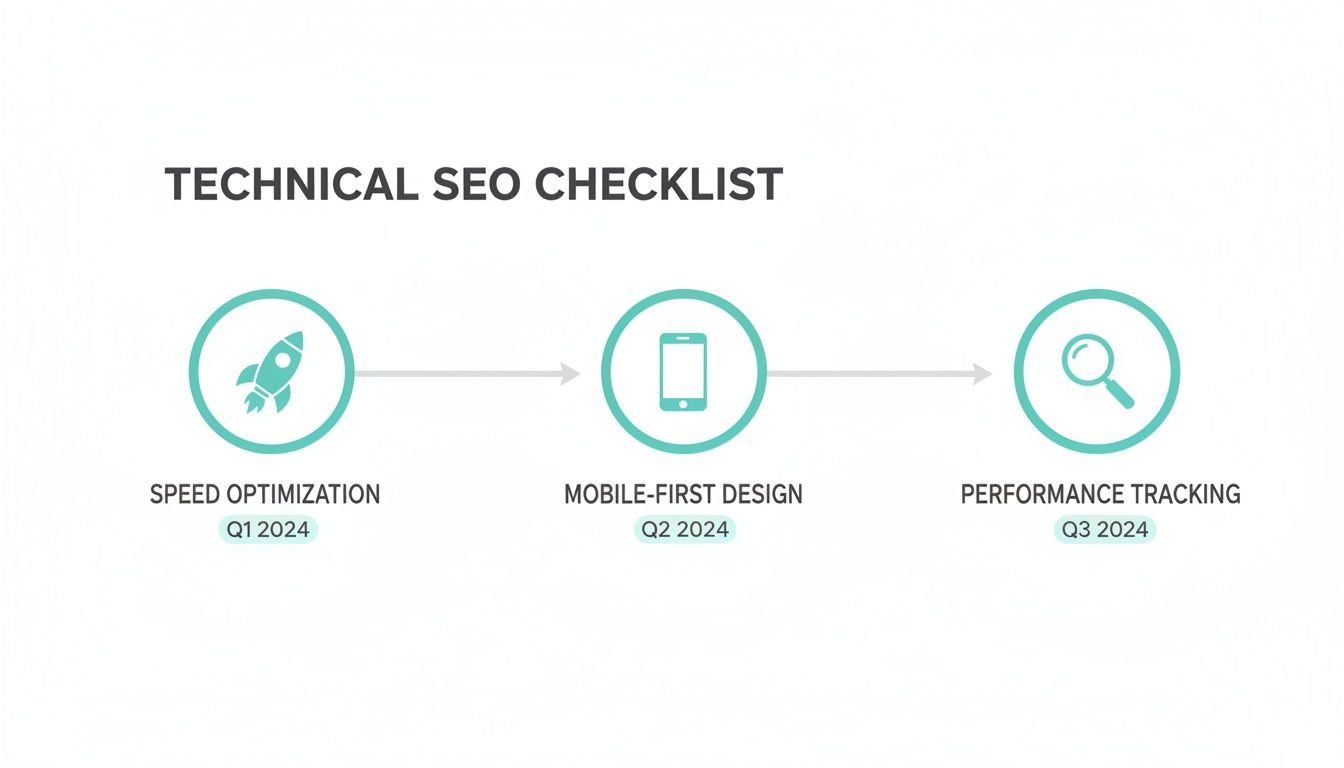
As you build out this new content, remember that the technical pillars shown above—site speed, mobile experience, and proper tracking—are what allow your content to perform at its best. A great page on a slow, clunky site is a wasted effort.
Days 61-90: Authority & Reputation Amplification
Your site is now technically sound and populated with great, locally-focused content. The final piece of the puzzle is building your authority. This phase is all about sending strong signals to Google that you are a trusted, credible, and prominent leader in your local market.
This means getting your name out there. We’ll be building citations on relevant local directories and pursuing high-quality backlinks that pass authority and trust back to your website. At the same time, you'll be kicking your review generation into high gear to build the social proof that closes deals.
The 30/60/90-Day SEO Action Plan
To make this even simpler, here's a checklist-style table summarizing your priorities for the next three months. Print this out and stick it on your wall. It's your blueprint for building a powerful local SEO presence.
| Timeframe | Key Focus | Action Items |
|---|---|---|
| Days 1-30 | Foundation & Local Presence | • Complete a full technical SEO audit & fix critical errors. • Fully optimize Google Business Profile (photos, services, Q&A). • Finalize and map all primary keywords to core pages. • Set up Google Analytics & Search Console tracking. |
| Days 31-60 | Content & On-Page SEO | • Write and publish 3-5 new service-area pages. • Create 2-3 detailed project portfolio case studies. • Optimize on-page elements (titles, headers, images) for all new content. • Implement Local Business schema markup on your site. |
| Days 61-90 | Authority & Reputation | • Begin targeted local citation building campaign (5-10 per month). • Launch a system for proactively generating customer reviews. • Identify and pursue 1-2 high-quality local backlink opportunities. • Write and publish your first 2 blog posts on relevant topics. |
This plan provides a clear, manageable path forward. By focusing on these specific actions in this order, you're not just "doing SEO"—you're systematically building a lead-generation asset that will serve your construction business for years to come.
Common Questions We Hear from Builders
If you're a builder or contractor, you're an expert at your craft, not necessarily digital marketing. So when it comes to something like SEO, it's only natural to have a few questions. Let's tackle the ones we get asked the most, with straight answers based on years of experience working with trades like yours.
How Long Until I See Real Leads from SEO?
This is always the first question, and the honest answer is it’s a process, not a light switch. SEO isn't about instant gratification, but about building a sustainable lead-generation machine.
You can often see some quick wins, especially with your Google Business Profile. Getting that dialed in can bring phone calls within the first 30-60 days. But for the real, game-changing results—ranking for your most profitable services across all the towns you serve—you need to be patient.
Think of it like laying a proper foundation. It takes time to pour the concrete and let it cure, but that's what supports the entire structure for decades. In the same way, you should expect to see a significant and steady climb in high-quality organic traffic and leads within 4 to 6 months of consistent work. Of course, this can change based on how competitive your local market is and how aggressive we get with the strategy.
Should I Invest in SEO or Just Run Google Ads?
We get this one a lot. It’s not a question of “either/or,” but rather “both, but strategically.” They’re two different tools for two different jobs.
- Google Ads gives you immediate visibility. It's like renting a prime billboard. You start getting calls right away, but the second you stop paying, the billboard comes down and the calls stop. It's fast but temporary.
- SEO is about building a permanent asset. It's like buying the land and building your own showroom on that busy highway. It takes longer to build, but once it's up, it generates foot traffic for years to come at a much lower cost.
Our advice? Build the SEO foundation first. A website that's optimized to convert visitors into leads not only attracts free traffic but also makes your Google Ads more effective. When Google sees that you're sending paid traffic to a high-quality, relevant page, it actually rewards you with a better Quality Score, which can lower what you pay for each click.
Can SEO Really Bury Negative Online Reviews?
Absolutely. This is a huge part of what we call online reputation management. You can’t just log in and delete a bad review someone left on Google or Yelp, but you have tremendous power to control what people see when they search for your company name.
The strategy is to flood the first page of Google with positive, high-quality content that you control. By creating and promoting things like project portfolios, case studies, and video testimonials, you systematically push those negative articles or reviews down onto page two, three, or four—where almost no one ever looks.
It’s not about being deceptive. It’s about making sure your full body of work defines your reputation, not one unhappy customer or a misleading comment. You’re simply telling a more complete and accurate story about the quality of your business.